Last Updated on September 23, 2026 by Dee
There’s something so satisfying about drawing flowers. They don’t have to be perfect—actually, the slightly wonky, hand-drawn ones often have the most charm. Whether you’re filling a sketchbook page, creating art for a project, or just unwinding after a long day, simple flower drawing is one of the most relaxing and rewarding things to draw.
Quick Answer: Simple flower drawing starts with a small circle centre and five rounded petals — the five-petal flower — before building up to daisies, tulips, a simplified rose, bell flowers and a step-by-step hibiscus, using just a pencil and a fineliner.
I’ve been sketching florals for years (first as an art teacher, now as a full-time creative), and the thing I always tell beginners is this: flowers are forgiving. Petals can be uneven. Stems can curve. Nature isn’t symmetrical, and neither is your art.
In this post, I’m sharing my favourite simple flower drawing ideas—from basic petal shapes to a step-by-step hibiscus flower drawing, plus tips for creating flower patterns and digital flowers. And because I love giving you something to take away, I’ve also got 5 free flower outline printables waiting for you below.
Let’s get sketching.
Why Flower Drawing is Perfect for Beginners
Flower drawing is perfect for beginners because flowers forgive imperfection, offer endless variety, and reward you with quick, satisfying results — even if you’re new to drawing or coming back to it after a break.
No pressure for perfection. Real flowers aren’t perfectly symmetrical, so your drawings don’t need to be either. A slightly lopsided daisy? Still looks like a daisy.
Endless variety. From simple five-petal blooms to intricate roses, there’s always a new flower to try. You’ll never run out of sketch ideas.
Quick wins. You can complete a simple floral drawing in just a few minutes. That instant gratification keeps you coming back for more.
They look impressive. Even basic flower sketches look lovely on a page. Fill a sketchbook spread with quick florals and it feels like you’ve created something special.
If you love easy doodles drawings, flowers fit right in. They’re essentially nature’s doodles—organic shapes that flow naturally from your pen.
Enjoying these simple flowers? My shop has printable drawing reference template sets for when you want to keep practising beyond this page.
Browse the shop →Basic Flower Shapes to Master First
Before jumping into more detailed flower illustration, it helps to get comfortable with a few foundational shapes. Think of these as your building blocks.
The Five-Petal Flower
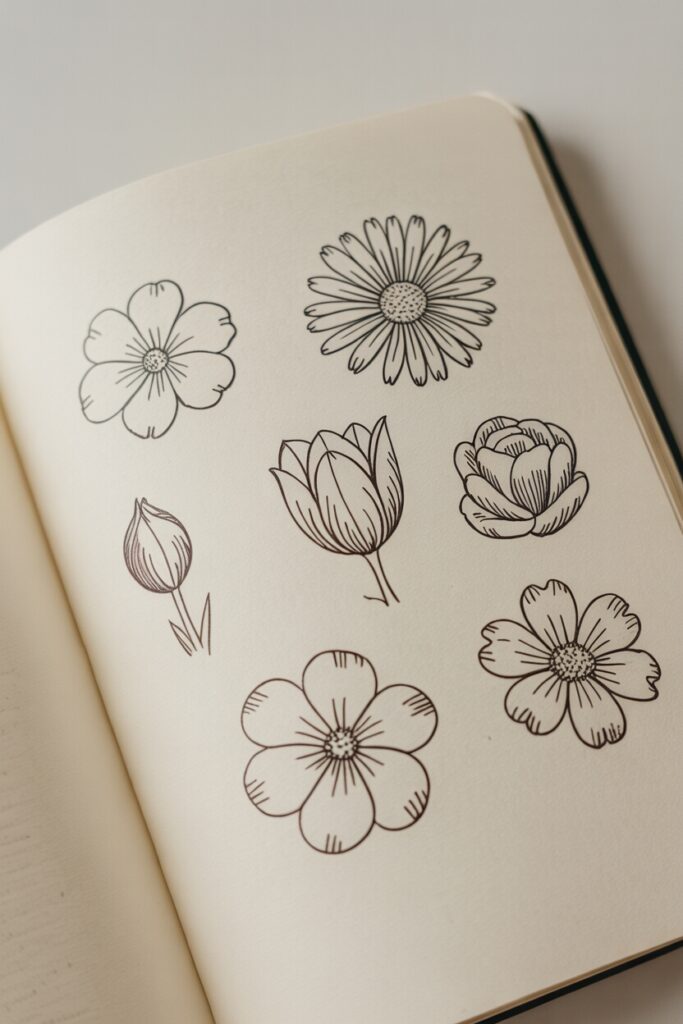
This is the simplest flower you can draw. Start with a small circle for the centre, then add five rounded petals around it—like a pinwheel. Done. You’ve just drawn a flower.
Try varying the petal shapes: rounded edges for a softer look, pointed tips for something more dynamic.
The Daisy
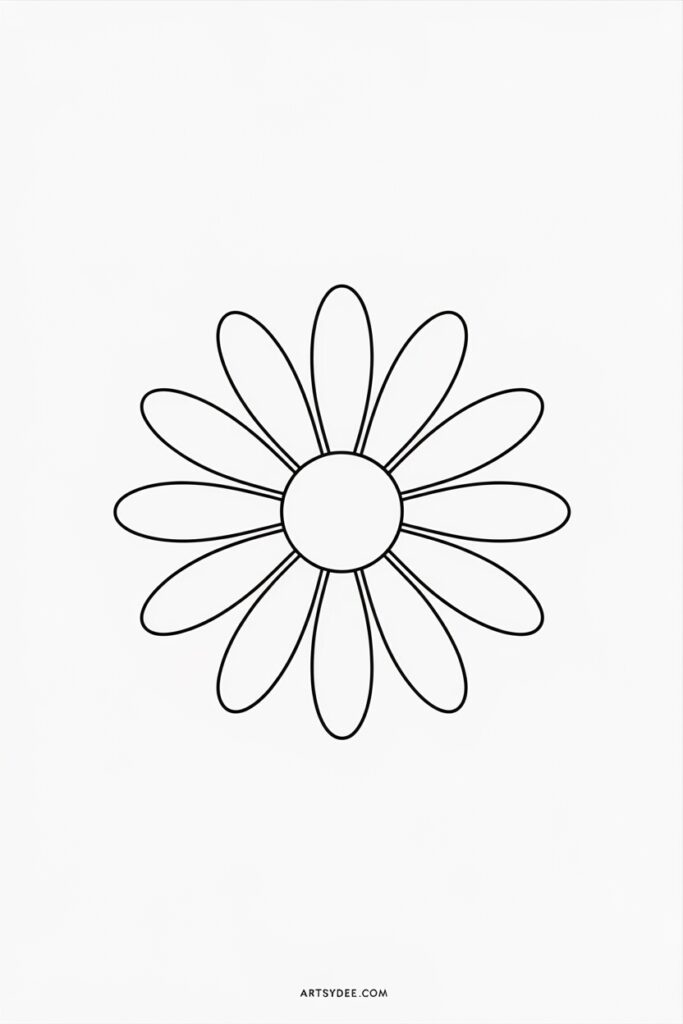
Similar to the five-petal flower, but with more petals (usually 8-12) and a larger, more defined centre. Keep the petals thin and slightly uneven for a natural feel.
The Tulip
Two curved lines coming up from a stem, meeting at the top in a gentle point. Add a third petal peeking out from behind if you want more dimension.
The Rose (Simplified)
Roses look complicated, but here’s the trick: start with a tiny spiral in the centre, then layer loose, curved petals around it. Don’t overthink it—messy roses often look the most romantic.
The Bell Flower
Draw a small bell or cup shape, add a few lines inside for texture, and attach it to a curved stem. Simple and sweet.
Once you’ve got these basic shapes down, you can combine them, add leaves, and create entire floral drawing compositions. For more ideas, check out my post on doodle art flowers—it’s packed with over 150 flower doodle ideas.
Step-by-Step: Hibiscus Flower Drawing
The hibiscus is one of my favourite flowers to draw. Those big, tropical petals have such beautiful curves, and the distinctive stamen in the centre makes it instantly recognisable.
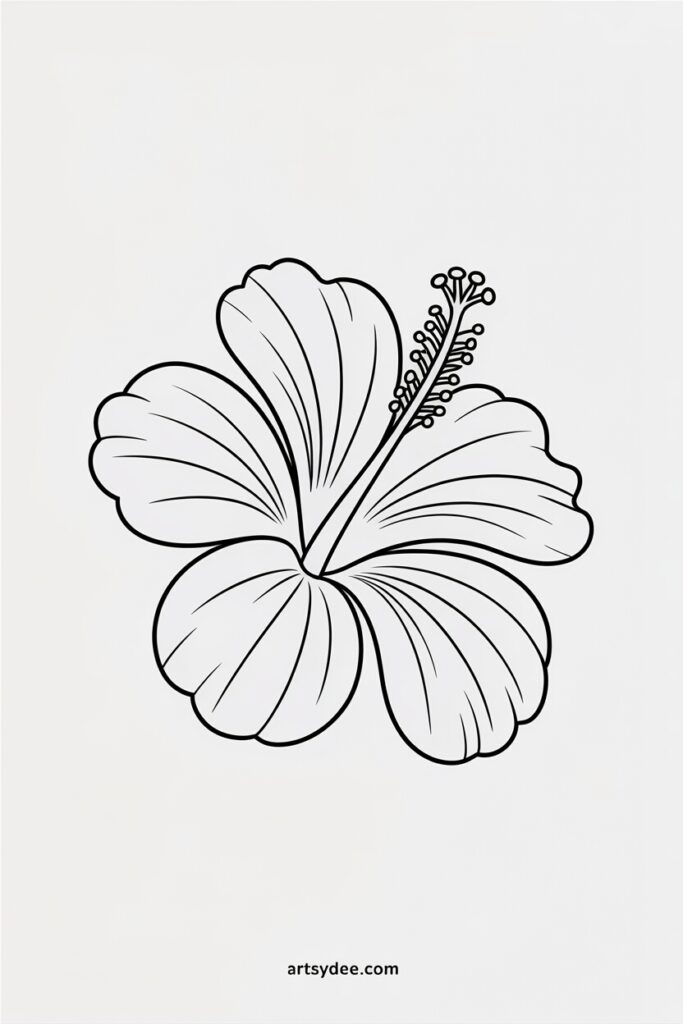
Here’s how to draw one:
Step 1: Draw the Centre
Start with a small oval in the middle of your page. This will be the base of the stamen (that long bit that sticks out from the centre of a hibiscus).
Step 2: Add the Stamen
Draw a long, slightly curved line extending up from the oval. At the top, add tiny dots or small circles—these are the pollen-covered tips.
Step 3: Sketch the First Petal
Hibiscus petals are large and slightly ruffled. Draw a wide, wavy petal shape extending from behind the centre. Think of it like a soft, curved triangle with wavy edges.
Step 4: Add More Petals
Hibiscus flowers typically have five petals. Work your way around the centre, overlapping each petal slightly behind the previous one. Vary the size and curve of each petal to keep things natural.
Step 5: Draw the Details
Add a few curved lines within each petal to show the natural ridges. These lines should follow the direction of the petal—radiating out from the centre.
Step 6: Include Leaves (Optional)
Hibiscus leaves are oval with serrated edges. Add one or two behind the flower for context.
And there you have it—a beautiful hibiscus flower drawing! This makes a gorgeous addition to any sketchbook or works brilliantly as a flower outline for watercolour painting.
For more pretty flower drawing ideas, have a look at my collection of 70+ flower drawing ideas.
Easy Flower Pattern Drawing Ideas
Once you’re comfortable with individual flowers, try arranging them into patterns. Flower pattern drawing is incredibly relaxing—almost meditative—and the results make beautiful backgrounds, gift wrap designs, or journal decorations.
Simple Repeat Pattern
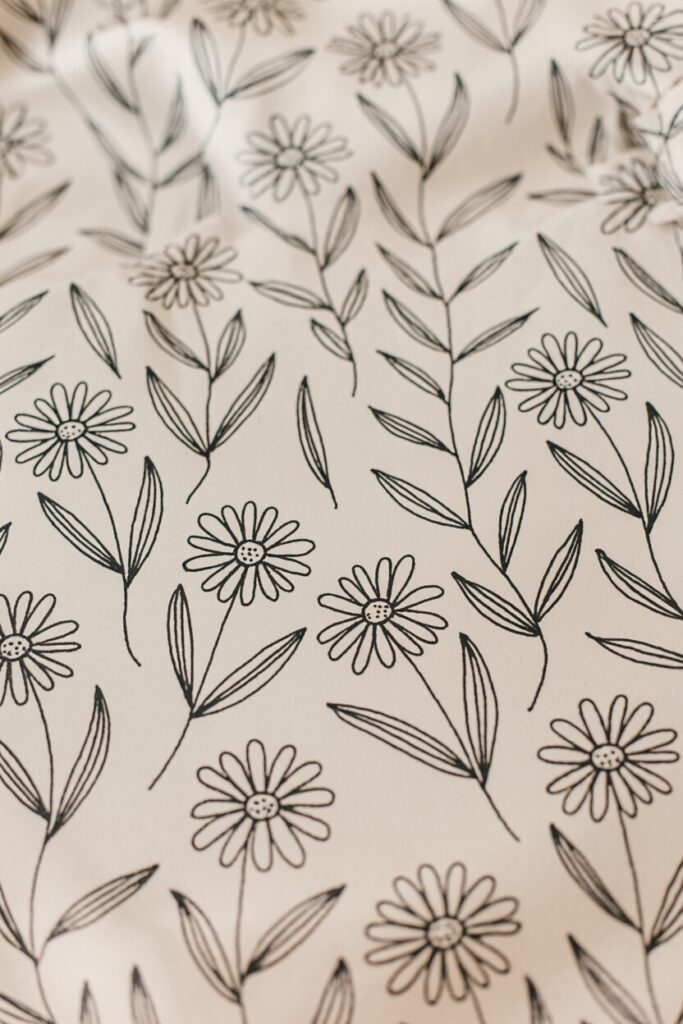
Pick one flower shape (like a basic daisy) and draw it in rows across your page. Keep the spacing even, or stagger the rows for a more dynamic look. Add small leaves or dots between the flowers to fill gaps.
Scattered Floral Pattern
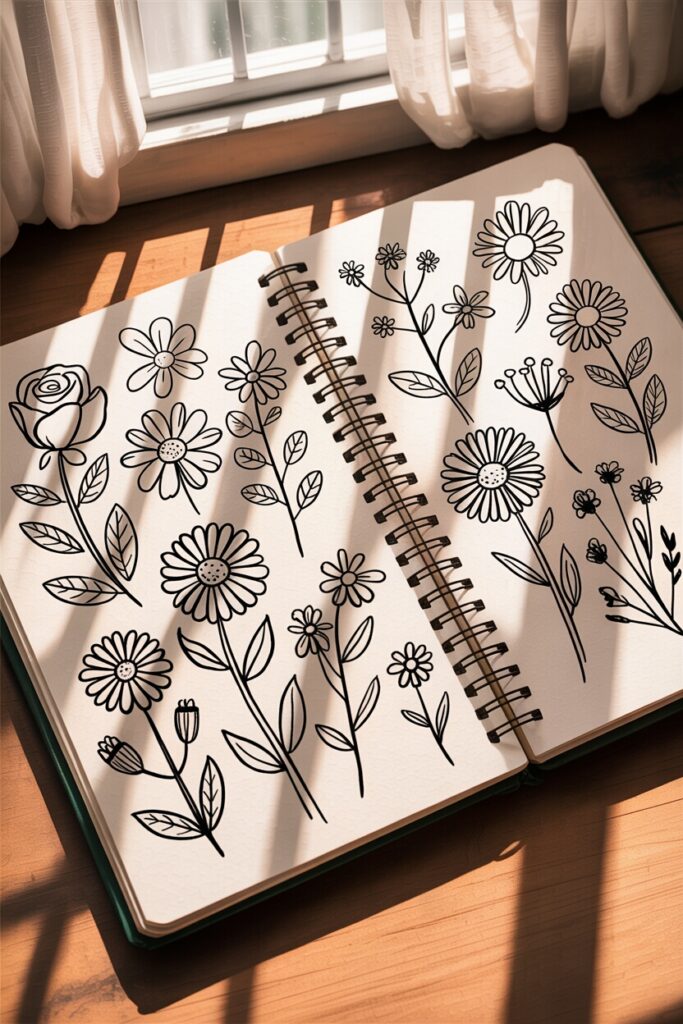
This one’s more freeform. Draw flowers of different sizes randomly across the page, then fill the spaces with smaller blooms, leaves, and simple line details. No grid, no rules—just let it flow.
Wreath or Border Pattern
Arrange your flowers in a circle or along the edge of your page. This works beautifully for journaling, card-making, or framing quotes and lettering.
Tile Pattern
Draw a small square and fill it with a repeating floral motif. When you tile this design, it creates a seamless pattern—perfect for digital projects or fabric design.
If you enjoy this kind of relaxed, repetitive drawing, you might also love doodle art. It’s a similar vibe—mindful, creative, and surprisingly addictive.
Supplies for Simple Flower Sketches
You don’t need fancy supplies to draw flowers. Honestly, any pen and paper will do. But if you want recommendations, here’s what I reach for:
For Clean Line Art
A good fine-liner makes all the difference. I love the Sakura Pigma Micron pens—they’re archival quality, don’t bleed, and come in various tip sizes. The 01 and 03 sizes are perfect for delicate flower sketches.
For more variety in line weight, the Mogyann Drawing Pens set gives you 12 different tip sizes—brilliant for adding detail and dimension.
For Sketching and Shading
A basic graphite drawing pencil set (ranging from 2H to 6B) lets you create everything from light guidelines to rich, dark shading. Perfect for realistic flower sketches.
For Watercolour Florals
If you want to add colour to your flower outlines, grab some Canson XL Watercolor Paper—it handles washes beautifully without buckling. Pair it with a simple watercolour set and you’re good to go.
I’ve got a whole post on watercolour flowers if you want to explore that further.
For Tracing Templates
If you’re using my printable flower outlines (more on that in a sec), an LED light tracing box makes transferring designs super easy. Just place your paper over the template, switch on the light, and trace away.
Digital Flower Drawing Tips
Drawing flowers digitally opens up a whole new world of possibilities. You can undo mistakes, experiment with colours, and create scalable designs for prints or products.
Getting Started with Digital Flowers
If you have an iPad and Apple Pencil, Procreate is hands-down the best app for digital flower illustration. The brushes feel natural, and there are loads of free floral brush sets available online.
Start with a simple round brush for sketching, then switch to a textured brush for inking. The “6B Pencil” brush in Procreate is gorgeous for loose, organic flower sketches.
Layer Your Work
One of the biggest advantages of digital drawing? Layers. Sketch your flowers on one layer, ink on another, and add colour on a third. This way, you can adjust each element without affecting the others.
Experiment with Colour
Digital tools make it easy to try different colour palettes. Draw your flower outline once, duplicate it, and fill each copy with different colours. You’ll quickly find combinations you love.
Create Seamless Patterns
Most digital art apps have tools for creating seamless, repeating patterns. Once you’ve drawn a few simple flowers, you can arrange them into a tile that repeats infinitely—perfect for backgrounds, fabric designs, or stationery.
For more things to draw in your sketchbook (digital or traditional), check out my fun drawing ideas post.
Free Flower Outline Printables
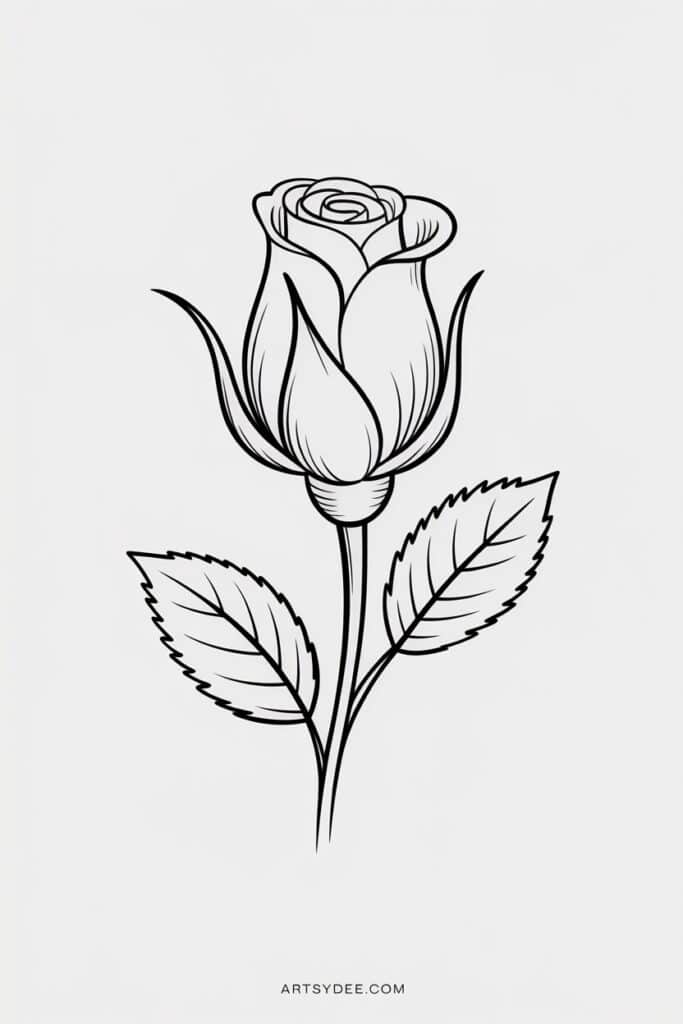
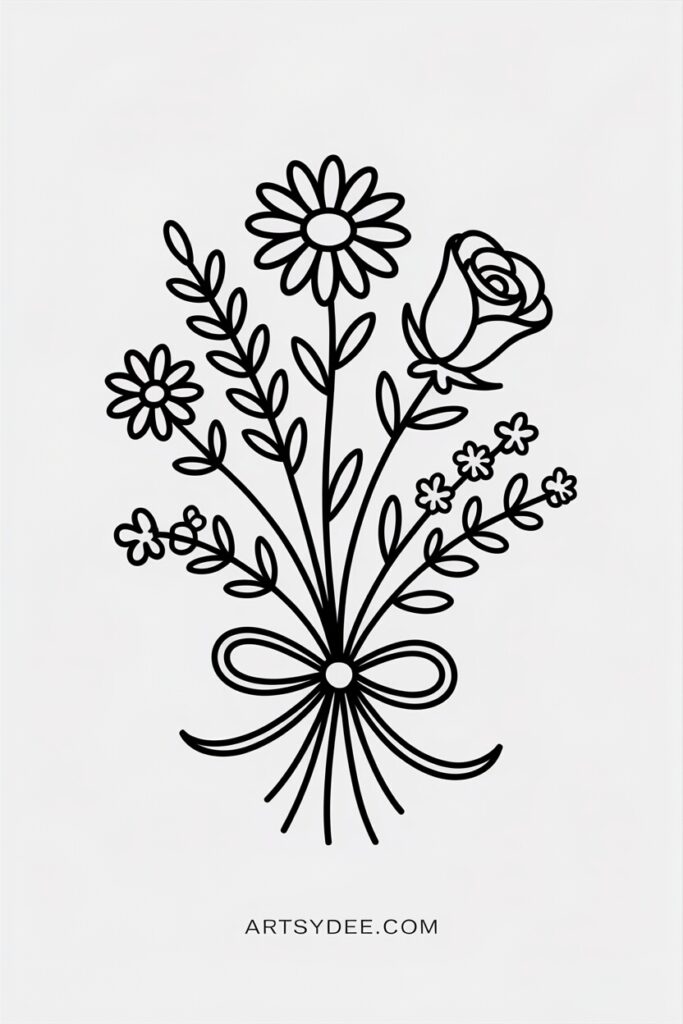
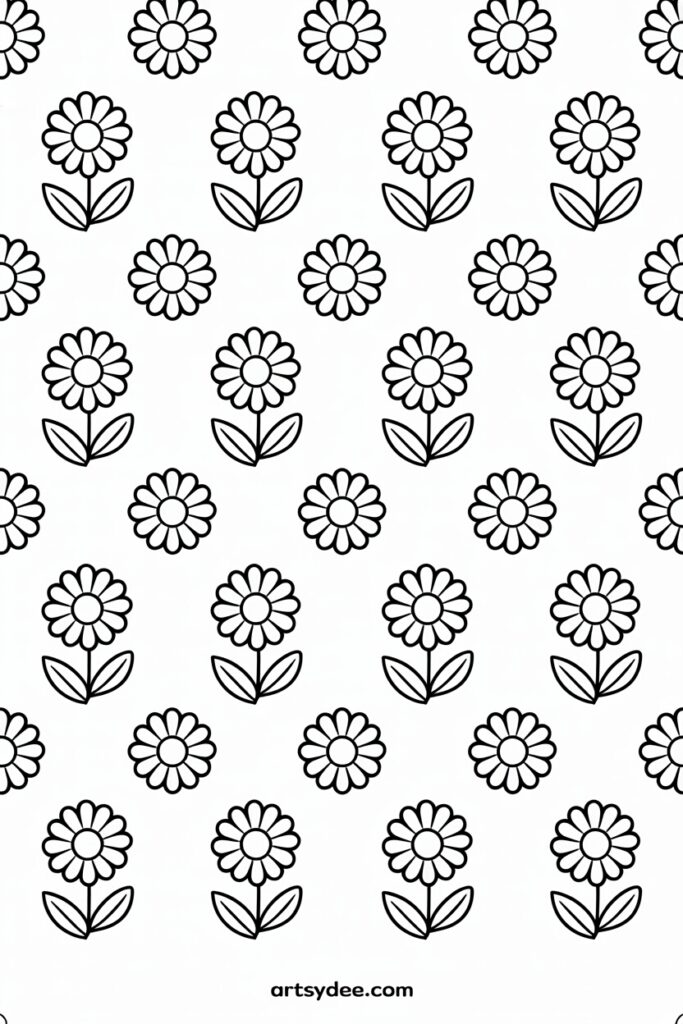
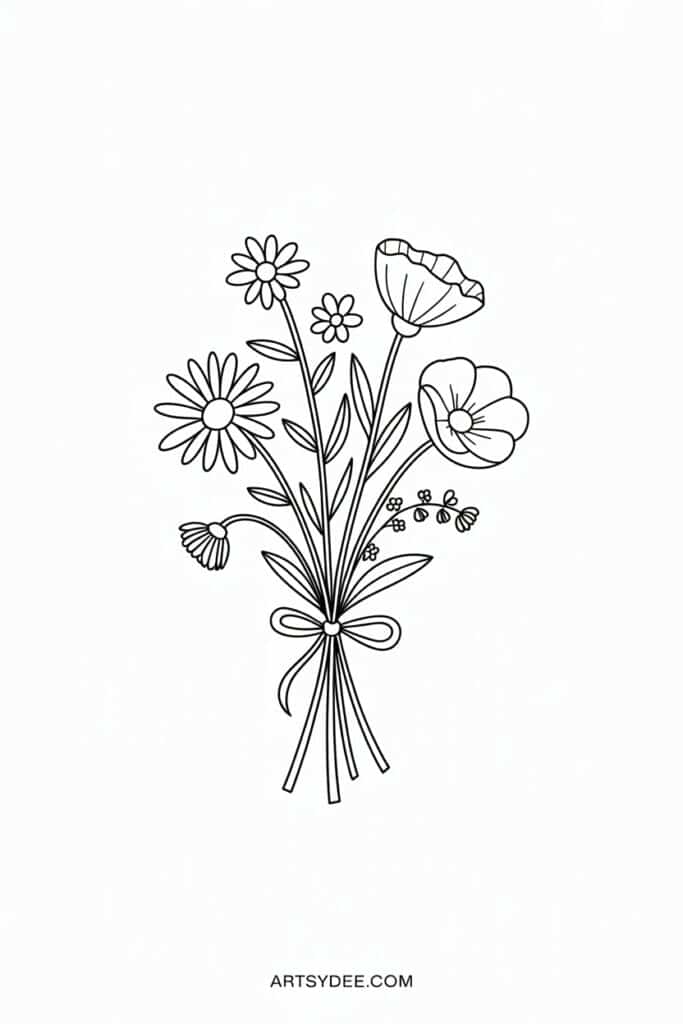
Want to skip the sketching and jump straight to colouring or painting? I’ve created a set of 5 free flower outline printables just for you.
What’s Included:
- Hibiscus outline – that gorgeous tropical bloom we drew earlier
- Simple daisy – classic and cheerful
- Rose bud – elegant and romantic
- Wildflower bunch – a sweet little bouquet
- Flower pattern tile – for practising pattern design
Each template is a clean, black-line drawing on a white background—perfect for tracing, colouring with pencils or markers, or painting with watercolours.
More Flower Sketch Ideas for Your Sketchbook
Need more inspiration? Here are some quick flower sketch ideas to fill your pages:
Single blooms. Draw one flower per page, large and detailed. Focus on the petals, the centre, the subtle curves.
Flower studies. Pick a real flower (from your garden or a photo) and draw it from multiple angles. Front view, side view, from above.
Seasonal florals. Spring daffodils, summer sunflowers, autumn dahlias, winter hellebores. Match your flower sketches to the season—it’s a lovely way to mark the passing months in your sketchbook.
Fantasy flowers. Who says flowers have to be realistic? Invent your own blooms with unusual petal shapes and imaginary colours.
Flowers with quotes. Draw a simple floral border around a favourite quote or affirmation. Instant wall art.
Mini bouquets. Combine three or four different flower types into a small arrangement. Add a ribbon or twine for a finishing touch.
For even more ideas, my posts on easy flower doodle drawing ideas and flower templates have loads of printable guides to get you started.
How to Turn Your Flower Sketches into Finished Art
Turn a finished flower sketch into something more by framing it, turning it into a greeting card or journal decoration, pairing it with hand lettering, or noticing the little quirks in your petals and leaves that are becoming your own style.
Frame Your Favourites
That hibiscus drawing you’re proud of? It deserves more than a sketchbook burial. Scan it, print it on nice paper, and pop it in a frame. Instant wall art that you made yourself.
Create Greeting Cards
A simple flower illustration on the front of a folded card makes a thoughtful, personal gift. Add a quick “thinking of you” inside, and you’ve got something far more meaningful than a shop-bought card.
Add to Your Journal
If you keep a journal or planner, flower drawings make beautiful decorations. Draw a quick bloom in the corner of your daily page, or create a floral border around important dates.
Develop a Personal Style
The more you draw flowers, the more you’ll notice patterns in your work. Maybe you always add extra leaves. Maybe your petals have a particular curve. Lean into these tendencies—they’re becoming your style.
Combine with Lettering
Flowers and hand lettering are a perfect match. Try drawing a floral wreath around a word or phrase, or let flowers grow up from the bottom of your lettering. This combination works beautifully for quotes, names, or special occasions.
Common Mistakes (and How to Avoid Them)
Even simple flower drawing has a few pitfalls. Here’s what to watch out for:
Making Every Petal Identical
Real flower petals vary in size and shape. If all your petals look exactly the same, your flower will feel stiff and unnatural. Embrace the wonk.
Forgetting the Centre
The centre of a flower anchors the whole design. A too-small centre makes petals look disconnected. A too-large centre overwhelms everything. Find the balance.
Ignoring Negative Space
Don’t cram every inch of your page with petals. The spaces between flowers matter too. They let your drawings breathe.
Overworking the Details
Sometimes less is more. A few carefully placed lines suggest texture better than a hundred frantic marks. Know when to stop.
Being Too Precious
It’s just a sketchbook. It’s just a drawing. Give yourself permission to make ugly flowers sometimes. That’s how you learn.
Quick Tips for Better Flower Drawings
Before I wrap up, here are a few tips that’ll take your floral drawing to the next level:
Start light. Sketch with a light hand first, then go over your lines once you’re happy with the shape. This gives you room to adjust without messy eraser marks.
Vary your line weight. Use thicker lines for outer edges and thinner lines for inner details. This adds depth and makes your flowers pop.
Add imperfections. A nibbled leaf, a wilting petal, a slightly bent stem—these little “flaws” make your drawings feel alive.
Study real flowers. Even a quick look at a reference photo will improve your accuracy. Notice how petals overlap, how stems curve, how leaves attach.
Fill the page. Don’t be precious about white space. Let your flowers sprawl across the paper. A full page of florals always looks better than a timid little bloom in the corner.
Practice often. Like anything, flower drawing gets easier the more you do it. Keep a small sketchbook handy and doodle flowers whenever you have a spare moment.
Your Next Steps
Drawing flowers is one of those skills that rewards you immediately. Even your very first attempt will look like something—and that’s the beauty of it.
Grab your pen, print out my free flower outline templates, and start sketching. Don’t worry about making it perfect. Just enjoy the process.
And if you create something you love, I’d genuinely love to see it. Tag me on Pinterest or Instagram—nothing makes my day like seeing your art.
Happy drawing! 🌸
Related Posts You’ll Love:
- 100+ Cute Little Doodles: Simple Techniques to Create Adorable Art
- 80+ Easy Doodle Drawings for Beginners
- 60+ Free Flower Coloring Pages to Inspire Your Imagination
- 20+ Free Sunflower Printables: Patterns, Templates & Stencils
Grab the Free Flower Drawing Templates
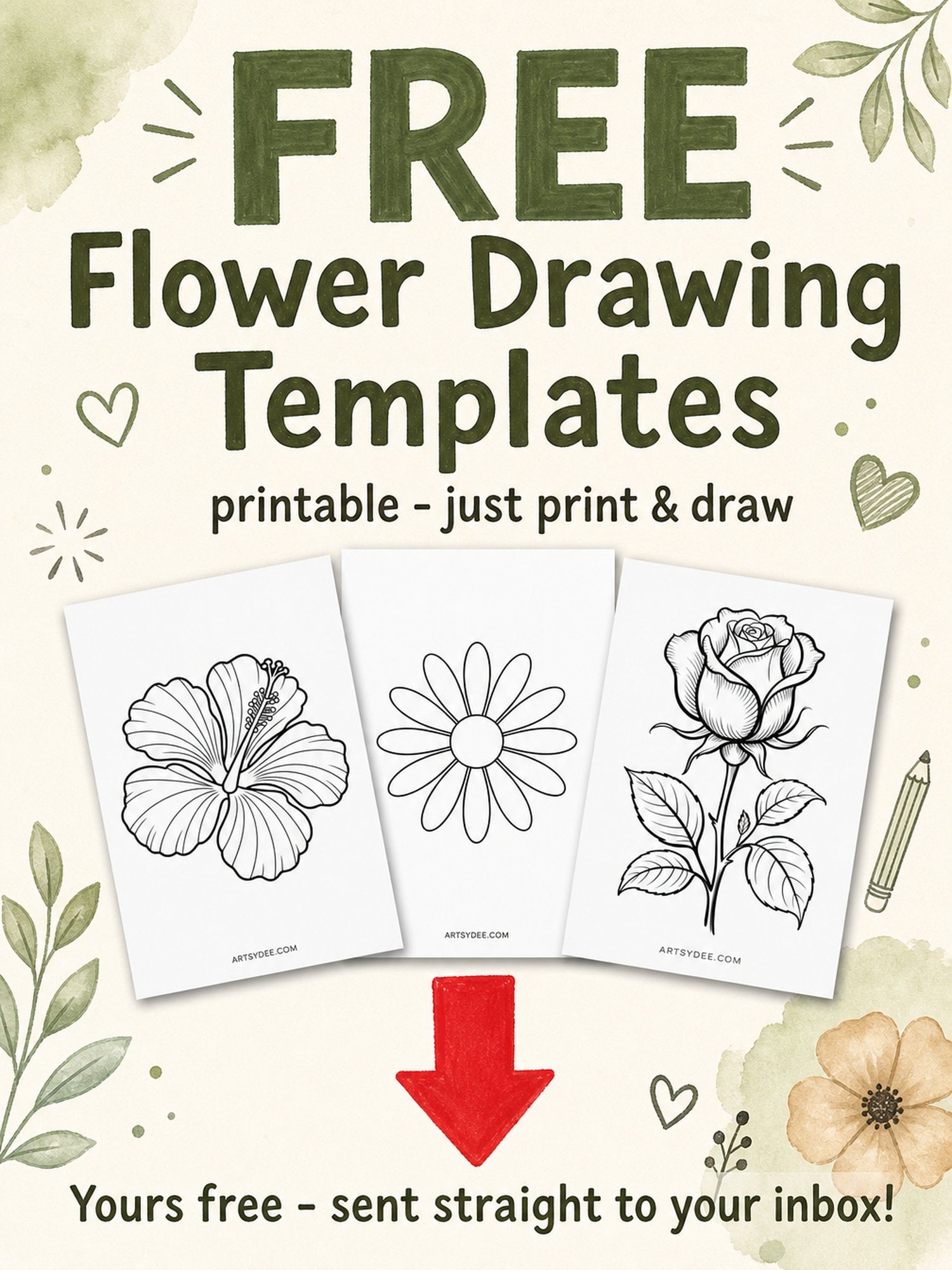
👉 Pop your email into the box near the top of this post and I’ll send these straight to your inbox — free!
Simple Flower Drawing: FAQ
Do I need to be good at drawing to draw flowers?
Nope — that’s the whole point. Flowers are forgiving. Real ones aren’t symmetrical, so your petals can be uneven and your stems can curve and it’ll still read as a flower. A slightly lopsided daisy is still a daisy. They’re one of the most beginner-friendly things you can draw.
What are the free flower templates, and how do I get them?
There are 5 free flower outline printables — easy flowers to trace and copy. Just pop your email into the signup box in the post and Dee sends them straight to your inbox. They’re lovely for tracing practice, colouring, or as outlines for painting.
Which basic flower shapes should I learn first?
Start with the building blocks the post walks through: the five-petal flower (a circle centre plus five rounded petals), the daisy (8–12 thinner petals), the tulip, a simplified rose (a tiny spiral with loose petals around it), and the bell flower. Once those feel comfortable you can combine them and add leaves.
How do I draw a hibiscus step by step?
The post breaks it down: start with a small oval for the centre, add a long curved stamen with dotted tips, then sketch a wide wavy petal and work around to five overlapping petals. Finish with curved ridge lines inside each petal and a couple of serrated leaves behind. Vary the petal sizes to keep it natural.
What supplies does Dee recommend for flower sketches?
Honestly any pen and paper works, but her go-tos are Sakura Pigma Micron fine-liners (the 01 and 03 sizes) for clean lines, a graphite pencil set from 2H to 6B for shading, and Canson XL Watercolour Paper if you want to add washes. An LED tracing box makes using the printable outlines super easy.
Can I turn these flower drawings into watercolour paintings?
Absolutely — a clean flower outline is the perfect base for watercolour. Trace one of the printables onto watercolour paper and paint over it. If you’d like ready-made line art built for painting, Dee’s watercolour flower templates start at £8 (~$10), with premium reference sets including colour recipe cards at £14 (~$18): patreon.com/Artsydee.
Can I draw flowers digitally?
Yes, and it opens up undo buttons, endless colour tweaks and scalable designs for prints. If you’ve got an iPad and Apple Pencil, the post recommends Procreate as the best app for digital florals — the brushes feel natural and there are loads of free floral brush sets online to get you started.
Your free flower templates are a lovely warm-up for the sketchbook. When you are ready for more guided practice, you’ll find my printable drawing reference and template sets in the Artsydee shop, ready to print and draw from as often as you like.
See the template sets →