Last Updated on July 19, 2026 by Dee
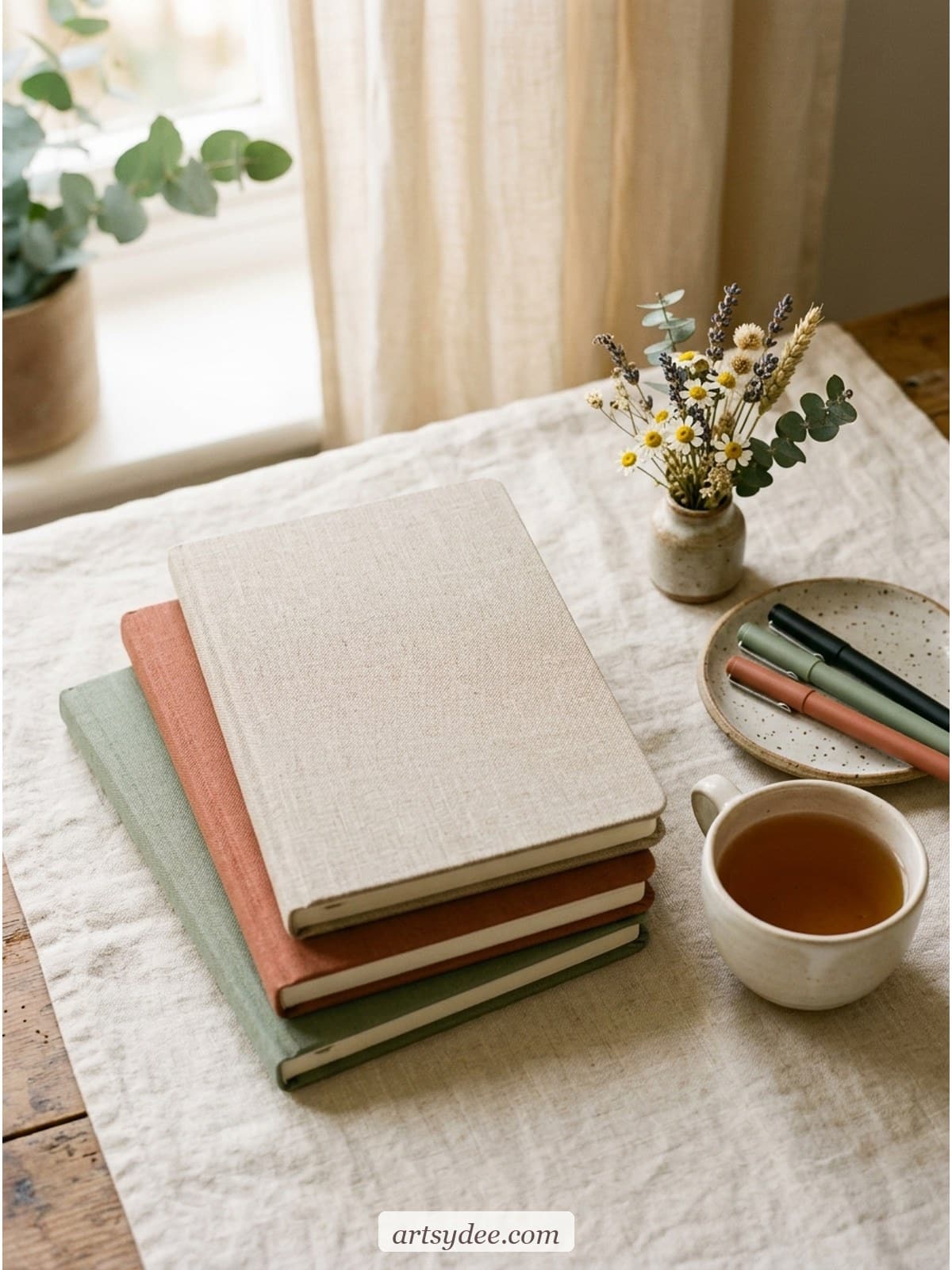
Bullet journals get talked about like they’re a vibe. They’re not — they’re a habit. A weekly spread, a monthly page, a habit tracker, a brain dump for the days the inside of your head feels like a busy train station. The pages do the heavy lifting; the trick is having pages set up before you sit down to use them.
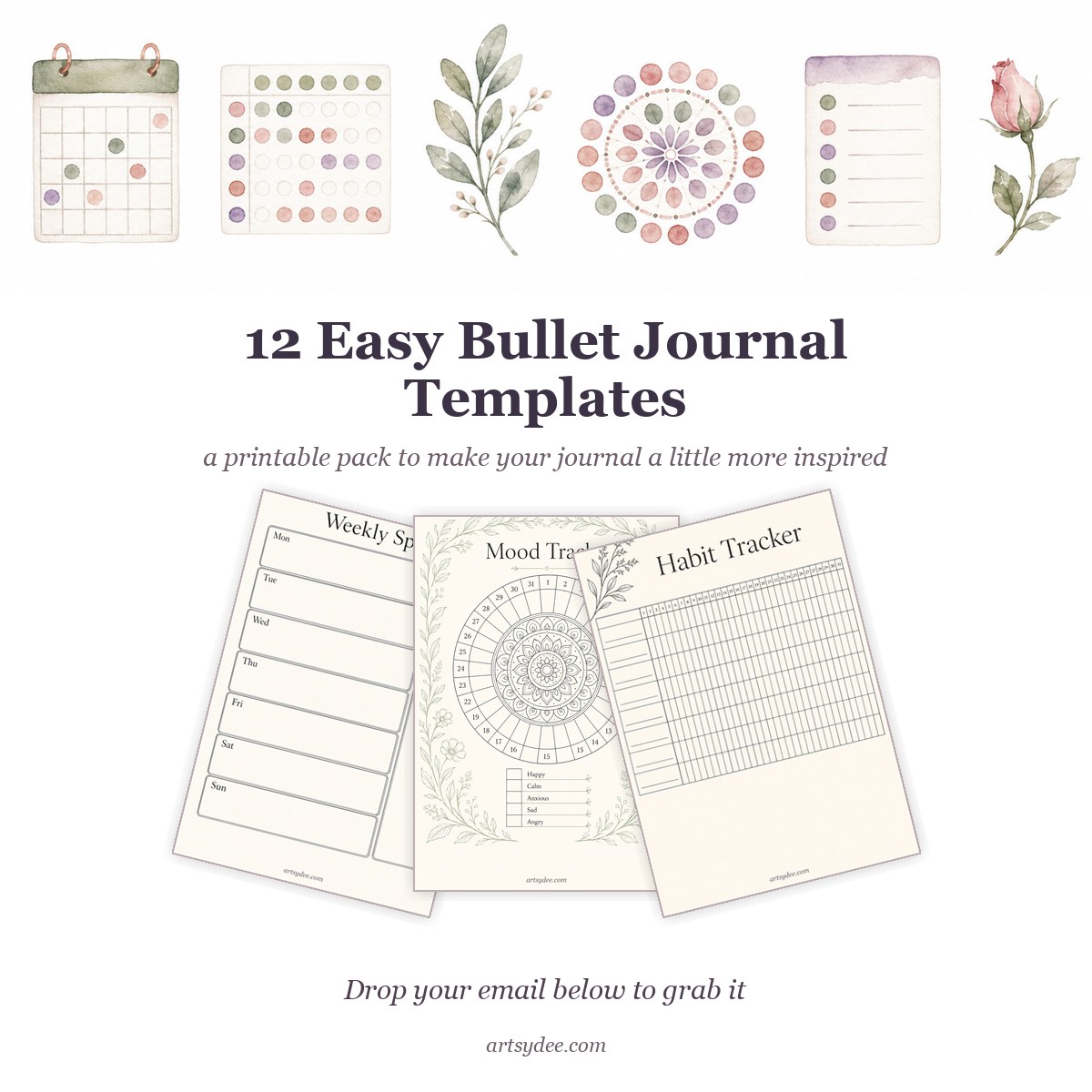
So I made you the pages. 12 easy bullet journal templates — cover, weekly, monthly, habit tracker, mood tracker, gratitude, year-at-a-glance, sleep, water, reading list, goals, and brain dump — designed to print on a sheet of A4 and slot straight into a binder or paste into your favourite notebook. The whole pack lives in one printable PDF you can have on your desk in the next ninety seconds.
Quick map of what’s coming: a no-faff explanation of what a bullet journal actually is (and why it works better than a planner for messy weeks), the bare-minimum supplies, all 12 spread ideas with the exact reason you’d reach for each one, the easiest ways to customise the templates, and a small section of “what made me actually keep mine” tips. There’s a free pack at the top of the post if you want to skip ahead and play.
Table of Contents
What is a bullet journal (and why does it work)?
Quick answer: A bullet journal is a blank notebook (usually dot-grid) you set up yourself with custom spreads — a weekly, a monthly, a habit tracker, whatever you actually need. It works because the pages aren’t generic. You build them for your week, so the system fits your life instead of the other way round.
The original method came from Ryder Carroll back in 2013 — a simple shorthand of dots, dashes, and circles for tasks, events, and notes. The internet got hold of it, watercolour borders happened, and now “bullet journaling” covers everything from minimalist dot-and-line spreads to elaborate themed monthly pages with hand-painted florals. Both are valid. The point isn’t the aesthetic. It’s that you have a single notebook where your week, your habits, and the contents of your head all live in one searchable place.
Why it works better than a planner: planners assume your week looks the same every week. It doesn’t. Some weeks you need a habit grid; some weeks you need a brain dump and a gratitude page. A bullet journal lets you draw the spread that matches what’s actually happening, instead of fighting against pre-printed boxes that don’t fit. Templates speed that up — you get the structure of a planner with the flexibility of a blank notebook.
If you’ve never tried it, the easiest entry point is to print one or two pages, paste them into a notebook you already own, and use them for a week. No commitment to a brand-new system, no two-hour Pinterest setup session. Just one weekly spread, one habit tracker, and see what happens.

Spreads set up? The Creations Club has printable journal papers, tags and stickers to decorate them — £8/month (~$10).
See what’s inside the Club →What you need to get started
Quick answer: A dot-grid notebook, a fineliner pen, and the printer you already own. Optional but lovely: a thin pack of coloured fineliners, a small set of watercolour pencils, and washi tape if you want to stick the templates straight into a notebook. You can start tonight with what you have.
The two non-negotiables: a notebook with dots (so the templates align cleanly when you paste them in or trace from them), and one pen that doesn’t bleed. Everything else is optional. I use a Leuchtturm1917 dot-grid notebook because the paper handles fineliners and a touch of watercolour without ghosting through, but any A5 dot-grid will do — even a £4 supermarket one.
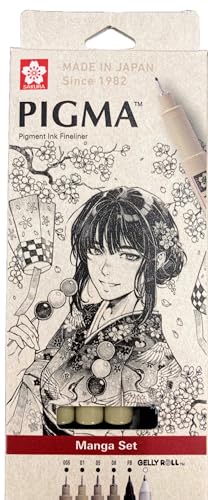
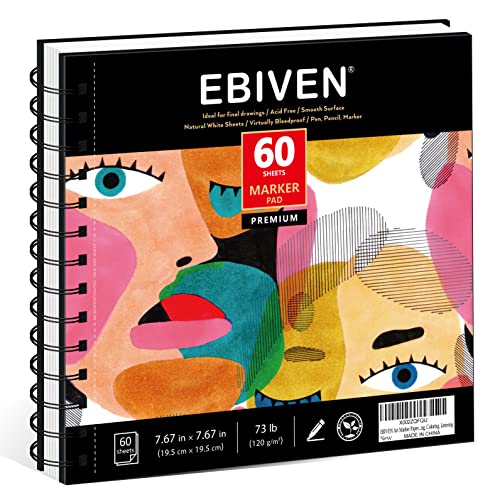
For pens, a Sakura Pigma Micron set covers you for everything — the 005 for fine grid lines, the 03 for body writing, the 05 for headers. If you want to add a soft watercolour wash to a spread, a Canson XL Watercolor pad is a friendlier surface than a notebook page — paint there, scan the result, and paste it in.

This post contains affiliate links, which means I may earn a small commission at no extra cost to you if you make a purchase. I only recommend products I genuinely love and use myself.
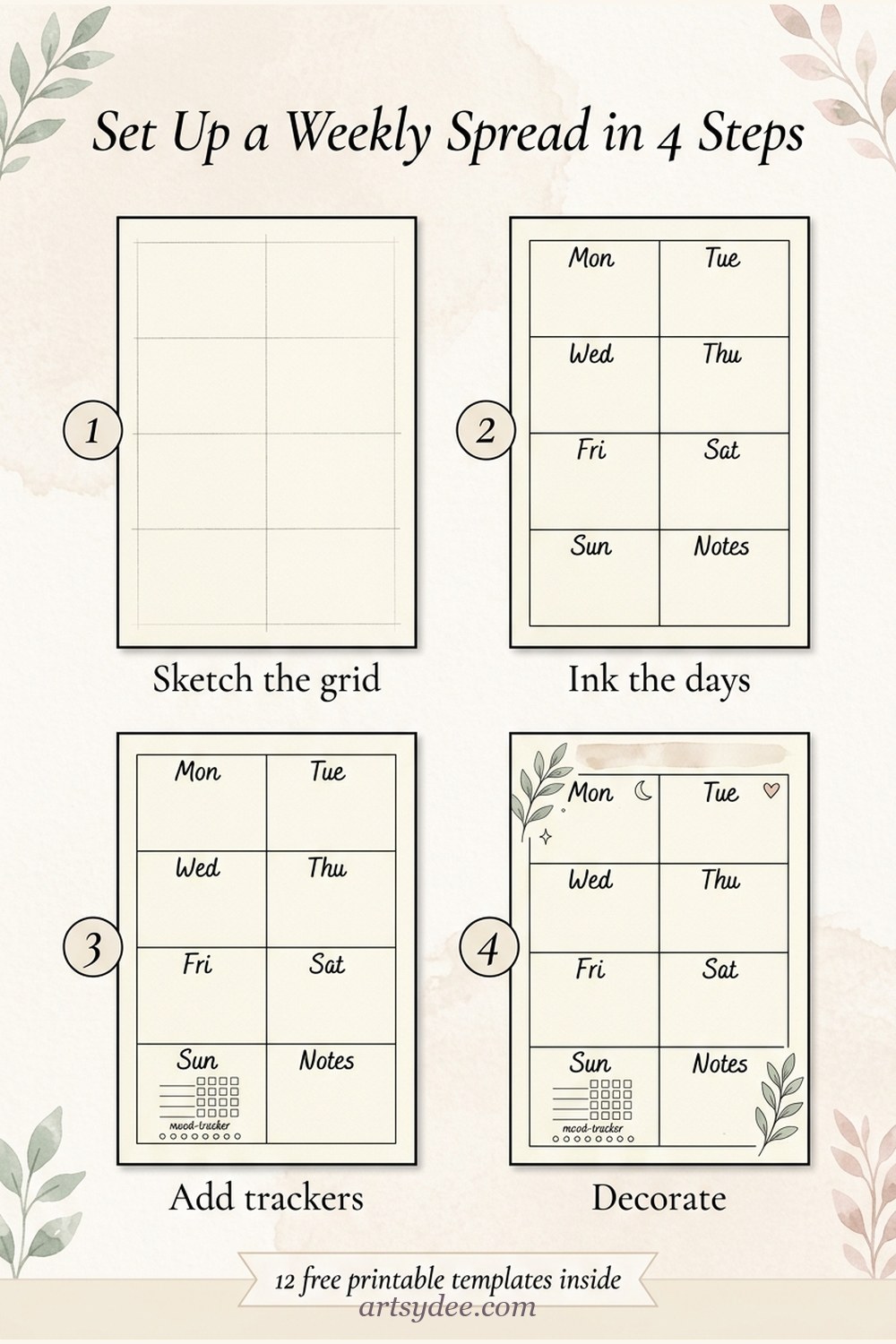
12 bullet journal page ideas to try
Quick answer: The 12 most useful bullet journal spreads to set up first are: a cover page, a weekly spread, a monthly spread, a habit tracker, a mood tracker, a gratitude page, a year-at-a-glance, a sleep tracker, a water tracker, a reading list, a goals page, and a brain dump. All twelve are inside the free printable pack at the top of this post — print, slot in, done.
Here’s what each one is for and why you’d use it. You don’t need all twelve at once. Pick the three or four that match what your week actually needs and start there.
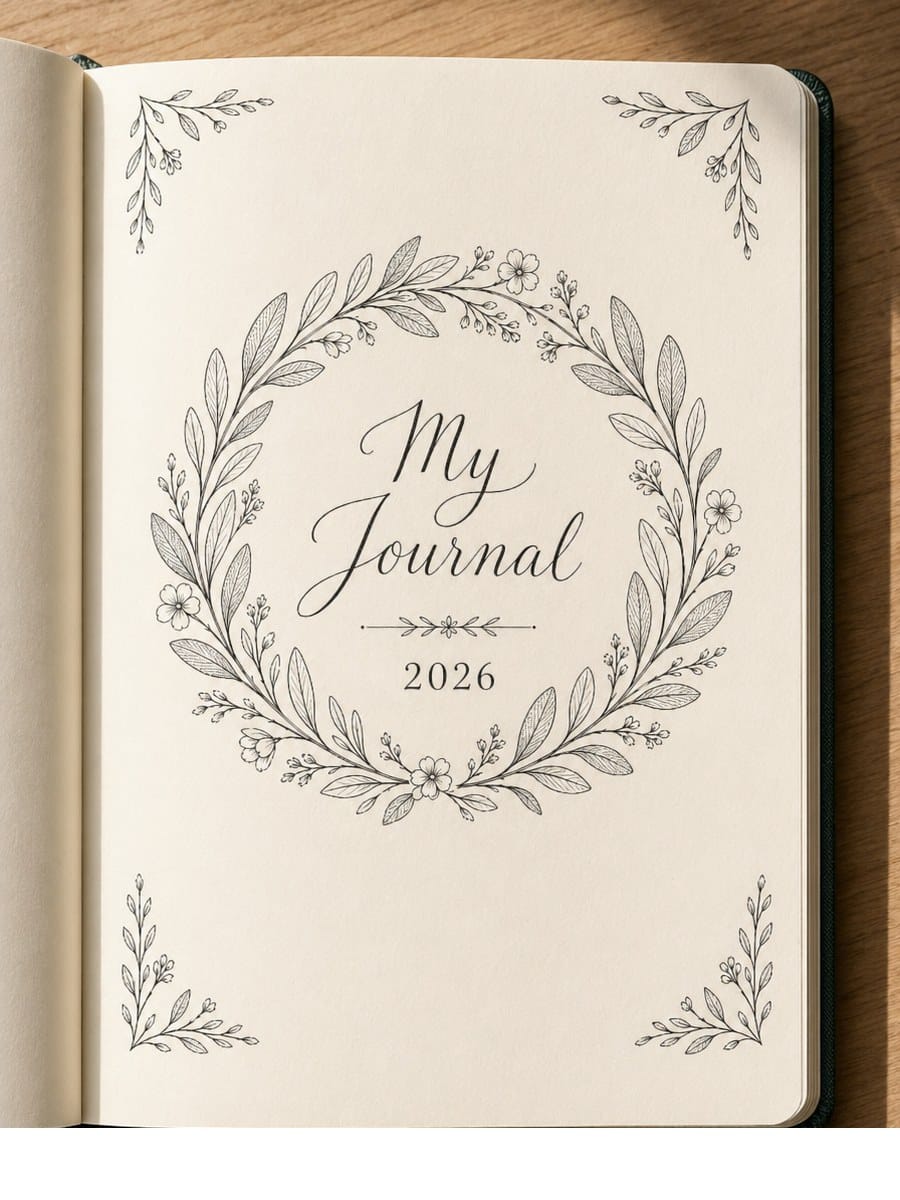
1. Cover page
The opening spread of the month. A botanical wreath, your name, the month and year — that’s it. It sets the tone for the pages that follow and gives you a lovely “oh yes, I’m doing this” moment when you flip the notebook open.
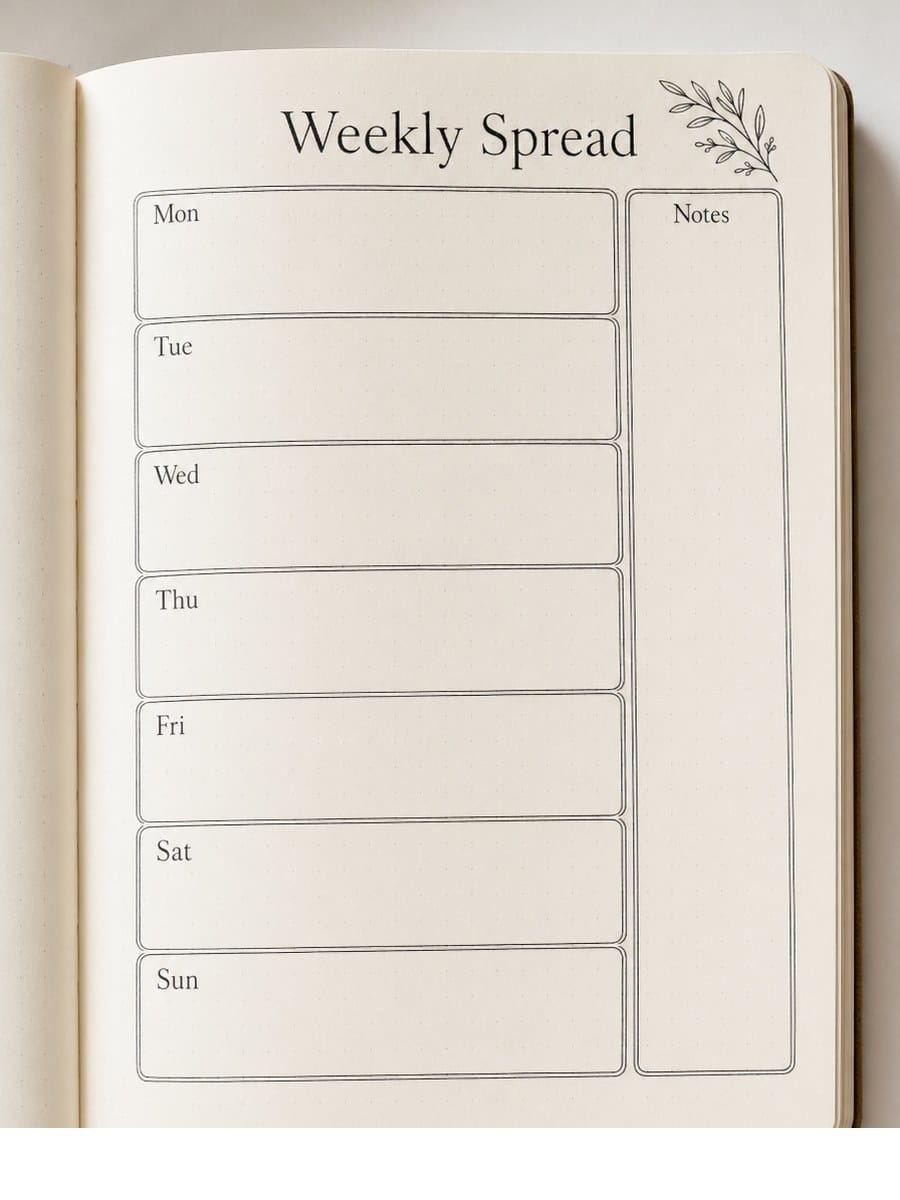
2. Weekly spread
The hardest-working page in the pack. Seven day boxes laid out vertically with a thin “notes” column running the full height. Use the day boxes for tasks, events, and a single line about how the day actually went. Use the notes column for the things that don’t fit a day — gift ideas, recipe links, a phrase you don’t want to forget.
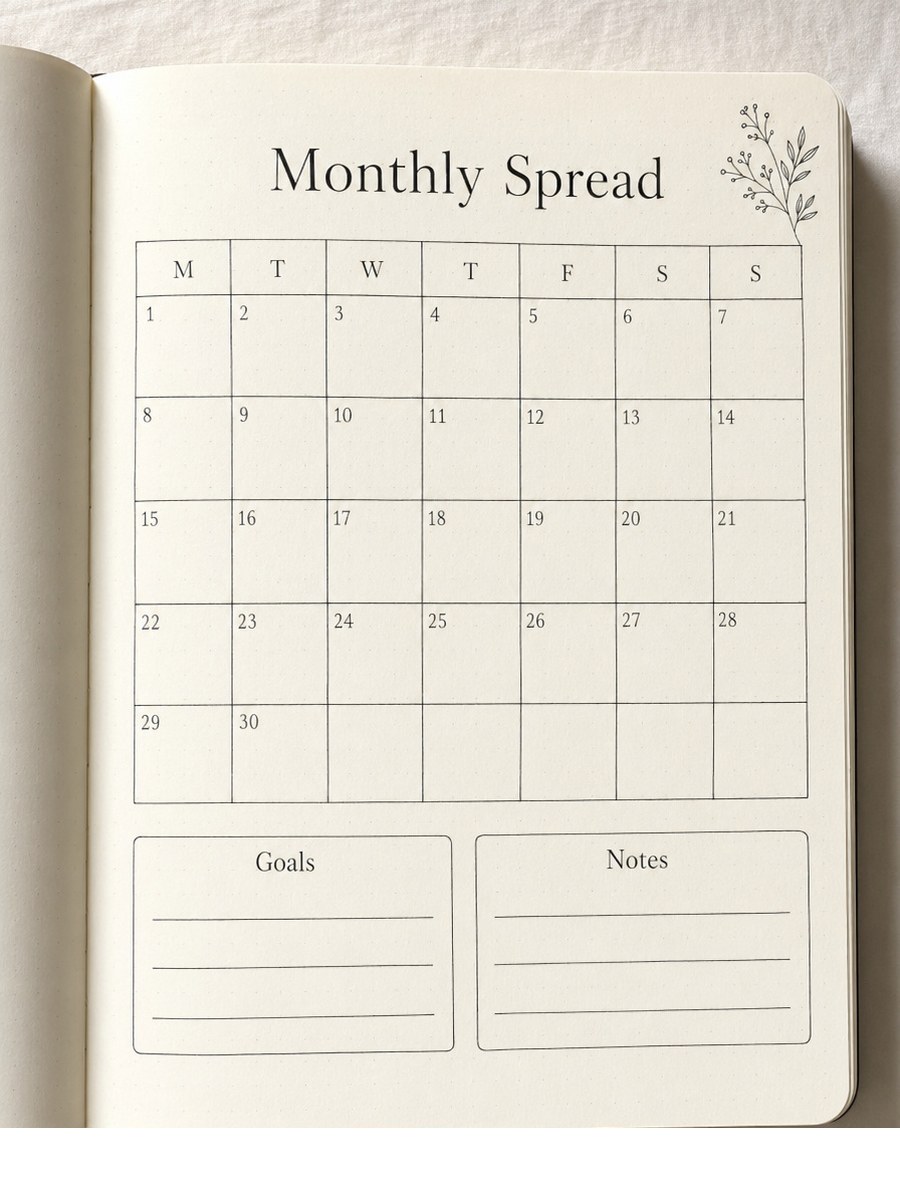
3. Monthly spread
The bird’s-eye view. A clean calendar grid for the month, with a small goals box and a notes box underneath. Use this on the first of the month to map birthdays, deadlines, and the three things you actually want to make happen before the next month begins.
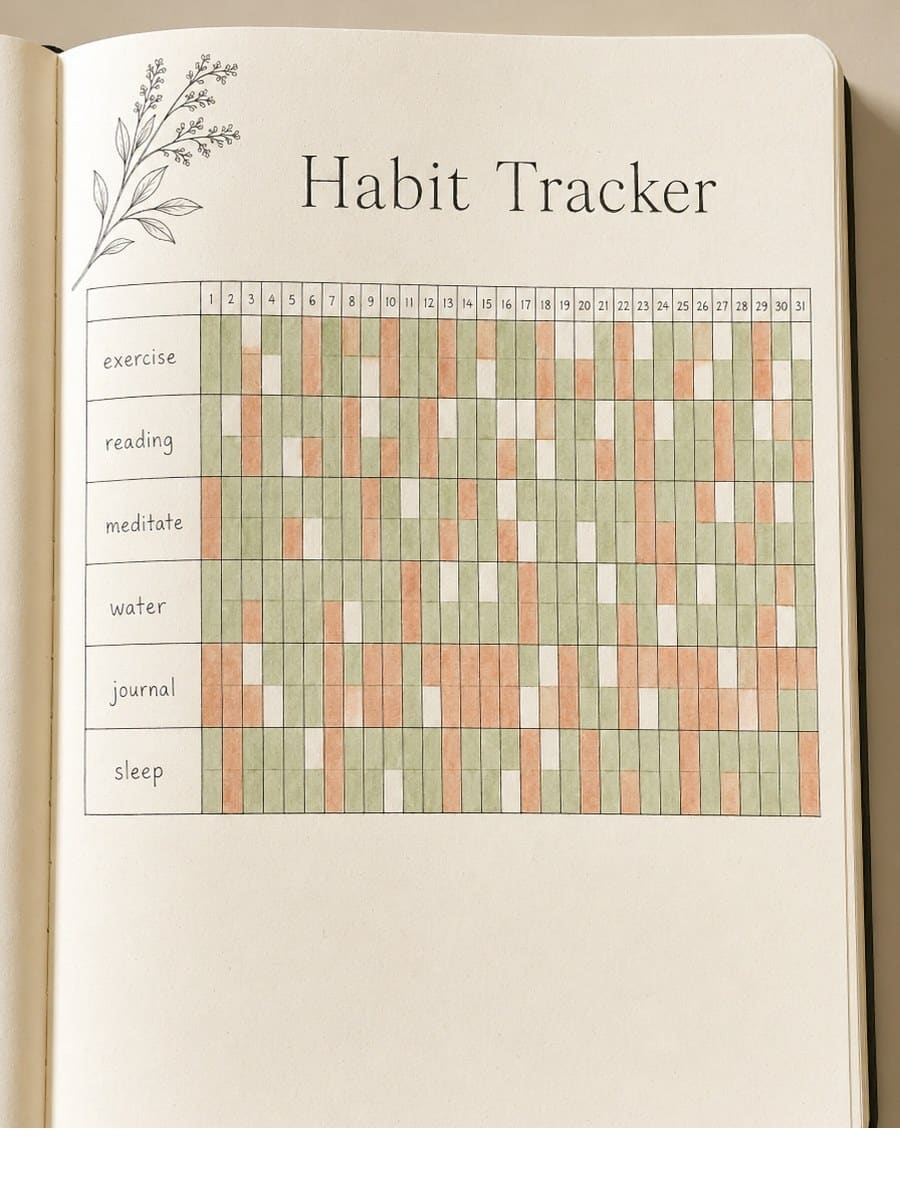
4. Habit tracker
A grid: habits down the left, days of the month across the top. Tick the squares. The visual cue of a row that’s mostly green is genuinely motivating — and the visual cue of a row that’s mostly empty tells you, without judgement, that the habit you said you wanted isn’t actually getting any time.
5. Mood tracker
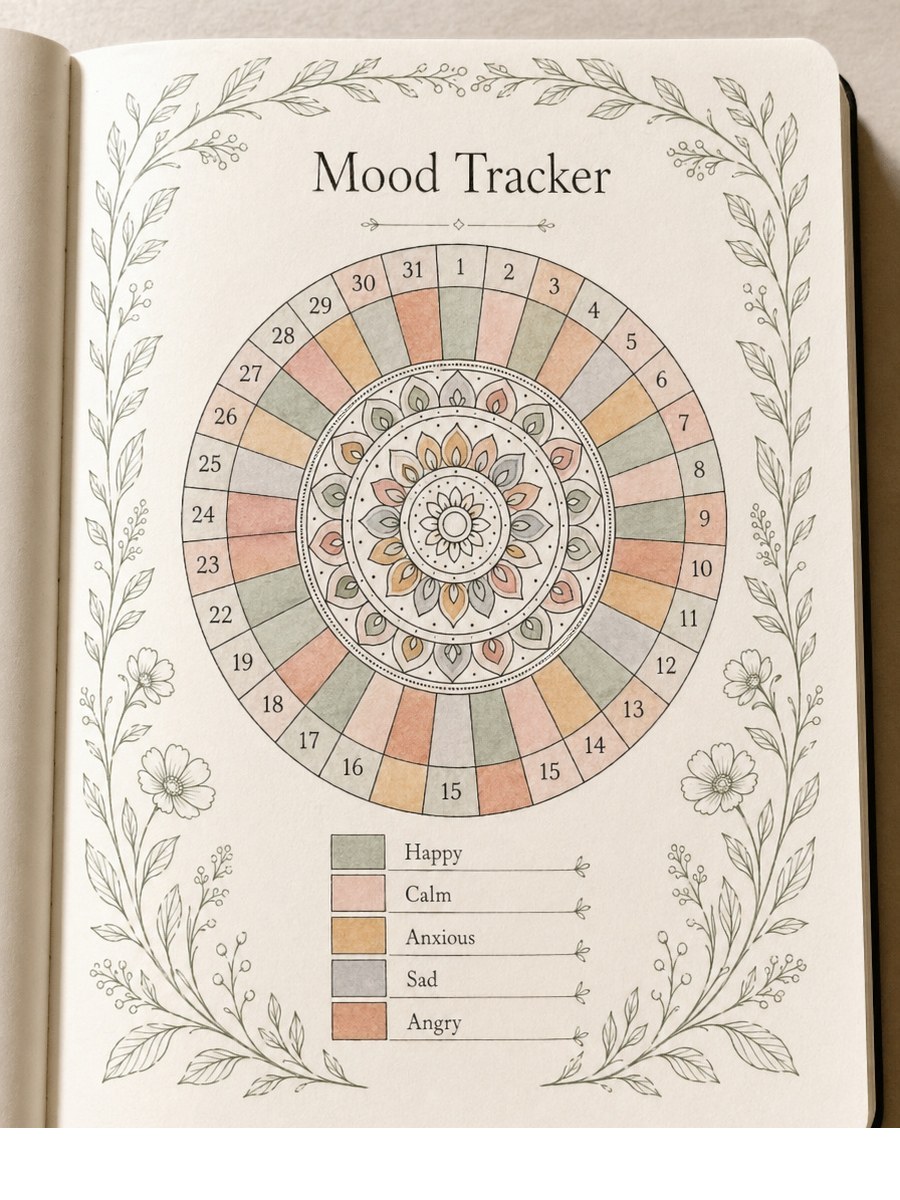
A circular mandala divided into 31 wedges, one per day. Pick five colours for the five mood states you actually have (great, good, okay, low, tough). Colour in one wedge a day. At the end of the month, the pattern shows you something you couldn’t see day-to-day — that you tend to crash on Sundays, or that the week of your period is consistently rough, or that you’ve had more good days than you remember.
6. Gratitude page
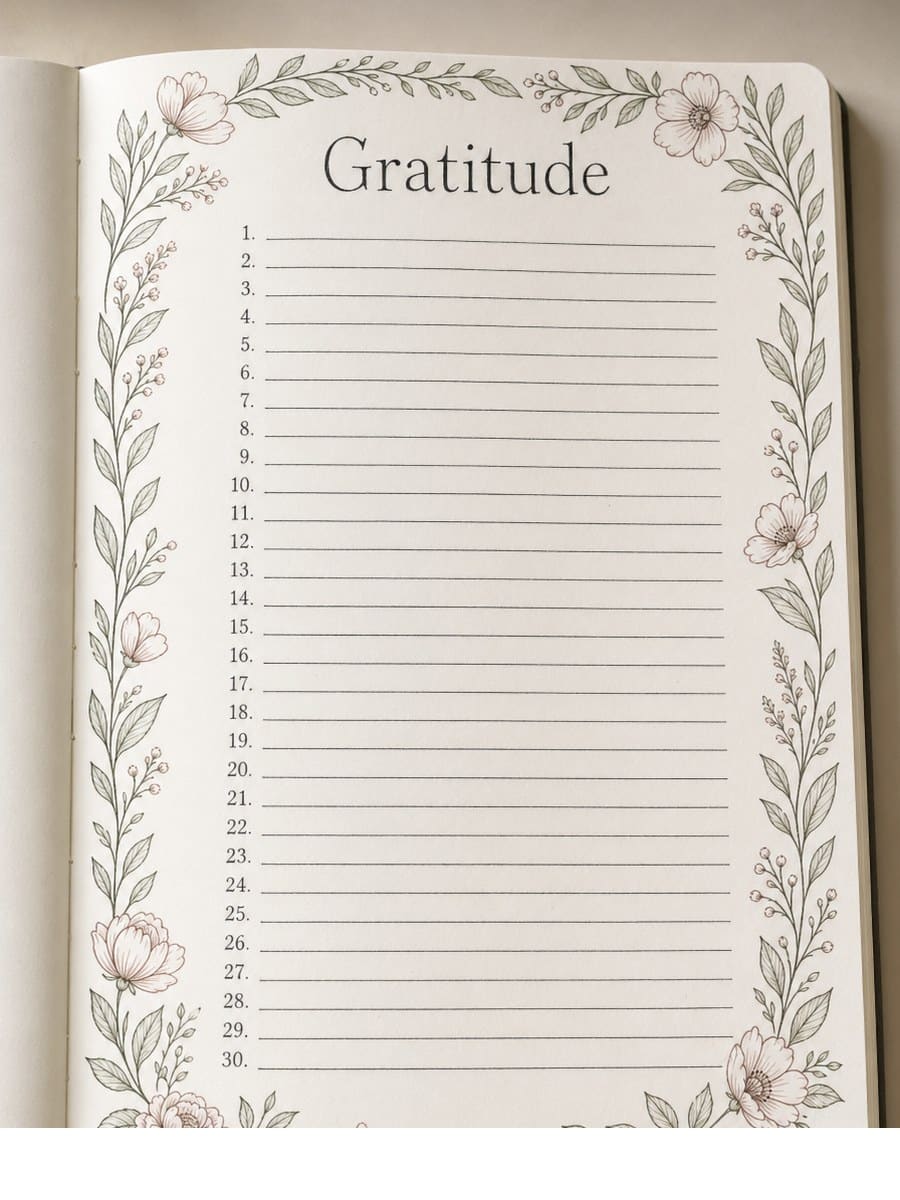
Thirty numbered lines, one per day. Three things — small ones. A coffee that hit right, a text that made you laugh, a cat sitting on your foot. The point isn’t to feel performatively grateful; it’s to give your brain a daily nudge to notice the good while it’s happening, instead of only noticing the rough.
7. Year at a glance
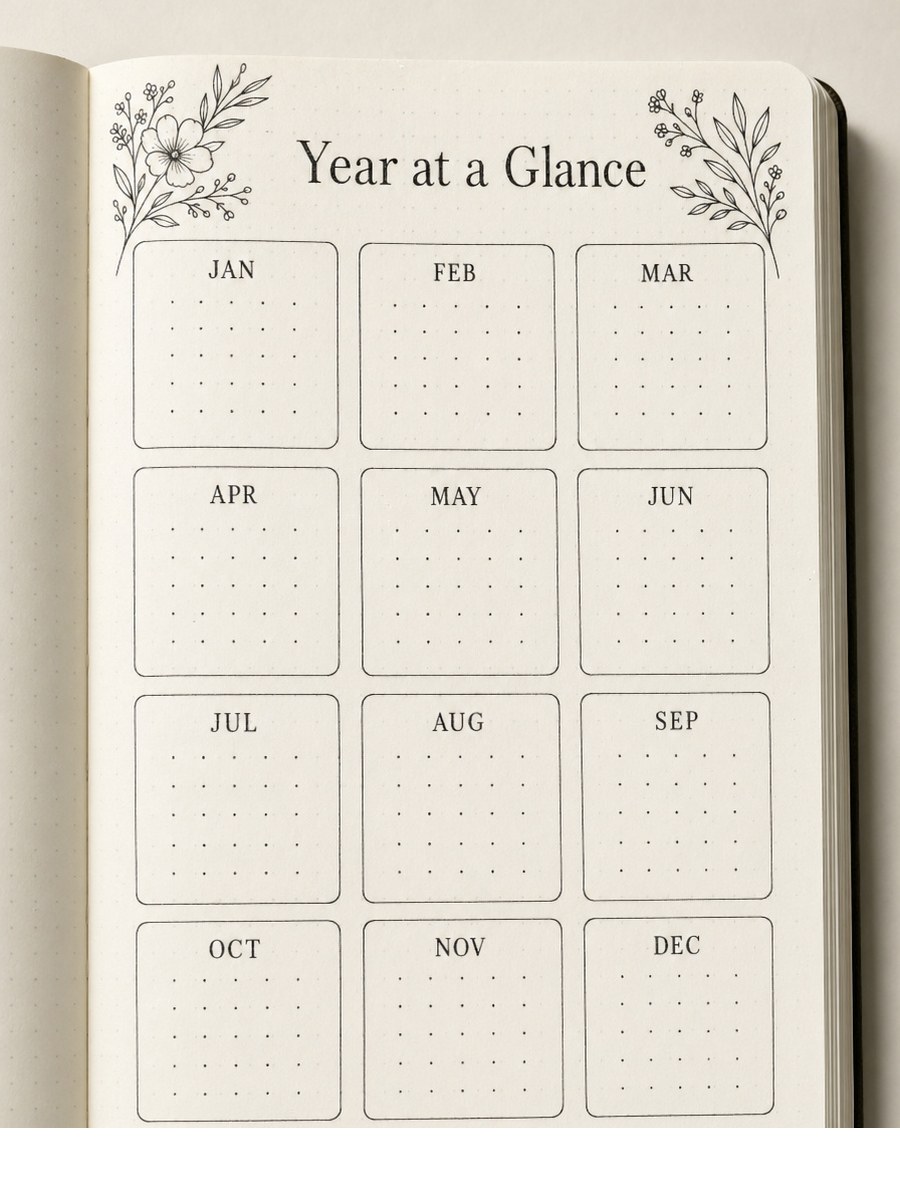
All twelve months in a 3-by-4 grid on a single page. Use it for the long view: when’s the next big trip, when’s the deadline you’re already worried about in October, which months tend to be quiet and which always run hot. Honestly the most useful page in any planner I’ve owned, and it takes ninety seconds to fill in.
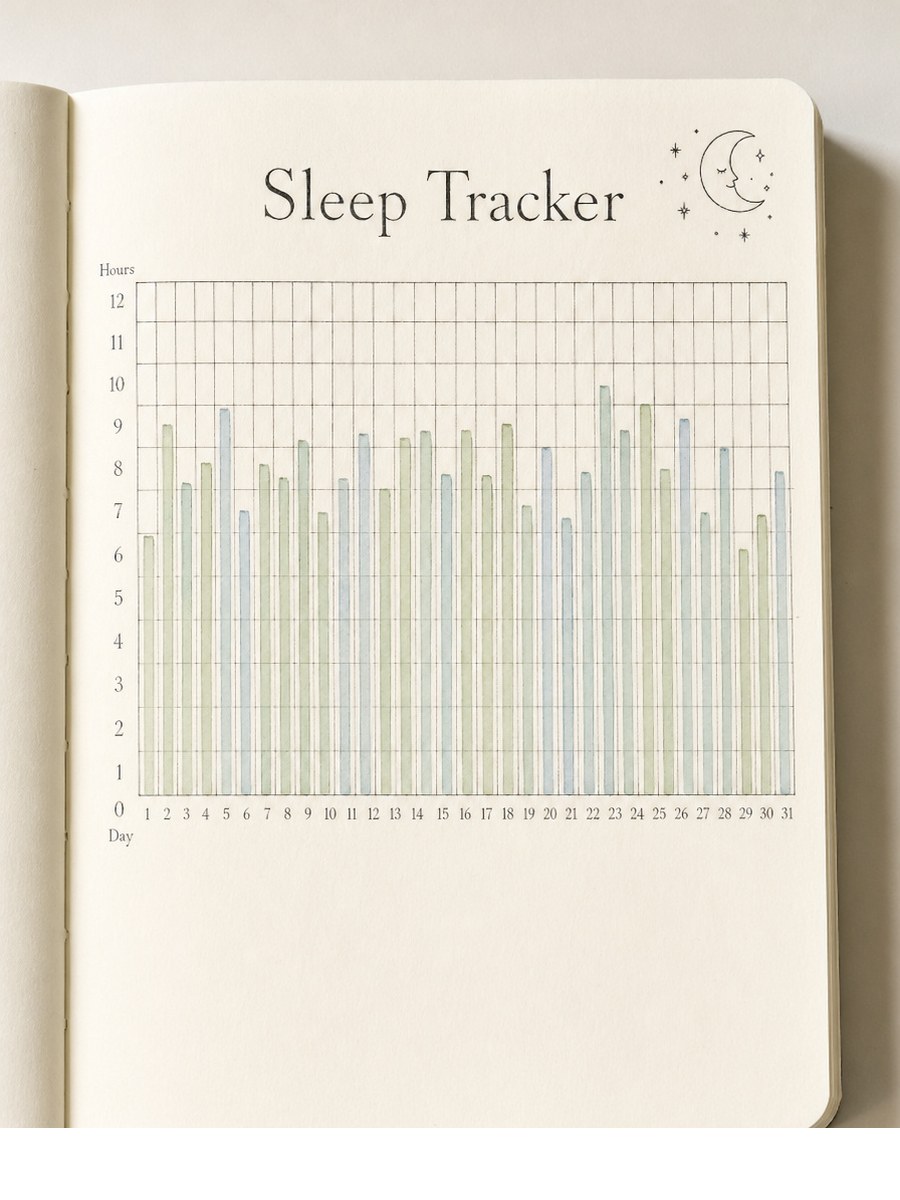
8. Sleep tracker
A simple bar chart — hours up the side, days across the bottom. Fill in the bar each morning. After a fortnight you’ll be able to see, in colour, the relationship between your sleep and the rest of your life. Every “why am I so tired” mystery I’ve ever had has been solved by looking at two weeks of this page.
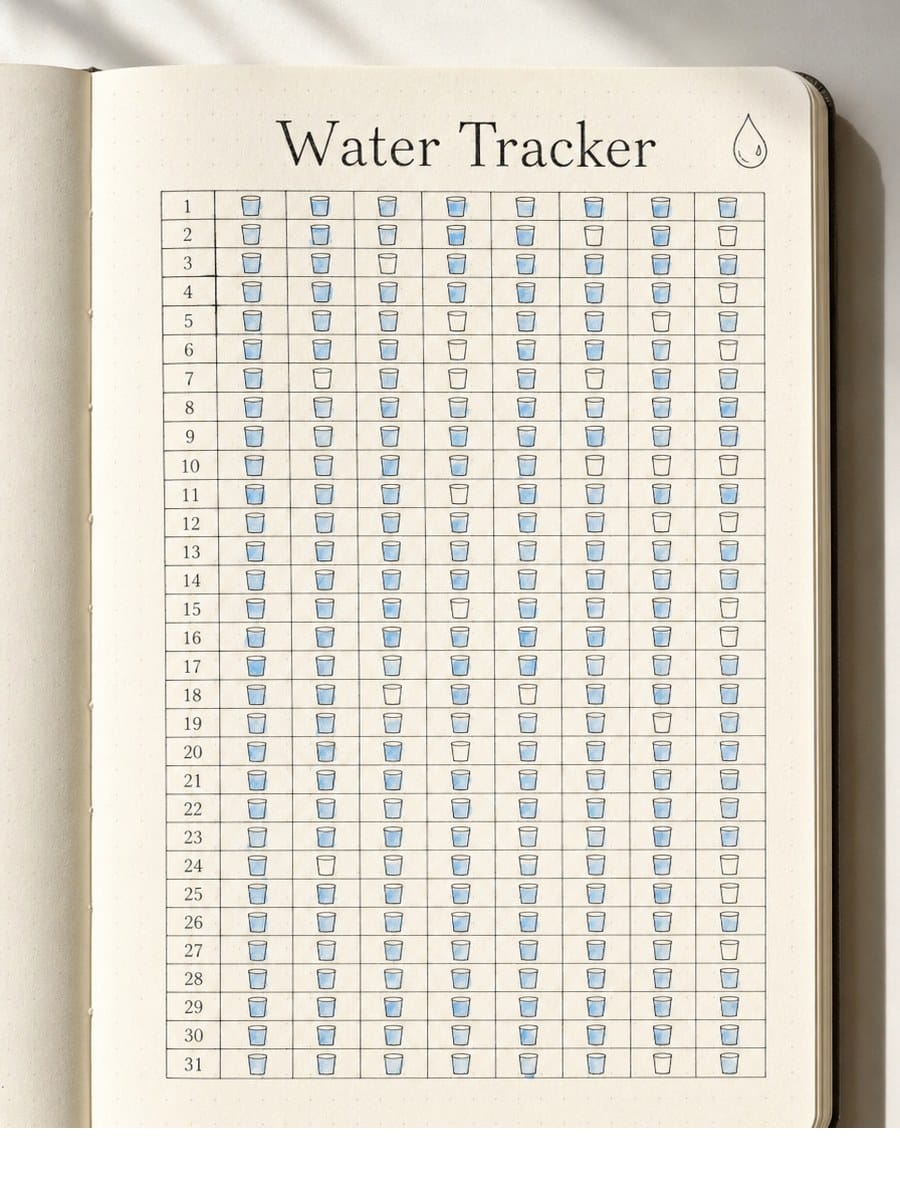
9. Water tracker
Thirty-one rows, eight little glass icons per row. Tick a glass for every cup. Embarrassingly motivating once you start. The act of having to tick the box is enough of a friction to make you actually drink the water — which is the entire point.
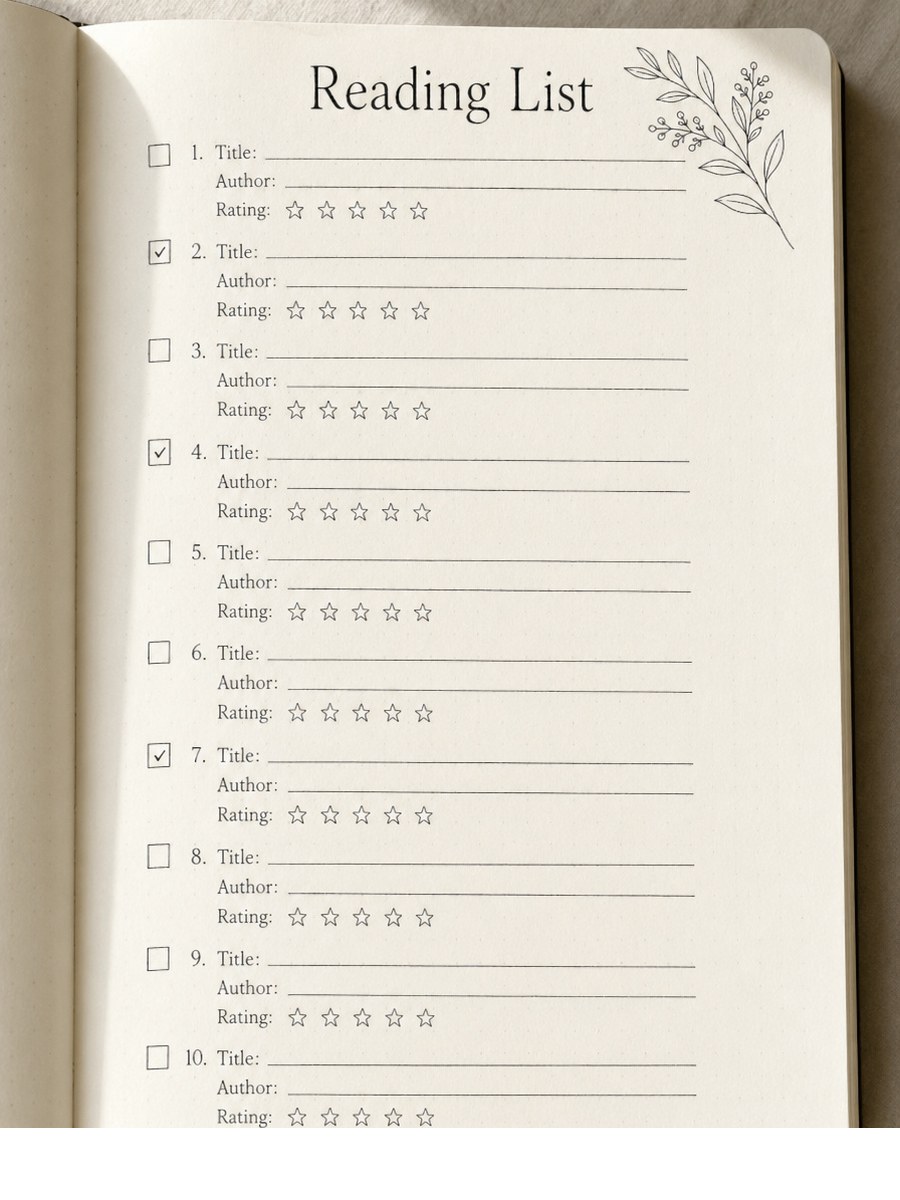
10. Reading list
Fifteen entries: title, author, five-star rating to colour in. Use it for “books I’m currently reading” or “books I want to get to this year” — both work. The rating column gives you a small dopamine hit at the end of every book and turns the page into a quiet record of your reading year.
11. Goals page
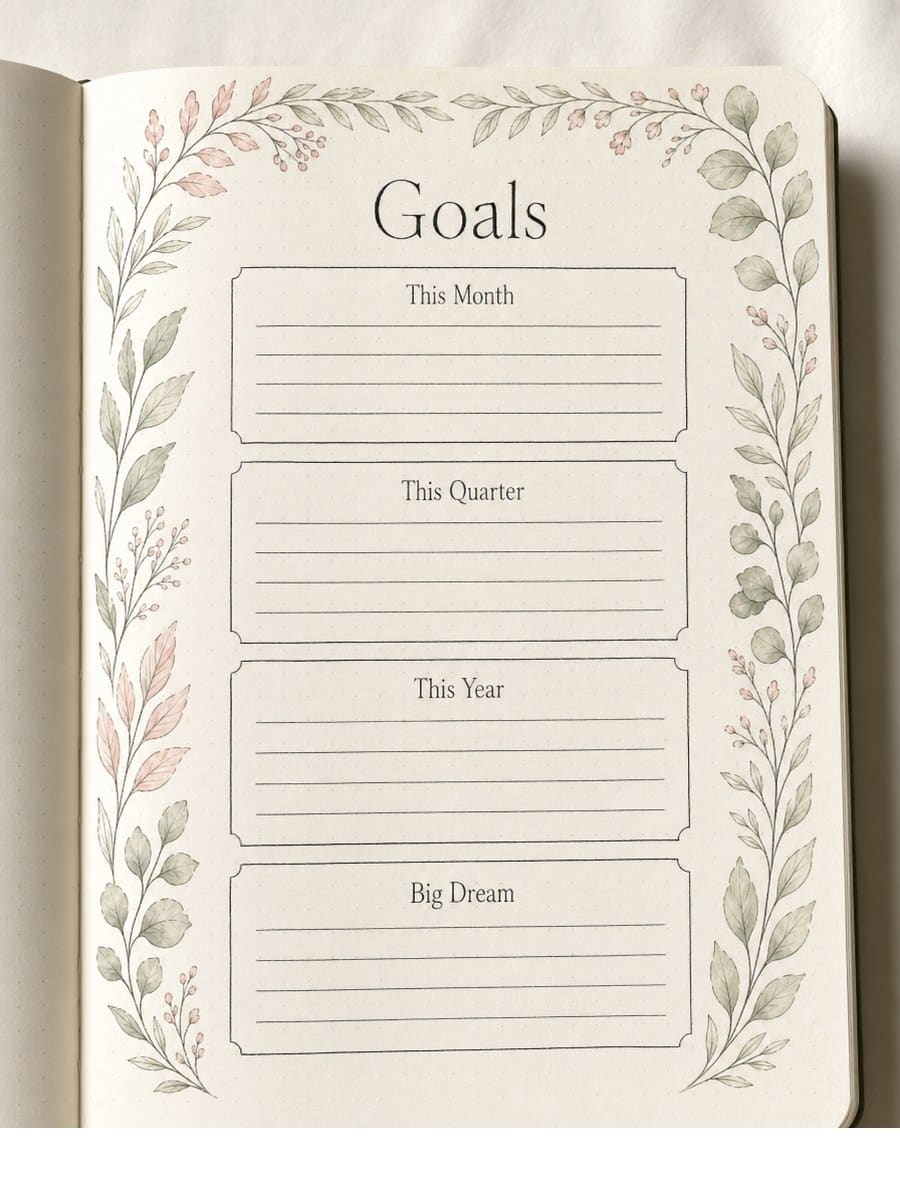
Four labelled boxes — this month, this quarter, this year, big dream. Write the actual goals (not aspirations: goals you can do something about this week). Revisit on the first of every month. The “big dream” box is the one most people skip and the one that quietly makes the biggest difference over a year.
12. Brain dump
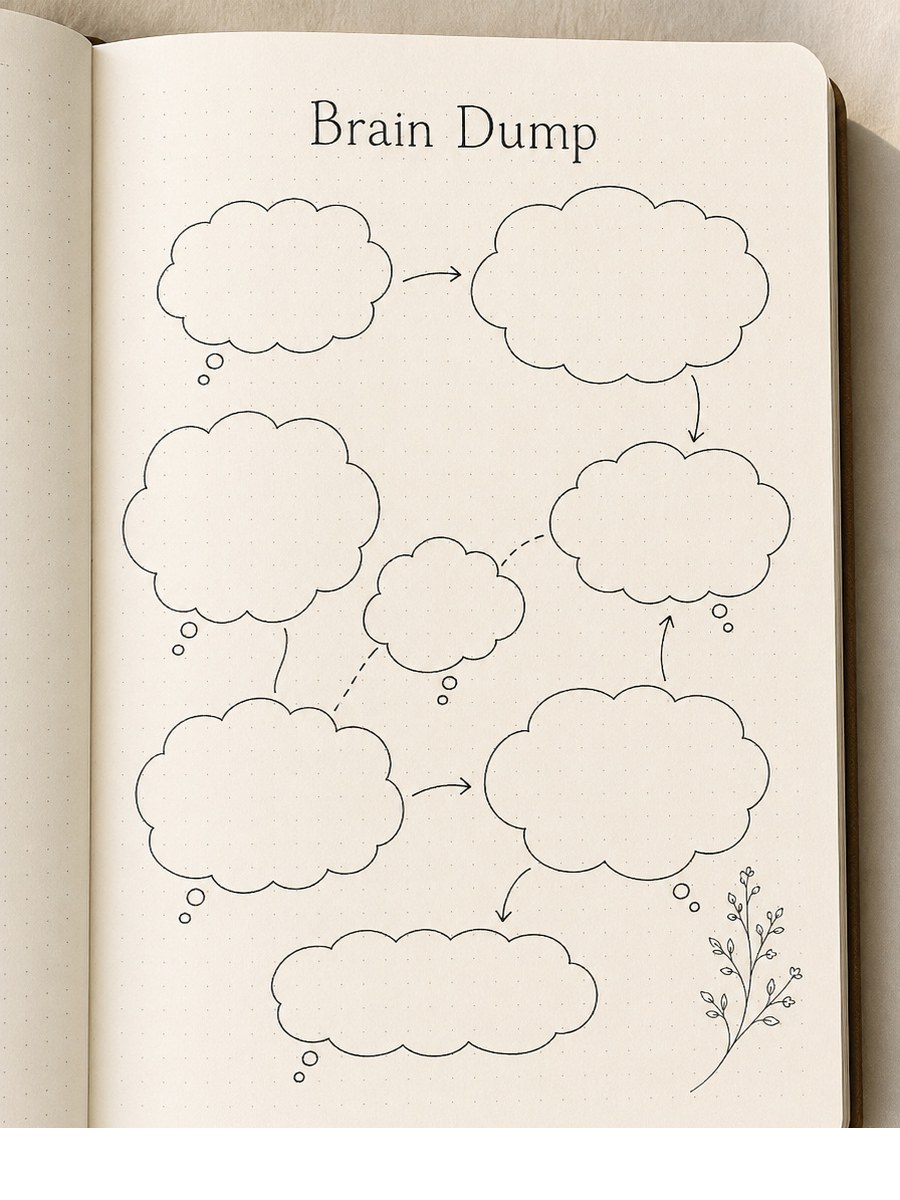
The page for the days when the inside of your head feels like an open browser with too many tabs. Empty everything onto the dot grid — tasks, worries, ideas, half-finished sentences, all of it. Don’t sort. Don’t tidy. Sort it later, after the page has done its job. You’ll feel five degrees calmer the moment the last thought comes out.
How to customise your templates
Quick answer: Print the templates onto plain A4, then customise by hand with fineliners, washi tape, or a soft watercolour wash. If you want to digitally edit them, open the PDF in any tablet drawing app (Procreate, GoodNotes, Notability) and add layers on top — the templates are clean line art designed to be drawn on.
The lowest-effort customisation is a colour rule. Pick two colours for the month — say sage green for headers and a dusty terracotta for highlights — and use only those, every page. Suddenly the spreads feel intentional and curated even though all you did was use the same two pens for thirty days.
The slightly fancier version is a botanical theme. Use the corner of each page for a single hand-painted sprig — a sage leaf for a quiet week, a small terracotta wildflower for a busier one. Easy watercolour sketchbook ideas has a stack of botanical motifs simple enough to copy in two minutes per page.
If you’d rather skip pen-and-paper and work on an iPad, all twelve templates work as backgrounds in Procreate or GoodNotes. I’ve got a separate Patreon vault of Procreate brushes and stamps that pair beautifully with these spreads — the watercolour stamp set in particular makes adding tiny botanical accents to a digital habit tracker feel embarrassingly satisfying.
Want 400+ printables in one place?
If you love this template pack, you’d genuinely love the Artsydee Creations Club. Every week I add new printables — bullet journal spreads, planners, junk-journal kits, colouring pages, watercolour templates, the full mix. The moment you join, you also get a vault of 400+ printables ready to download.
👉 Check out the Creations Club here — it’s £8/month, cancel anytime. The fastest way to keep your bullet journal stocked with fresh templates without hunting for the next pack every week.
Tips for actually sticking with it
Quick answer: Set your bullet journal up the night before. Keep it open on your desk, not on a shelf. Aim for “messy and used” rather than “perfect and abandoned.” Skip days without guilt and pick back up the next morning — the system is supposed to serve you, not the other way around.
The single biggest predictor of whether you’ll keep a bullet journal isn’t aesthetic. It’s visibility. If the notebook lives in a drawer you’ll forget it. If it lives on your desk open to today’s page, you’ll glance at it twenty times a day and update it without thinking.
- Set up Sunday night. Print the next week’s spread, paste it in, write the dates. Five minutes on a Sunday saves you a Monday-morning panic.
- Write less, not more. A weekly spread with three things per day is a weekly spread you’ll keep using. A weekly spread with a paragraph per day is one you’ll abandon by week three.
- Skip without guilt. Missed a day on the habit tracker? It’s still a habit tracker. Pick up where you left off. The streak isn’t the point — the awareness is.
- Make ugly pages. Your first month’s spreads will not be Pinterest-pretty. That’s fine. The journal is a tool, not a portfolio.
- Photograph the pages you love. When a spread does come together, take a quick phone shot. Future-you will want the proof on the bad days.
If you want a steady supply of fresh prompts to scribble alongside your spreads, my 100 sketchbook prompts pack works gorgeously as a daily side-quest in the corner of a journal page.
🎬 Prefer watching? Subscribe to my YouTube channel — I post weekly walkthroughs of my own bullet journal setups, plus printable flip-throughs and quick watercolour tutorials.
Bullet journal FAQ
Do I need a special notebook to bullet journal?
No. Any notebook with dots will do. Dot grid is the standard because the dots act as faint guides without being as visually loud as squared paper, but lined or even blank notebooks work fine too — you just lose a little of the alignment help when you’re freehanding columns. If you’re starting tonight, use what you have.
How long does it take to set up a bullet journal each week?
If you’re using these templates: about five minutes. Print the weekly spread, write in the dates, and slot it into your binder. If you’re hand-drawing every spread from scratch with watercolour borders: closer to thirty minutes. The templates exist precisely so you don’t have to make that choice every Sunday.
Are these templates printable on US Letter paper?
Yes. They’re designed for A4 portrait, but if you select “fit to page” in your printer settings, they’ll print on US Letter with a slightly larger top and bottom margin. The proportions stay correct — nothing gets squished.
Can I use these templates digitally in Procreate or GoodNotes?
Yes — drop the PDF or any individual PNG into your iPad app of choice and treat it as a background layer. The templates are clean black line art on white, so they sit beautifully under any pen, brush, or watercolour layer you add on top.
What’s the difference between a bullet journal and a planner?
A planner has the spreads pre-printed in a fixed order — same weekly layout every week, whether you need it or not. A bullet journal lets you build the spread you actually need that week and ignore the spreads you don’t. The trade-off: a planner is faster to use, a bullet journal is faster to fit your life. Templates like these split the difference — you get the speed of a planner and the flexibility of a journal.
Final thoughts
You don’t need a perfect notebook, a £40 pen set, and a Pinterest-worthy aesthetic to bullet journal. You need twelve pages and a Sunday evening. The pack at the top of this post gives you the twelve. The Sunday evening, you’ll need to find yourself.
Try one spread this week. The weekly’s the easy entry point — print it, paste it in, fill it in on Monday morning, and see if a system this simple actually shifts how the week feels. That’s the whole experiment.
Want to browse the rest of the printable shop? Everything I’ve made — bullet journal kits, junk-journal pages, watercolour templates, planners — lives at payhip.com/Artsydee. The Creations Club is the all-you-can-eat membership; the shop is for one-off picks.
If you want more printables like this — bullet journal kits, planners, junk-journal pages, watercolour templates — the Creations Club is the home for all of it. And if you want to follow along: I’m @artsydee_inspiring_creations on Instagram, @artsydee on Pinterest, and @artsydee on YouTube. Come say hi.
You might also like
- 100 sketchbook prompts — daily quick-sketch prompts to pair with your bullet journal pages
- Sketch ideas for beginners — gentle starting points if you’re new to drawing in your journal
- Aesthetic things to draw — small motifs that make a spread look intentional in two minutes
- Easy drawings for beginners — confidence-building drawings to scatter through a journal
- Easy watercolour sketchbook ideas — for the version of you that wants a soft wash on every page
Pin this for later! ↓
Once your bullet journal layouts are working, decorating them is the fun part. Inside the Artsydee Creations Club you get printable journal papers, ephemera, tags and stickers added every month for £8/month (~$10) — plenty to make each spread feel like yours.
See what’s inside the Club →