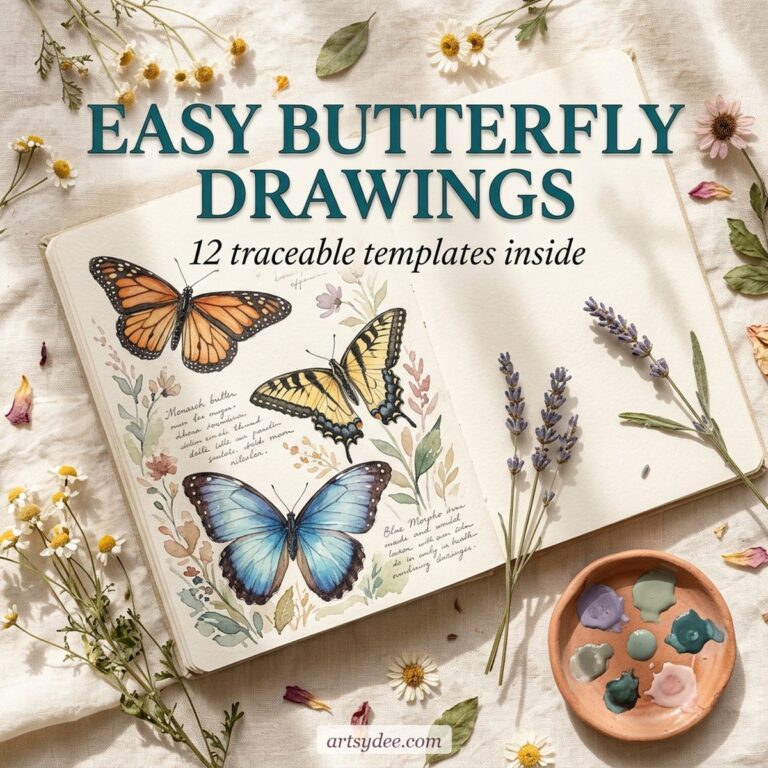
Last Updated on July 20, 2026 by Dee
Butterflies are one of those subjects that quietly carry a sketchbook page. A pair of soft wings, a slim body, two delicate antennae — somehow they manage to look like a finished painting even when you’ve barely warmed up. And they might just be one of the most forgiving things a beginner can draw.
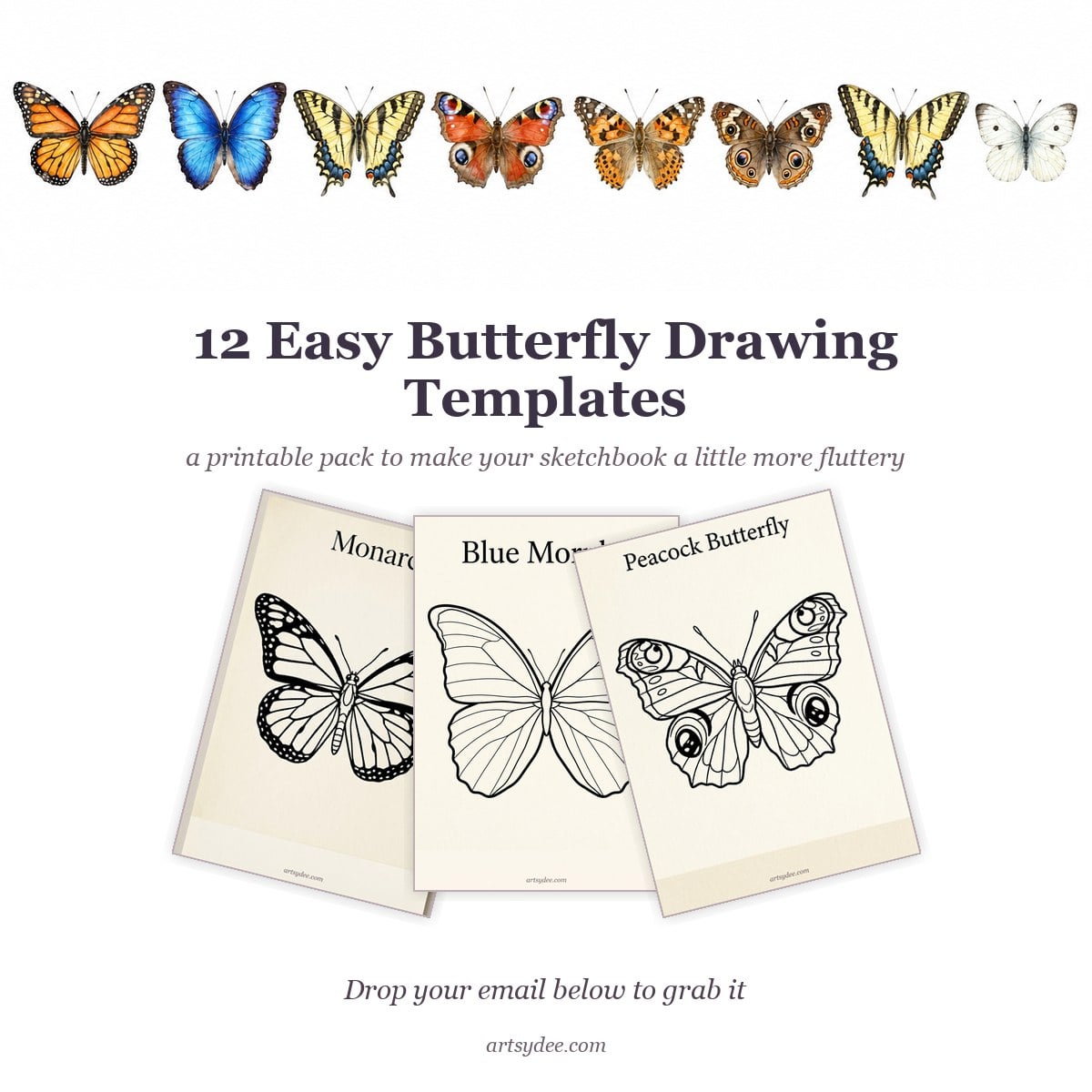
I’ve put together a free pack of 12 easy butterfly drawing templates — a monarch, a swallowtail, a blue morpho, a painted lady, a buckeye, a tiger swallowtail, a peacock, a whimsical cartoon-style version, an ornate decorative-mandala butterfly, a simple top-down view, a side-view resting butterfly, and a butterfly with flowers. Trace them, watercolour over them, or use them as warm-ups when your sketchbook feels intimidating.
🎬 Prefer watching? Subscribe to my YouTube channel — I drop sketchbook flip-throughs and step-by-step tutorials every week.
Table of Contents
Why butterflies are the perfect beginner subject
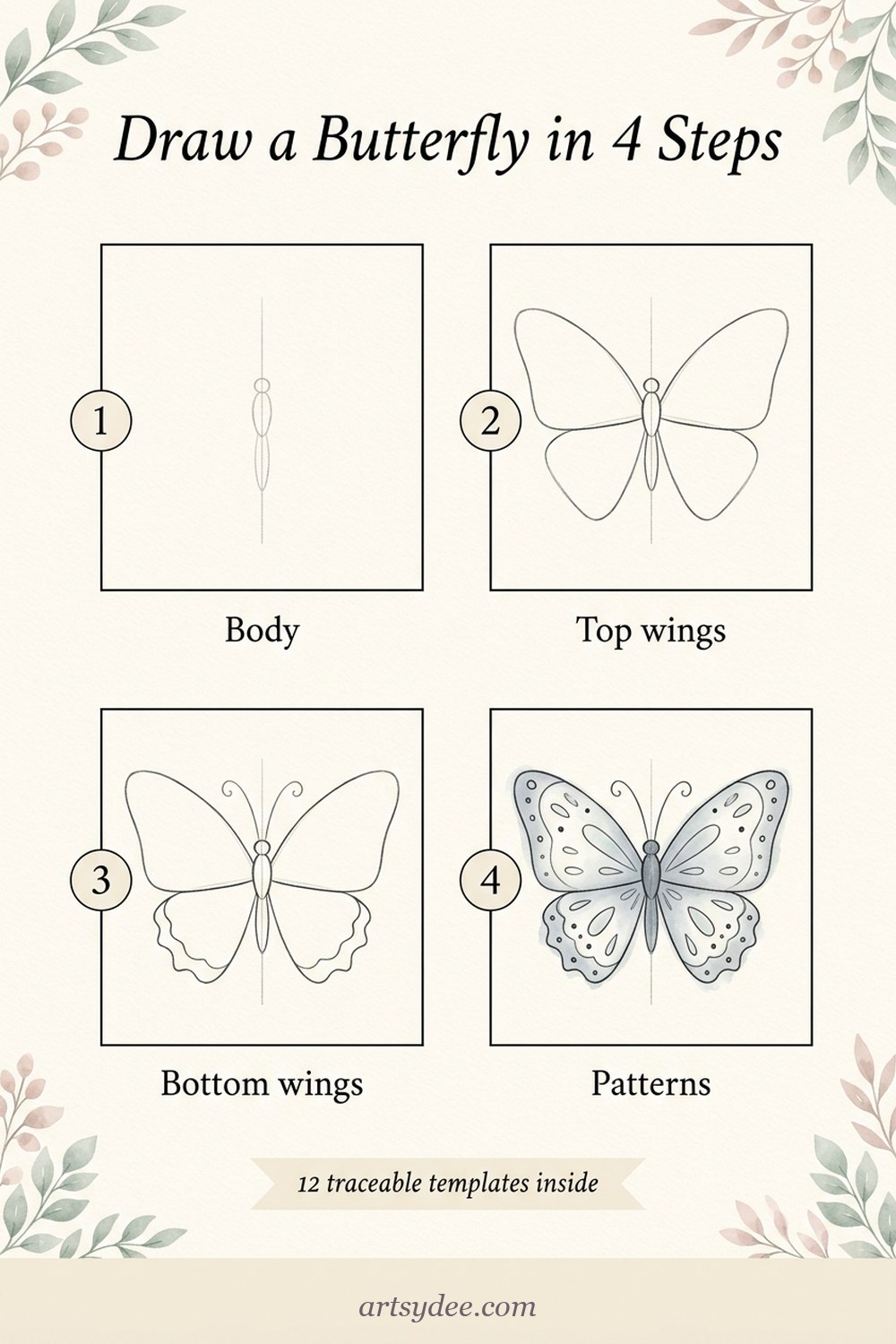
Quick answer: Butterflies are made up of simple symmetrical shapes — two pairs of wings on either side of a slim body — which makes them forgiving for beginners. They look beautiful even when they’re a little wonky, they pair with almost any medium (graphite, ink, watercolour, gel pen), and you can finish a satisfying drawing in about 15 minutes.
If you’re staring at a blank sketchbook and your brain has gone quiet, a butterfly is a kind invitation. The shapes are clean. The symmetry does most of the heavy lifting. And there’s no version of “wrong” — every butterfly you’ll ever see has a slightly different wing pattern, so even an off-balance swallowtail reads as your butterfly.
The other thing I love: butterflies make space for atmosphere. A simple monarch resting on a single line of grass, with two tiny wildflowers off to the side, already feels like a finished piece. You’re not painting a portrait — you’re suggesting a whole afternoon in the garden.
Butterflies flowing? My shop has premium drawing template sets for whatever lands on your page next.
Browse the shop →Grab your free 12 butterfly drawing templates
Quick recap of what’s in the pack — all sized for A4, all clean line art you can trace or paint over:
- Monarch butterfly — the warm orange classic with the dotted wing border
- Swallowtail butterfly — long elegant tail extensions on the lower wings
- Blue morpho butterfly — broad rounded wings, jewel-toned painting potential
- Painted lady butterfly — scalloped wings with marginal spots
- Common buckeye butterfly — those dramatic round eye-spots on every wing
- Tiger swallowtail — bold vertical stripes plus tail extensions
- Peacock butterfly — four big eye-spots, one in each wing corner
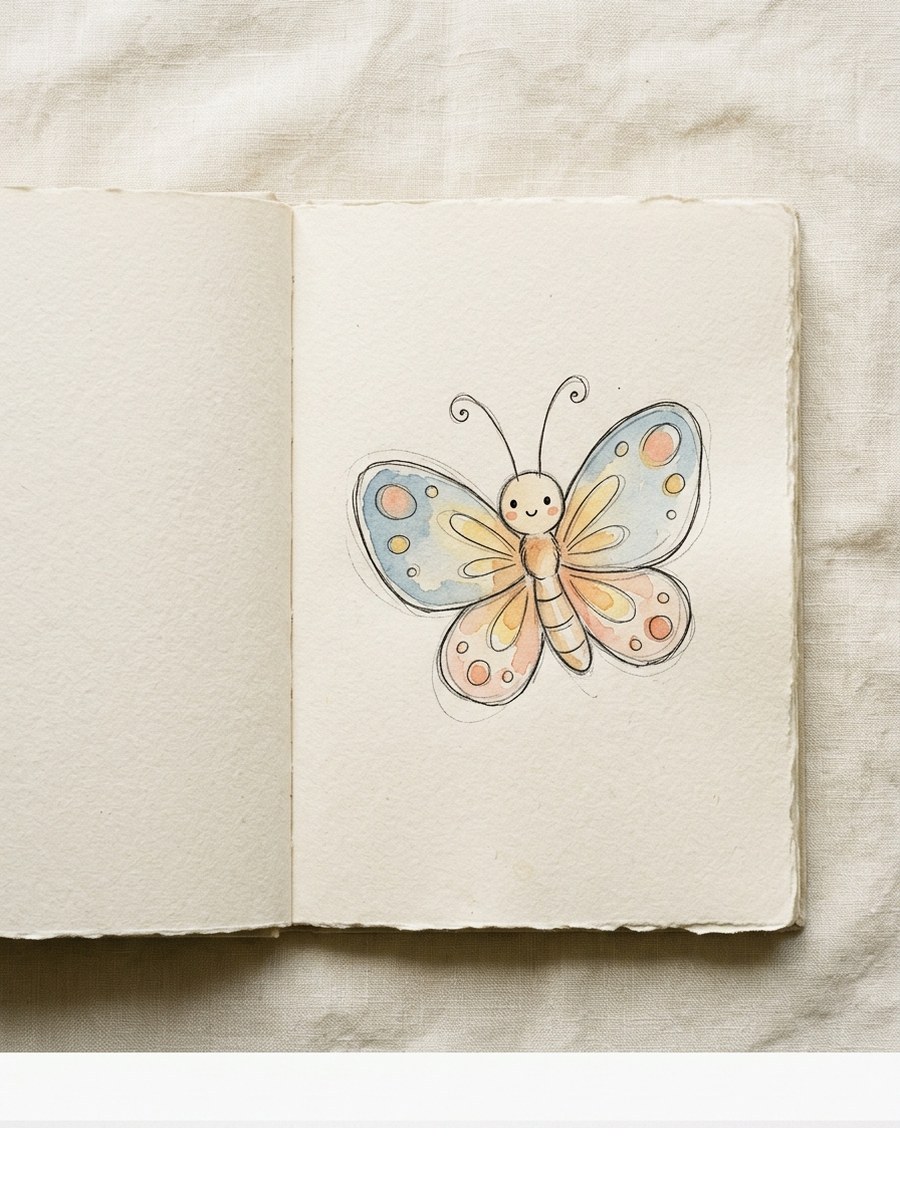
- Simple cartoon butterfly — whimsical, friendly, gentle
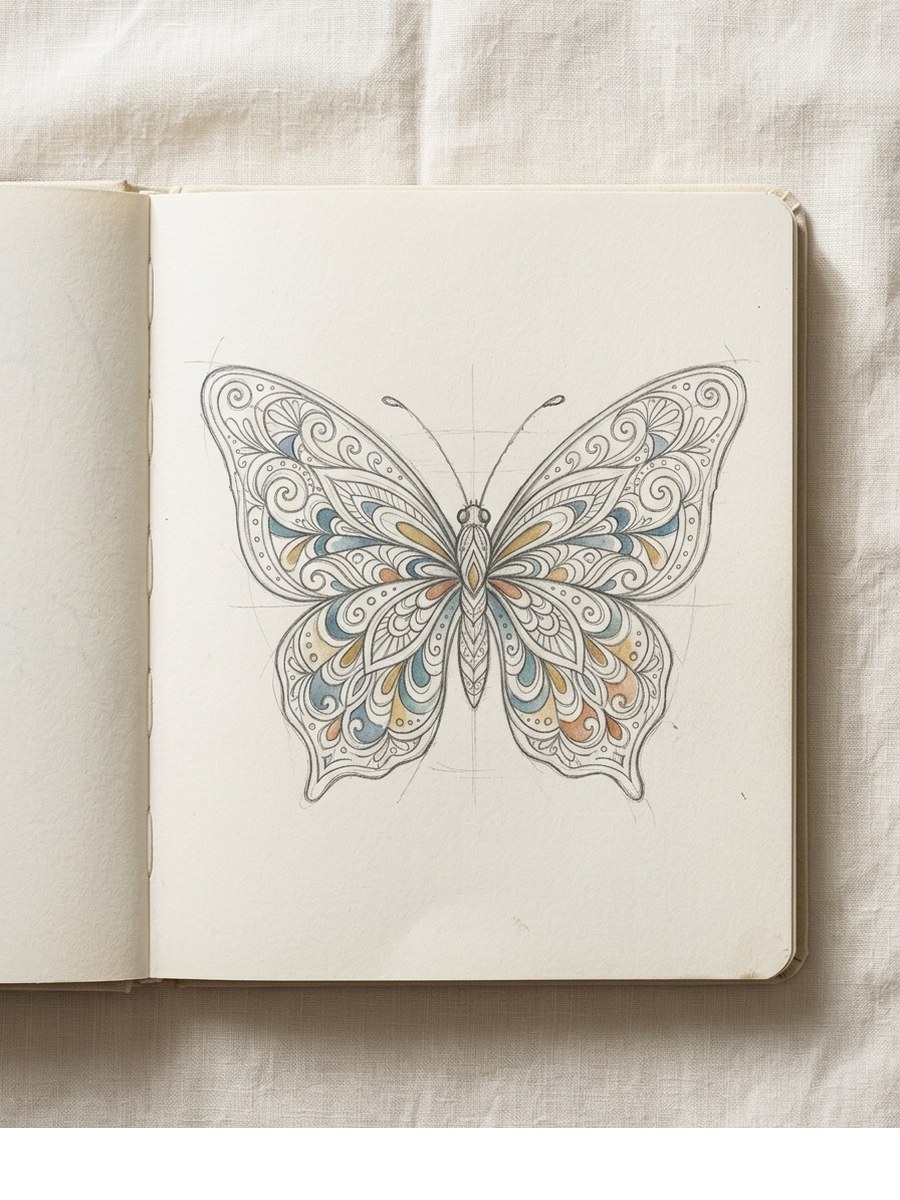
- Ornate decorative butterfly — mandala-style for adult colouring
- Top-view wings spread — beginner-friendly minimal detail
- Side-view resting butterfly — wings folded upright, perched on a twig
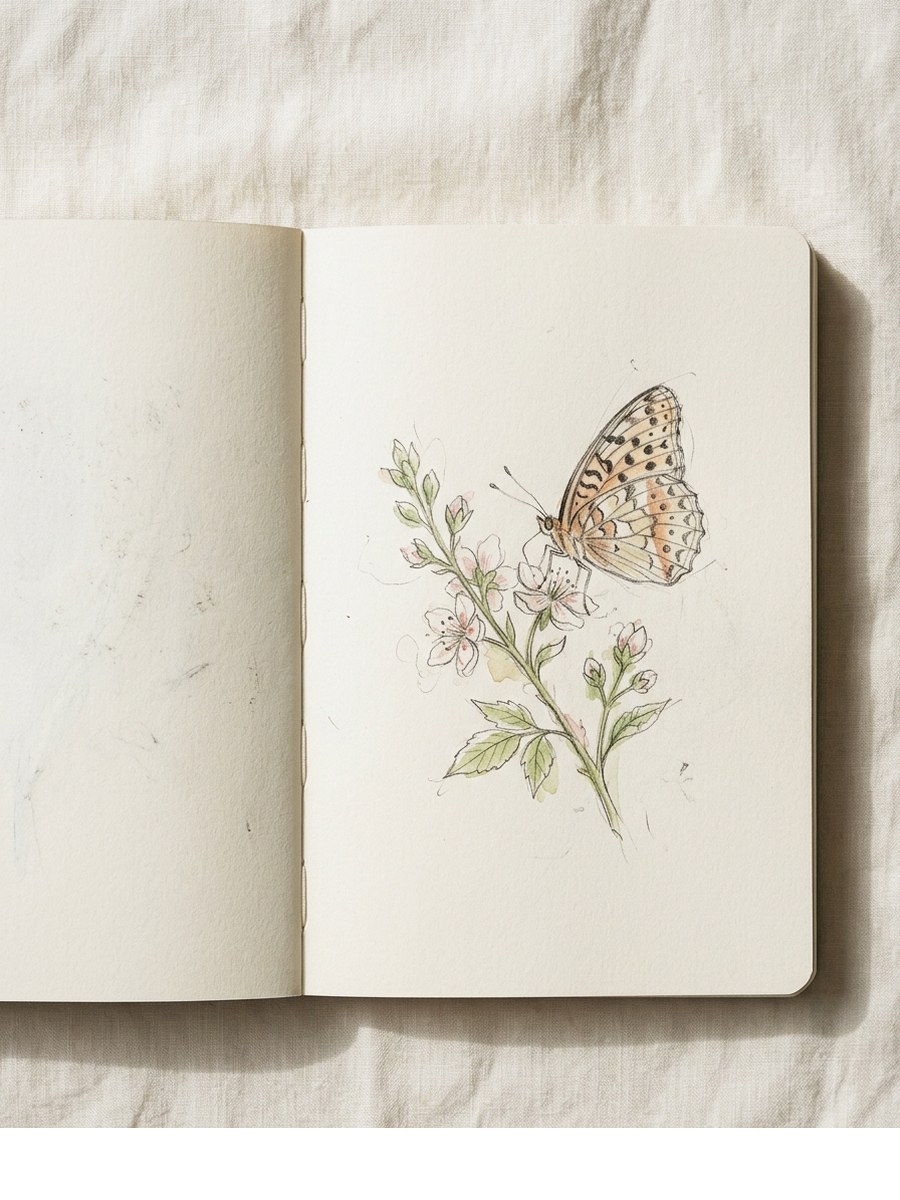
- Butterfly with flowers — three-quarter view, perched on wildflowers
Scroll back up to the email box if you haven’t grabbed it yet — pop your email in and the pack lands in your inbox in a couple of minutes. That’s the only step.
What you need to get started
Quick answer: A pencil, an eraser, a piece of paper, and a printed template are enough. If you want to add value or wash, a graphite set (2H–6B) covers all the shading you’ll need; for paint, a small watercolour pan set and a single round brush will get you through every butterfly in this pack.
I’m a fan of keeping the supply list short — butterflies reward restraint more than they reward equipment. Here are the bits I actually reach for when I’m sketching butterflies:
Heads up: a couple of links below are affiliate links. If you click and buy something I may earn a small commission at no extra cost to you. I only link to supplies I genuinely use.
- A soft graphite pencil set — a Faber-Castell graphite set is perfect for the soft tonal shifts on a monarch’s wings.
- A small watercolour pan set — I use a Winsor & Newton Cotman pocket box for everything butterfly-related; the burnt sienna and ultramarine cover most species.
- Cold-press watercolour paper — even if you’re tracing, paint over a printed template on a sheet of Strathmore 400-series watercolour paper for the loveliest soft washes.
- A round watercolour brush — a single Princeton Velvetouch round size 6 covers wash, edges, and the delicate vein lines.

|

|

|

|
12 easy butterfly drawings to try
Quick answer: The twelve butterflies in this guide go from absolute-beginner (a simple top-view butterfly) to gently more involved (an ornate decorative-mandala design). Pick whichever one matches your mood — there’s no order you need to follow.
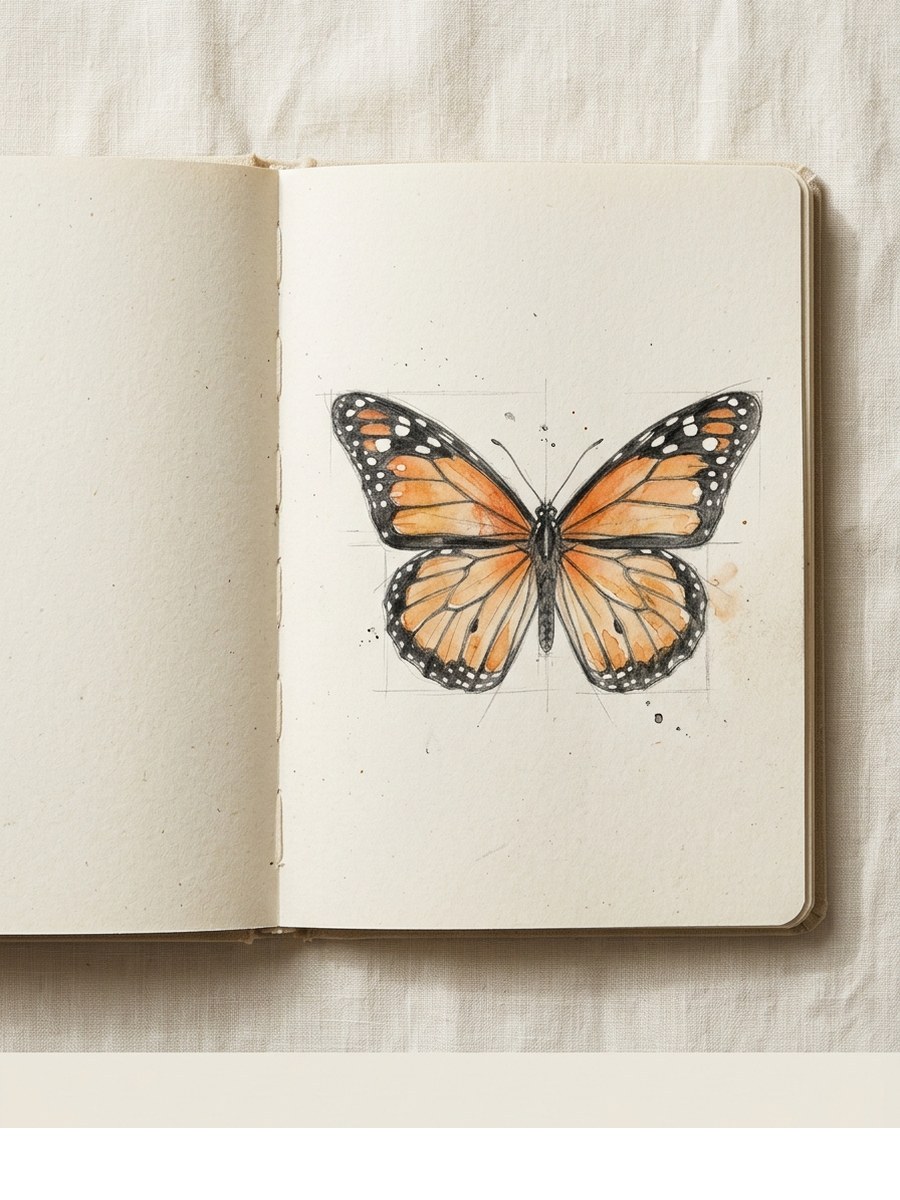
1. The monarch butterfly
Start with the slim oval body, then mirror two soft curving wing shapes on either side. The monarch’s wings are roughly fan-shaped on top and a little more scalloped underneath. Map out the dark vein lines lightly — they’re what make the wing read as a monarch — and add a thin border of small dots around the edges. Keep your pencil light. The whole butterfly only needs a handful of careful lines.
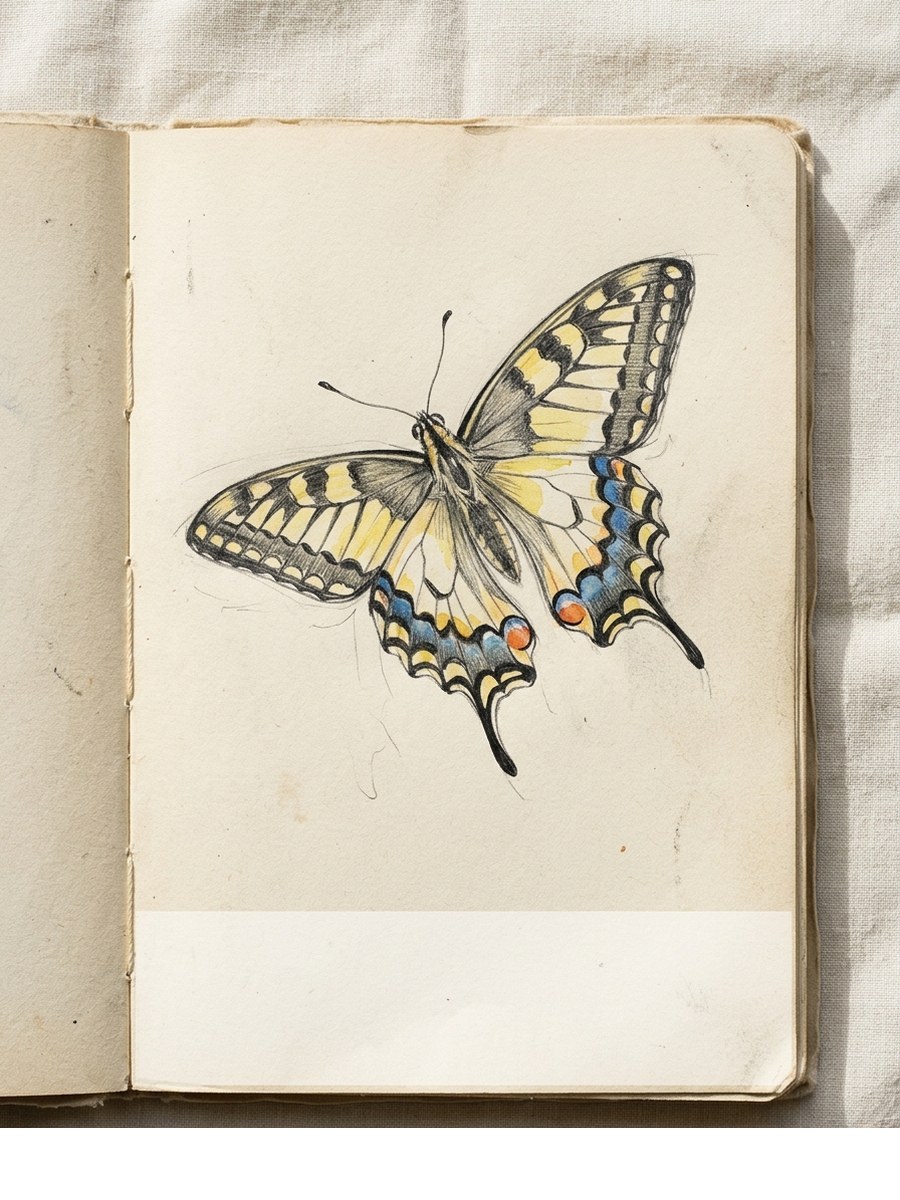
2. The swallowtail
The swallowtail’s superpower is the elongated tail extension on each lower wing. Sketch the body, then the upper wings as gentle teardrops, then drag the lower wings down into a long elegant point. Add three or four sweeping vein lines per wing and a thin scalloped border. You can leave it loose — swallowtails look magic with watercolour.
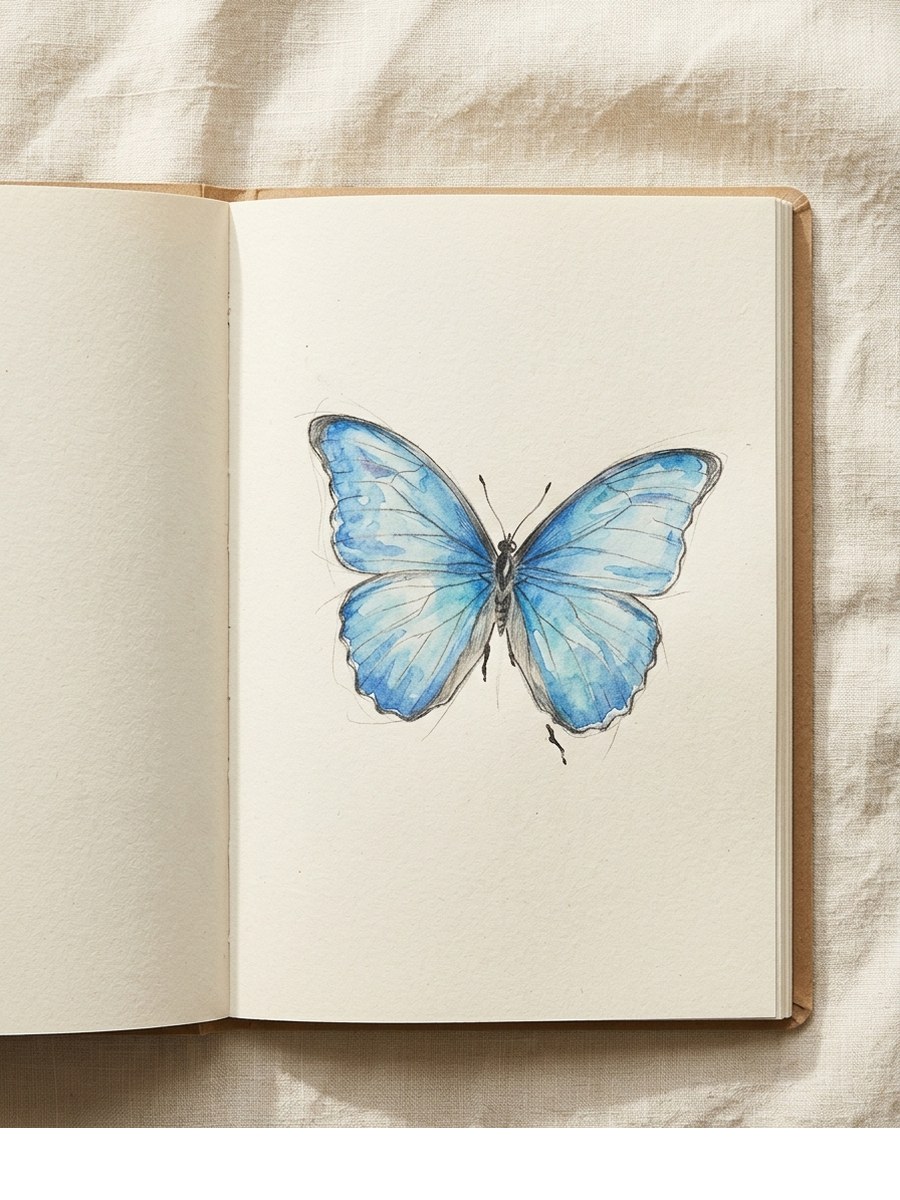
3. The blue morpho
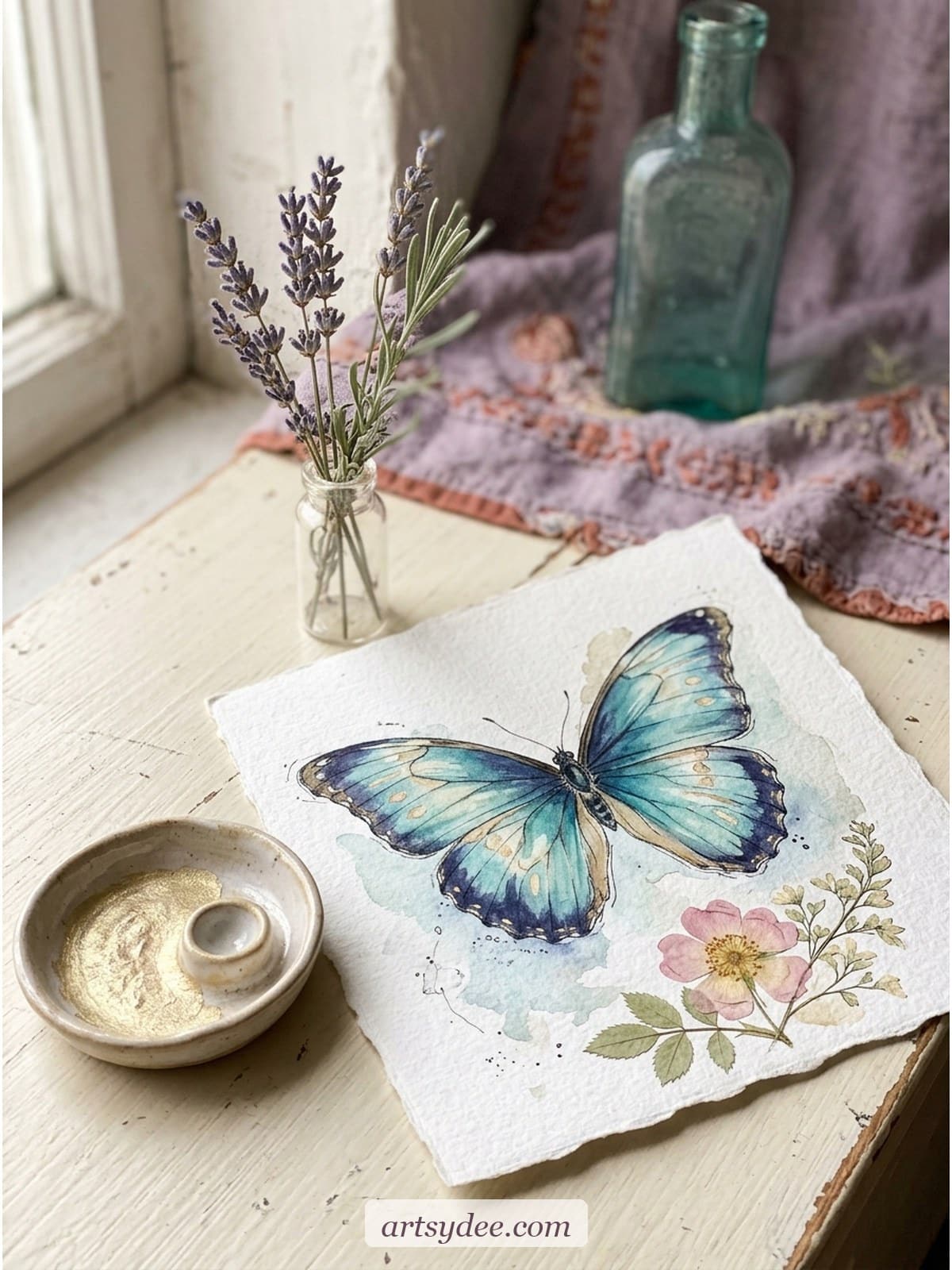
Broad rounded wings, top-down view. The blue morpho’s wing shape is the gentlest of the bunch — almost butterfly-clipart in its simplicity. The magic is in the colour: a luminous teal-blue wash, slightly darker around the edges. Even a single uneven wash reads as a blue morpho.
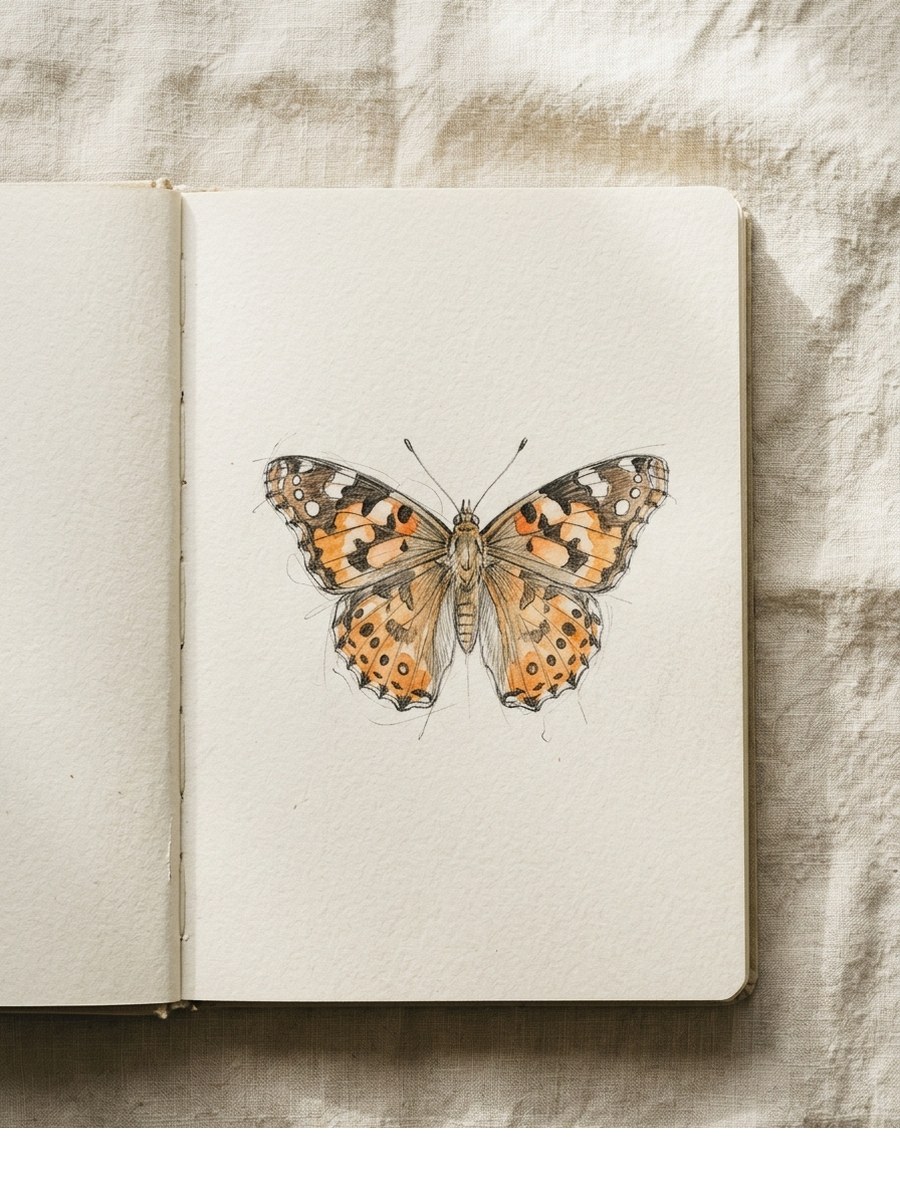
4. The painted lady
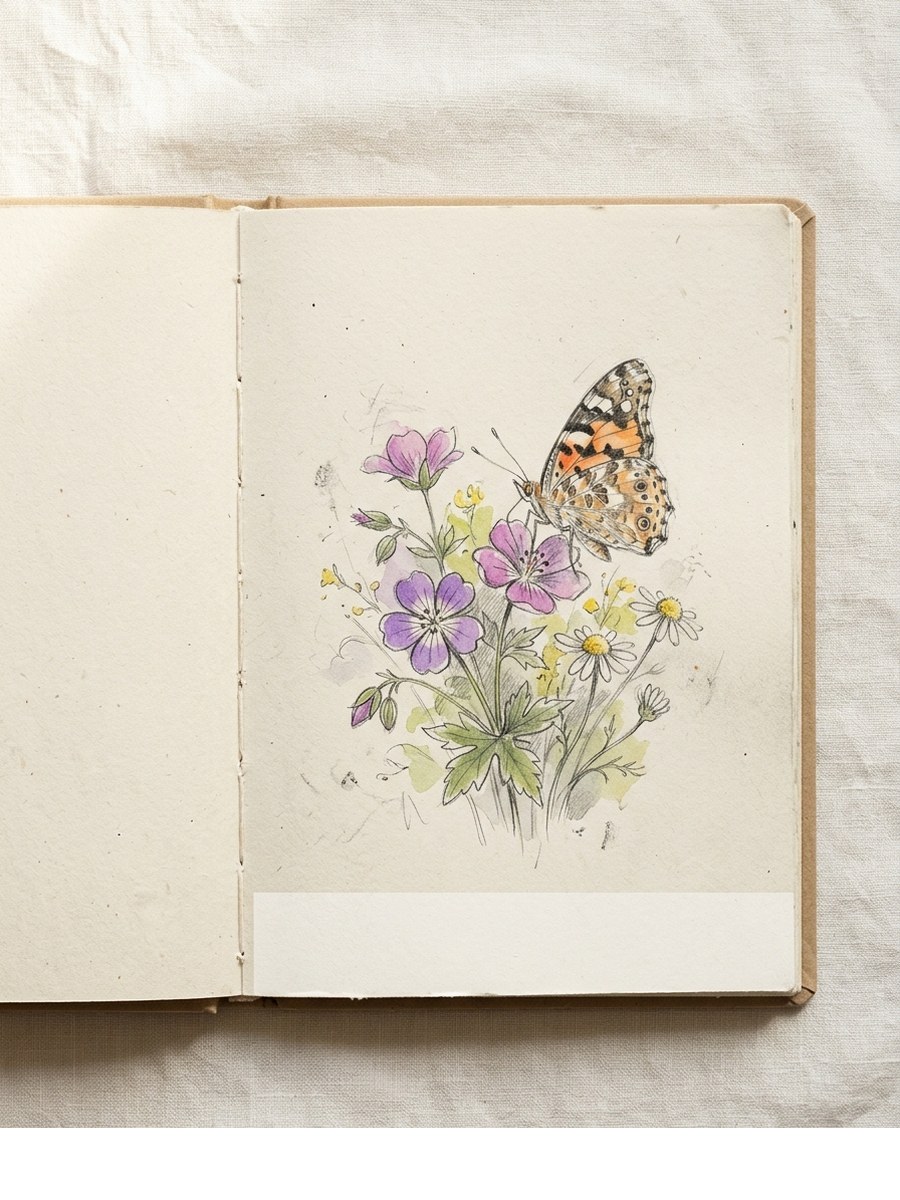
Smaller scalloped wings with subtle marginal spots — soft warm browns and oranges work beautifully. The painted lady is one of the most forgiving butterflies because it’s quite asymmetrical in real life, so a slightly off-balance sketch still looks correct.
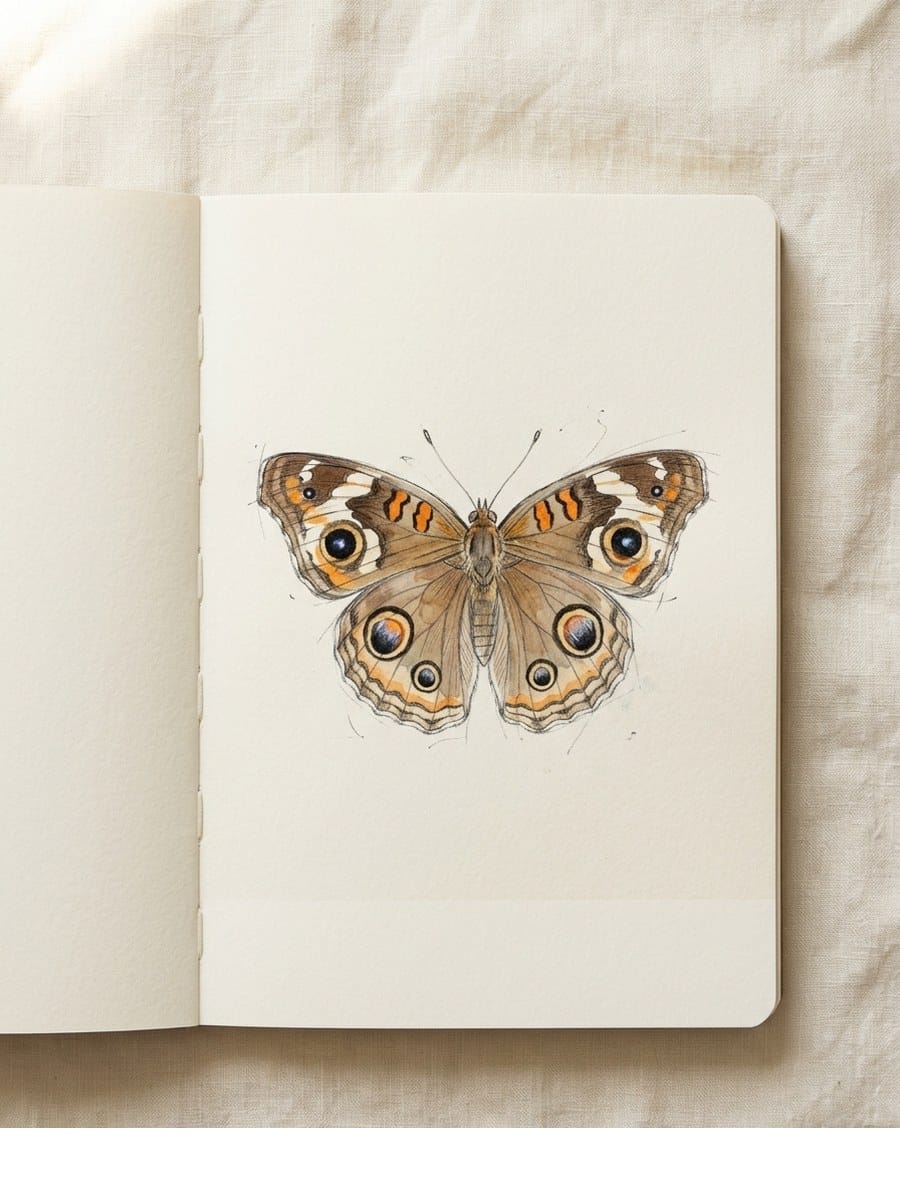
5. The common buckeye
Those dramatic round eye-spots are what define the buckeye. Sketch the wings as soft trapezoids, then add one large eye-spot near the upper edge of each wing — a circle inside a circle, with a tiny dot in the middle. Suddenly the whole thing reads as a butterfly, even with no other detail.
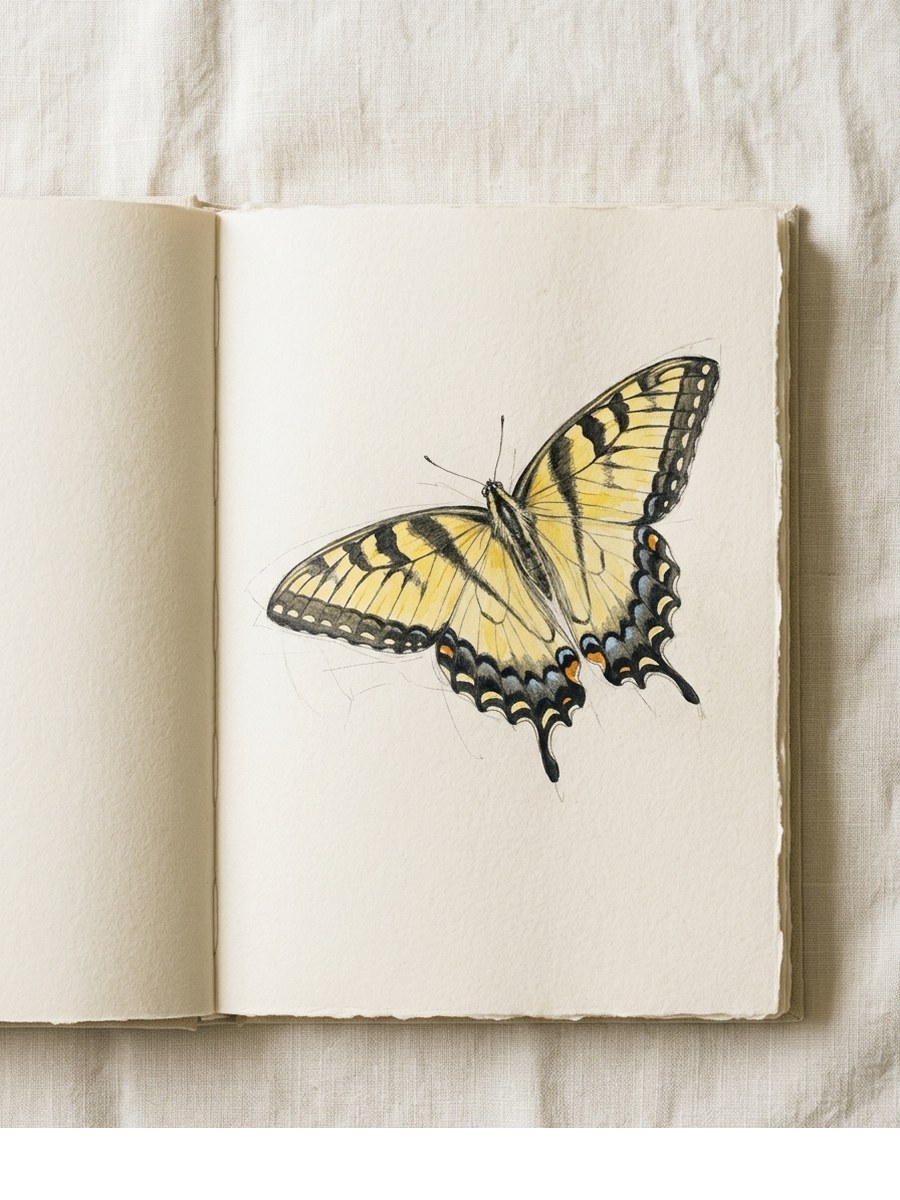
6. The tiger swallowtail
Same elongated tail as the swallowtail, but with bold vertical stripes running across the upper wings. Tiger swallowtails are pleasantly graphic — three or four heavy black stripes against a yellow wash and you’re done. A favourite for sketchbook pages because the contrast is so satisfying.
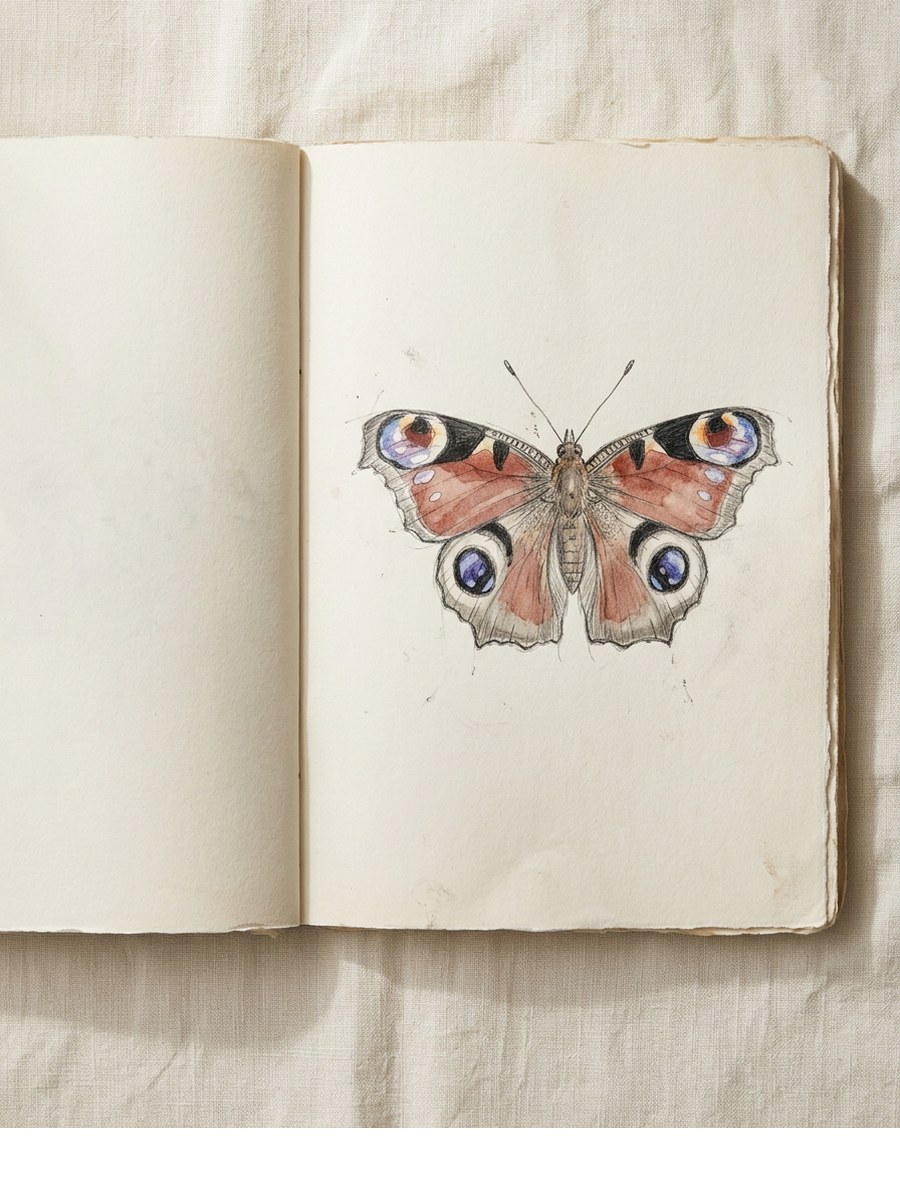
7. The peacock butterfly
Four large eye-spots — one in each corner. The peacock is the most dramatic butterfly in the pack, and it’s surprisingly approachable because the eye-spots do all the work. Map out the wing shape, place the four spots, and you’ve already got a recognisable peacock.
8. The simple cartoon butterfly
This is the whimsical one — rounded teardrop wings, a small smiling face on the body, two curling antennae, and a few tiny floating hearts and stars around it. It’s the butterfly you’d put on a child’s wall, or in a sketchbook page about a good day. Don’t overthink the face: two small dots for eyes, one curved line for the smile, done.
9. The ornate decorative butterfly
This one’s for slow, meditative sketchbook sessions. The wings are filled with intricate symmetrical patterns — paisleys, flowers, dots, swirls, leaves — almost like a butterfly-shaped mandala. Trace the template, then spend an evening filling it in with fineliner or coloured pencil. It’s slow art on purpose.
10. The top-view wings spread
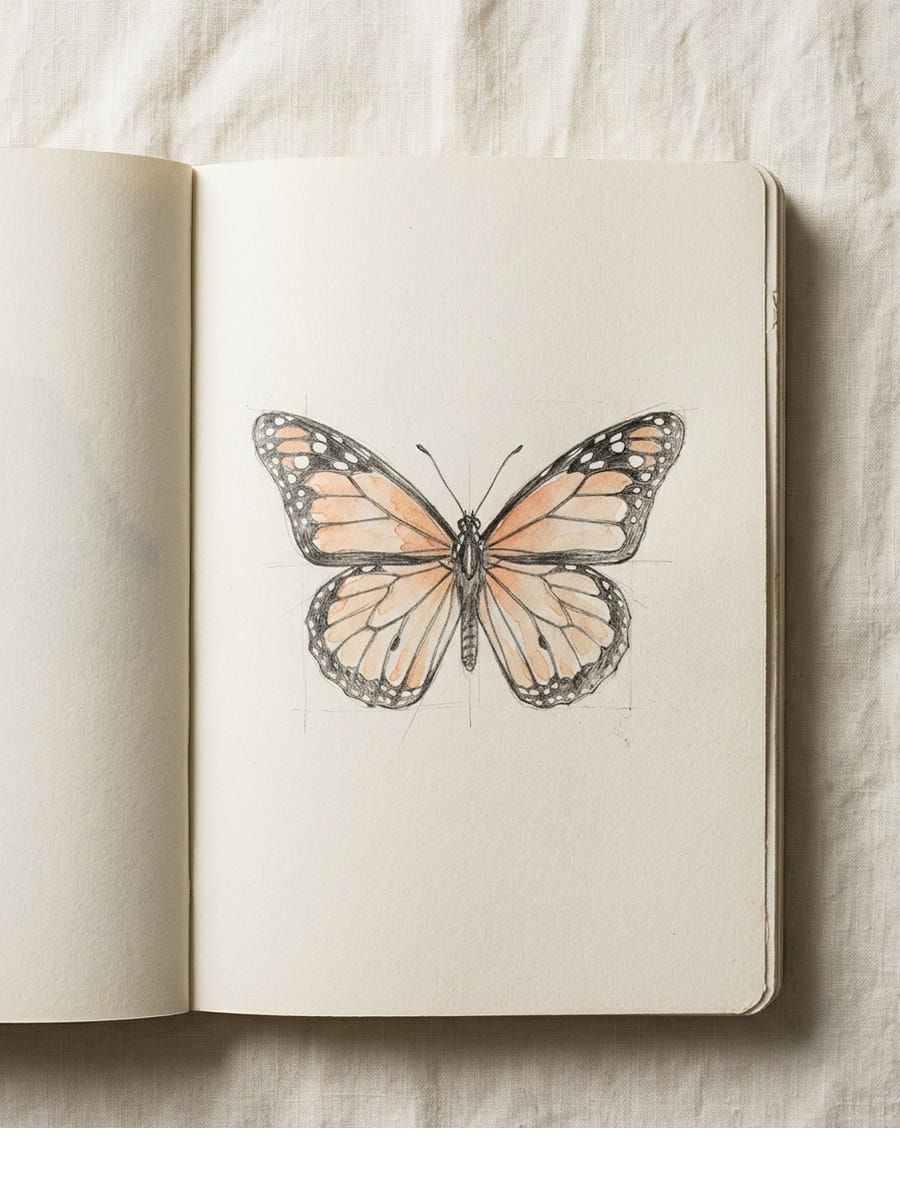
The most stripped-back butterfly in the pack — slim oval body, two long curving antennae, clean rounded wing outlines with just a few elegant vein lines. Five-minute sketch, lovely as a margin doodle, perfect for warming up.
11. The side-view resting butterfly
Wings folded closed upright above the body, perched on a small twig. This is the perspective you actually see in real life — butterflies almost never sit with their wings spread. The single wing pattern is exposed, the body is in profile, and the whole composition feels quiet and grounded.
12. The butterfly with flowers
The most “finished piece” of the bunch — a butterfly perched at a three-quarter angle on a small cluster of wildflowers. This template gives you the composition for free; all you have to do is add tone, pattern, or colour. Perfect for a journal page where you want something that already looks intentional.
How to take your butterfly drawings further
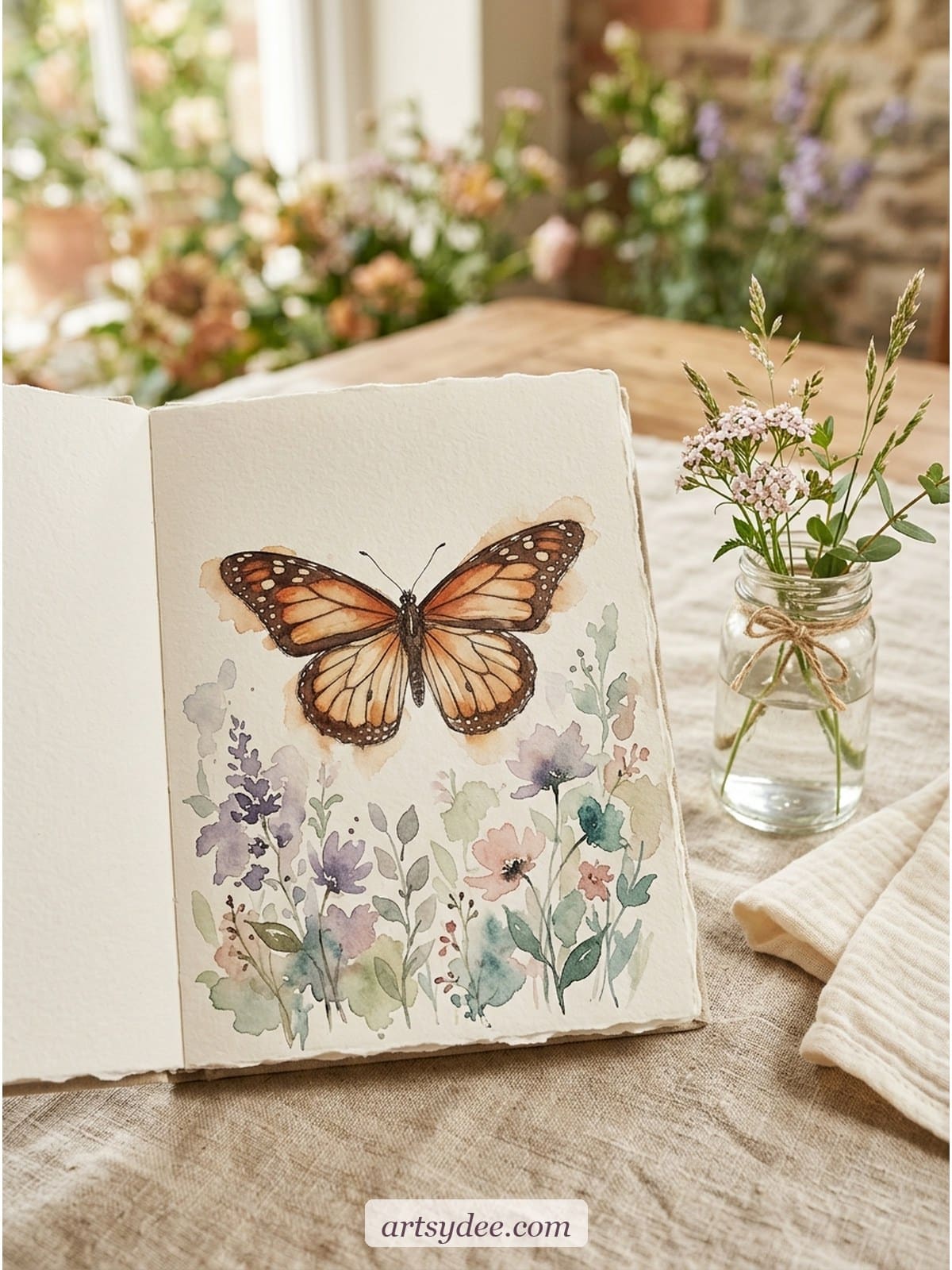
Quick answer: Once you’re comfortable with the line work, paint over a printed template with a soft watercolour wash — burnt sienna and yellow ochre for a monarch, ultramarine and cerulean for a blue morpho, or a wet-on-wet bleed of warm grey and pale gold for a painted lady. Watercolour over a traceable line is the fastest way to graduate from “drawing” to “painting”.
If you want to keep practising, try the same butterfly four times across one page in different mediums — graphite, ink, watercolour, gel pen. You’ll learn more from one page of comparison than from four separate finished pieces.
And if butterflies turn into a phase you want to stay in, my Patreon drops new watercolour template packs every month — the kind you can trace, paint, or re-mix into your own sketchbook. The Tier 2 Creatives Treasure Chest is £8 a month and includes the full back catalogue of watercolour PDFs, Procreate brushes, and printable extras (a lot of which sit in this dreamy garden-and-botanical space).
Tips for beginners
Quick answer: Sketch with a light pencil first (anything from 2H to HB), let the body anchor the symmetry, build values gradually rather than going dark too soon, use the central body line as your mirror axis, and let the butterfly take up about two-thirds of the page rather than centring it perfectly.
- Sketch lightly first. A pencil that’s too dark will dent the page and shadow your watercolour wash. Use a soft hand and a 2H if you’re doing line work, an HB if you’re shading.
- Anchor with the body. Always draw the body first — that slim oval becomes your central axis. Sketch one wing, then mirror it on the other side using the body as your reference line.
- Build values gradually. Most beginners go too dark too fast on the wings. Lay down a soft mid-tone, look at it, then push the shadows where the dark vein lines naturally fall.
- Don’t centre perfectly. An off-centre composition (rule of thirds) almost always looks better than a butterfly planted dead-centre on the page.
- Let the page breathe. A small butterfly with lots of negative space around it usually feels more atmospheric than a big butterfly filling the whole sheet.
Want stencils too? Try the butterfly stencil pack
If you’d rather skip the freehand part entirely and use cut-out stencils — for journaling, mixed media, kids’ projects, or pattern-making — I’ve got a separate post with 38 free butterfly stencil templates. Same garden-romantic energy, totally different use case. The drawing templates here are for tracing and painting; the stencil templates are for cutting and stamping. Two different tools, both lovely.
More printable inspiration in the Creations Club
If junk-journal-adjacent printables are more your thing — vintage ephemera, scrapbook kits, pocket pages, decorative borders, and seasonal collections — that’s the home of the Artsydee Creations Club. £8 a month, new printables every month, and a growing back catalogue. Watercolour and Procreate templates live on my Patreon; junk-journal printables live in the Creations Club.
You can also browse the full Artsydee Payhip shop if you’d rather pick up individual template packs.
Butterfly drawing FAQ
What’s the easiest butterfly to draw?
Start with the simple top-view butterfly or the cartoon-style one. Both rely on basic teardrop wing shapes and a slim oval body — five minutes of pencil work and you’ve got a recognisable butterfly. Once you’re comfortable with the symmetry, the monarch and the blue morpho are the next gentle step up.
Can I print these butterfly templates on regular paper?
Yes — they print beautifully on standard A4 printer paper for tracing and pencil work. If you want to paint over them with watercolour, print onto a sheet of cold-press watercolour paper instead so the paper doesn’t buckle.
How do I keep butterfly wings symmetrical?
Draw the body first, lightly. That slim vertical oval becomes your axis of symmetry. Sketch one wing, then mirror the same shape on the other side, using horizontal reference lines through the body to match the upper-wing edge, the wing tip, and the lower-wing edge. If freehand symmetry feels intimidating, fold a piece of tracing paper in half, sketch one wing on the open side, then trace it through to the other side. Tracing the templates in the pack also bypasses the symmetry problem entirely.
What watercolour palette works best for painting butterflies?
For most species, three colours go a long way: a warm yellow (yellow ochre or new gamboge), a warm orange-brown (burnt sienna), and a deep blue (ultramarine). Mix all three for the dark vein lines. For a blue morpho, swap in cerulean and white gouache for the highlights; for a tiger swallowtail, lean on lemon yellow with ivory black for the stripes.
Can I sell drawings I make using these templates?
The templates are for personal practice — trace them, paint over them, fill your sketchbook. Original artwork you create after practising is yours. The template files themselves can’t be resold or redistributed.
Final thoughts
If your sketchbook has been quiet, a butterfly is a kind way back in. It’s symmetrical, it’s forgiving, it makes space for atmosphere, and it asks almost nothing of you in terms of supplies. Print one of the templates tonight, trace it lightly, and see what happens when you add a bit of wash.
📌 Pin this for later — save the pin below to your favourite sketchbook board so the templates stay close to hand. And if you’d like more like this, follow me on Pinterest where I share a new aesthetic drawing prompt or template pack most weeks.
You might also like
- 38 Free Butterfly Stencil Templates — for journaling, mixed media, and pattern-making
- Easy Drawings for Beginners — 50 simple ideas to get you sketching tonight
- Aesthetic Things to Draw — moody, dreamy, sketchbook-friendly prompts
- 100 Sketchbook Prompts — a year’s worth of drawing ideas
- Sketch Ideas for Beginners — gentle, low-pressure drawing prompts
Twelve free butterfly templates will warm up a good number of pages — monarchs, swallowtails and all. When you’re ready for more, my Payhip shop has premium drawing template sets, reference packs and Procreate brushes to keep the sketchbook moving.
See the template sets →