Last Updated on October 13, 2026 by Dee
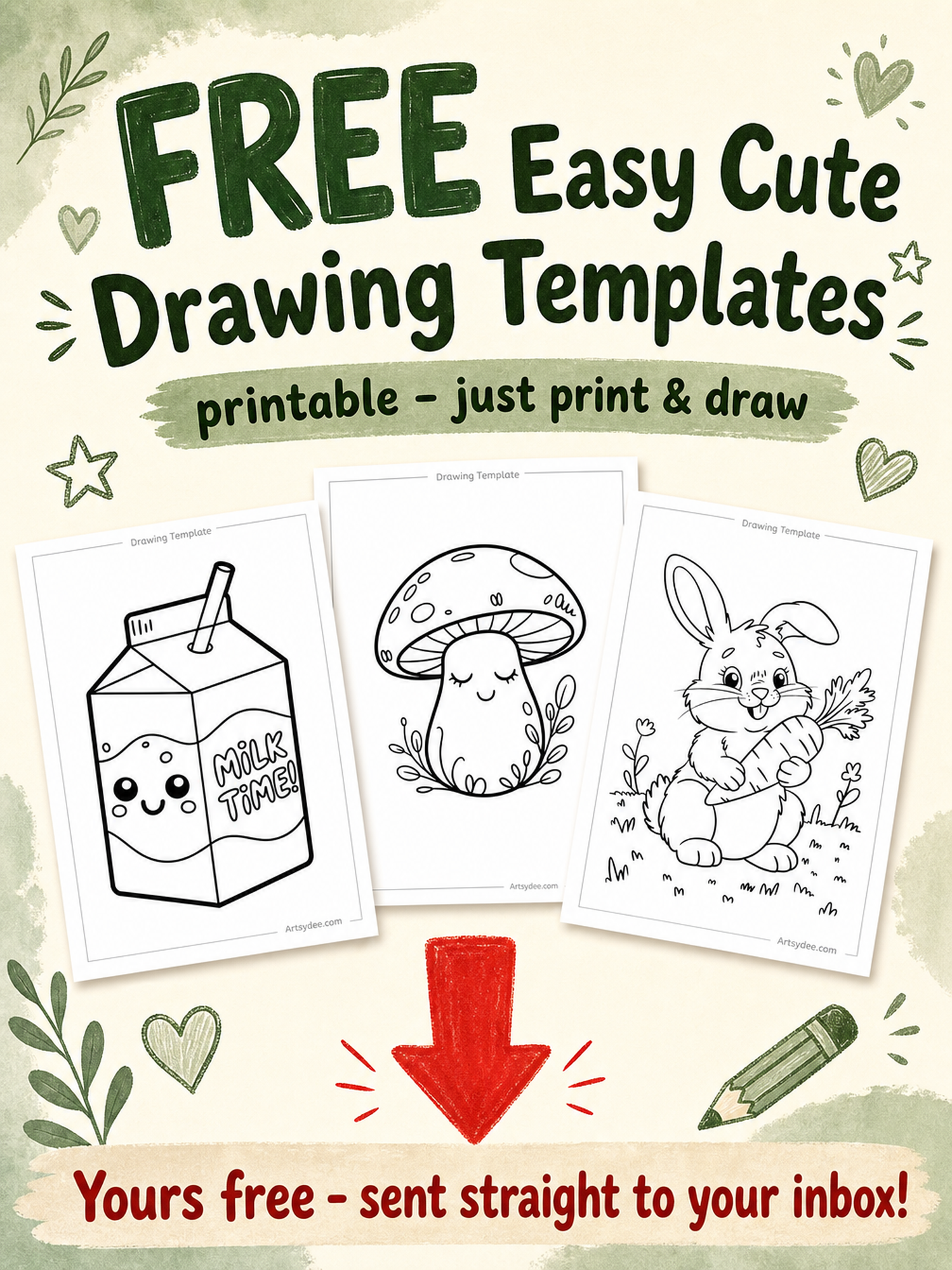
Here are easy drawing ideas for beginners, plus two free printables: Easy Cute Drawing Templates and Sketchbook Drawing Templates, sent to your inbox.
There’s something about a completely blank sketchbook page that can stop you cold. Even when you’re bursting with the desire to draw something, the moment you sit down with a pencil in hand, the ideas vanish. I’ve seen it happen with every single beginner student I’ve ever taught, and honestly? I’ve been there myself more times than I can count.
🎨 Grab your free printable in the box above — just pop your email in!
👉 Pop your email into the box near the top of this post and I’ll send these straight to your inbox — free!
The good news is that the blank page isn’t the problem — it’s just the absence of a starting point. Once you have a list of genuinely fun, genuinely doable drawing ideas in front of you, everything changes. You stop overthinking and start making marks. And making marks is where all the good stuff happens.
In this post I’ve gathered 20+ easy drawing ideas for beginners — subjects that are satisfying to draw, forgiving of imperfect technique, and actually enjoyable rather than just “educational.” I’ve also included some practical tips on supplies and how to actually improve over time. And because I know what it’s like to stare at a notebook wondering what on earth to put in it, I’ve got two free printable packs waiting for you.
🎬 Love video tutorials? Subscribe to my YouTube channel for weekly art inspiration and step-by-step drawing ideas!
Table of Contents
Free Sketchbook Prompt Templates
Looking for more creative resources? Visit my Payhip shop for premium Procreate stamp sets, drawing templates, and creative bundles to fuel your sketchbook practice!
Ideas flowing again? My shop has premium drawing template sets to keep the momentum going.
Browse the shop →Want 400+ Creative Resources?
If you love these free templates, come and join me on Patreon. It’s where my weekly watercolor template sets go out to members: printed outlines with painted references, so you can see where the color goes, plus Procreate stamps and palettes.
Easy Things to Draw for Absolute Beginners
Quick Answer: The easiest drawing ideas for beginners include simple flowers (daisies, sunflowers), basic shapes and patterns, cute animals (cats, owls, foxes), food items, and nature elements like leaves and mushrooms. Start with subjects that have simple, recognisable outlines and build from there.
When I was teaching art to beginners — teenagers, adults, absolute total non-artists who insisted they “couldn’t draw a straight line” — I always started them with the same question: what do you actually enjoy looking at? Because the best drawing subjects aren’t the ones I assign. They’re the ones you’ll happily practise ten times over without getting bored.
That said, here are six subjects I recommend to almost every beginner, because they’re genuinely forgiving and look impressive even with basic technique.
1. Daisies
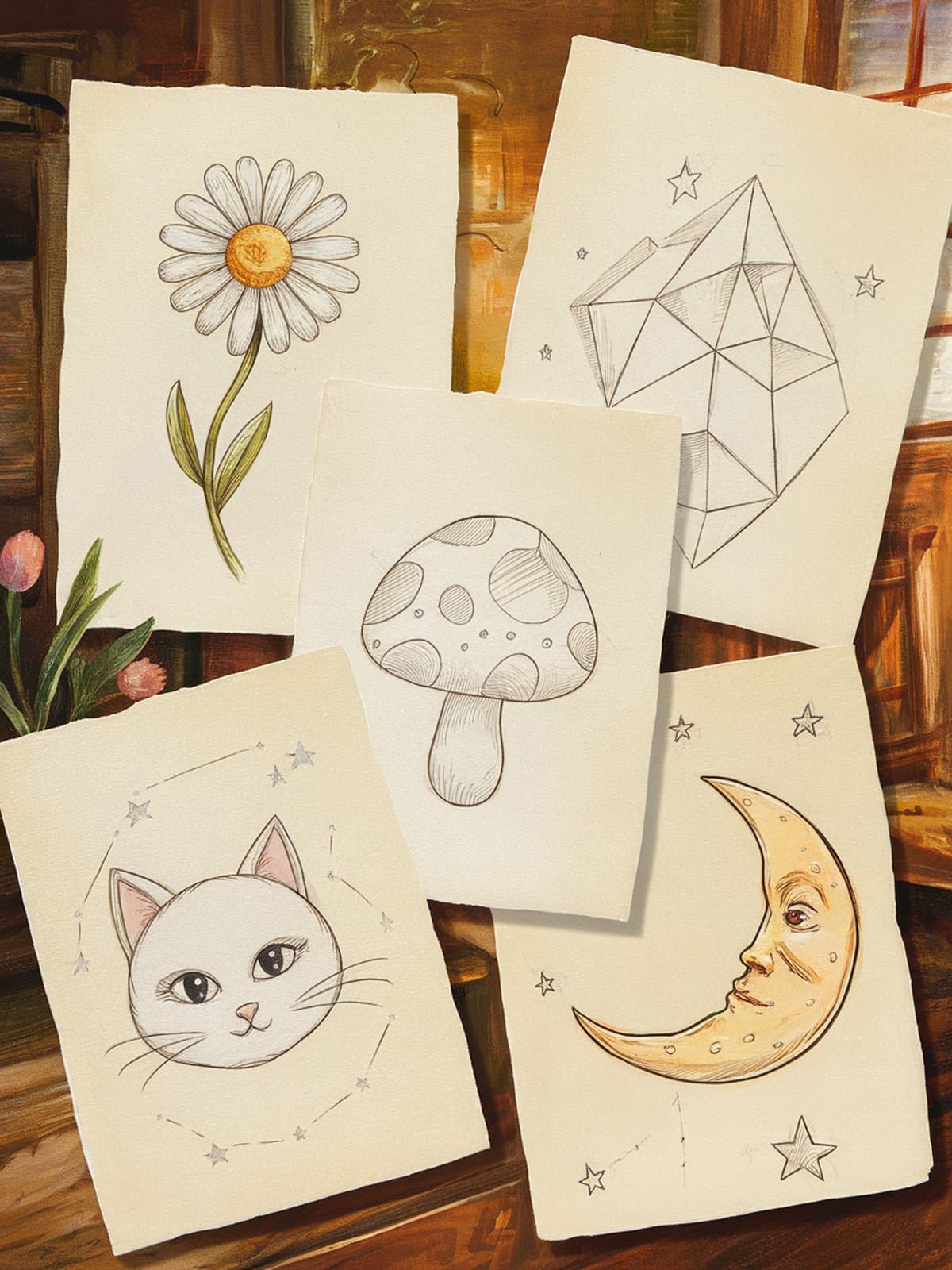
A daisy is just a circle surrounded by oval petals. That’s it. Once you can draw that, you can vary the petal count, add a stem, cluster several together, and suddenly you’ve got botanical art. Daisies are the gateway flower — easy to learn but beautiful enough to fill a whole sketchbook page.
2. Mushrooms
Mushrooms are one of my absolute favourite subjects for beginners. The classic domed cap plus a simple stalk is just two curved shapes. Then you can go wild — spots, gills, grass, tiny doorways. They’re fantastical enough to be interesting and simple enough that beginners feel genuinely pleased with the result. Check out my full mushroom drawing tutorial for step-by-step guidance.
3. Geometric Shapes and Patterns
Triangles, hexagons, diamonds — when you arrange geometric shapes into patterns, something magical happens. tangle-style doodle art and mandala-style drawing is built entirely on this principle. If your freehand lines aren’t perfectly straight yet, that’s actually fine — slight imperfections in geometric art look intentionally handmade.
4. Simple Cat Faces
A round head, two triangle ears, almond eyes, a tiny nose, and some whisker lines. A cat face is endlessly customisable — make it realistic, make it kawaii, make it grumpy or serene. It’s one of those drawing ideas that’s fast to do but creates something genuinely expressive. Great for filling up margins while you’re watching TV.
5. Crescent Moon and Stars
Stars are just two overlapping triangles, and a crescent moon is one circle overlapping another. Combine them into a composition and you have something that looks intentionally beautiful. Add some tiny clouds or a single shooting star and you’ve got a whole sky scene. This is a particularly good subject for anyone who feels nervous about realism — these stylised celestial shapes always look lovely.
6. Simple Houses
A square with a triangle on top. That’s literally all you need to start. From there you can add windows, a door, chimney smoke, a garden path, trees. Drawing simple houses and buildings is endlessly soothing and a brilliant way to practise straight lines and perspective without getting overwhelmed by complex theory.
Cute and Simple Drawing Ideas
There’s a whole genre of drawing that leans into sweetness — kawaii-style food, rounded animals, soft shapes with minimal detail. This style is enormously popular on sketchbook pages and social media, and it’s genuinely beginner-friendly because it prioritises charm over accuracy. Here are some of my favourite cute drawing ideas for beginners:
7. Kawaii Food
Give anything a tiny face and it becomes kawaii. A strawberry with dot eyes and a smile, a boba tea with rosy cheeks, a little slice of watermelon looking adorable. Check out my cute food drawings post for loads of ideas specifically in this style.
8. Clouds and Weather
Fluffy clouds are just overlapping circles along the top with a flat base. A rainy cloud with falling droplets, a lightning bolt, a sun peeking behind — weather drawings are simple, quick, and genuinely satisfying. They’re great for filling sketchbook corners or creating mood boards.
9. Simple Owls
An oval body, two large circle eyes, a small beak, and wing shapes on the sides — owls are one of those subjects that look complex but are actually built from very basic shapes. Add some branch lines underneath and some feather texture, and you’ve got something genuinely beautiful.
10. Snails
A snail shell is a lovely drawing exercise because it’s a spiral — and practising spirals is one of the best warm-up exercises for any artist. Draw a body underneath and two little antennae and you’ve got a complete little creature. They look particularly wonderful with some colour or pattern on the shell.
11. Balloons
Simple oval or teardrop shapes with a knot and string underneath. But group several together in different sizes and suddenly you’ve got a festive composition. Balloons are great for practising curves and for adding a pop of colour — they look lovely with light shading to show the rounded form.
12. Butterflies
Two large upper wings and two smaller lower wings, meeting at a thin body. The beauty of drawing butterflies is that you only need to do one half perfectly — the other can be mirrored. This makes them brilliant symmetry practice, and the wing patterns you add are entirely up to you. Simple dots and scalloped edges are all you need.
Nature Drawing Ideas for Beginners
Nature is the most endlessly generous source of drawing inspiration I know. It never runs out, it’s always slightly different, and it forgives imperfect proportions because real plants and leaves are charmingly inconsistent anyway. Here are some of the best nature drawing ideas for beginners:
13. Single Leaves
Pick up a leaf from outside (or a houseplant) and draw it from observation. You don’t need to get every vein exactly right — just capture the overall shape and a few details. Leaf drawing builds your eye for organic shapes faster than almost anything else, and it connects you to actually looking at the world around you, which is what being an artist is really about.
14. Sunflowers
Sunflowers have a big central seed head (which you can fill with dots or crosshatch pattern) surrounded by long, pointed petals. They’re bold and graphic, which means they look great even when the proportions aren’t perfect. Add a thick stem and a couple of leaves and you’ve got a proper botanical illustration vibe.
15. Cactus
The humble cactus is practically made for beginner drawers. Rounded tube shapes, a few spines, maybe a flower or two — it’s simple to construct and looks absolutely charming in a sketchbook. Desert plant drawings have been popular for a reason: they’re forgiving, versatile, and lovely in both simple pencil sketches and full-colour versions.
16. Simple Mountains
A few triangle shapes overlapping with some snow at the top and you have a mountain range. This is one of the most satisfying minimal drawings you can do — it looks intentional and clean, and once you add a moon or stars above, it becomes quite striking. Great for filling sketchbook spreads or practising composition.
17. Wheat and Grass
A cluster of wheat stalks or wild grass is brilliant drawing practice because it forces you to draw many similar-but-slightly-different shapes quickly. The looseness works in your favour — you don’t need perfect placement, just a natural flow. This is a wonderful way to practise quick gestural lines.
18. Pebbles and Stones
Arrange a handful of smooth pebbles on your desk and draw them. They’re essentially rounded organic shapes with some simple shading — but they teach you a huge amount about drawing form and how light hits a curved surface. Humble subject, excellent practice. And infinitely available if you go outside.
What Supplies Do You Need for Drawing?
The honest answer: less than you think. I’ve seen people produce breathtaking work with a biro and the back of an envelope. That said, having a few decent supplies does make the experience more enjoyable — and when things are enjoyable, you practise more, and that’s when you improve.
For a beginner, I’d suggest starting with: a set of decent pencils (HB, 2B, and 4B cover most needs), a fine-liner pen or two, and a good sketchbook. I love using the Canson XL Mixed Media Sketchbook for beginners — it handles pencil, ink, and even light watercolour washes without complaining, which means you can experiment freely without worrying about the paper buckling.
Here are some supplies worth having as you build your drawing practice:


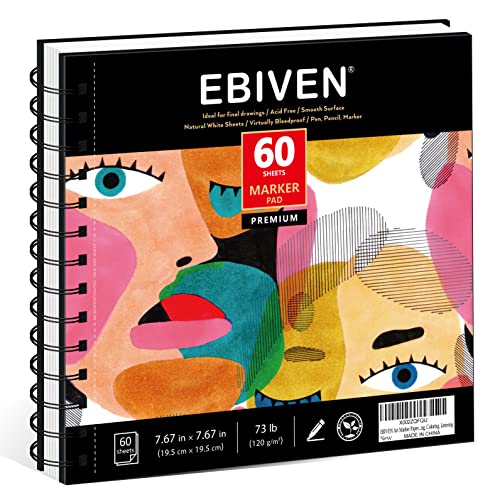
This post contains affiliate links, which means I may earn a small commission at no extra cost to you if you make a purchase. I only recommend products I genuinely love and use myself!
How to Actually Get Better at Drawing
This is the question I got asked more than any other when I was teaching. Students would show up with sketchbooks full of careful, tentative marks, worried that they weren’t “getting better fast enough.” And almost always, the answer was the same: you’re practising too carefully and not often enough.
Here’s what actually works:
Draw for 10 Minutes Every Day
Ten minutes daily beats two hours once a week, every single time. The brain builds drawing skills through repetition and frequency, not marathon sessions. Keep your sketchbook somewhere visible — on the kitchen table, beside the sofa — so it’s easy to pick up without any ceremony. There’s a reason I put together the 100 sketchbook prompts post — having prompts already written means you never waste that 10 minutes deciding what to draw.
Copy What You Like
Copying other artists’ work (for your own practice, not to sell or share publicly) is one of the most effective learning tools there is. Find an illustration you love — in a book, on Pinterest, in a magazine — and try to recreate it. You’ll figure out exactly how they achieved their lines and shapes in a way that reading about it never teaches. Don’t skip this step because it feels “unoriginal.” Every great artist learned this way.
Don’t Wait Until You’re “Ready”
There’s no such thing as being ready to start drawing. You start drawing, and that’s how you become a person who draws. The sketchbooks of famous artists are full of terrible, embarrassing pages — because every artist has terrible pages. The ones who improve are the ones who keep going anyway. For more ideas on what to put in your sketchbook, the sketch ideas for beginners post has plenty of starting points.
Embrace the Messy Page
A sketchbook is not a portfolio. It’s a thinking tool, a practise space, a place where you can work things out without pressure. Give yourself permission to fill pages with awful drawings. The awful drawings are not a failure — they are literally how improvement happens. Fill that page. Fill ten pages. Keep going.
Add Colour Gradually
When you feel ready to go beyond pencil and fine-liner, try adding light watercolour washes or coloured pencil on top of your drawings. Starting with colour as a secondary layer (rather than the main event) lets you build confidence with both materials at once. It’s particularly lovely with nature subjects — a simple leaf sketch looks stunning with a single wash of green over it.
Free Cute Drawing Templates
Here’s your second set of free printables — 30 cute drawing templates you can trace, copy, or use as inspiration for your own drawings. They’re a brilliant way to build confidence before you start drawing completely freehand.
Frequently Asked Questions About Drawing for Beginners
What should a beginner draw first?
Start with simple geometric shapes and build from there. Circles become fruits, faces, and flowers. Rectangles become buildings and books. Once you’re comfortable with basic shapes, move on to simple nature subjects like leaves, mushrooms, and daisies — they’re forgiving and look impressive even with basic technique.
How do I get ideas for drawing?
Keep a running list in your sketchbook of things that catch your eye — a coffee cup, a plant on your windowsill, a quote you love. You can also use drawing prompt cards (like the free ones in this post!) to remove the “what should I draw today” paralysis entirely. The 50 sketchbook prompt templates above are designed specifically for this.
How long does it take to get good at drawing?
Better question: how long before drawing becomes enjoyable? Usually just a few weeks of regular practice. Don’t aim for perfect — aim for interesting. Drawing 10 minutes a day is more valuable than one three-hour session a week. Most beginners notice a genuine shift in their confidence and ability within about 6-8 weeks of consistent daily practice.
Do I need expensive supplies to start drawing?
Absolutely not. A standard HB pencil and any paper will do. As you get more confident, you might enjoy a decent sketchbook and a few coloured pencils or fine-liner pens — but expensive supplies won’t make you a better artist faster. I’ve taught students who produced stunning work with supermarket stationery. Tools are nice, but they’re not the reason people improve.
What are the easiest things to draw for beginners?
The easiest things to draw are subjects made from simple, recognisable shapes: daisies, mushrooms, crescent moons, simple cat faces, leaves, and geometric patterns. These subjects are forgiving of imperfect technique and look charming even when they’re not perfectly accurate. The key is to choose something you actually enjoy drawing — that’s what keeps you coming back to practise.
Final Thoughts
The most important thing I can tell you as a beginner drawer is this: you don’t need permission to start. You don’t need to be “talented.” You don’t need special supplies or a dedicated art space. You need a pencil, something to draw on, and the willingness to make marks without worrying too much about what they look like.
Use the ideas in this post as starting points. Grab the free prompt templates and let them take the pressure off choosing what to draw. Fill the pages. Draw the things that interest you, not the things you think you “should” practise. And give yourself permission to have a sketchbook full of imperfect, joyful, genuinely yours drawings.
If you’d love to see drawing ideas in action, come and visit my YouTube channel — I share weekly art inspiration and step-by-step tutorials that are designed specifically for beginners and people who want to build a relaxed, enjoyable creative practice.
Share your sketchbook pages on Pinterest — I love seeing what beginners create! And for weekly drawing tutorials, head over to my YouTube channel and hit subscribe.
You Might Also Like
📌 Pin this for later!
Once the free prompts have got you making marks, the trick is never running dry again. My Payhip shop has premium template sets, Procreate brushes and bundles ready to print whenever the blank page starts staring back.
Have a browse →