Last Updated on October 13, 2026 by Dee
Here are 35+ beautiful flower drawing ideas for every skill level, from simple doodles to detailed botanicals, plus free hand-drawn flower templates.
Flowers are one of those subjects that work no matter what skill level you’re at. Beginners love them because the shapes are forgiving — a slightly lopsided petal just looks more natural, not wrong. And for more experienced artists, there’s always another layer of detail to explore, another way to simplify or complicate the form. Drawing ideas flowers come in endless variety, from a simple five-petal daisy you can sketch in two minutes to an intricate Tudor rose that takes an afternoon.
Whether you’re filling a sketchbook page, looking for something relaxing to draw on a quiet evening, or trying to get better at botanical illustration, flowers are genuinely the best place to start — and to return to again and again. I’ve been drawing them for years and I still reach for flowers when I want a warm-up, when I’m stuck creatively, or when I just want to make something beautiful without overthinking it.
In this post I’ve gathered 35+ flower drawing ideas across every style and skill level — simple doodles, detailed botanicals, mandalas, tropical blooms, and everything in between. I’ve also included a step-by-step rose tutorial that matches the infographic further down the page.
🎬 Love watching art tutorials? Subscribe to my YouTube channel for weekly drawing and watercolour inspiration!
Table of Contents
Free Flower Drawing Templates
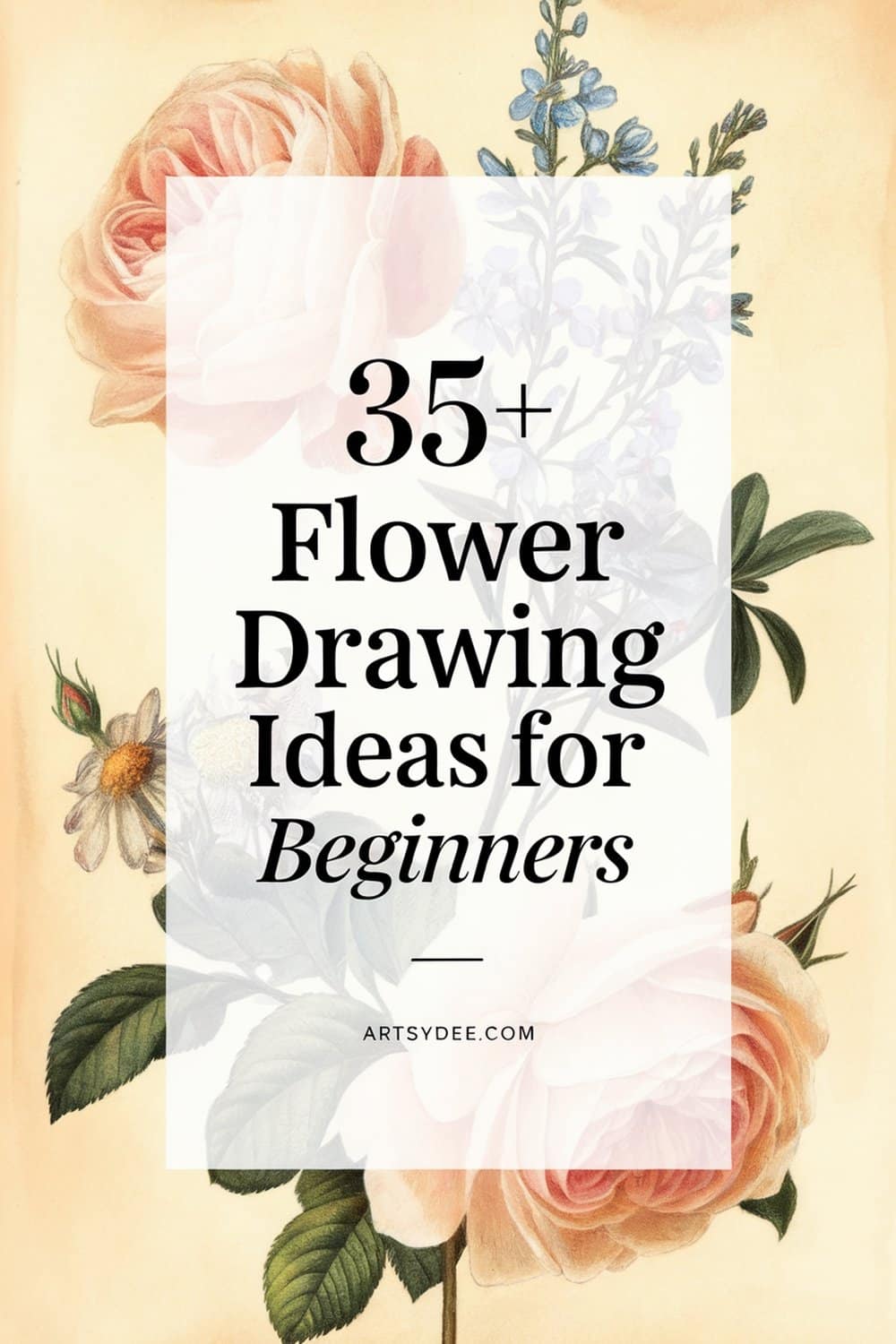
Before we get into all those beautiful flower drawing ideas, grab your first free printable! This pack of 20 flower drawing templates gives you simple outlines to trace and practise with — perfect for building confidence before drawing from scratch.
Traced the free flower templates already? There are fuller printable drawing packs waiting in my shop.
Browse the printable shop →Want 400+ Creative Resources?
If you love these free printables, come and join me on Patreon. It’s where my weekly watercolor template sets go out to members: printed outlines with painted references, so you can see where the color goes, plus Procreate stamps and palettes.
Simple Flower Drawing Ideas for Beginners
Quick Answer: The easiest flower drawing ideas for beginners use basic shapes — circles, ovals, and simple petal outlines. Start with daisies, five-petal flowers, and tulip silhouettes before moving on to more complex blooms like roses.
These are your go-to ideas when you want something achievable, satisfying, and genuinely pretty. None of these require any drawing experience — just a pencil and willingness to try.
- Classic five-petal flower — Draw a circle in the centre, then add five rounded petals radiating outward. Add a stem and a couple of leaves. Done. This is the foundational flower every artist starts with.
- Simple daisy — Elongated oval petals around a large central circle. Works beautifully in both pencil and pen.
- Tulip silhouette — Three curved lines coming to a point, sitting on a gentle S-curve stem. Elegant and very beginner-friendly.
- Cartoon sunflower — Circle centre with oval petals, alternating sizes. Add a happy face or leave it plain.
- Tiny wildflower cluster — Small four-petal flowers scattered in a little grouping. Looks gorgeous as a corner doodle or filling empty space on a sketchbook page.
- Simple poppy — Four large, slightly crinkled petals with a dark centre. The irregular petal edges make it forgiving and charming.
- Baby’s breath sprigs — Clusters of tiny dots on branching stems. Incredibly simple, adds so much delicacy to any flower drawing.
- Lily of the valley — A curved stem with small bell shapes hanging off it. Beginner-friendly and sweet.
Rose Drawing Ideas (From Beginner to Advanced)
Quick Answer: Roses can be drawn at any skill level — start with a simple spiral method for beginners, progress to layered petal techniques, then try full botanical rose studies with leaves, thorns, and shading for a real challenge.
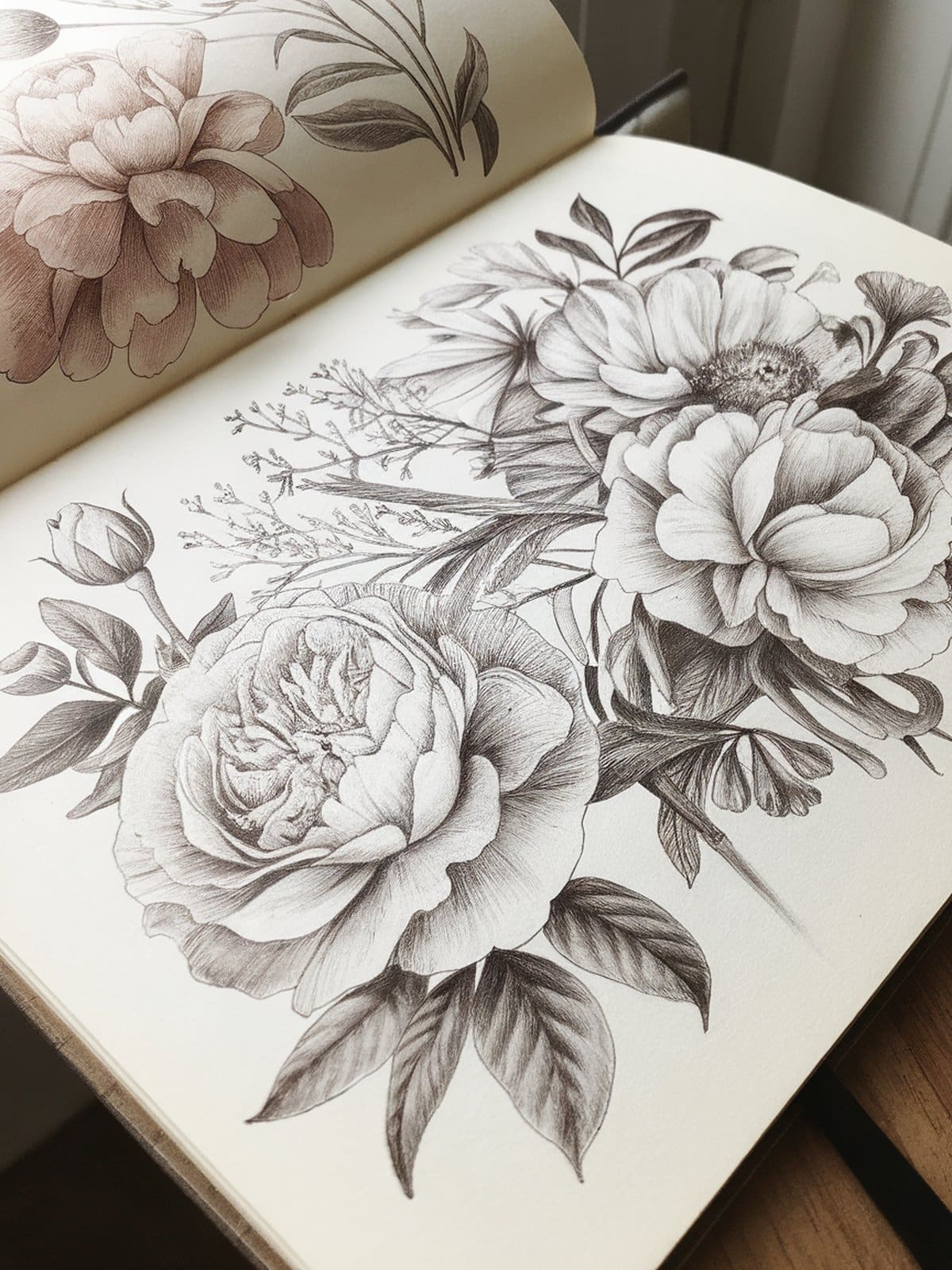
Roses have a reputation for being difficult. They really aren’t — once you understand that a rose is basically a tight spiral with petals wrapping around it, the whole thing clicks. Try these ideas at whatever level feels right:
- Spiral rose (beginner) — Start with a loose spiral, then draw curved petals wrapping around the outside. This is the easiest rose method and it genuinely looks good.
- Side-view rose bud — Draw a small teardrop shape for the bud, then add sepals at the base and a stem. Lovely and simple.
- Open-faced garden rose — Multiple rows of gently cupped petals radiating from a ruffled centre. Work from the inside outward.
- Cottagecore climbing rose — A looping branch with multiple roses at different stages — bud, half-open, fully open. Perfect for border designs.
- Botanical rose study — Full front-facing rose with detailed petals, thorned stem, and serrated leaves. Add pencil shading for depth.
- Rose in a teacup — A single rose or small bouquet sitting in a vintage teacup. Charming, popular, and very giftable as a card drawing.
- Geometric rose — Use straight lines and angles to create an angular, stylised rose. Looks striking in black pen.
- Dotwork rose — Build up the shading using tiny dots instead of hatching. Time-consuming but beautiful results.
Sunflower and Daisy Drawing Ideas
Sunflowers and daisies are joyful, graphic flowers — their bold shapes work well at any size and in any medium. They’re also brilliant for practicing petal patterns and centres.
- Classic sunflower head — Large oval centre (fill it with tiny circles or a honeycomb pattern), surrounded by long pointed petals in two alternating layers.
- Mini sunflower doodles — Tiny simplified sunflowers scattered across a page. Great for sketchbook fillers and journal embellishments.
- Sunflower field scene — Multiple sunflowers at different heights and angles, suggesting a field receding into the distance.
- Daisy chain border — Linked daisy flowers forming a decorative border or wreath. Works beautifully around lettering or as a page header.
- Michaelmas daisy cluster — Loose grouping of smaller daisies with thin petals. The asymmetry is the point — don’t try to make them perfect.
- Gerbera daisy — Wider, more structured than a field daisy, with multiple rings of petals. Great for practising layered petal techniques.
- Sunflower seed head close-up — Just the centre of a sunflower, filling the whole page. The spiral pattern of seeds is a fascinating drawing challenge.
Wildflower and Meadow Drawing Ideas
Wildflowers have an organic looseness to them that makes them forgiving and freeing to draw. Imperfection is the aesthetic — which is brilliant news for anyone who worries about getting things exactly right.
- Loose meadow bouquet — An informal gathering of different wildflowers — cornflowers, poppies, ox-eye daisies, grasses — tied with a simple ribbon or string.
- Single stem cornflower — Distinctive spiky, almost thistle-like petals radiating from a button centre. Strikingly graphic in blue if you add colour.
- Foxglove spire — Tall stem with trumpet-shaped flowers graduating in size from bottom to top. Draw the spotted interiors for extra detail.
- Cow parsley / Queen Anne’s Lace — Delicate umbrella-shaped clusters of tiny flowers on branching stems. Intricate but very achievable with fine liner pen.
- Wild garlic in bloom — Star-shaped white flowers on tall thin stems. Simple, clean, beautiful.
- Thistle head — Spiky bracts surrounding a fluffy purple top. Unexpectedly gorgeous to draw and very distinctive.
- Meadow grass with seed heads — Tall grasses with decorative seed heads mixed in with small flowers. Adds lovely texture to any botanical drawing.
- Pressed flower botanical page — Draw flowers as though they’ve been pressed flat — from directly above, showing the whole flower spread out. A lovely stylised treatment.
Tropical and Exotic Flower Drawing Ideas
If you want to stretch your skills and draw something a bit unexpected, tropical flowers offer incredible variety — dramatic shapes, interesting symmetry, and a real challenge in getting the structure right.
- Bird of paradise flower — The striking orange and blue petals that look like a tropical bird’s head. Very graphic and rewarding to draw.
- Hibiscus bloom — Large, wide-open petals with a prominent stamen column. Great for practising flowing petal edges and overlapping shapes.
- Anthurium — A single waxy heart-shaped spathe with a prominent spadix. Simple but very striking in silhouette.
- Protea flower — A dramatic globe of pointed petals. The layering is complex but the overall shape is satisfying and unusual.
- Orchid study — Three outer sepals, two petals, and the distinctive lip. Draw a single orchid bloom from the front — it’s more achievable than it looks.
- Lotus flower — Pointed oval petals layering from a flat base. Often drawn in a slightly simplified style — works beautifully in line art.
- Heliconia — Bold, boat-shaped bracts in alternating red and yellow. Very geometric and striking as a drawing subject.
Botanical Line Art and Illustrations
Botanical illustration is its own world — precise, detailed, and genuinely beautiful. You don’t need to be aiming for a natural history museum publication to enjoy this style. Even a loosely botanical approach to drawing flowers produces something special.
- Single stem botanical study — One flower with its complete stem, leaves, and if possible, a bud at a different stage. Draw it as accurately as you can from observation or reference.
- Leaf and petal detail sheet — Fill a page with studies of individual parts — one petal, a cross-section of a bud, leaf vein patterns, a single stamen. Hugely educational and beautiful as a page.
- Black ink botanical wreath — A circular arrangement of different flowers and leaves drawn in black fine liner. Timeless and beautiful as wall art.
- Minimalist line flower — A flower reduced to its simplest continuous line drawing. Try it in one single unbroken line.
- Botanical alphabet — Draw each letter of the alphabet as a flower or plant. Long-term project that’s a lovely sketchbook series.
- Negative space flower — Instead of drawing the flower, draw everything around it — the background shapes — leaving the flower as white space.
- Cross-section flower diagram — Cut through a flower head and draw what you see — the pistil, stamens, ovary. Scientific-meets-artistic.
Mandala and Doodle flowers Designs
Mandala flowers combine the repetition of geometric pattern with organic floral forms — the result is meditative to draw and striking to look at. You don’t need a compass or ruler; approximate symmetry is part of the charm.
- Simple 8-petal mandala flower — Draw a circle, divide it into 8 segments, and place one petal shape in each segment. Fill the centre with a smaller concentric circle and add detail patterns to the petals.
- Sunflower mandala — Use the natural spiralling pattern of sunflower seeds as the starting point for a mandala design.
- Lotus mandala — Multiple rings of lotus petals radiating outward, each row slightly larger. Works beautifully in pencil shading.
- Doodle flowers tile — Fill each petal of a simple flower with a different tangle-style doodle art pattern — dots, lines, curves, crosshatching.
- Snowflake flower hybrid — Combine the six-fold symmetry of a snowflake with floral petal shapes. Very geometric but organically beautiful.
- Circular botanical wreath mandala — Draw a symmetrical arrangement of flowers and leaves that forms a complete circular mandala shape.
How to Draw a Simple Rose Step by Step
Quick Answer: To draw a simple rose, start with a small spiral for the centre, then add curved petals wrapping around it, working outward. Add sepals at the base, a stem, and leaves to complete the drawing.
Here’s the method I teach beginners — it works every time. The infographic below shows the full process visually, but the steps are:
- Draw a small circle and an oval — The circle will become the centre of the rose, the oval guides the overall flower shape. Keep both loose and light.
- Add a spiral inside the circle — A loose, open spiral, not too tight. This is the very heart of the rose, the part that curls in the centre.
- Wrap the first petals around the spiral — Three curved lines forming cup shapes that wrap around the spiral. Think of each petal as a gentle C or U shape.
- Add more petals working outward — Each row of petals is slightly larger and more open than the one inside it. Aim for 3-5 petals per row, slightly overlapping.
- Add the stem and leaves — A gentle curving stem beneath the flower. Add 2-3 simple oval leaves with a central vein. Optionally add a thorn or two.
- Refine and shade — Erase any guidelines. Darken the lines you want to keep. Add shading inside the petals at the inner edges where shadow would naturally fall.
Want more step-by-step sketchbook practice? My sketch ideas for beginners post has loads more to work through, and if you’re looking to develop a proper daily drawing practice, check out my 100 sketchbook prompts for a year’s worth of ideas.
Best Drawing Tools for Flower Sketches
You genuinely don’t need much to draw beautiful flowers — a basic pencil and a piece of paper is enough to get started. But having the right tools does make the process more enjoyable and the results more satisfying. Here are my honest recommendations:
For pencil work, I reach for a set that includes a range of hardness — an HB or 2H for initial sketching and guidelines, and a 2B or 4B for darker lines and shading. A good drawing pencil set makes the process of building up tonal values much easier than working with just one pencil.
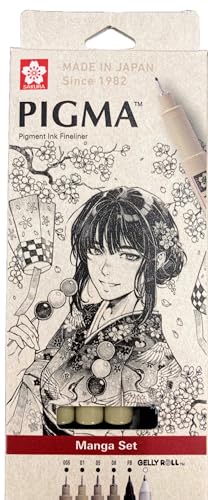
For ink and line art, fine liner pens (0.1mm to 0.5mm) are brilliant. Micron pens are a long-standing favourite — they’re waterproof, consistent, and come in the full range of nib sizes you need for detailed botanical work.
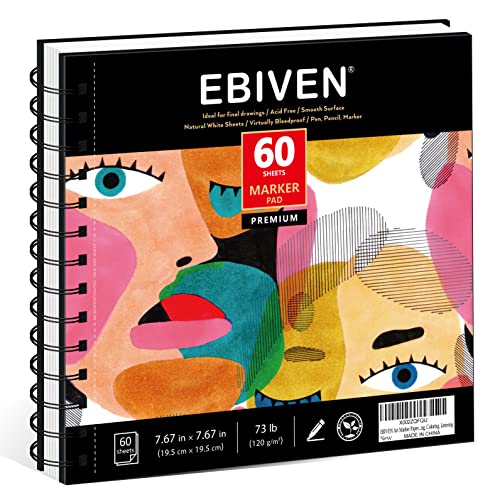
For paper, a good sketchbook with smooth cartridge paper is ideal for pencil drawing — it’s worth picking one with thick enough pages (at least 90gsm) so that your erasing doesn’t damage the surface. If you’re planning on adding ink or watercolor to your flower sketches, look for a mixed media sketchbook.

This post contains affiliate links, which means I may earn a small commission at no extra cost to you if you make a purchase. I only recommend products I genuinely love and use myself!
Looking for more digital resources to go alongside your drawing practice? My Payhip shop has templates and printable guides designed specifically for artists at every level.
Beginner Tips for Drawing Flowers
Quick Answer: The most important beginner tips for drawing flowers are: draw lightly at first, use reference photos, break complex flowers into simple shapes, and practise individual elements (petals, leaves, centres) separately before putting them together.
A few things that make a real difference when you’re starting out:
- Draw lightly first. Make your initial lines very light so you can erase and adjust without leaving marks. Commit to darker lines only once you’re happy with the shape.
- Use reference. Drawing from a photo or a real flower is not cheating — it’s how professional botanical illustrators work. Reference helps you understand the actual structure of the flower rather than guessing.
- Break it down into shapes. Before you draw a single petal, see the whole flower as a collection of basic shapes — circles, ovals, curved triangles. Sketch those first, then refine.
- Practise individual elements. Fill a page with just petals. Or just leaves. Or just flower centres. This targeted practice builds muscle memory much faster than drawing whole flowers repeatedly.
- Embrace imperfection. Real flowers aren’t symmetrical. Your drawing doesn’t need to be either. Slightly uneven petals often look more natural and lively than mathematically perfect ones.
- Work in layers. Light sketch, refine, ink or darken, shade. Don’t try to do everything in one pass.
- Draw small before you draw big. Thumbnail-sized flower sketches are much less intimidating than full-page versions. Get the proportions right small, then scale up.
If you’re looking for more beginner-friendly drawing resources, my sketch ideas for beginners post walks through some great starting points, and cute food drawings is another lovely gentle topic to practise your line control with.
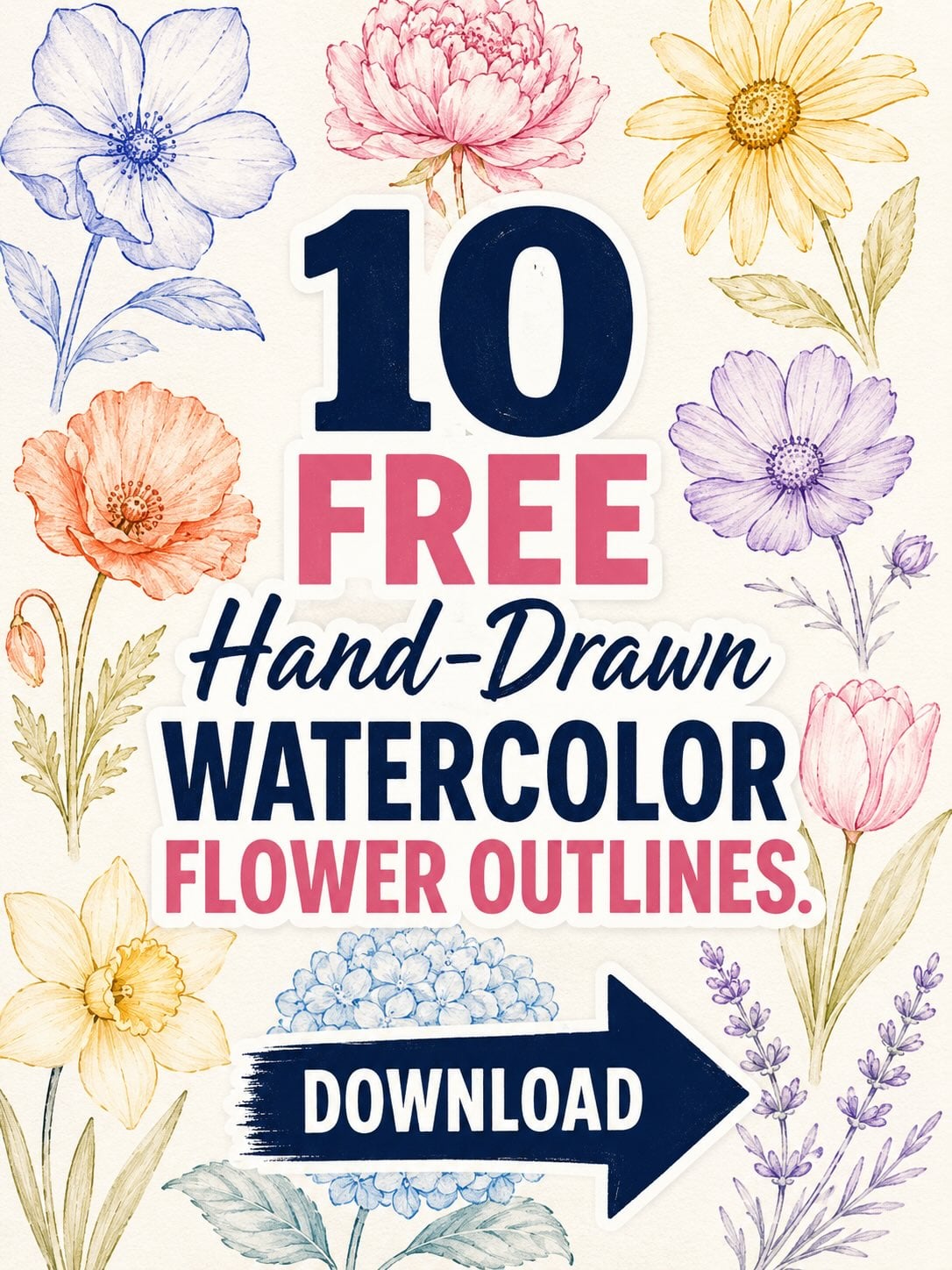
Free Hand-Drawn Flower Watercolor Templates
Frequently Asked Questions
What is the easiest flower to draw for beginners?
The easiest flower for beginners is a simple five-petal flower — draw a circle in the centre and add five rounded petals evenly spaced around it. Daisies and tulip silhouettes are also very beginner-friendly because their shapes are clear and forgiving. Avoid roses and orchids until you’re comfortable with basic petal shapes.
How do I draw flowers that look realistic?
To draw flowers that look realistic, always work from reference — either a real flower or a detailed photograph. Look for how petals overlap, how the centre connects to the outer petals, and where shadows naturally fall. Drawing lightly at first and building up layers of tone gives you the most control over the finished result.
What drawing tools are best for flower sketches?
For pencil sketching, a range of hardness (HB, 2B, 4B) works well — lighter pencils for initial sketches, darker ones for shading. For ink illustration, fine liner pens (0.1mm to 0.5mm) give you precision for detail work. A good quality sketchbook with slightly textured paper makes both techniques look better.
How do I draw a rose step by step?
To draw a rose step by step: start with a small spiral for the centre, wrap curved petals around it working outward in rows, add sepals at the base, then a stem and leaves. The key is to see each petal as a curved cup shape, not a flat shape — this gives the rose its dimensional quality. The infographic in this post shows the full process in six steps.
Can I draw flowers even if I have no art experience?
Absolutely — flowers are one of the most beginner-friendly drawing subjects because their natural irregularity means small imperfections look intentional. Start with simple five-petal flowers and daisies, use reference images, and draw lightly so you can make adjustments easily. Most people are surprised how quickly they improve with just a little consistent practice.
Final Thoughts
Flowers really are endlessly drawable — there’s something here for every mood, every skill level, and every amount of time you have. Thirty seconds for a tiny daisy doodle in the margin of your notebook. An afternoon for a detailed botanical rose study. Whatever you reach for, just start. The pencil on the paper is always the hardest part.
Don’t forget your free printables above — the 20 Flower Drawing Templates pack gives you simple outlines to practise with, and the 30 Cute Doodle Templates are brilliant for building line confidence and getting comfortable with the drawing process.
Want to see more drawing tutorials and sketchbook ideas? Find me on Pinterest for more ideas to save and come back to. And for video tutorials, subscribe to my YouTube channel — new art content every week!
You Might Also Like
- Sketch Ideas for Beginners — Getting Started with Sketchbook Drawing
- 100 Sketchbook Prompts to Fill Your Pages This Year
- Cute Food Drawings — Easy Ideas to Try in Your Sketchbook
- Mushroom Drawing Ideas for Your Sketchbook
- Loose Watercolour Flowers — Painting Floral Ideas for Beginners
Pin this for later!
The free flower templates give you simple outlines to build confidence before drawing from life. When you’re ready for more pages, my shop has bigger printable drawing packs — instant download, yours to print forever.
See the printable packs →