Last Updated on February 12, 2026 by Dee
There’s something incredibly satisfying about a pen sketch. No erasing, no going back — just you, a pen, and whatever ends up on the page. It’s raw, it’s honest, and honestly? Some of my favourite sketchbook pages started with nothing more than a cheap ballpoint and a “let’s see what happens” attitude.
If you’ve been staring at a blank page wondering what to draw with your pens, I’ve got you covered. This post is packed with over 45 pen sketch ideas that work for fineliners, ballpoint pens, brush pens, and everything in between. Whether you want to practice hatching, try some urban sketching, or just fill a page with satisfying ink patterns, there’s something here for you.
And because I know the best creative sessions are the ones where someone else does the thinking for you, I’ve put together TWO free printable packs — grab your free Pen Sketch Reference Sheets right after the table of contents below, and keep scrolling for an Ink Techniques Practice Pack further down the page!
🎬 Love video tutorials? Subscribe to my YouTube channel for weekly art tutorials and sketchbook inspiration!
Table of Contents
Free Pen Sketch Reference Sheets
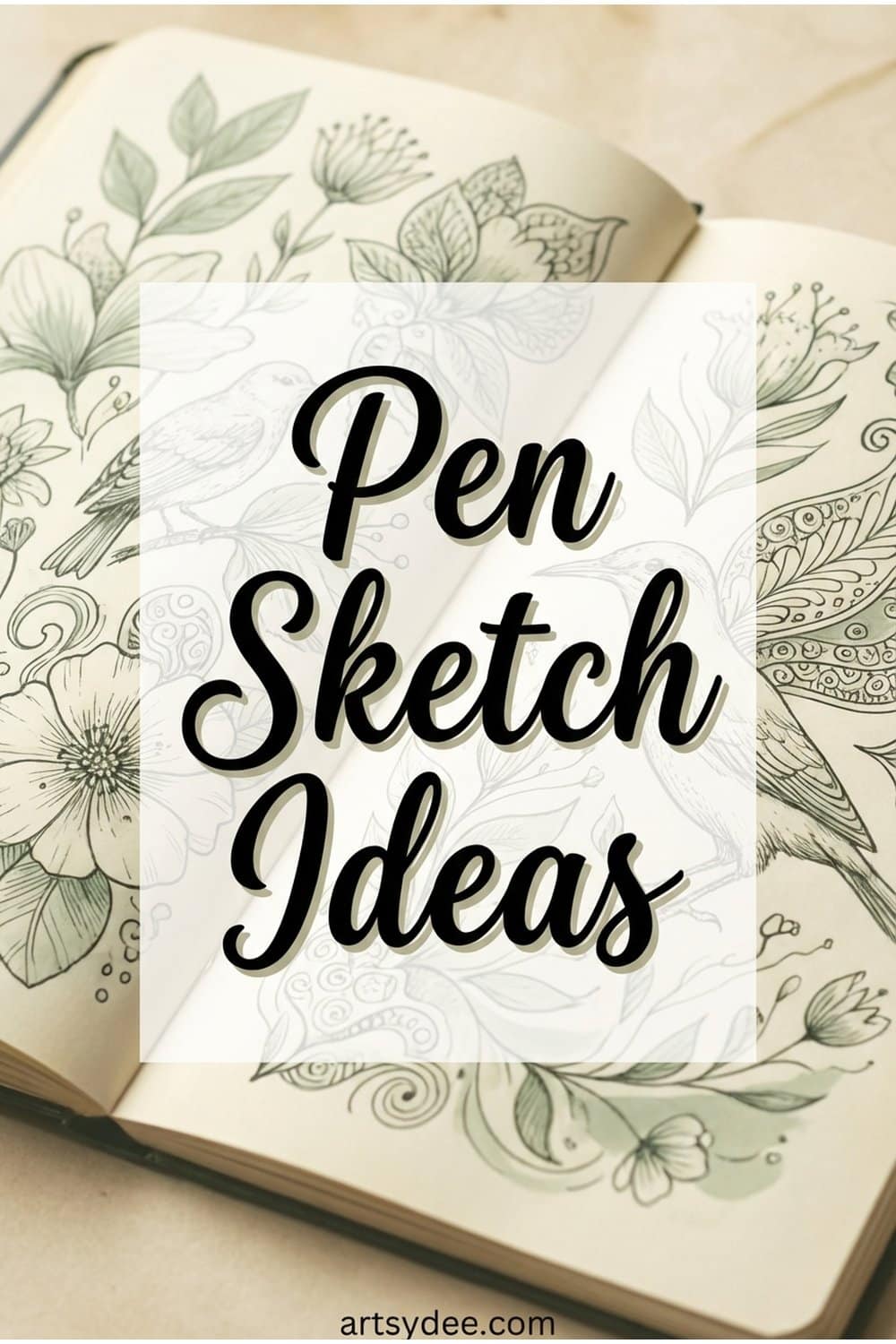
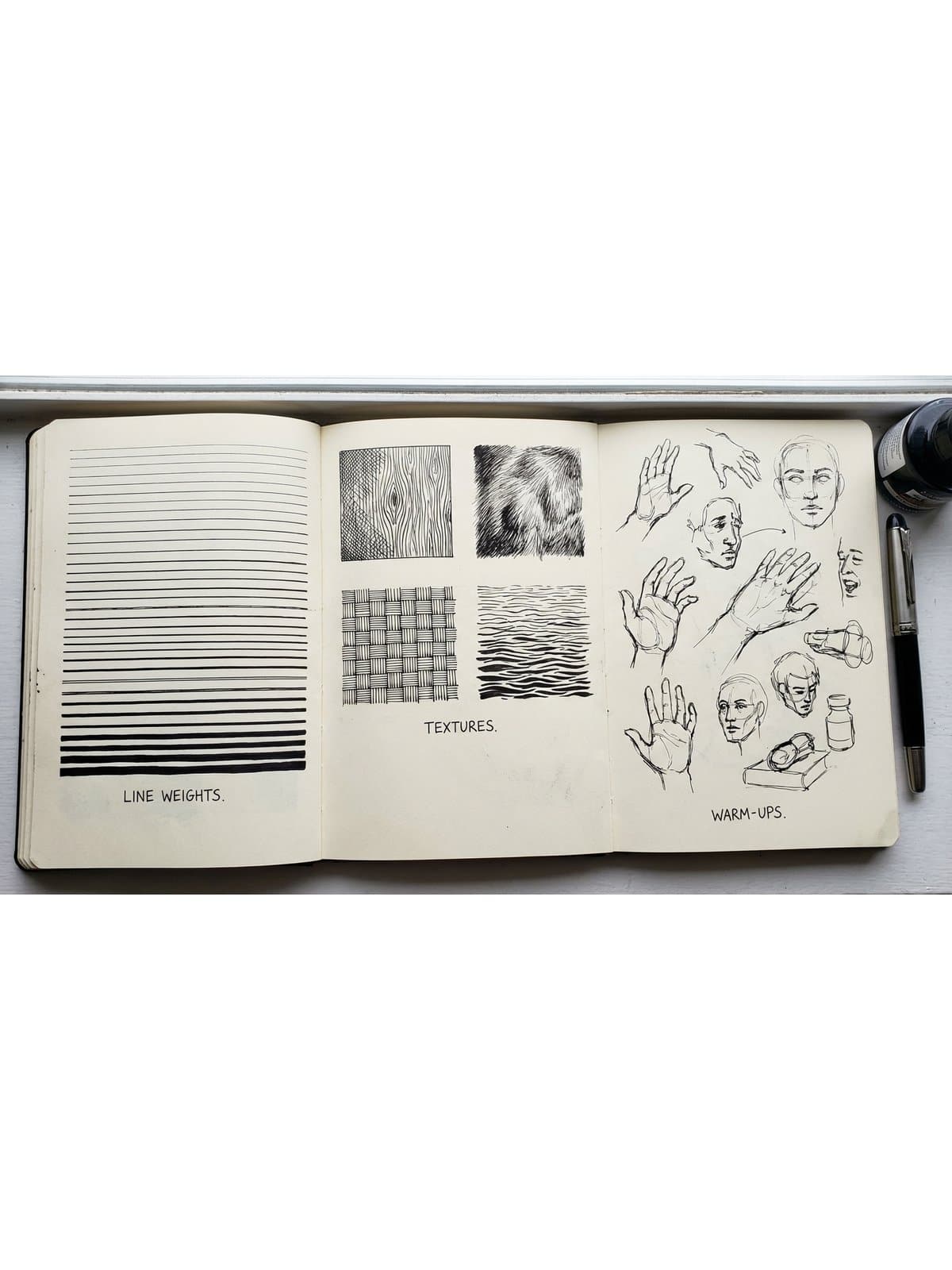
Before we get into all the ideas, here’s a printable set of pen sketch reference sheets you can keep in your sketchbook. They’ve got visual examples of different ink techniques plus composition ideas you can flip to whenever you’re stuck.
Choosing the Right Pen for Sketching
Quick Answer: The best pen for sketching depends on the effect you want — fineliners give crisp consistent lines, ballpoint pens create beautiful tonal gradients, and brush pens add expressive thick-to-thin variation.
You don’t need fancy pens to make gorgeous ink drawings. Seriously. Some of the best pen sketches I’ve seen were done with the free pen from a hotel nightstand. That said, knowing what each pen type does well can help you choose the right tool for your pen sketch ideas.
Fineliners
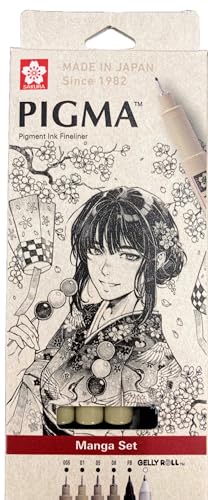
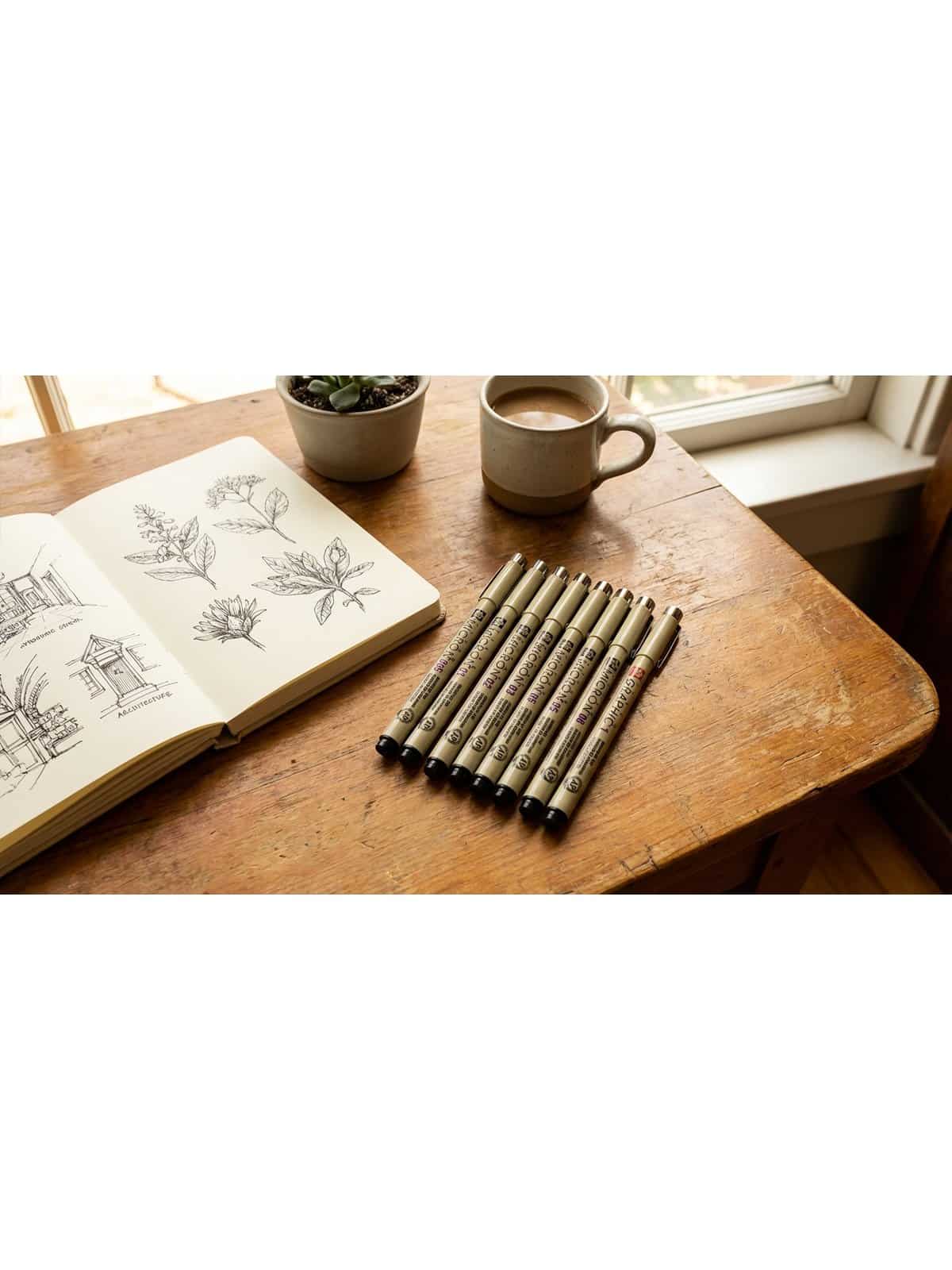
Fineliners like the Sakura Pigma Micron set are the workhorses of pen sketching. They come in different nib sizes (from 005 all the way up to 08) and lay down a consistent, archival-quality line that won’t bleed or fade. They’re perfect for hatching, crosshatching, and detailed line work. If you’re new to pen sketching, a set of Microns is honestly the best place to start.
Ballpoint Pens
Don’t underestimate the humble ballpoint. Unlike fineliners that give you a consistent line weight, ballpoint pens let you build up tone gradually. Light pressure gives pale, delicate marks. Heavy pressure gives deep, rich darks. This makes ballpoint pens brilliant for realistic shading and portraiture — and you probably already have one sitting on your desk.
Brush Pens
Brush pens are where things get expressive. The flexible tip responds to pressure, giving you thick-to-thin line variation in a single stroke. They’re fantastic for gesture drawings, loose botanical sketches, and anything where you want that calligraphic energy. The Faber-Castell PITT Artist Pens are a solid choice if you want to try a brush pen alongside fineliners in one set.
If you want more ideas for getting started with drawing, check out my post on sketch ideas for beginners — it covers pencil and pen approaches that work for any skill level.
Essential Ink Techniques Every Sketcher Should Know
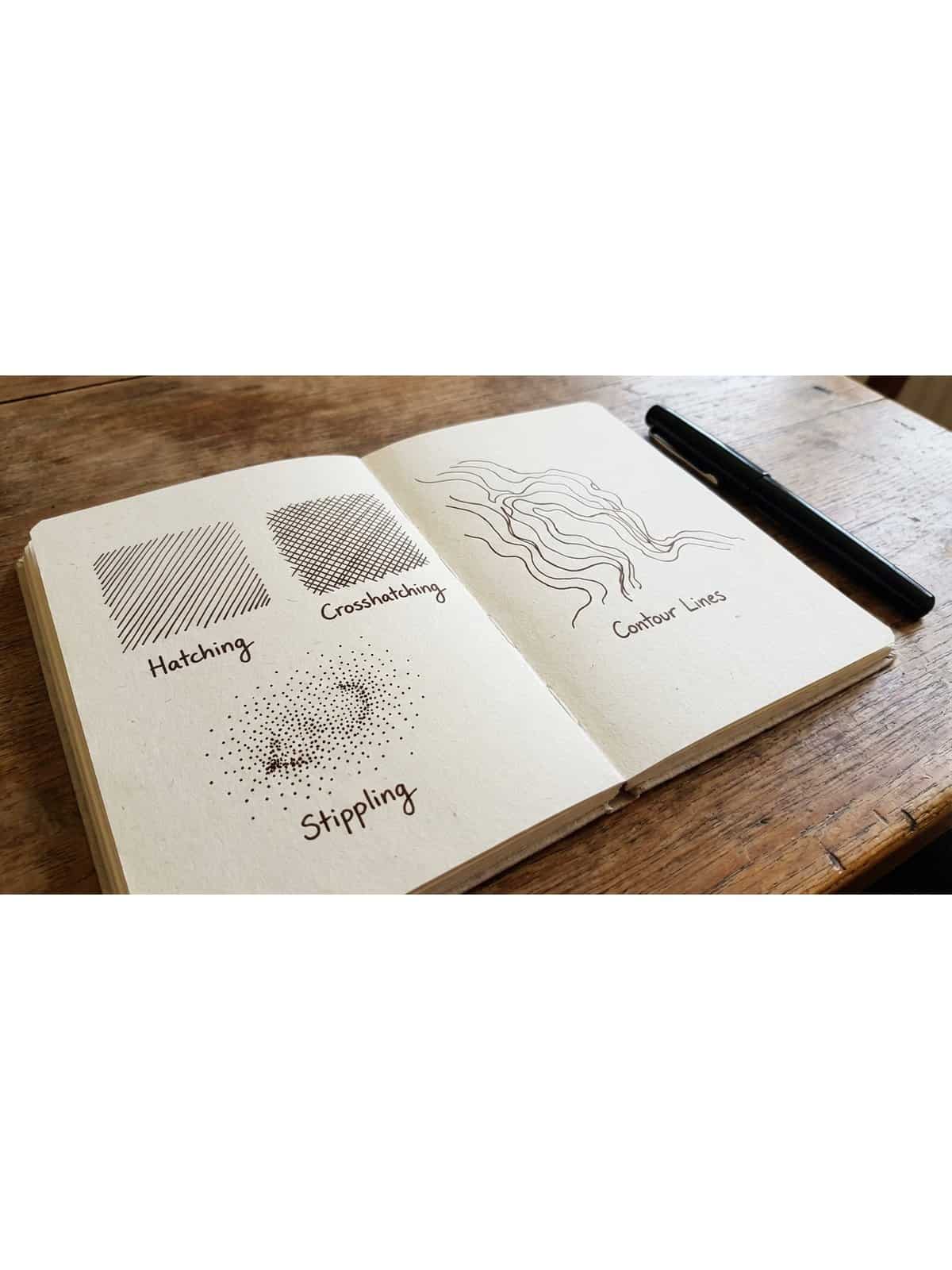
Quick Answer: The four fundamental ink techniques are hatching (parallel lines), crosshatching (overlapping lines at angles), stippling (dots), and contour drawing (following the form’s edges). Mastering these gives you complete control over value and texture in pen drawings.
Before jumping into specific pen sketch ideas, it helps to have a few techniques in your back pocket. These are the building blocks of every great ink drawing, and once you get comfortable with them, you can combine and adapt them for any subject.
Hatching
Hatching is the simplest ink technique — just parallel lines drawn close together. The closer the lines, the darker the area appears. The further apart, the lighter. It’s straightforward but incredibly effective for creating smooth tonal transitions. Try varying the spacing gradually across a shape to see how it creates the illusion of rounded form.
Crosshatching
Crosshatching layers hatching lines at different angles. Two layers give medium tones. Three or four layers create rich, deep shadows. The beauty of crosshatching is how much depth you can build with nothing but straight lines. It takes patience, but the results are worth it.
Stippling
Stippling uses dots instead of lines. Dense clusters of dots create dark areas, scattered dots create highlights. It’s meditative, time-consuming, and produces absolutely gorgeous results — especially for organic textures like stone, skin, or tree bark. Just put on a podcast and dot away.
Contour Drawing
Contour drawing follows the edges and curves of your subject with a single, continuous line. Blind contour drawing (where you don’t look at the page) is one of the best warm-up exercises I know. The results look wonderfully wonky, but it trains your eye to really observe what you’re drawing. If you’re looking for more drawing warm-ups, my 100 sketchbook prompts list has loads of quick exercises to try.
Nature Pen Sketch Ideas
Quick Answer: Nature subjects like leaves, flowers, feathers, and tree bark are ideal for pen sketching because their organic textures pair beautifully with ink techniques like stippling and hatching.
Nature and pen drawing are a perfect match. Organic shapes are forgiving (no one’s going to tell you your leaf is the wrong shape), and the textures you find in nature — bark, petals, veins, feathers — practically beg to be rendered in ink.
Here are some of my favourite nature pen sketch ideas to try:
- Single leaf study — Pick up a leaf, any leaf, and draw every vein. Use hatching to show where it curls and stippling for dry, textured patches.
- Botanical flower sketch — Draw a flower from your garden or a photo. Focus on the overlapping petals and how light falls across them.
- Tree bark close-up — This is a stippling dream. Get close to the trunk and draw just a small section. The texture will mesmerise you.
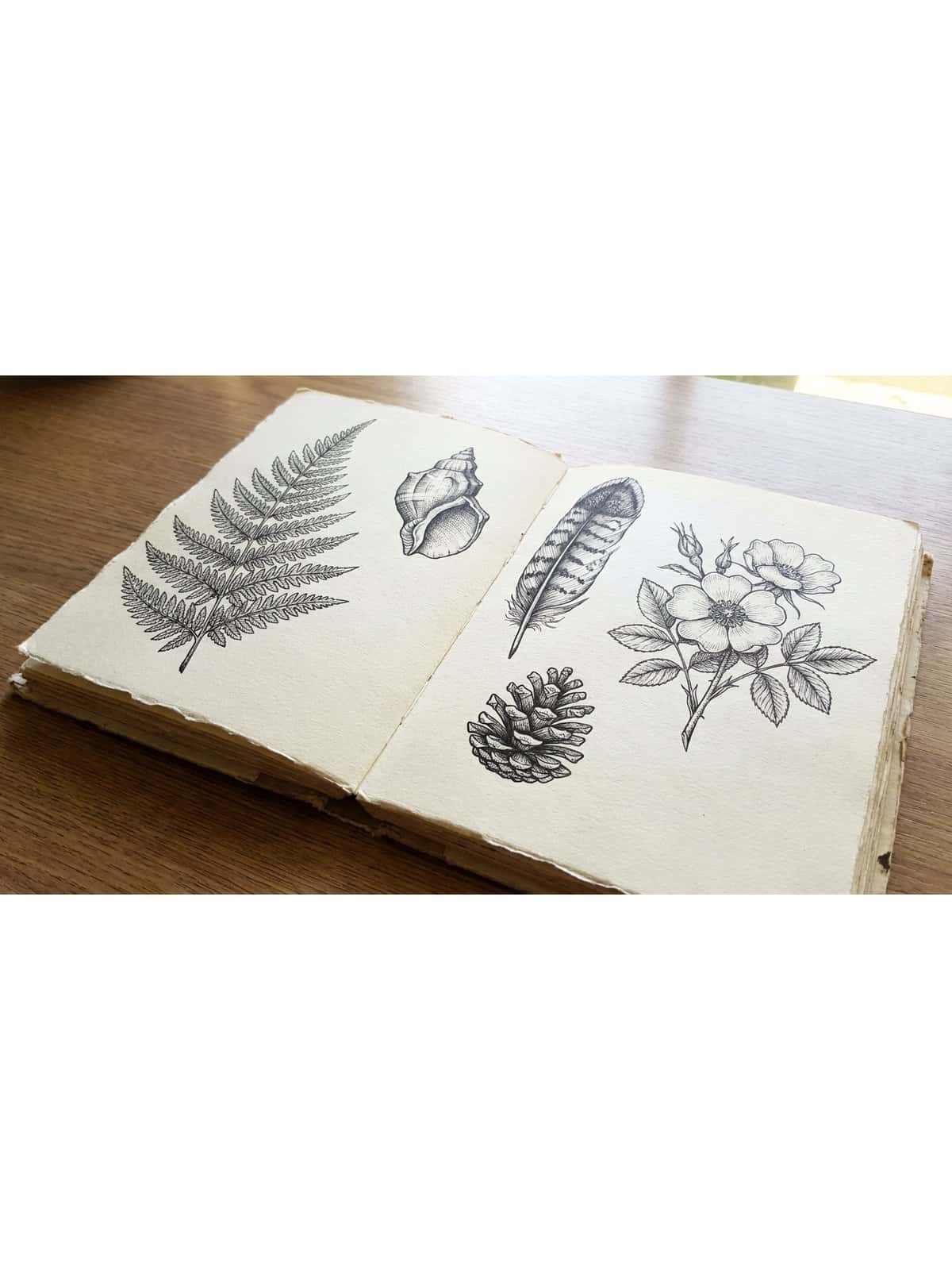
- Feather study — Feathers have this gorgeous structure of barbs and after-feathers that looks incredible in fineliner.
- Shell collection — Arrange a few shells and draw them. The spiral forms are great practice for contour lines.
- Pinecone from above — That spiral pattern is both challenging and deeply satisfying to draw.
- Mushroom cluster — Mushrooms are wonderfully weird subjects. If you love drawing mushrooms, I’ve got a whole post on mushroom drawing with step-by-step ideas.
- Succulent in a pot — The geometric rosette shapes look stunning in pen, especially with crosshatching in the shadows between leaves.
Architecture and Urban Sketching Ideas
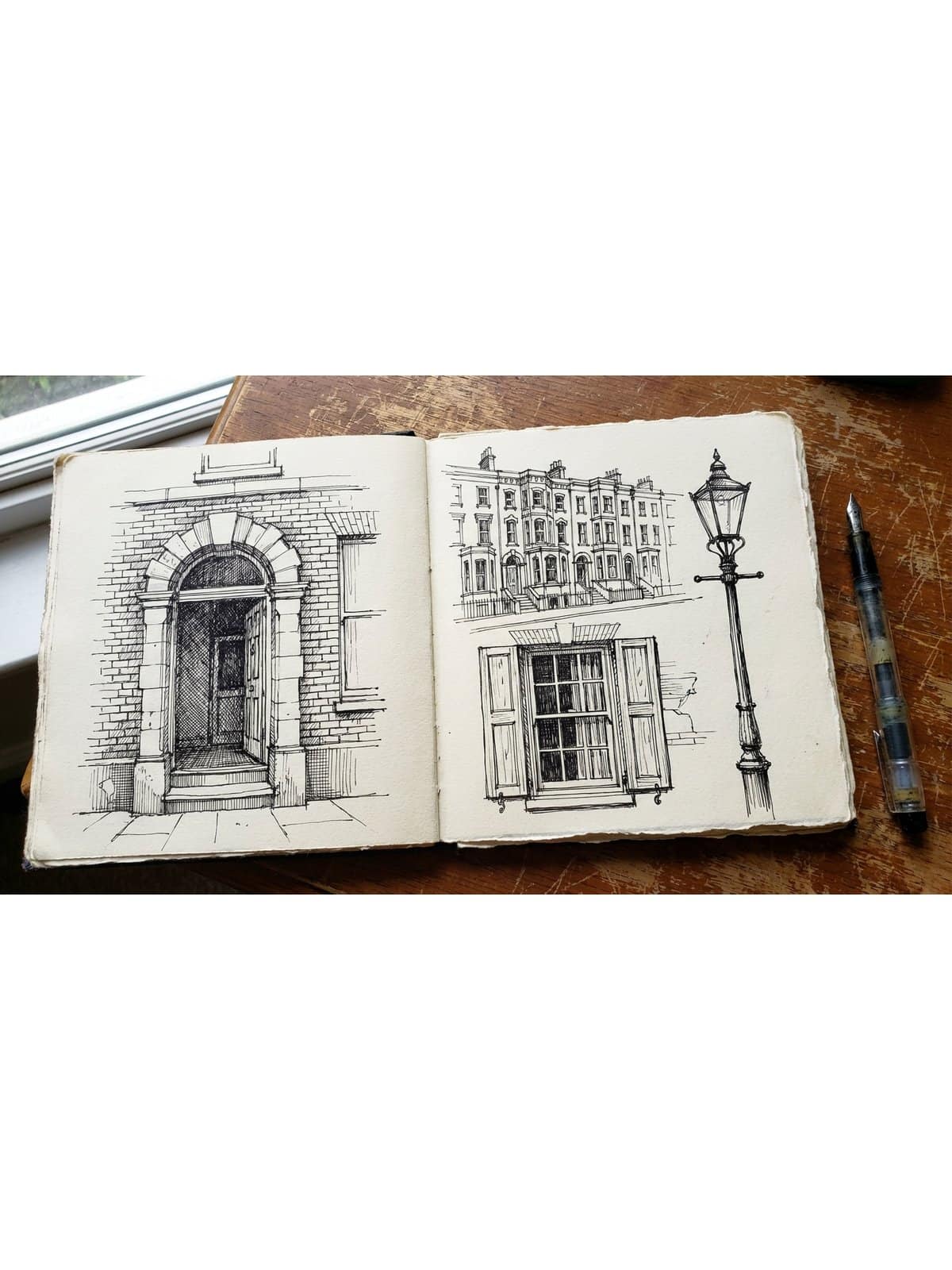
Quick Answer: Urban sketching with pens captures the character of buildings, streets, and cityscapes. Start with simple doorways or windows before tackling full street scenes, and don’t worry about getting the perspective perfectly right.
Urban sketching is one of the most popular uses for pen and ink, and for good reason. There’s something about the permanence of ink that suits the solidity of buildings. Plus, you can sketch anywhere — a park bench, a cafe, even sitting on the pavement. No easel required.
- Your own front door — Start close to home. Literally. Draw your front door with all its details, the doorknob, the hinges, any plants nearby.
- Window with a view — Draw a window frame and whatever you can see through it. The frame becomes a natural border for your composition.
- Rooftops and chimneys — Look up instead of straight ahead. Rooflines have beautiful geometry.
- A single shopfront — Pick an interesting shop and capture its personality: the signage, the window display, the door details.
- Street corner perspective — Two buildings meeting at a corner gives you natural perspective lines. Great for practising vanishing points.
- Old church or cathedral detail — You don’t have to draw the whole building. Just a carved detail, an arched doorway, or a stained glass window section.
- Bridge sketch — Bridges have gorgeous structural lines and reflections in water underneath.
If you’re looking for more things to fill your sketchbook with, check out my easy doodle drawings post — some of those simpler doodle approaches work brilliantly as warm-ups before tackling a bigger urban sketch.
Still Life Ink Drawing Ideas
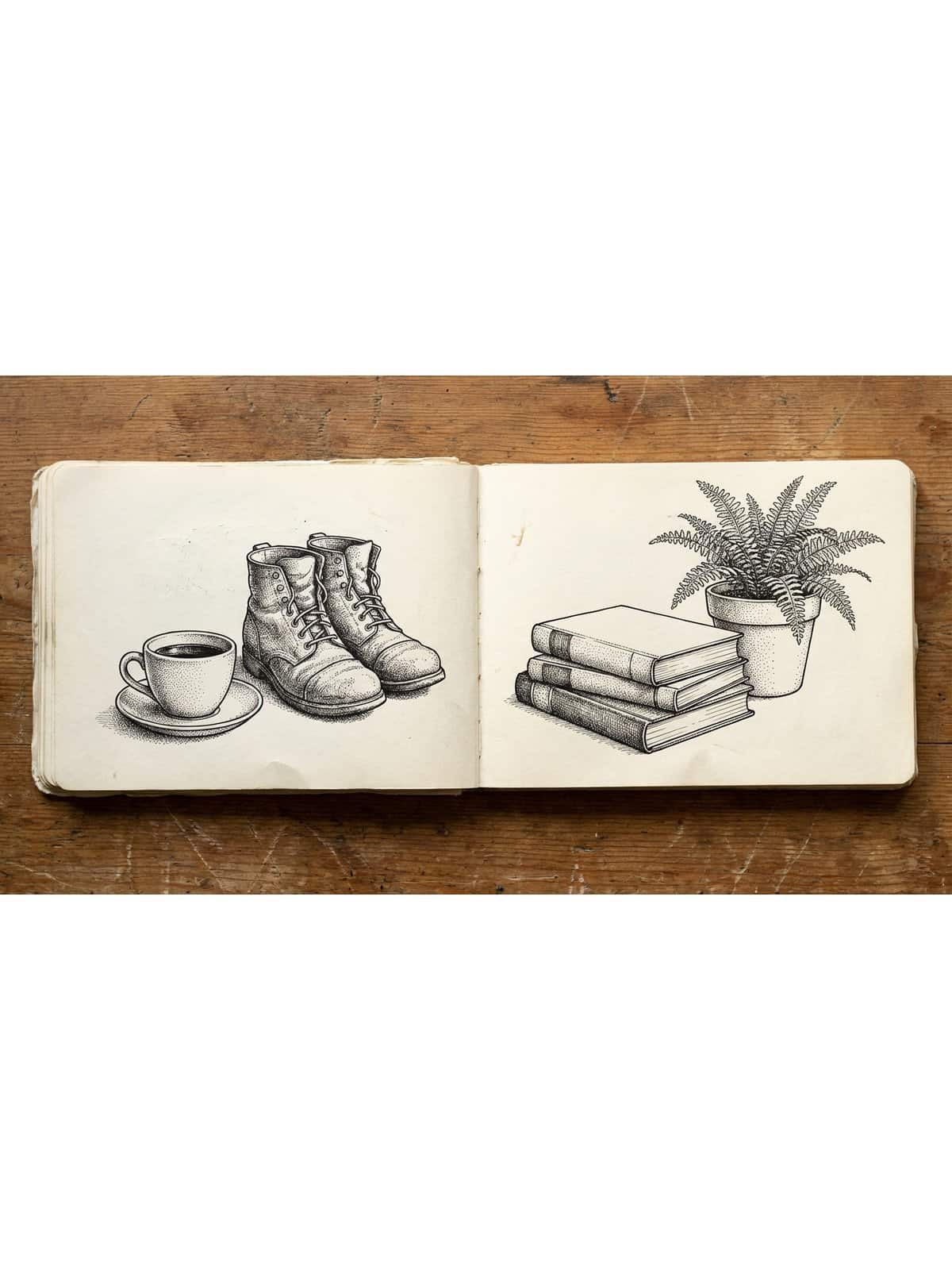
Quick Answer: Still life pen sketches let you practice observation and technique without leaving your desk. Everyday objects like coffee cups, shoes, keys, and kitchen items make excellent subjects for ink drawings.
Still life sketching is the unsung hero of pen drawing practice. You don’t need to go anywhere special, and you can set up a subject in about three seconds flat. Just grab whatever’s nearby and draw it.
- Coffee cup and saucer — A classic for a reason. The ellipses of the rim and saucer are great practice, and you can add the texture of steam for fun.
- Keys on a keyring — All those tiny teeth and the ring itself are oddly satisfying to draw in fineliner.
- Your shoes — Shoes have so much character. Old trainers with creases? Chef’s kiss for a pen sketch.
- Stack of books — Play with the different page textures and spines. Crosshatching works beautifully for the shadows between books.
- Kitchen utensils in a jar — Wooden spoons, whisks, and spatulas have interesting shapes and textures.
- Fruit bowl arrangement — The organic shapes of different fruits are perfect for practising shading techniques. If you enjoy drawing food, my post on cute food drawings has loads more inspiration.
- Vintage camera or watch — Mechanical objects with all their dials and details are pen sketching gold.
Portrait and Figure Pen Sketches
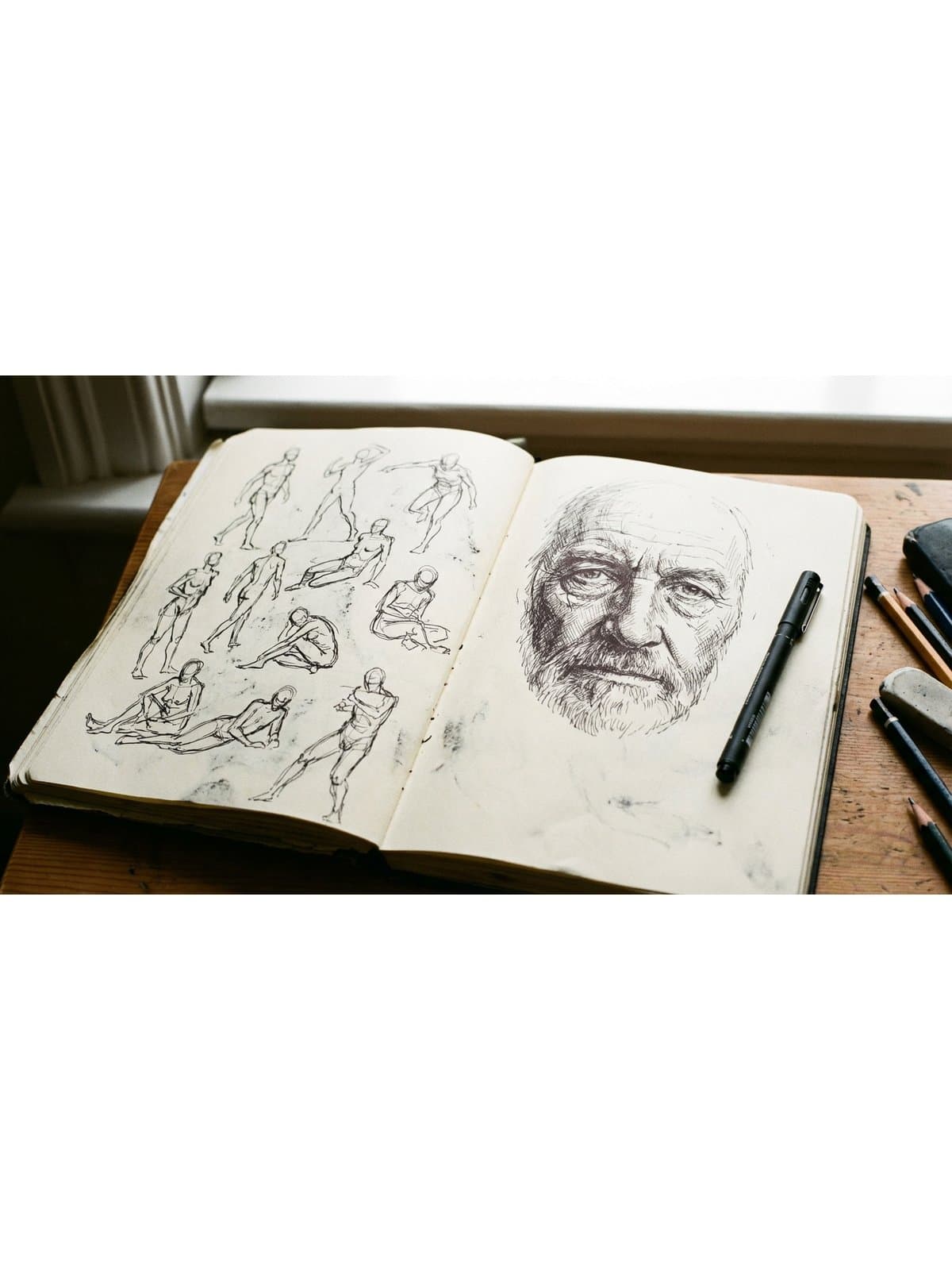
Quick Answer: Pen portraits and figure sketches build confidence with mark-making because you can’t erase. Start with quick gesture drawings using a brush pen, then progress to more detailed fineliner portraits as your confidence grows.
Drawing people in pen feels scary at first — the “no erasing” thing hits different when you’re trying to get someone’s likeness right. But here’s the secret: imperfect pen portraits often have more life and character than perfectly rendered pencil ones. The boldness of ink forces you to commit to your lines, and that confidence shows.
- 30-second gesture drawings — Use a brush pen and draw the whole body in under 30 seconds. Don’t think, just move the pen. These are about capturing energy, not accuracy.
- Hands in different poses — Your own hands are the most available model you’ll ever have. Draw them holding a cup, gripping a pen, resting on a table.
- Eyes study — Draw a single eye in detail using crosshatching for the iris and stippling for the skin texture.
- Profile silhouette — Draw someone in profile using only their outline. Simple, bold, and surprisingly expressive.
- People on the bus/train — Quick sketches of strangers are amazing practice. They move, so you have to work fast and capture the essentials.
- Self-portrait in pen — Set up a mirror and go for it. Allow yourself to be loose and imperfect.
Abstract Ink Patterns and Doodles
Quick Answer: Abstract pen patterns and doodles are a relaxing way to practice ink techniques without worrying about accuracy. Zentangle-style patterns, geometric designs, and freeform ink doodles all build pen control while being genuinely fun.
Sometimes you don’t want to draw “something” — you just want to make marks on paper and zone out. Abstract patterns and doodling are perfect for this. They’re meditative, they build pen control, and the results often end up looking way cooler than you expected.
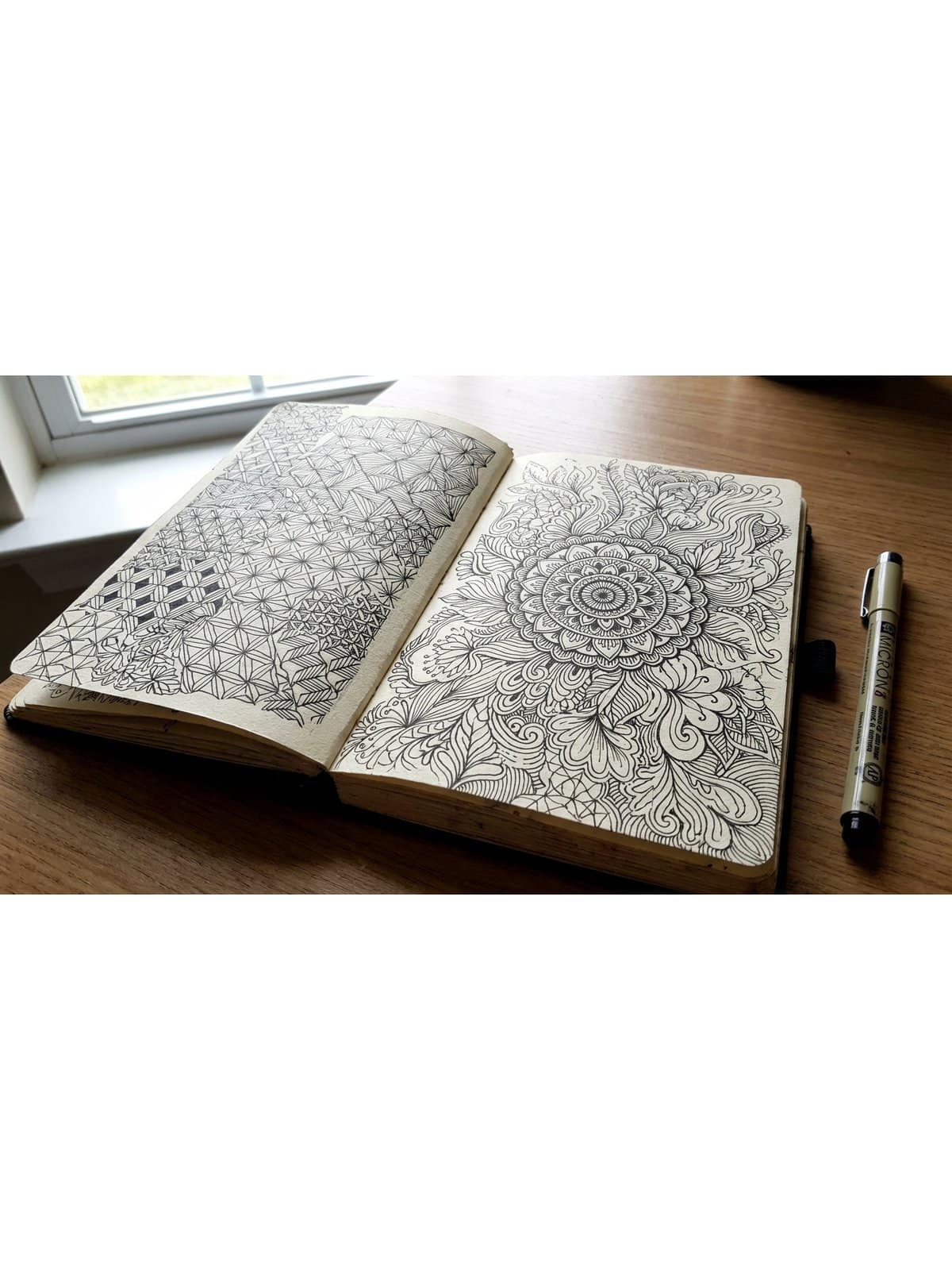
- Zentangle-style tiles — Draw a small square (about 9cm) and fill it with repeating patterns. There are thousands of Zentangle patterns to try, or just invent your own.
- Geometric grid patterns — Draw a grid and fill each square with a different ink technique — hatching in one, stippling in another, crosshatching in the next.
- Organic flowing lines — Start with a wavy line and add more parallel lines that follow the same curve. The moiré effect is mesmerising.
- Mandala in pen — Start from the centre and work outward. Fineliners are ideal for the precision this requires.
- Freeform ink doodle page — No rules. Just start in one corner and let shapes grow and connect across the page. My aesthetic simple doodles post has lots of pattern ideas if you want more starting points.
- Pattern sampler — Fill a whole page with small boxes, each containing a different pattern. It becomes a visual reference sheet you can return to.
- Op-art optical illusion — Draw wavy grids that trick the eye into seeing movement or depth. Satisfying to create and mesmerising to look at.
For more doodle inspiration, you’ll love my posts on cute easy doodles and doodle art designs. And if you keep a journal, my 50 journal doodle ideas are perfect for decorating your pages with pen.
Supplies for Pen Sketching
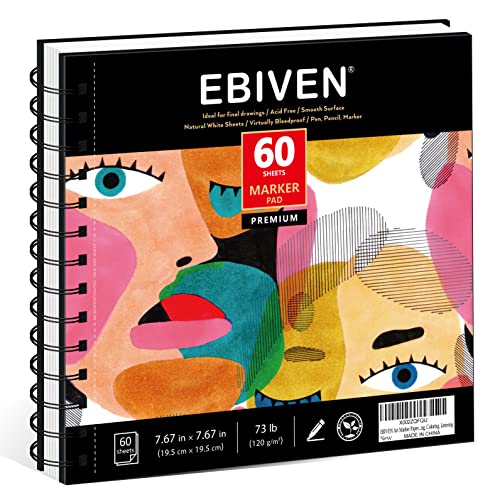
You really don’t need much to get started with pen sketching. A single pen and some paper will do. But if you want to invest in a few quality tools that’ll make the experience even better, here are my recommendations.
My go-to fineliner set is the Sakura Pigma Micron range — the ink is archival quality and never bleeds, even on thinner paper. For a wider range of tip sizes and brush options, the Staedtler Pigment Liner set is another excellent choice I use regularly.

This post contains affiliate links, which means I may earn a small commission at no extra cost to you if you make a purchase. I only recommend products I genuinely love and use myself!
Free Ink Techniques Practice Pack
Want to actually practise all those techniques I mentioned? This free Ink Techniques Practice Pack walks you through hatching, crosshatching, stippling, and contour drawing with guided exercises on each page. Print them out, grab your favourite pen, and work through them at your own pace.
Looking for even more printable resources? Check out my Payhip shop for premium drawing templates and guides that go deeper into specific techniques!
Pen Sketch Ideas FAQ
What is the best pen for sketching?
The best pen for sketching depends on what you want to achieve. Fineliners (like Sakura Pigma Microns) are ideal for detailed, consistent line work. Ballpoint pens are great for tonal shading and are incredibly accessible. Brush pens suit loose, expressive drawing. For most people starting out, a set of fineliners in 2-3 different nib sizes gives you the most versatility.
How do I get better at pen drawing if I can’t erase?
The inability to erase is actually what makes pen drawing such a powerful learning tool. Start with light, loose lines rather than committing to heavy marks right away. If you make a “mistake,” work it into the drawing or simply move on — most people won’t notice. Over time, the permanence of ink trains you to observe more carefully before making a mark, which improves all your drawing skills.
What paper is best for pen sketching?
Smooth, heavyweight paper works best for pen drawing because it prevents feathering (where the ink bleeds along the paper fibres). Bristol board is the gold standard for finished pen and ink work. For everyday sketchbook use, look for paper that’s at least 100gsm with a smooth finish. Avoid heavily textured watercolour paper, as it can catch on fine pen tips.
Can I do pen sketches with a regular ballpoint pen?
Absolutely. Ballpoint pens are seriously underrated as a sketching tool. They offer something fineliners don’t — pressure sensitivity. Light pressure gives pale, silvery marks while heavy pressure creates rich, dark tones. This makes them brilliant for realistic shading and portraiture. Some incredible artists work exclusively in ballpoint, so don’t dismiss the pen on your desk.
What should I draw first when learning pen and ink?
Start with simple still life objects — a piece of fruit, a mug, your keys. These subjects let you focus on learning ink techniques without the pressure of getting a complex subject “right.” Practice hatching and crosshatching on simple geometric shapes (spheres, cubes, cylinders) before moving to more complex subjects. The goal is building comfort with the pen, not creating masterpieces straight away.
Final Thoughts
Pen sketching is one of those art practices that rewards you the more you do it. Every page you fill makes the next one easier, and there’s a special kind of confidence that comes from knowing you can create something beautiful with just a pen and paper.
Don’t overthink which idea to start with — just pick one, grab whatever pen is closest, and go. The beauty of a sketchbook is that nobody has to see it but you. Some pages will be gorgeous. Some will be… interesting. All of them count.
Grab your free Pen Sketch Reference Sheets and Ink Techniques Practice Pack above, and let me know on Pinterest which pen sketch idea you try first.
Want to see these techniques in action? Head over to my YouTube channel where I share step-by-step drawing and watercolour tutorials every week. Hit subscribe so you don’t miss the next one!
Follow me on Pinterest for daily art inspiration, and check out my YouTube channel for video tutorials!
You Might Also Like
- Sketch Ideas for Beginners
- 100 Sketchbook Prompts
- Easy Doodle Drawings
- Aesthetic Simple Doodles
- Doodle Art Designs
Pin this for later!