Last Updated on October 13, 2026 by Dee
Here are easy doodle ideas for beginners, from little swirls and flowers to mushrooms and clouds, plus free Easy Cute Drawing Templates and Doodle Art Design Templates.
You know that moment when you’re in a boring meeting, your pen starts moving almost by itself, and twenty minutes later you’ve covered half your notebook with the most satisfying little swirls and flowers you’ve ever drawn? That’s doodling doing what it does best — bypassing the part of your brain that says “I can’t draw” and getting straight to the good bit.
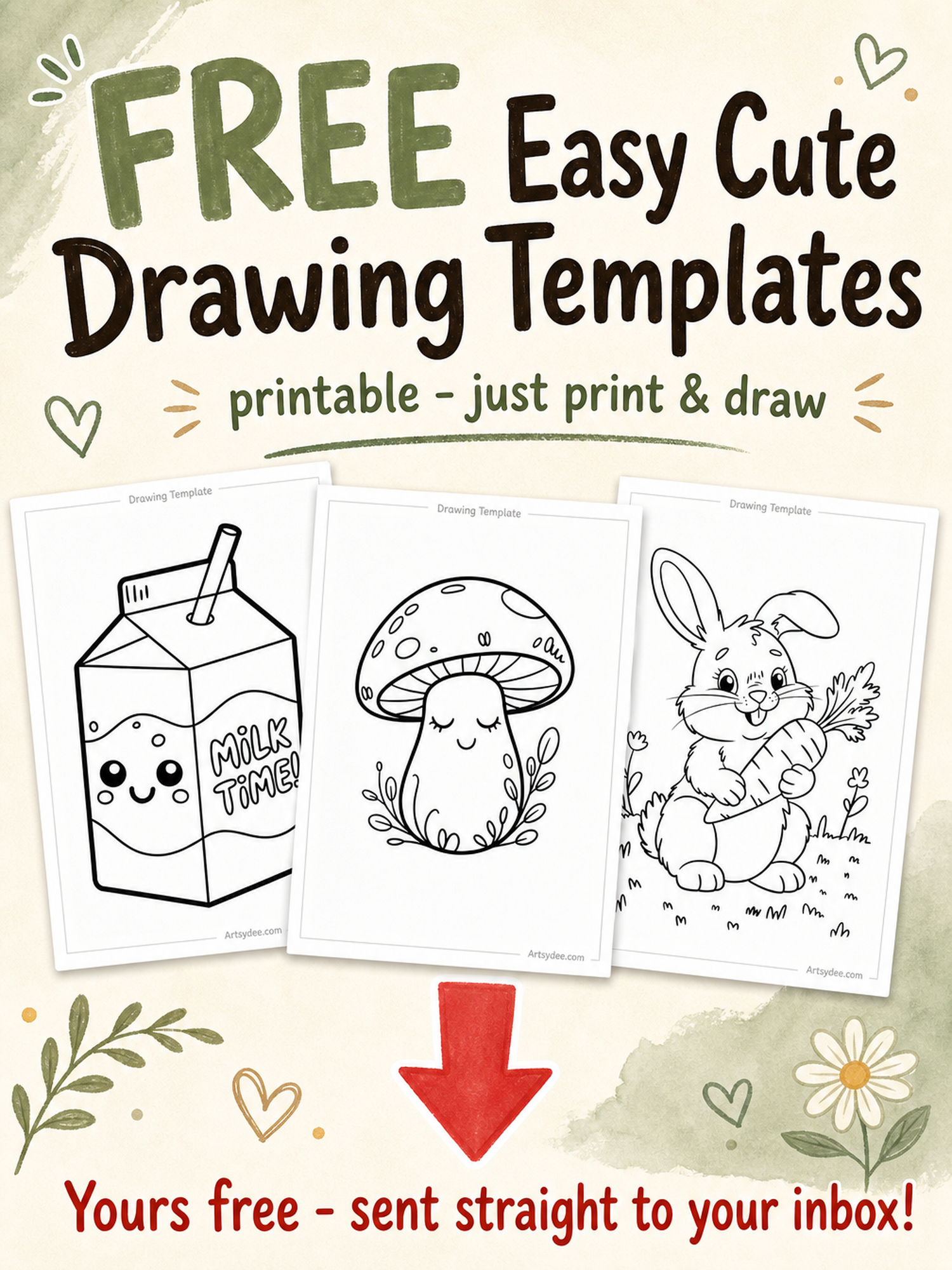
🎨 Grab your free printable in the box above — just pop your email in!
👉 Pop your email into the box near the top of this post and I’ll send these straight to your inbox — free!
I’ve been doodling since I was about seven years old, and what I love most is that doodling has almost no rules. You’re not trying to capture likeness or perspective. You’re just making marks that feel good to make — and that turns out to be one of the most effective ways to start building real drawing confidence.
🎬 Subscribe to my YouTube channel for weekly art inspiration and check out these 9 easy sketchbook ideas you can try today! 👇🏻
Table of Contents
Free Doodle Art Templates
Before we dive into the ideas, grab your free templates! These 20 ready-to-use doodle art templates are perfect for tracing, colouring, or using as drawing references when you want a starting point rather than a blank page.
Enjoying the doodling? My shop has premium drawing template sets for when you’ve traced these a few times over.
Browse the shop →Want 400+ Creative Resources?
If you love these free templates, come and join me on Patreon. It’s where my weekly watercolor template sets go out to members: printed outlines with painted references, so you can see where the color goes, plus Procreate stamps and palettes.
What Are Easy Doodle Ideas? (Quick Answer)
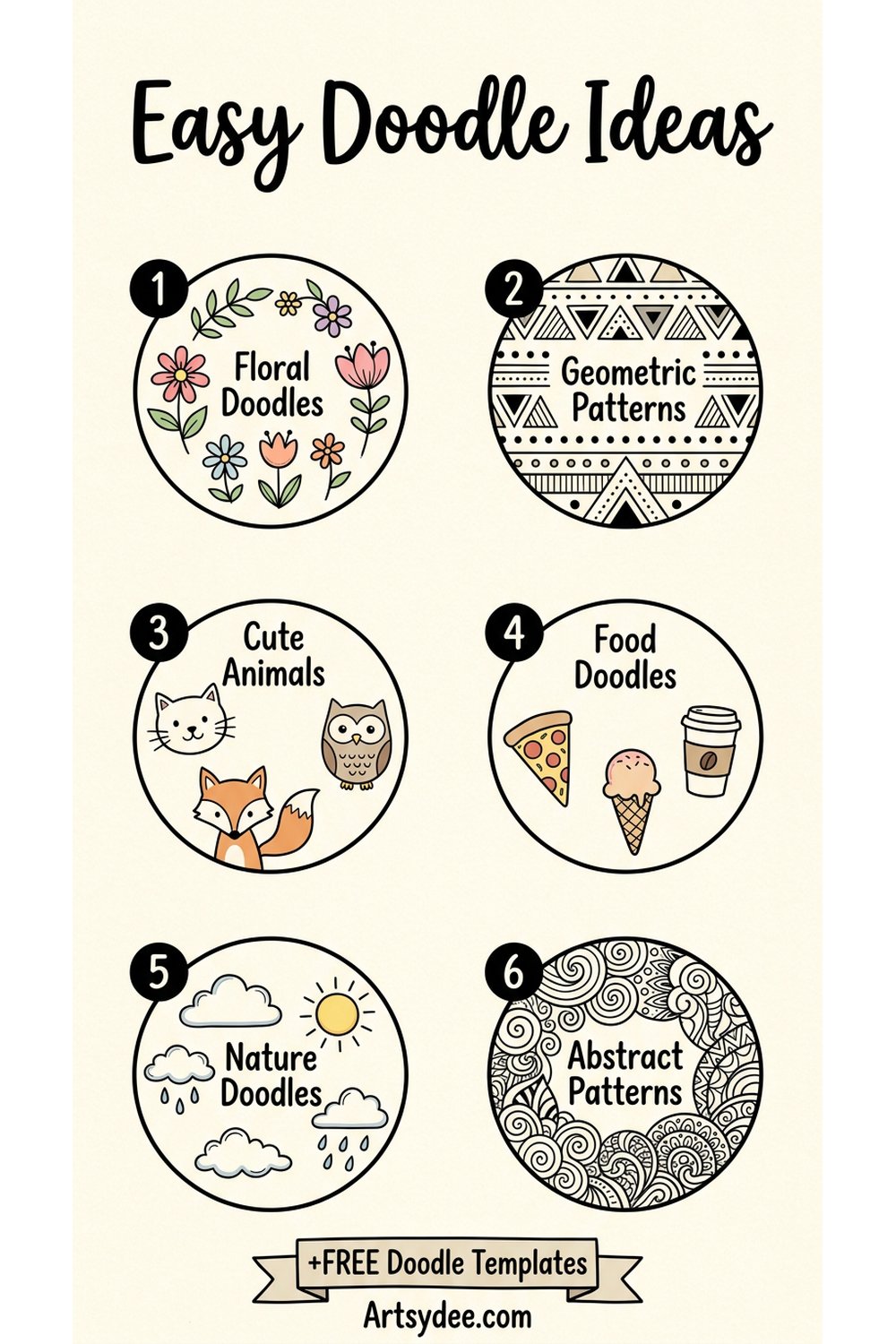
Quick Answer: Easy doodle ideas include simple patterns (dots, lines, swirls), cute characters (simple animal faces, kawaii food), nature shapes (flowers, leaves, clouds), and geometric designs. The key is to use basic shapes — circles, triangles, squares — as your building blocks.
Here’s the thing that separates doodling from “trying to draw properly” — there’s genuinely no wrong answer. When you doodle, you’re not aiming for realism or photographic accuracy. You’re exploring what happens when your pen makes a mark and you follow where it leads. A wonky flower is not a failed flower; it’s a charmingly handmade flower, and that’s completely the point.
What makes doodling so powerful for building drawing confidence is the low stakes. Because nothing is precious or “meant to be good,” your hand relaxes, your lines flow more naturally, and before you know it you’ve created something that actually looks rather lovely. The skills you build through doodling — understanding proportion, controlling line weight, repeating patterns evenly — transfer directly to more deliberate artwork.
Repeating simple patterns is particularly useful. When you draw the same simple leaf shape twenty times across a page, the first five might feel wobbly. By the tenth, your hand has memorised the motion. This is genuine muscle memory developing, and it happens faster through doodling than almost any other practice method.
Cute Doodle Ideas for Beginners
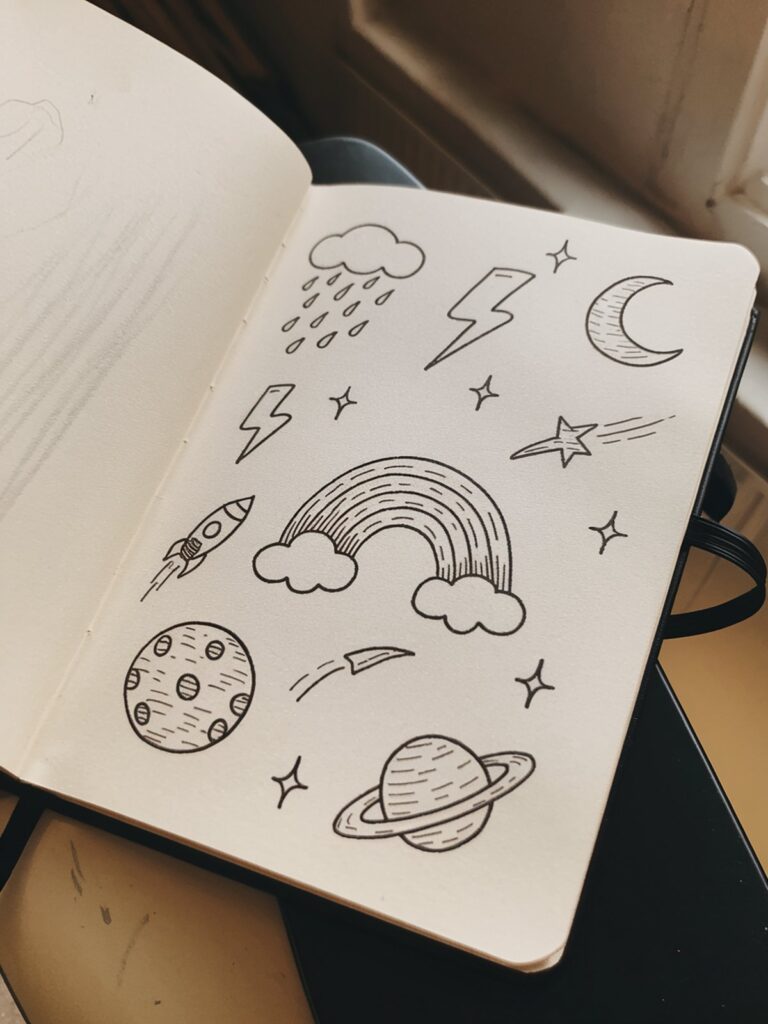
Cute doodles are probably the most popular category for a reason — they’re instantly rewarding and wonderfully forgiving. Let’s go through some of my favourites to get you started.
1. Kawaii Food Doodles
A smiling pizza slice with tiny dot eyes is one of the most satisfying things you can draw in about thirty seconds. Start with a triangle for the slice, add a wavy curved edge for the crust, draw two small circles for eyes and a little curved line for a smile, and finish with some dots for toppings. You can apply the same kawaii face formula to ice cream cones, sushi rolls, coffee cups, cupcakes, and donuts. The key is keeping the faces simple — just eyes and a smile is all you need.
2. Simple Animal Faces
Animal faces work beautifully as doodles because you only need a few key features to make them recognisable. A cat face is just a circle, two triangular ears, a small nose triangle, whisker lines, and almond-shaped eyes. A fox needs a pointed snout shape added below. A bear is a circle with two rounded ears and a slightly flatter nose. Try drawing a row of different animal faces across a page — it’s brilliant practice for getting consistent proportions.
3. Stars and Moons
Stars and moons are doodling staples for good reason — they’re quick, they look great scattered around other elements, and they come in so many variations. Try five-pointed stars, four-pointed sparkle stars, tiny dot-stars, crescent moons, full moons with craters, and stars with little trailing lines. Mix sizes for a dreamy celestial spread across your page.
4. Simple Flowers
The five-petal daisy is the quintessential beginner doodle flower — one small circle in the centre, five oval or rounded petals around it, done. From there you can explore tulips (an oval with a flat base and two curved side petals), sunflowers (a larger centre circle with pointed petals), and simple roses (a spiral starting from the centre and working outward). Adding a simple stem and two leaves completes any flower instantly.
5. Cute Mushrooms
Mushrooms have had a real moment in doodle art, and I completely understand why — they’re simple, they look adorable, and they’re endlessly variable. The basic formula is a dome-shaped cap with a rounded rectangular stem beneath. Add spots on the cap, a kawaii face, or tiny details like a door and windows for a fairy-tale feel. Try drawing clusters of different sized mushrooms together for an enchanted forest vibe.
6. Clouds with Weather
A cloud is just a series of overlapping bumps along the top of a rectangle base — genuinely one of the simplest shapes to draw. Once you have your cloud, you can add raindrops falling beneath it, a little lightning bolt, or tiny snowflakes. You can also give it a kawaii face and let it look grumpy or delighted depending on the weather. Clouds work as gorgeous filler elements around other doodles.
7. Hearts in Different Styles
Hearts are so much more versatile than they seem at first. Try a classic symmetrical heart, a chunky bold heart with a thick outline, a heart made of tiny dots, a heart filled with a crosshatch pattern, or a string of hearts connected by a line. You can also try dimensional hearts that look slightly 3D with a highlight spot. They make wonderful repeating borders and frame elements.
8. Small Houses and Buildings
Little buildings are surprisingly easy to doodle and look wonderful filling a page. Start with a square or rectangle, add a triangular roof, draw a small door and one or two windows, and you have a house. You can make a whole neighbourhood of different-styled buildings — some with chimneys, some with arched windows, some taller like narrow terraced houses. Adding tiny details like flower boxes under windows or stars in a dark sky above makes them feel really complete.
9. Balloons and Bunting
Balloons are just ovals with a tiny knotted tail at the bottom and a thin string descending. Draw clusters of them at different heights, vary the sizes, and they instantly create a celebratory, joyful feeling on the page. Bunting is simply a line with small triangular flags hanging from it — draw triangles along a slightly curved line and you have a string of bunting. These are brilliant for borders and page headers.
10. Simple Plants in Pots
Plant doodles are everywhere right now and they’re so satisfying to draw. A simple terracotta pot (a trapezoid with a lip at the top) holding a succulent (made of rounded teardrop shapes), a trailing vine, or a single statement leaf looks charming in just a few strokes. Draw a little shelf of different pots for an instantly cosy botanical illustration.
Geometric Doodle Patterns to Try
If cute characters aren’t quite your thing, geometric doodling might be your perfect entry point. These patterns feel almost meditative to draw — the repetitive, structured nature means your brain can switch off a little while your hand does the work. This is where doodling edges into mindfulness territory, and there’s actual research behind that.
The tangle-drawing method, developed by Rick Roberts and Maria Thomas, is built entirely around structured repetitive patterns — and it’s wonderful for beginners because every pattern is made up of simple steps. You don’t need to be able to draw to do doodle-inspired doodling; you just need to follow a sequence of marks.
Here are some geometric patterns worth trying:
- Grid patterns — draw a simple grid and fill each square with a different pattern (dots, lines, crosses, waves). No two squares the same.
- Concentric shapes — draw a shape and then repeat it slightly larger around the outside, again and again, like a topographic map. Works beautifully with circles, squares, and irregular blob shapes.
- Triangular fill patterns — fill a triangle with parallel lines going different directions, then surround it with more triangles filled differently.
- Dot grids — evenly spaced dots that you connect in different ways: as squares, as diamonds, as starburst patterns.
- Wave and scale patterns — overlapping arcs that create a fish-scale or scallop effect. Draw rows of arcs, each row slightly overlapping the one above.
- Simplified mandalas — start with a small circle in the centre, draw a ring of petals around it, then a ring of triangles, then a ring of dots, building outward in rings of different patterns.
For more geometric and structured doodle inspiration, check out these doodle art designs for more inspiration — there are some beautiful examples of complex patterns that are simpler to create than they look.
Nature Doodle Ideas
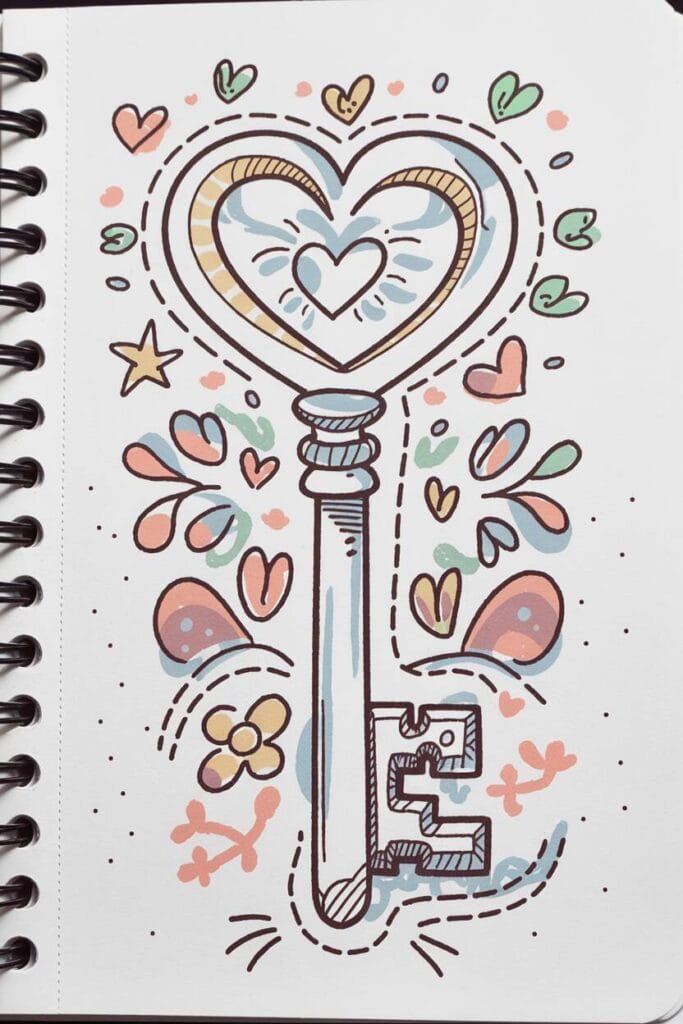
Nature is the most endlessly generous source of doodle inspiration there is — organic shapes, natural variation, and beautiful patterns everywhere you look. The great news is that nature is already wonderfully imperfect, which means slightly wonky leaf shapes and uneven flower petals actually look more authentic, not less.
Leaf Shapes
Start with a simple pointed oval for a basic leaf and add a central vein line with small branching veins on either side. From there, explore different leaf silhouettes: the distinctive three-lobed shamrock, a maple leaf (five pointed lobes), a rounded eucalyptus leaf, or a tropical monstera leaf with its distinctive split edges. Try drawing a whole branch of different leaf varieties.
Mushrooms
We covered kawaii mushrooms above, but nature mushrooms have their own appeal. Try drawing more realistic mushroom shapes — a flat cap mushroom seen from the side, a cluster of small toadstools, or a single dramatic fly agaric (the classic red-and-white spotted toadstool). Even realistic mushrooms are wonderfully simple in silhouette.
Simple Trees
A simple tree is just a trunk shape with a cloud of foliage on top. But you can get more interesting quickly: try a bare winter tree with branching lines spreading upward (draw the main trunk, branch it into two, then branch each of those, and repeat a couple more times), a bushy round summer tree, or a stylised triangular pine tree.
Clouds and Sky Elements
Beyond the simple cloud shape, the sky offers brilliant doodle subjects: a crescent moon with a few stars, a stylised sun with rays of different lengths, shooting stars with trailing lines, small birds as simple M-shapes in the distance, and hot air balloons combining an oval with a small basket below.
Raindrops and Water
Individual raindrops are one of the most satisfying simple shapes to doodle — a circle at the bottom with a pointed top, like a teardrop. Draw them falling at an angle, or cluster them in different sizes. You can also try wave lines for water, small puddle circles with lines radiating out from where a drop has fallen, or tiny dewdrop shapes along a leaf or branch.
Botanical Sprigs
A botanical sprig is simply a curved stem with leaves or berries attached. Draw a gentle S-curve for the main stem, then add small oval leaves paired on either side, or tiny circles at the branch tips for berries. Sprigs are wonderful as corner decorations and filler elements that connect other doodles on a page.
Sun and Sunrays
The classic sun doodle — a circle with rays — can be enriched beautifully by varying your ray style. Try long pointed rays alternating with short ones, wavy rounded rays, or rays that are little triangles. You can also draw a half-sun peeking over a horizon line, or a sunrise with rays spreading upward in a fan shape.
How to Fill a Page with Doodles
Knowing individual doodle elements is one thing — filling a whole page confidently is another. Here are the approaches I’ve found most useful.
Start with a Focal Point
Rather than starting at the top left and working across (which quickly feels like homework), place your first doodle roughly in the centre of your page. This becomes your anchor, and everything else grows around it organically. Your focal point might be a large flower, an interesting geometric shape, or even a word in decorative lettering.
Build Outward in Sections
Once your focal point is placed, imagine your page divided into rough sections radiating outward. Fill each section with a different pattern or element — a cluster of flowers here, some geometric fills there, a string of stars along one edge. This stops any one style from overwhelming the composition.
Mix Pattern Types
The most visually interesting doodle pages mix different types of marks: some areas densely filled with small repeated patterns, some areas with just a few larger elements, some areas left relatively simple. Variety in scale and density creates visual rhythm and stops the eye from glazing over.
Use Negative Space Intentionally
Not every inch of the page needs to be filled. Sometimes a large simple shape surrounded by white space reads as a deliberate design choice rather than an unfinished page. Try filling just the border of a page with doodles and leaving the centre intentionally blank — it looks wonderfully considered.
Create Borders and Frames
Drawing a frame of doodles around the edge of your page is one of the most satisfying ways to fill a spread. It gives your page an instant finished look even if the middle is sparse. Try alternating between two or three simple patterns — a flower, a leaf, a star, repeat — to build a consistent border.
For more sketchbook filling ideas, you’ll find loads of prompts and inspiration in this collection of sketch ideas for beginners.
Supplies for Doodling
The beautiful thing about doodling is that you genuinely need almost nothing to get started. A biro and the back of an envelope will do. But if you want to upgrade your tools a little, here’s what actually makes a difference. A set of Staedtler pigment liner pens gives you a range of line widths in one affordable pack.
My number one recommendation for doodling is a set of fine-liner pens. The consistent, smooth line you get from a fine-liner feels completely different from a ballpoint — your marks flow more confidently and the ink is waterproof, so you can add watercolour washes over the top if you want to add colour. A set of different nib sizes (0.05, 0.1, 0.3, 0.5, 0.8mm) gives you wonderful variety for detail work versus bolder lines. You can find a good beginner art supply set to get started without spending a fortune.


This post contains affiliate links, which means I may earn a small commission at no extra cost to you if you make a purchase. I only recommend products I genuinely love and use myself!
Free Cute Drawing Templates
Here’s your second free printable pack — 30 cute drawing templates that are perfect as doodle references or tracing guides when you want a starting point. Pop your email into the box at the top of this post to get it!
Doodle Ideas FAQs
What is the easiest doodle to draw?
The easiest doodles use just dots, lines, and circles. A simple 5-petal flower (one circle, five oval petals) is perfect for absolute beginners. From there, add a few leaves and you already have a pretty little floral doodle.
How do I get better at doodling?
Consistency beats intensity. Five minutes of doodling every day — even in the margins of your notebook — builds pattern memory faster than an occasional long session. Keep a tiny sketchbook or notebook handy and fill any spare moment with patterns. Your lines become noticeably more confident faster than you’d expect when you practise little and often.
Can doodling be an art style?
Absolutely! Doodle art is a completely valid and celebrated art style. Artists like Hattie Stewart and James Jean started with doodling. Your unique doodle style, however “simple” it feels, is something only you can create. Many professional illustrators describe their work as “grown-up doodling” — the leap from casual doodle to intentional illustration is smaller than you think.
Do I need special paper for doodling?
Any paper works! A smooth cartridge paper or dot grid notebook gives nice results with fine-liner pens. For something special, a dotted bullet journal lets you use the dots as guidelines for geometric patterns. Avoid very rough watercolour paper for fine-liner doodling — the tooth catches the nib and the lines look scratchy rather than smooth.
Final Thoughts
If I could leave you with just one thing after all of this, it’s this: start with what you already love. If you love cute things, draw kawaii food. If geometric patterns calm your brain, start with a grid. If you’re a nature person, pick up a leaf and try to draw its outline. The best doodle practice is the one that actually makes you pick up your pen.
Your free template packs are right there in this post — 20 doodle art templates and 30 cute drawing templates — so you never have to face the blank page completely alone. Use them as references, trace over them, or let them inspire your own variations.
And if you want more drawing and doodling content, I post regularly over on YouTube — come and join me there! 🎬 Subscribe to Artsydee on YouTube
Find me on Pinterest for daily doodle inspiration, and over on YouTube for video tutorials — I share new doodling content regularly and would love to see you there!
You Might Also Like
📌 Pin this for later!
Your free doodle template packs will keep the pen busy for weeks — and doodling is the kind of habit that only grows. My Payhip shop has premium drawing template sets, guides and Procreate brushes for when you want something new to fill.
See what’s in the shop →