Last Updated on July 21, 2026 by Dee
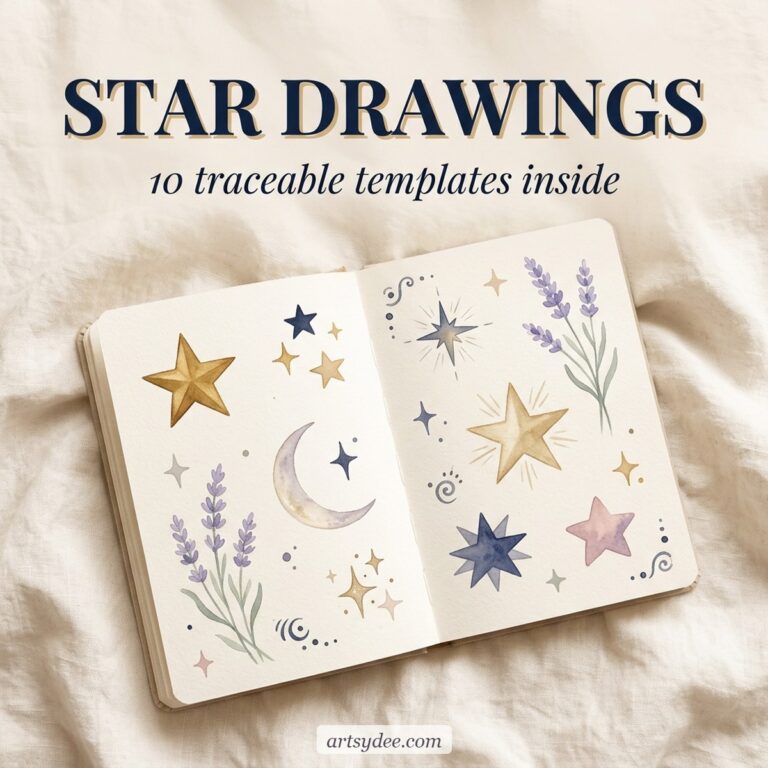
Stars are the gentlest first-step shape for an aesthetic sketchbook. A few straight pencil lines, a soft watercolour wash, a scatter of tiny gold sparkles — and somehow you’ve made something that feels like a quiet bit of night sky on the page. They’re forgiving for beginners, they look just as good in graphite as in gold ink, and they pair beautifully with crescent moons, soft clouds, and dreamy little constellations.
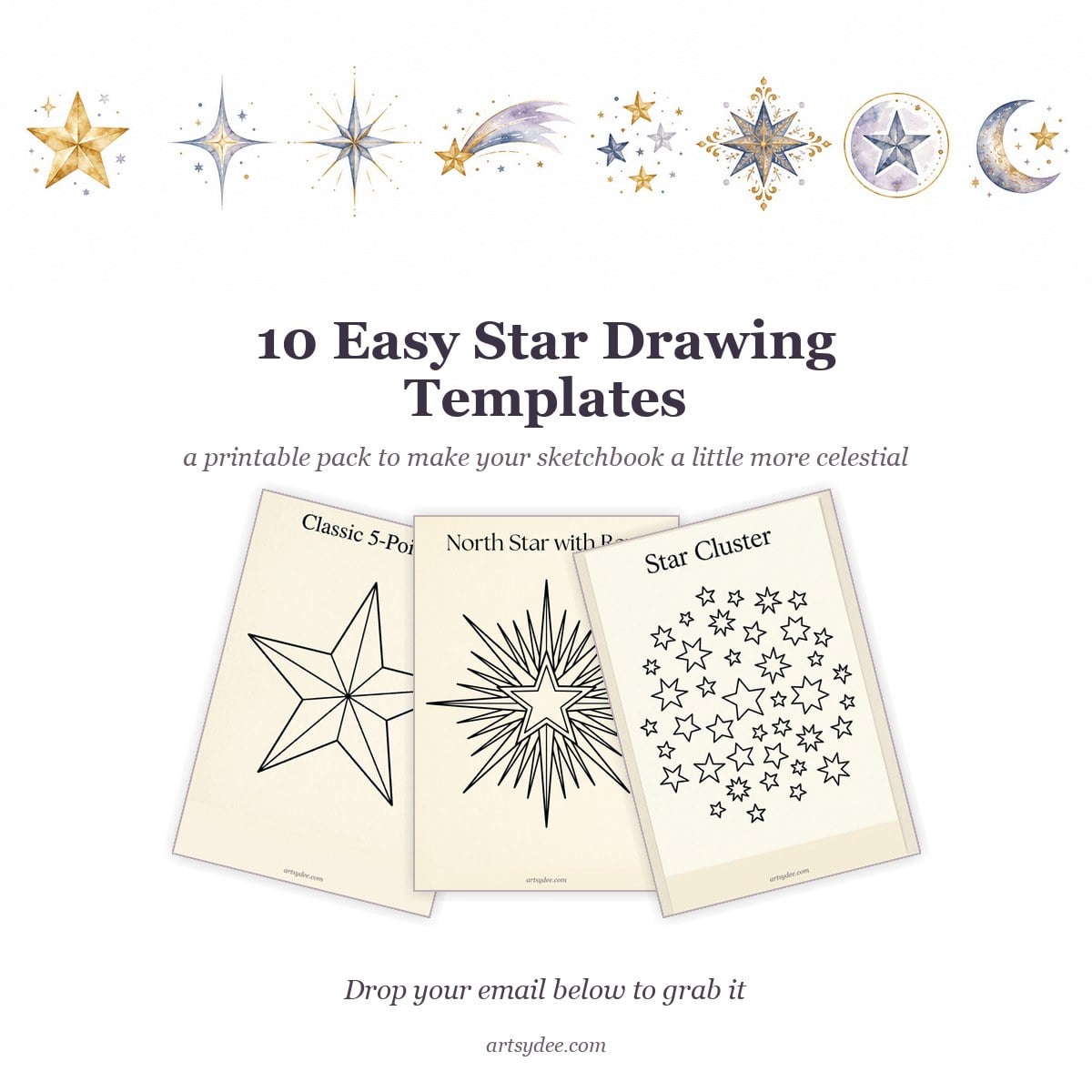
I’ve put together a free pack of 10 traceable star templates — the classic 5-point star, a 4-point sparkle star, a north star with rays, a shooting star with a trail, a small star cluster, an ornate decorative star, a friendly cartoon star, a constellation, a star inside a mandala circle, and a soft star-with-moon-and-clouds scene. Trace them, watercolour over them, or use them as warm-ups when your sketchbook feels intimidating.
🎬 Prefer watching? Subscribe to my YouTube channel — I drop sketchbook flip-throughs and step-by-step tutorials every week.
Table of Contents
Why stars are the perfect beginner subject
Quick answer: Stars are made of straight lines and a couple of repeating shapes — a 5-point outline, a 4-point sparkle, a few rays. That makes them forgiving for beginners. They look beautiful even when they’re a little wobbly, they pair with almost any medium (graphite, ink, watercolour, gold gel pen), and you can finish a satisfying star drawing in under five minutes.
If you’re staring at a blank sketchbook and your brain has gone quiet, a star is a kind invitation. The geometry is simple. The composition is small. And the celestial aesthetic gives you permission to add as many tiny sparkles, soft clouds, and dreamy little constellations as your heart wants — there’s no version of “wrong” because real stars come in every brightness and shape we imagine for them.
The other thing I love: stars make space for atmosphere. A single 5-point star tucked beside a soft crescent moon, with a few sparkle dots scattered through the surrounding air, already feels like a finished piece. You’re not painting a portrait — you’re suggesting a whole twilight sky.
Ten traceable stars is a lovely start — fuller template packs are waiting in the Artsydee shop.
Browse the shop →Grab your free 10 star drawing templates
Quick recap of what’s in the pack — all sized for A4, all clean line art you can trace or paint over:
- Classic 5-point star — the foundation shape with crisp symmetrical points
- Sparkle star — a 4-point shape with longer vertical points for that glimmer-of-light feeling
- North star with rays — a soft 5-point star with eight delicate radiating rays
- Shooting star with trail — a small bright star with a curved ribbon-like trail flowing behind
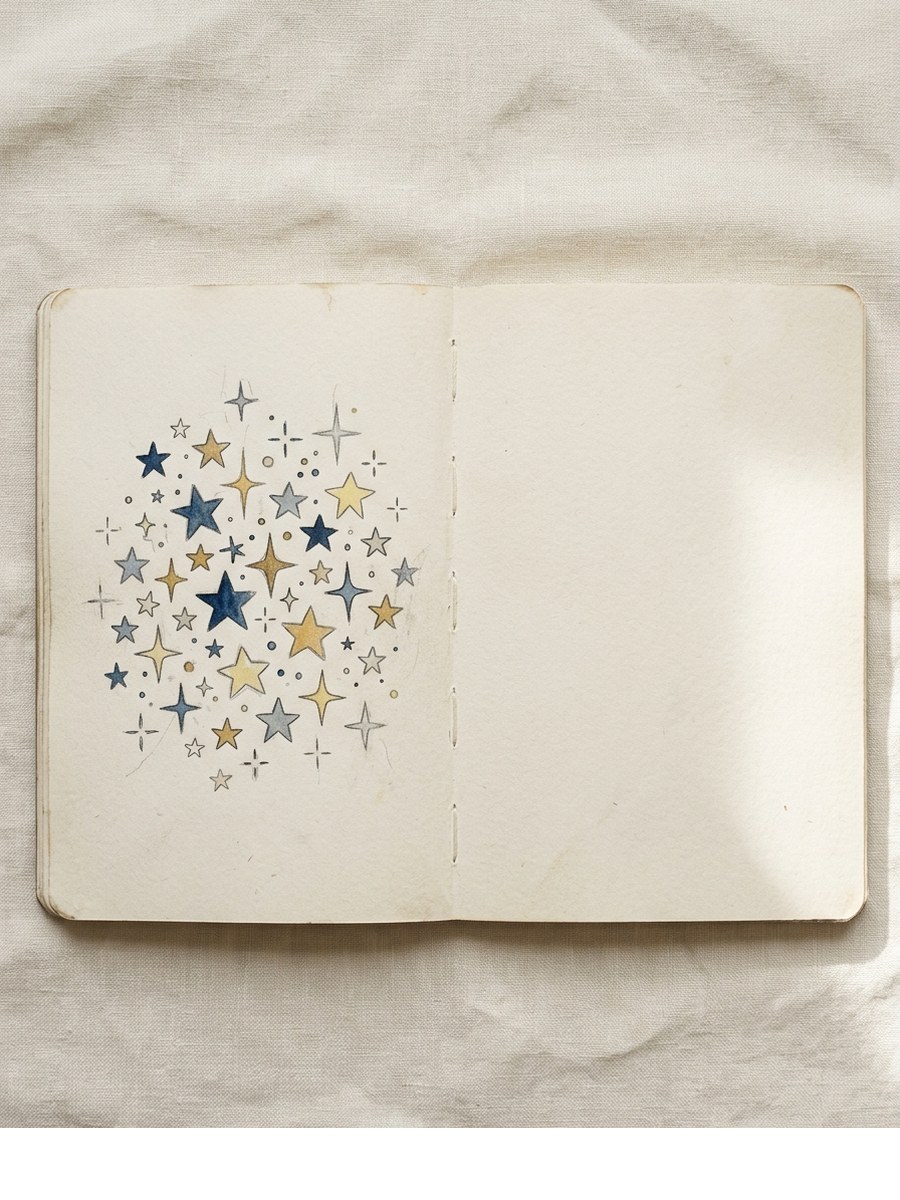
- Star cluster — a loose constellation grouping of seven stars in different sizes
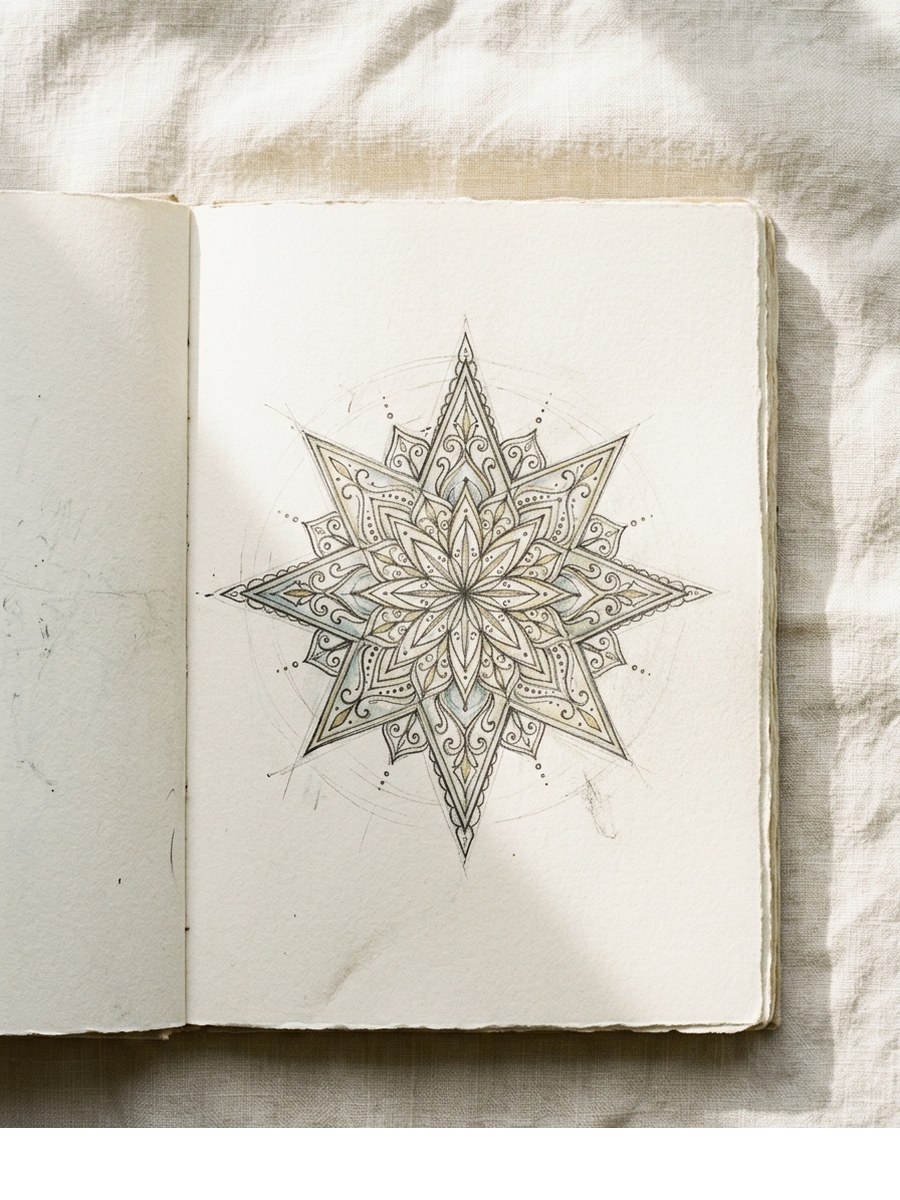
- Decorative ornate star — a 5-point outline with delicate filigree detail and a thin scalloped ring
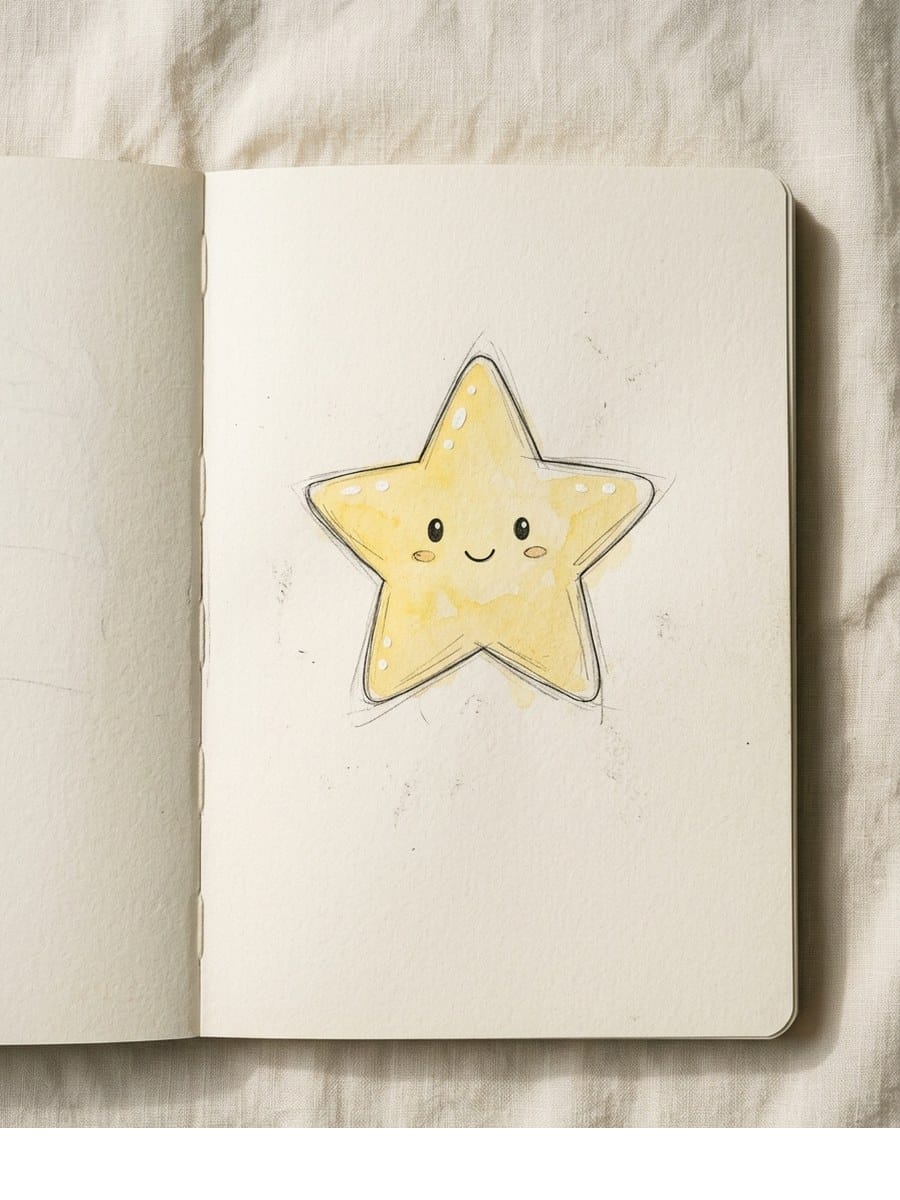
- Simple cartoon star — a friendly rounded star with a tiny smiling face
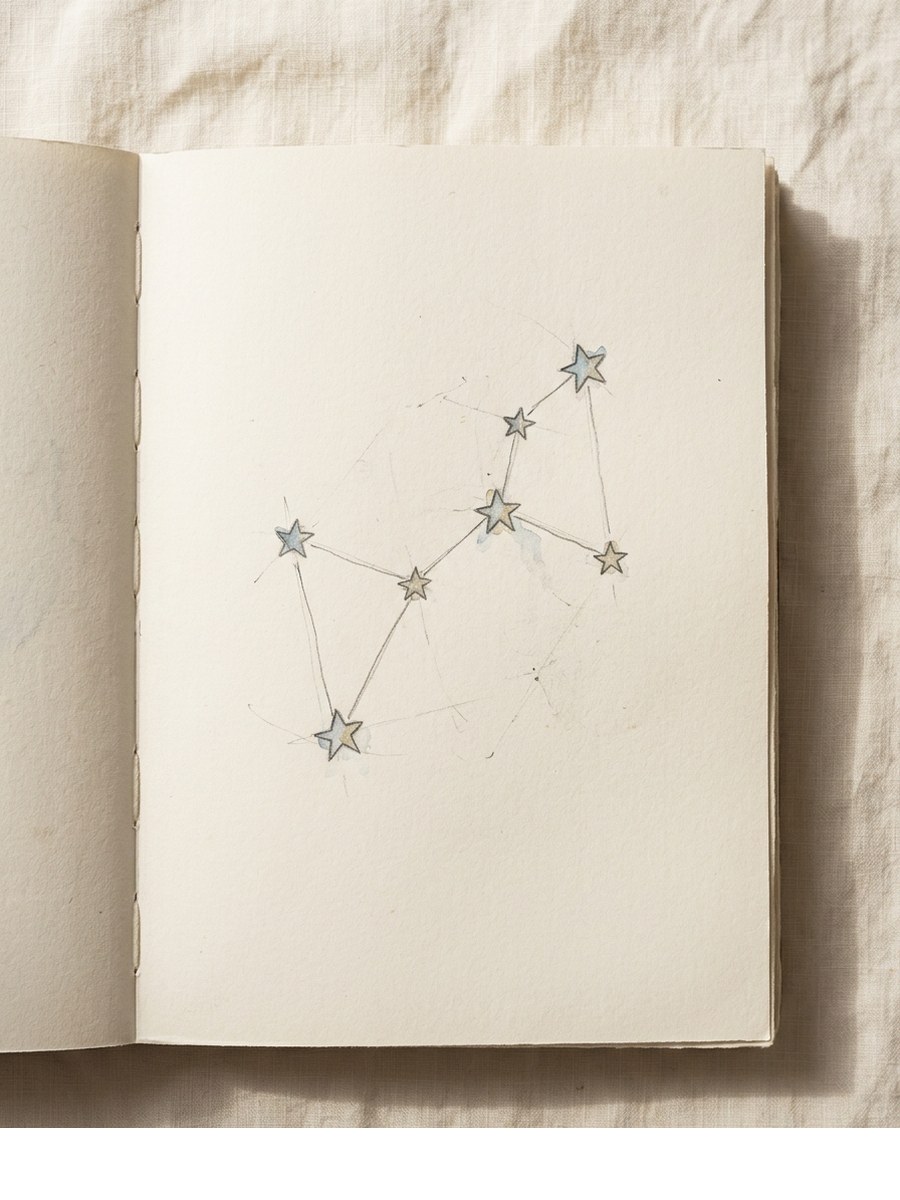
- Constellation — six to eight small stars connected by very thin lines into a stylised shape
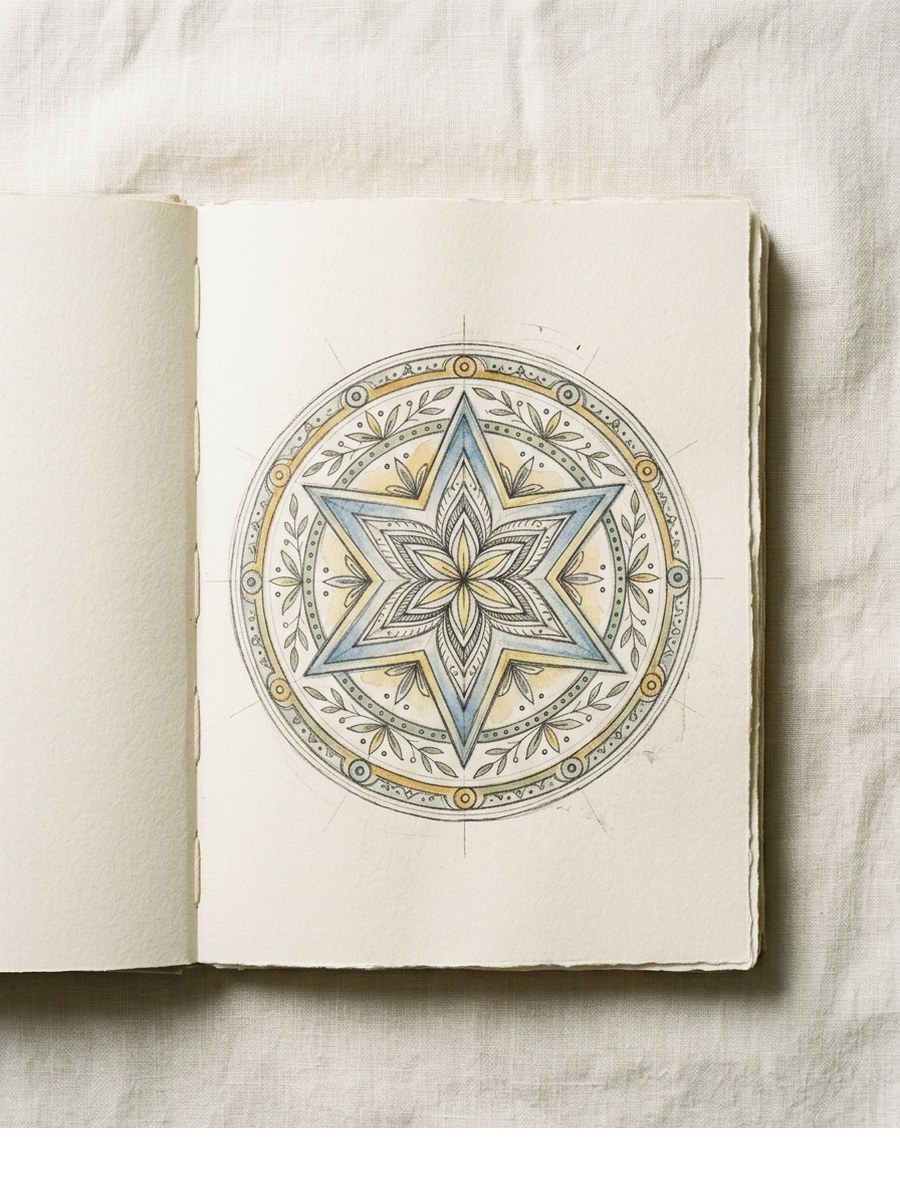
- Star within a mandala circle — a 5-point star inside a scalloped decorative ring
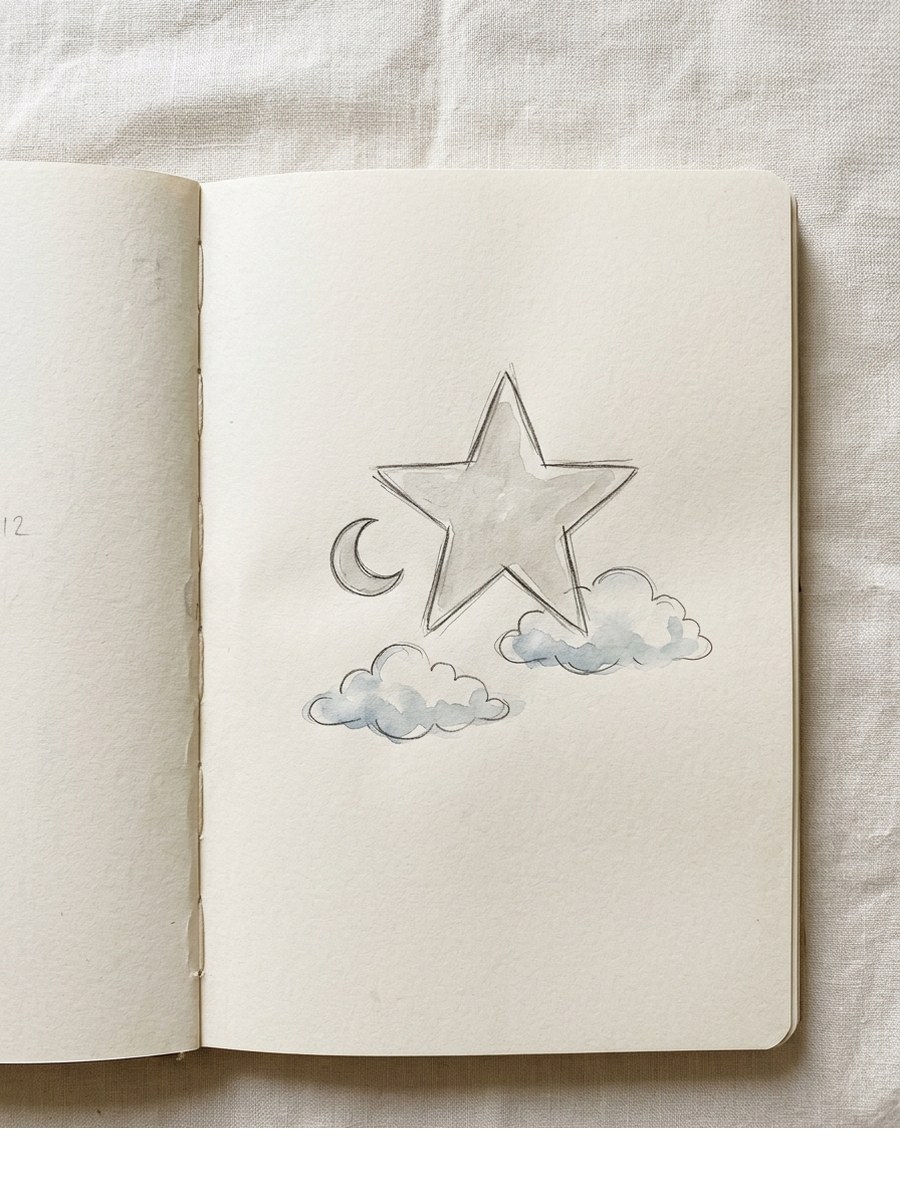
- Star with moon and clouds — a soft dreamy night-sky composition
Scroll back up to the email box if you haven’t grabbed it yet — pop your email in and the pack lands in your inbox in a couple of minutes. That’s the only step.
What you need to get started
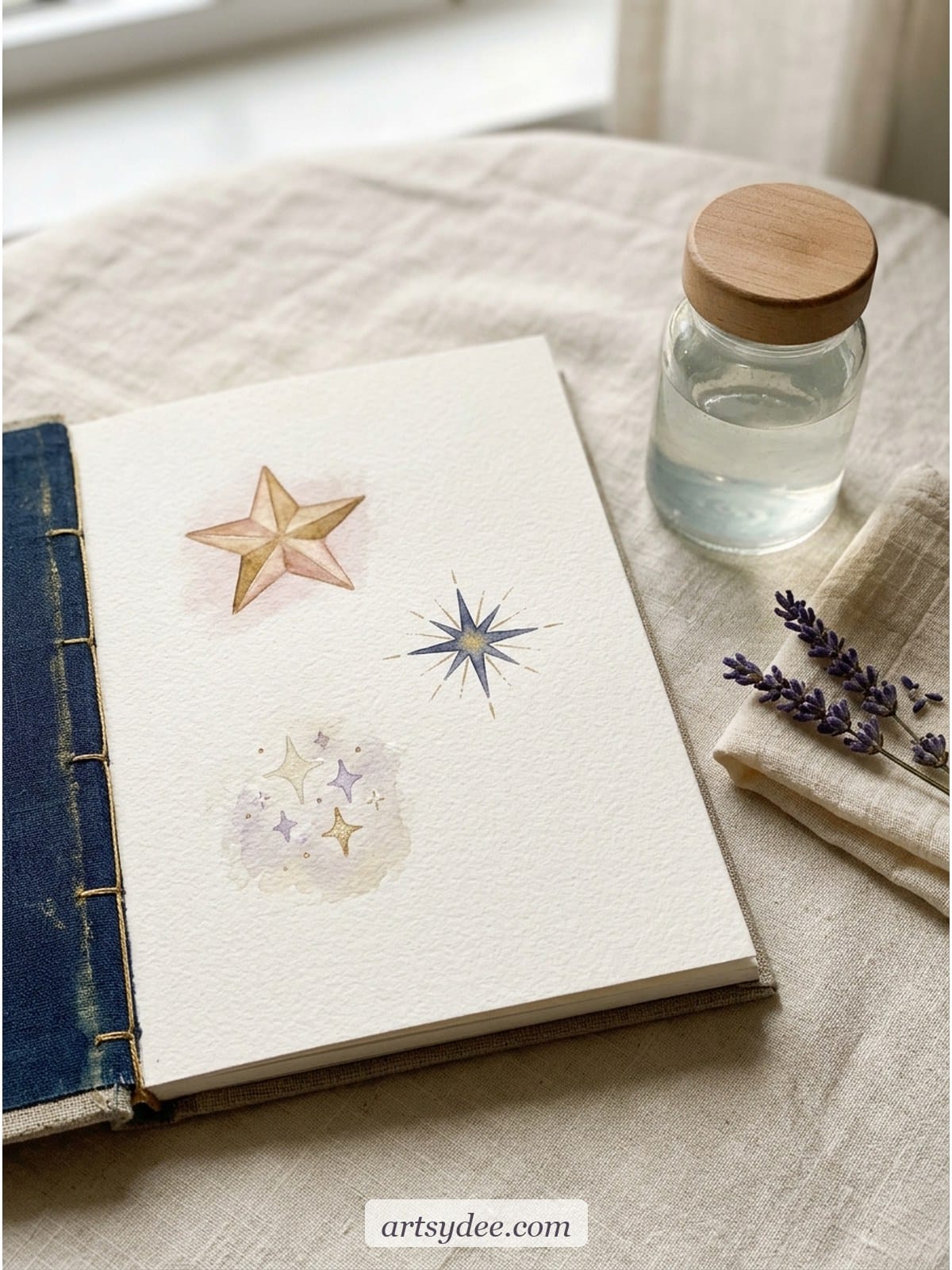
Quick answer: A pencil, an eraser, a piece of paper, and a printed template are enough. If you want to add value or wash, a graphite set (2H–6B) covers all the shading you’ll need; for paint, a small watercolour pan set and a single round brush will get you through every star in this pack. A gold or white gel pen is a lovely optional extra for sparkle accents.
I’m a fan of keeping the supply list short — stars reward restraint more than they reward equipment. Here are the bits I actually reach for when I’m sketching celestial stars:
Heads up: a couple of links below are affiliate links. If you click and buy something I may earn a small commission at no extra cost to you. I only link to supplies I genuinely use.
- A soft graphite pencil set — a Faber-Castell graphite set is great for layered shading inside the points of a star.
- A small watercolour pan set — I use a Winsor & Newton Cotman pocket box for everything celestial; warm yellow ochre, indigo and a touch of cream covers every star in this set.
- Cold-press watercolour paper — even if you’re tracing, paint over a printed template on a sheet of Strathmore 400-series watercolour paper for the loveliest washes.
- A round watercolour brush — a single Princeton Velvetouch round size 6 covers points, rays, and every tiny sparkle.

|

|

|

|
How to draw a perfect 5-point star without a compass
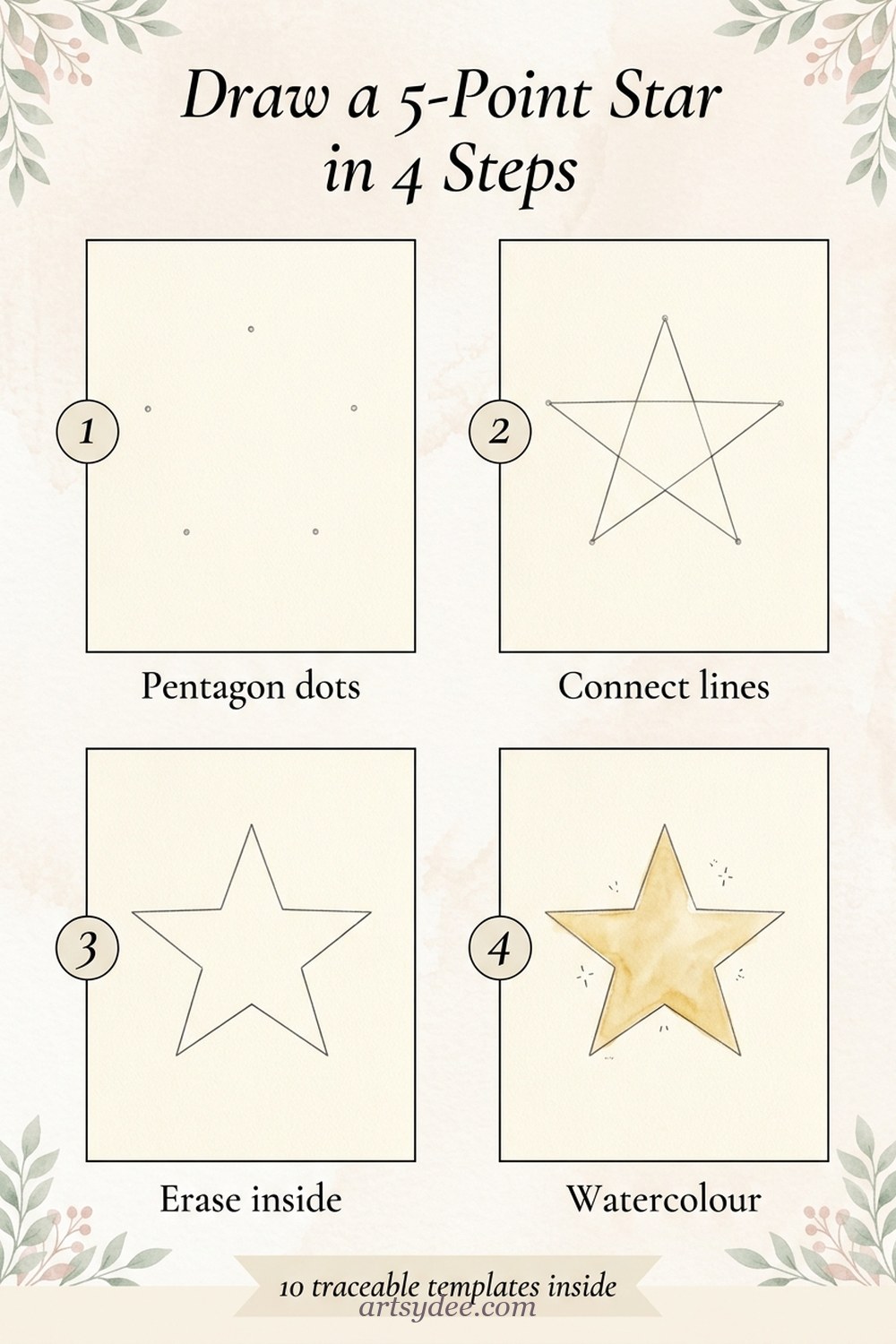
Quick answer: Lightly mark five evenly-spaced dots around an imaginary circle (one at the top, two roughly at “shoulder” height, two near the bottom). Then draw a single continuous line from the top dot down to the lower-right dot, across to the upper-left dot, across to the upper-right dot, down to the lower-left dot, and back up to the top — five straight lines, no lifting the pencil. Erase the guide dots.
The trick most beginners miss: the five dots aren’t laid out at the corners of a pentagon they imagine — they’re laid out at five evenly-spaced points around an invisible circle, which is a slightly different thing. If your stars keep coming out lopsided, this is almost always why. Sketch a faint pencil circle first, then mark your five dots evenly around its edge. The star draws itself from there.
Once you’ve drawn three or four 5-point stars in a row, your hand starts to remember the angles, and you’ll stop needing the guide circle at all. Until then, the circle isn’t cheating — it’s just the easiest geometry trick we have.
10 easy star drawings to try
Quick answer: The ten stars in this guide go from absolute-beginner (a single classic 5-point) to gently more involved (a star inside a mandala circle and a small dreamy moon-and-clouds composition). Pick whichever one matches your mood — there’s no order you need to follow.
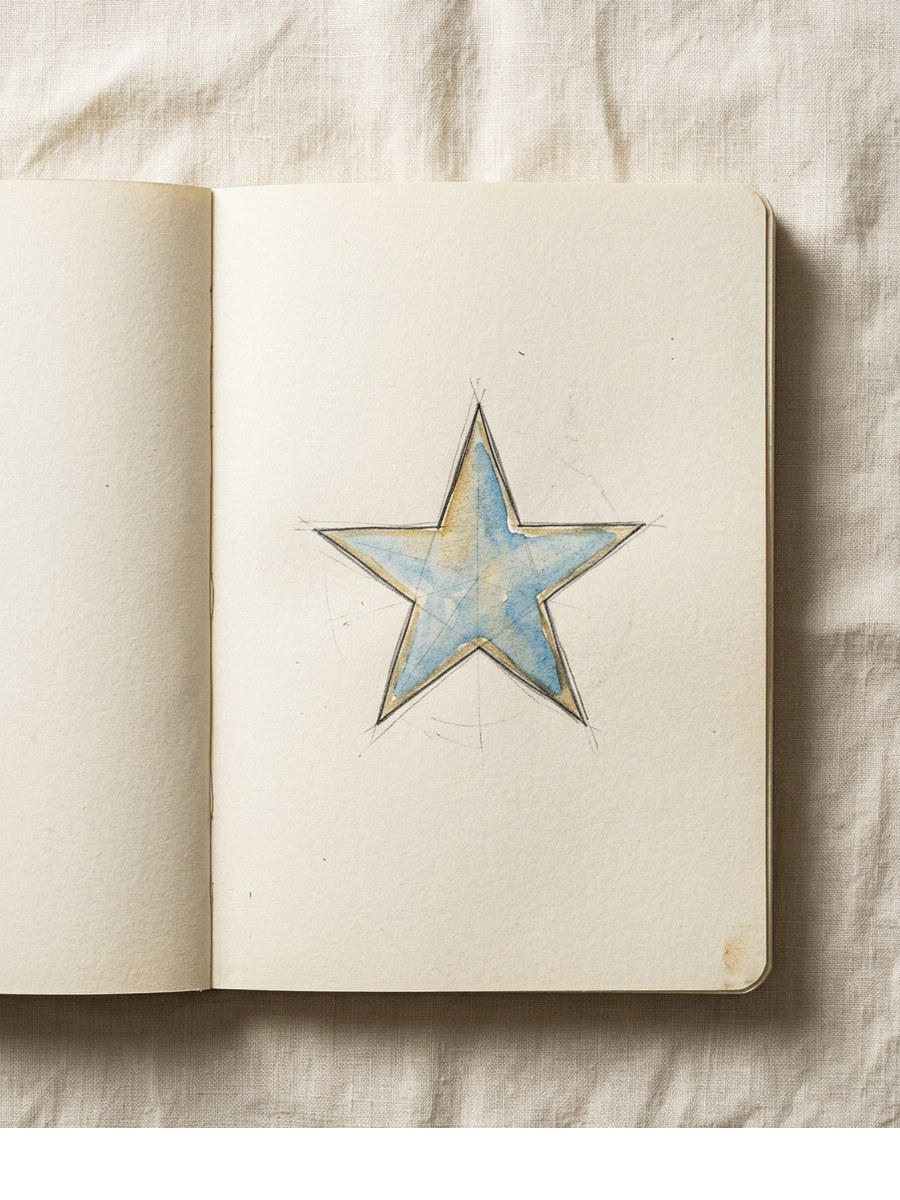
1. The classic 5-point star
Start with the foundation shape — five crisp symmetrical points, drawn as one continuous outline. The inner pentagonal lines that cross in the middle are part of the design (you don’t have to erase them). This is the star that lives in every flag, every notebook margin, and every quick doodle, and it’s the friendliest one to begin with.
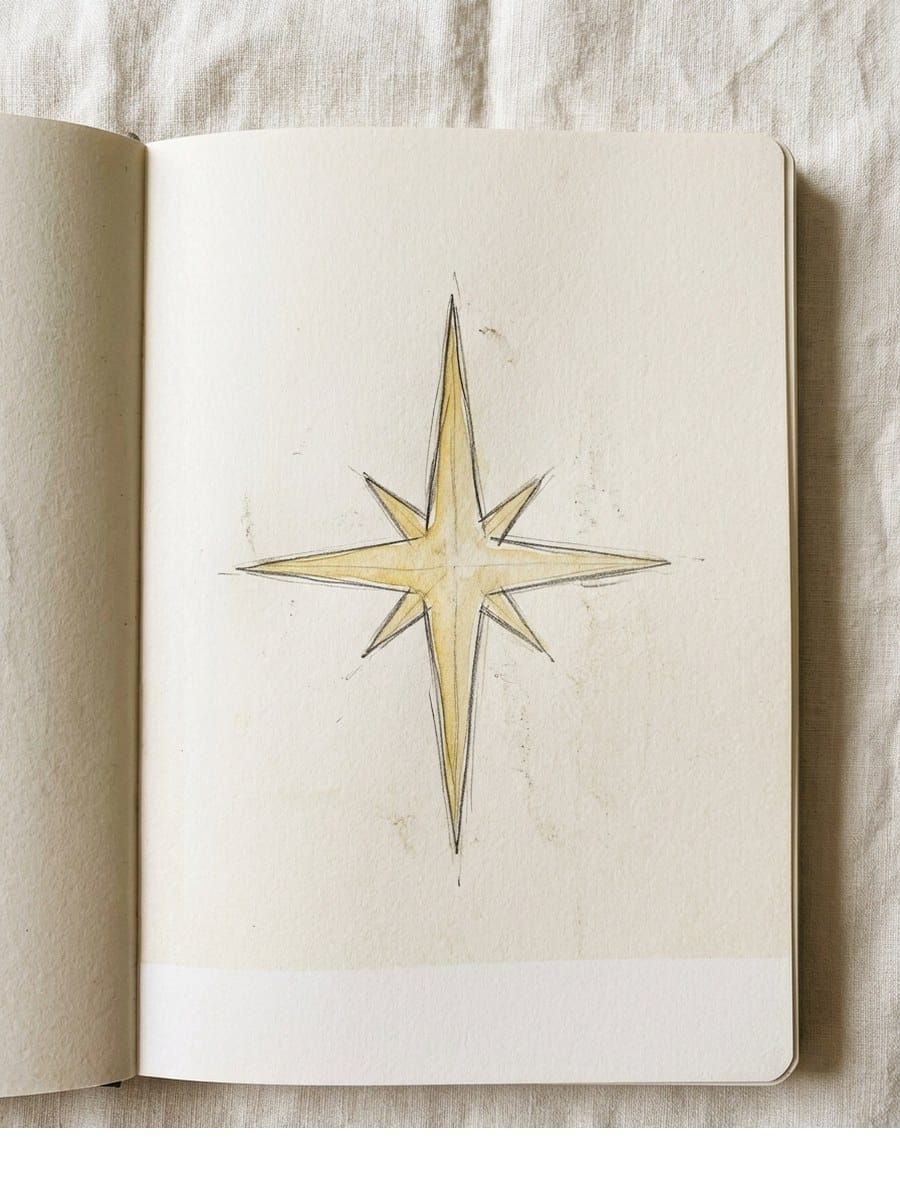
2. The sparkle star
A simple 4-point shape with slim elegant points extending up, down, left and right. Make the vertical points a touch longer than the horizontal ones — that’s the small bit of asymmetry that gives sparkle stars their glimmer-of-light feeling. Scatter a few smaller sparkle dots around the main shape and you’ve got an instant celestial sticker.
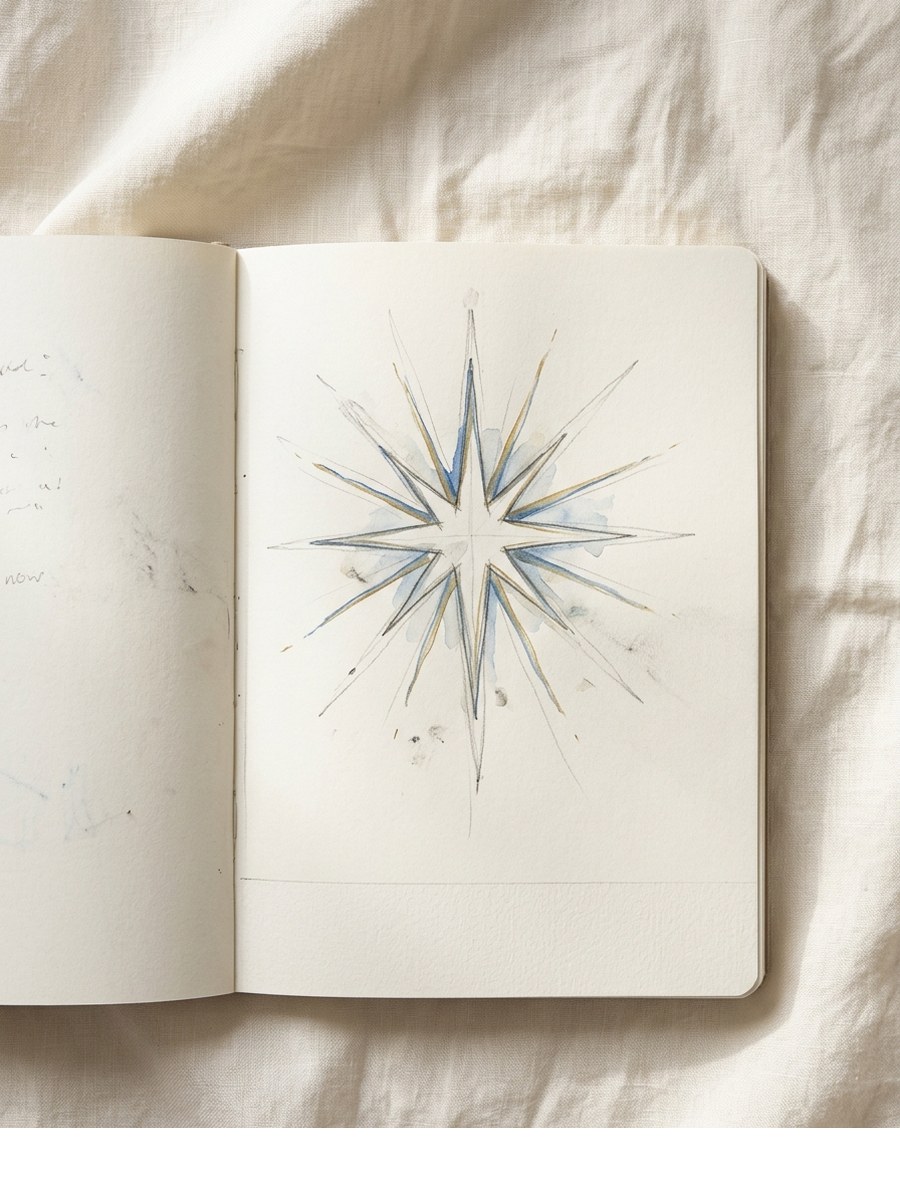
3. The north star with rays
A soft 5-point star with eight delicate radiating rays of varying lengths fanning outward, plus a small circle in the centre and a few tiny sparkle dots between the rays. Looks more complex than it is — once you’ve drawn the central star, the rays are just straight lines that taper to a point. Beautiful with a warm gold wash.
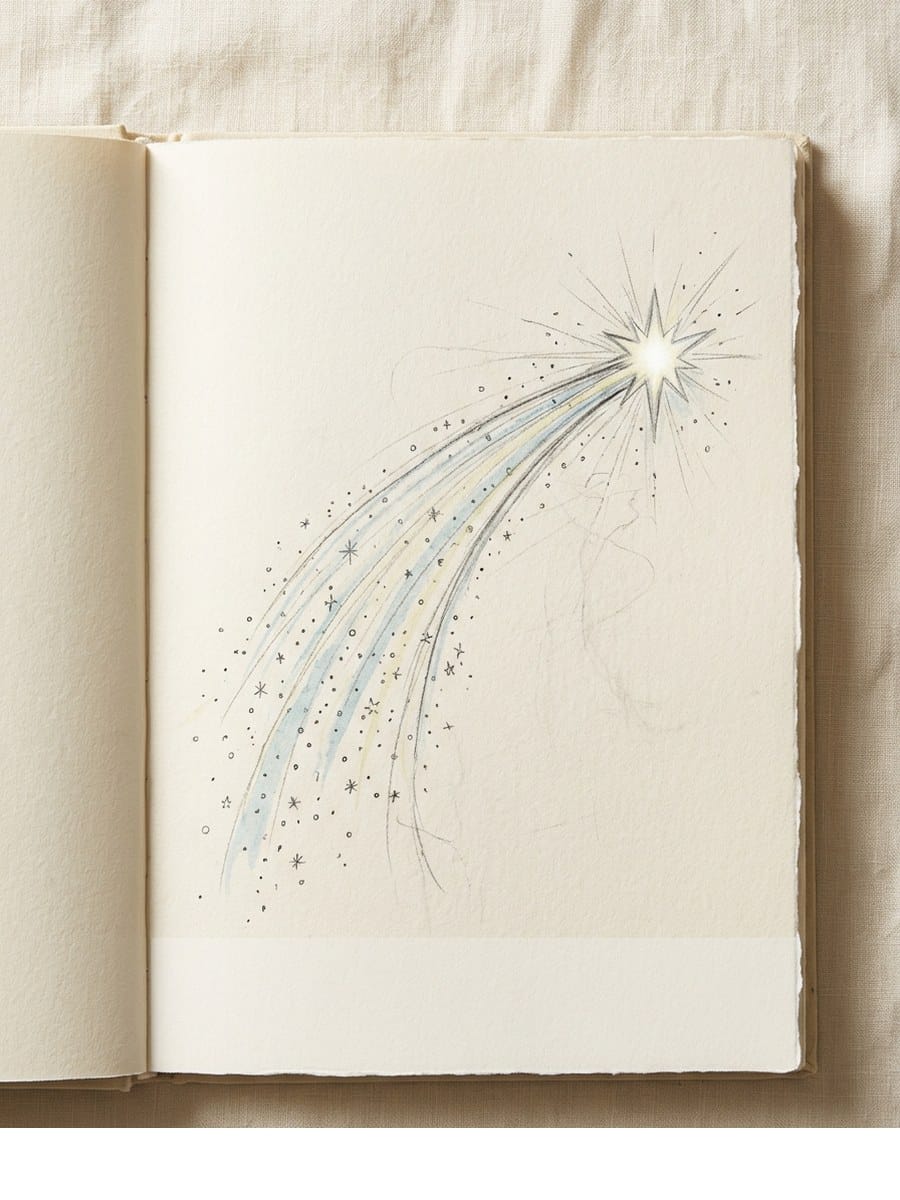
4. The shooting star with trail
A small bright 5-point star with a long curved trail of three soft swirling lines flowing behind it, and a couple of tiny sparkles in the wake. The shape looks intimidating but it’s just a small star and a flowing ribbon — don’t try to be too neat with the trail. A gentle curve is more dreamy than a straight line.
5. The star cluster
A scattered grouping of seven stars in different sizes — some 5-point, some 4-point sparkles, some single dots — arranged loosely across the page. This one is part doodle, part atmosphere. Wonderful as a sketchbook border or a corner accent on a journal page. Vary the sizes and don’t space them too evenly.
6. The decorative ornate star
A 5-point star outline with delicate filigree detail inside (small swirls and dots filling each arm), plus a thin decorative ring around the outside with tiny scallop edges. The detail looks intricate but it’s just small repeating marks — once you’ve filled one arm, the other four follow the same pattern. Lovely with gold ink over a graphite outline.
7. The simple cartoon star
A friendly 5-point star with rounded plump points and a small smiling face in the middle (two simple dot eyes and a tiny curved smile). Add a couple of small floating sparkle dots around it and you’ve got a sticker-style design. Perfect for journal pages about a good day, kids’ room art, or quick celebratory doodles.
8. The constellation
Six to eight small 5-point stars connected by very thin straight lines forming an abstract simple constellation shape. The template suggests a stylised swan or dipper — but you can adapt the connecting lines to spell out an initial, a heart, or any small shape that means something to you. The constellation makes the whole composition feel like a tiny narrative.
9. The star within a mandala circle
A central 5-point star sitting inside a circular mandala frame — the circle has gentle decorative scallop edges and a thin inner ring, with small repeating dot and leaf accents around the border. This is the meditative one. Lovely as a sketchbook centrepiece, and beautiful in a single colour wash with the line work showing through.
10. The star with moon and clouds
A small 5-point star sitting beside a sleeping crescent moon, with two soft cottony clouds floating below and a couple of tiny sparkle dots scattered around. This is the most narrative composition in the pack — a quiet little night sky on the page. Soft pencil for the clouds, a gold wash for the star and moon, and you have a finished mini-piece.
How to take your star drawings further
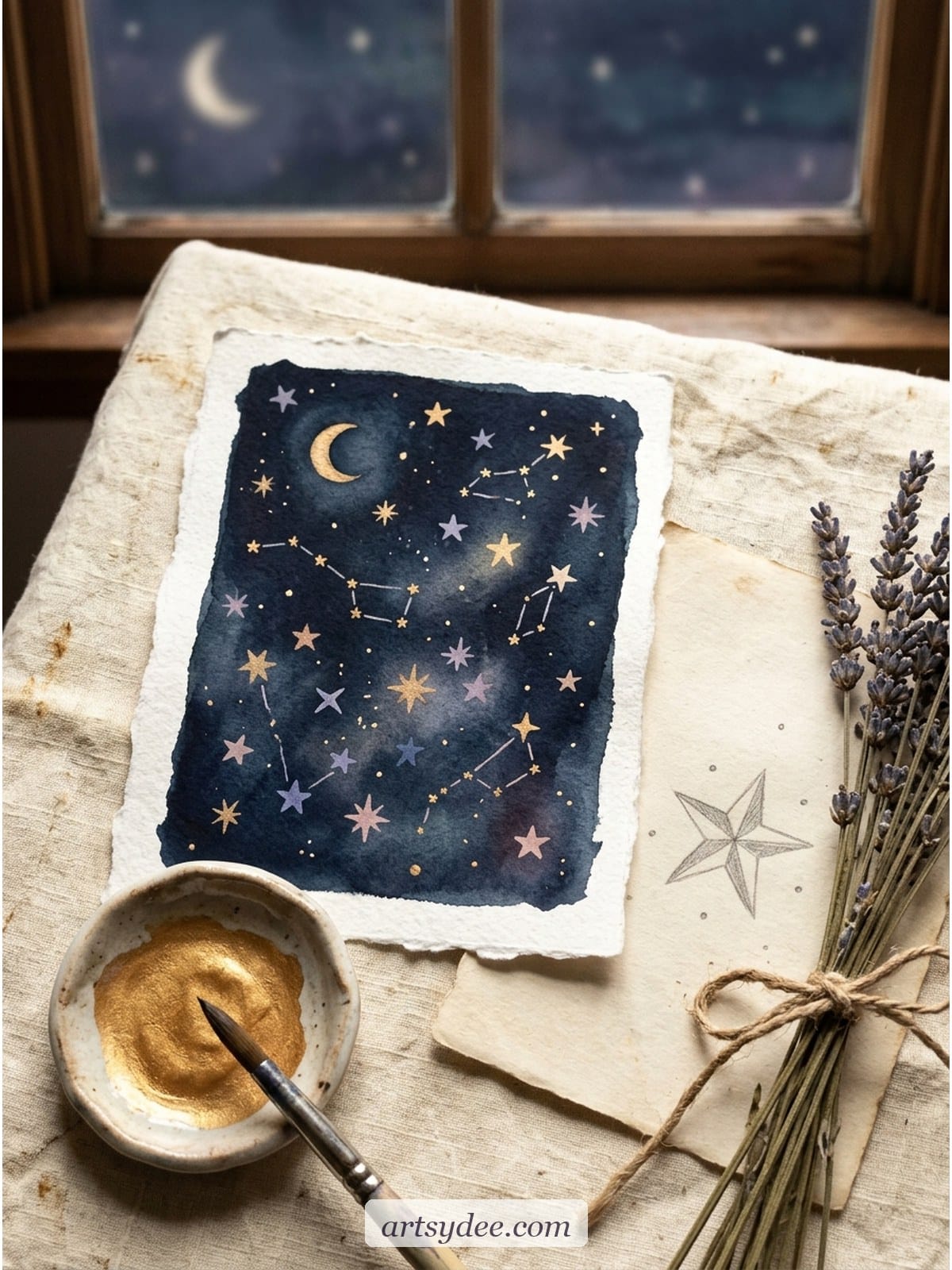
Quick answer: Once you’re comfortable with the line work, paint over a printed template with a soft watercolour wash — warm yellow ochre or antique gold for the star body, indigo or midnight navy for the surrounding sky, a touch of cream for sparkle highlights. Watercolour over a traceable line is the fastest way to graduate from “drawing” to “painting”.
If you want to keep practising, try the same star four times across one page in different mediums — graphite, ink, watercolour, gold gel pen. You’ll learn more from one page of comparison than from four separate finished pieces. And once you’ve drawn one style enough times to know it by feel, try it again in a different palette: the north star is iconic in gold, but it’s stunning in dusky lavender and silver too.
And if stars turn into a phase you want to stay in, my Patreon drops new watercolour template packs every month — the kind you can trace, paint, or re-mix into your own sketchbook. The Tier 2 Creatives Treasure Chest is £8 a month and includes the full back catalogue of watercolour PDFs, Procreate brushes, and printable extras (a lot of which sit in this dreamy celestial-and-botanical space).
Tips for beginners
Quick answer: Sketch with a light pencil first, use a faint guide circle for 5-point stars (the dots sit on a circle, not a pentagon), draw the outline as one continuous line, vary your sparkle sizes for star clusters, and ground your stars in a tiny composition (a moon, a cloud, a swirl) so they don’t float on the page.
- Sketch lightly first. A pencil that’s too dark will dent the page and shadow your watercolour wash. Use a soft hand and a 2H if you’re doing line work, an HB if you’re shading.
- Use a guide circle. For 5-point stars, lightly draw an invisible-feeling circle and mark five evenly-spaced dots around it. The star draws itself from there.
- One continuous line. The classic 5-point star is one stroke — top, lower-right, upper-left, upper-right, lower-left, back to top. No lifting the pencil. The rhythm matters more than the precision.
- Vary your sparkle sizes. A cluster of identical-sized dots looks like polka-dot wallpaper, not a starscape. Mix tiny dots with small 4-point sparkles with a couple of slightly larger 5-point stars.
- Ground them. Even one tiny crescent moon or a soft cloud at the bottom stops a star looking like it’s floating in white space. Add a faint shadow line under the moon if you want extra weight.
Want monthly templates? Join the Patreon
If you’d like a fresh watercolour template pack landing every month — celestial scenes, garden creatures, cherry blossoms, mushrooms, oceans — that’s exactly what my Patreon Tier 2 Creatives Treasure Chest is for. £8 a month, new templates every month, and a growing back catalogue of watercolour PDFs, Procreate brushes, colour palettes, and printable extras.
You can also browse the full Artsydee Payhip shop if you’d rather pick up individual template packs.
Star drawing FAQ
What’s the easiest star to draw for beginners?
Start with the classic 5-point star. Lightly draw a small guide circle, mark five evenly-spaced dots around it, then connect them in one continuous line: top, lower-right, upper-left, upper-right, lower-left, back to top. Erase the circle, and you’ve got a perfect star in under a minute.
Can I print these star templates on regular paper?
Yes — they print beautifully on standard A4 printer paper for tracing and pencil work. If you want to paint over them with watercolour, print onto a sheet of cold-press watercolour paper instead so the paper doesn’t buckle.
How do you draw a 5-point star without it looking lopsided?
The trick is the guide circle. Most beginners try to imagine the points sitting at the corners of a pentagon, which is hard to eyeball. Instead, lightly sketch a small circle and mark five evenly-spaced dots around its edge. Connect them as one continuous line and the star comes out symmetrical every time.
What pencils should I use to draw stars?
A 2H for the initial guide circle and outline (so it stays light and erases cleanly), an HB or 2B for general shading inside the points, and a 4B–6B for the deepest shadows on the ornate star or behind a moon. A blending stump helps for soft cloud textures, but your finger works in a pinch.
Can I sell drawings I make using these templates?
The templates are for personal practice — trace them, paint over them, fill your sketchbook. Original artwork you create after practising is yours. The template files themselves can’t be resold or redistributed.
Final thoughts
If your sketchbook has been quiet, a star is a kind way back in. It’s small, it’s forgiving, it makes space for atmosphere, and it asks almost nothing of you in terms of supplies. Print one of the templates tonight, trace it lightly, and see what happens when you add a soft gold wash and a tiny crescent moon.
📌 Pin this for later — save the pin below to your favourite sketchbook board so the templates stay close to hand. And if you’d like more like this, follow me on Pinterest where I share a new aesthetic drawing prompt or template pack most weeks.
You might also like
- Easy Drawings for Beginners — 50 simple ideas to get you sketching tonight
- Easy Moon Drawings + Free Templates — the perfect celestial pairing for these stars
- Aesthetic Things to Draw — moody, dreamy, sketchbook-friendly prompts
- 100 Sketchbook Prompts — a year’s worth of drawing ideas
- Sketch Ideas for Beginners — gentle, low-pressure drawing prompts
Stars pair so well with moons, clouds and little constellations that ten templates disappear quickly. The Artsydee shop on Payhip has larger printable template packs to keep your celestial sketchbook pages coming.
See the printable packs →