Last Updated on October 1, 2026 by Dee
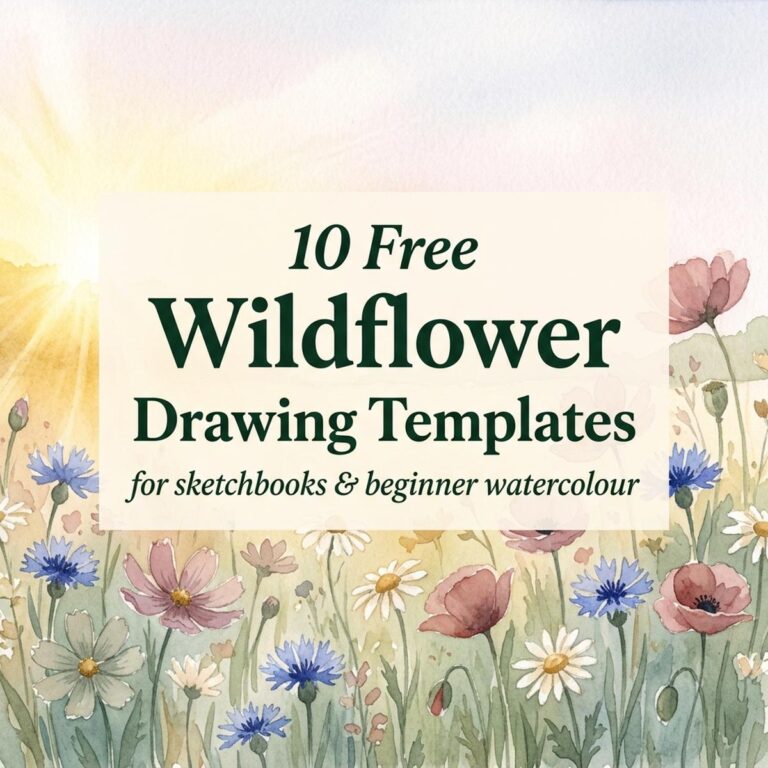
There’s something about wildflowers that makes a sketchbook feel a little more alive. They’re loose, slightly wonky, no two the same — exactly the kind of subject that gives you permission to draw imperfectly. So I pulled together 10 free wildflower drawing templates you can use for pencil sketching, watercolour wash-overs, or just tracing on a tea-and-quiet evening.
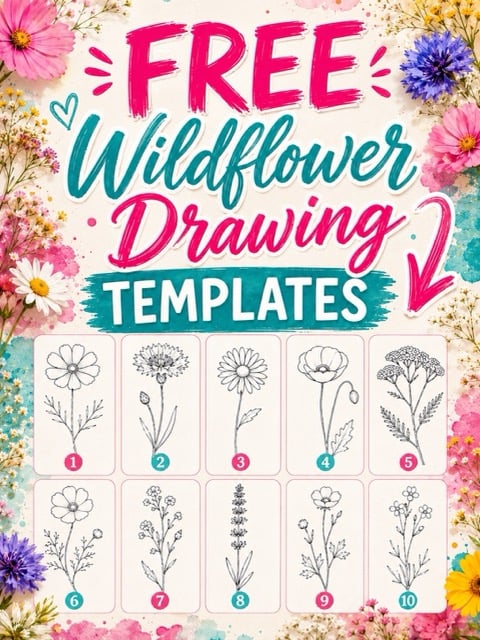
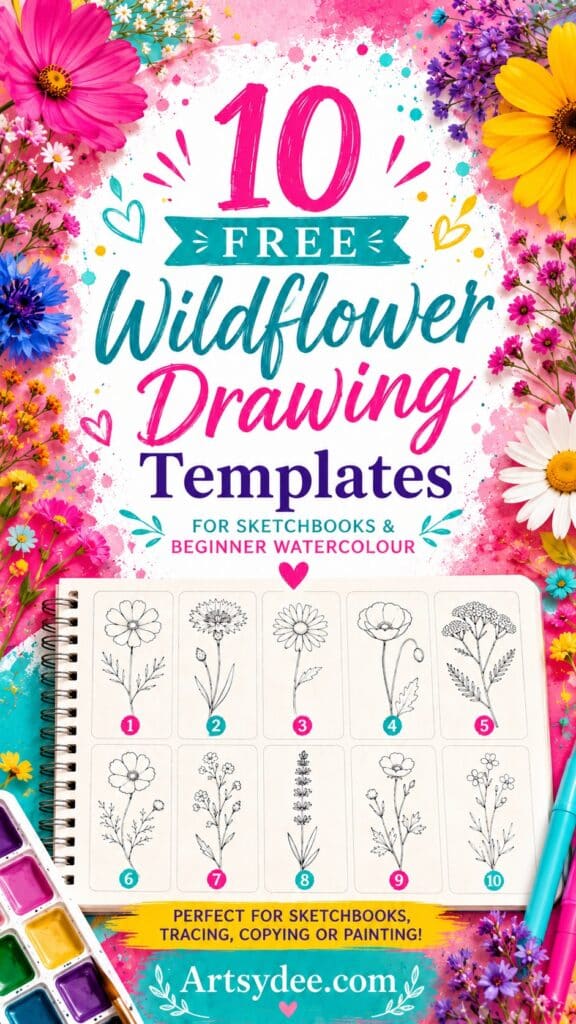
Cosmos, cornflowers, foxgloves, poppies, oxeye daisies, lupin, yarrow, chicory, queen anne’s lace, and tiny forget-me-nots — all soft pencil outlines on cream paper, A4 portrait, drop-them-in-your-printer ready. Grab them below and keep scrolling for tips on how to actually use them.
Get Your Free Wildflower Templates
Pop your email in below and the full printable pack lands in your inbox — cover, how-to-use page, all 10 wildflower templates, and a little thank-you page. No spam, just the freebie and an occasional gentle nudge with new templates.
Worked through all 10 wildflowers? My shop is stocked with premium drawing templates and creative bundles.
Browse the shop →Why Wildflowers Are the Perfect Beginner Sketchbook Subject
Quick answer: Wildflowers are forgiving. They’re meant to look loose and slightly imperfect, so beginner sketchbook artists can’t really “get them wrong” — and that takes the pressure off the page.
If you’ve ever stared at a blank sketchbook page and felt your pencil get heavy, you know that overthinking is the real enemy of a daily art practice. Wildflowers are the gentle workaround. Cornflowers don’t have geometric precision the way a tulip does. Yarrow is just lots of tiny dots. Forget-me-nots are five-petal stars stuck on a stem. The flowers themselves are doing most of the design work — your job is just to follow the lines and add your own quiet touch.
That’s why I built this template pack with soft pencil outlines rather than coloring-page heavy black lines. The lines are gentle suggestions, not rigid borders. You can trace them lightly, sketch over them with confidence, or watercolour right on top with a wash. They’re a starting point — the page doesn’t care what you do next.
What’s Inside the Free Wildflower Drawing Templates
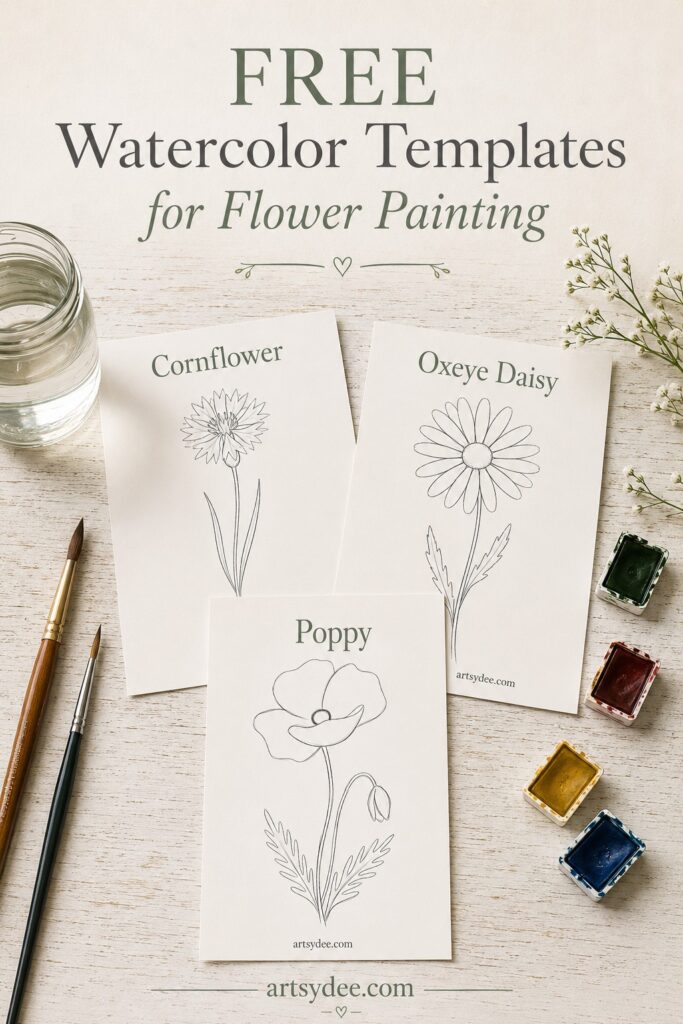
The pack is 14 pages total — 10 wildflower templates plus a friendly cover, a how-to-use page, a little Patreon mention if you want monthly templates, and a thank-you page. Each template page has the wildflower’s common name hand-lettered at the top, then a single soft pencil outline drawing in the middle of the page with plenty of breathing room around it.
- Cosmos — single tall stem with one open eight-petal bloom
- Cornflower — small round bloom with thin spiky petals
- Queen Anne’s Lace — flat lacy umbel of tiny five-petal florets
- Foxglove — tall spike of trumpet-shaped bell flowers
- Lupin — conical stack of pea-shaped flowers with palmate leaves
- Oxeye Daisy — round flat flower with long thin oval petals
- Poppy — four wide papery petals with one droopy bud on the same stem
- Yarrow — flat-topped umbel of tiny florets with feathery leaves
- Chicory — strap-like notched petals around a small centre
- Forget-me-not — small spray of five-petal stars on a curved stem
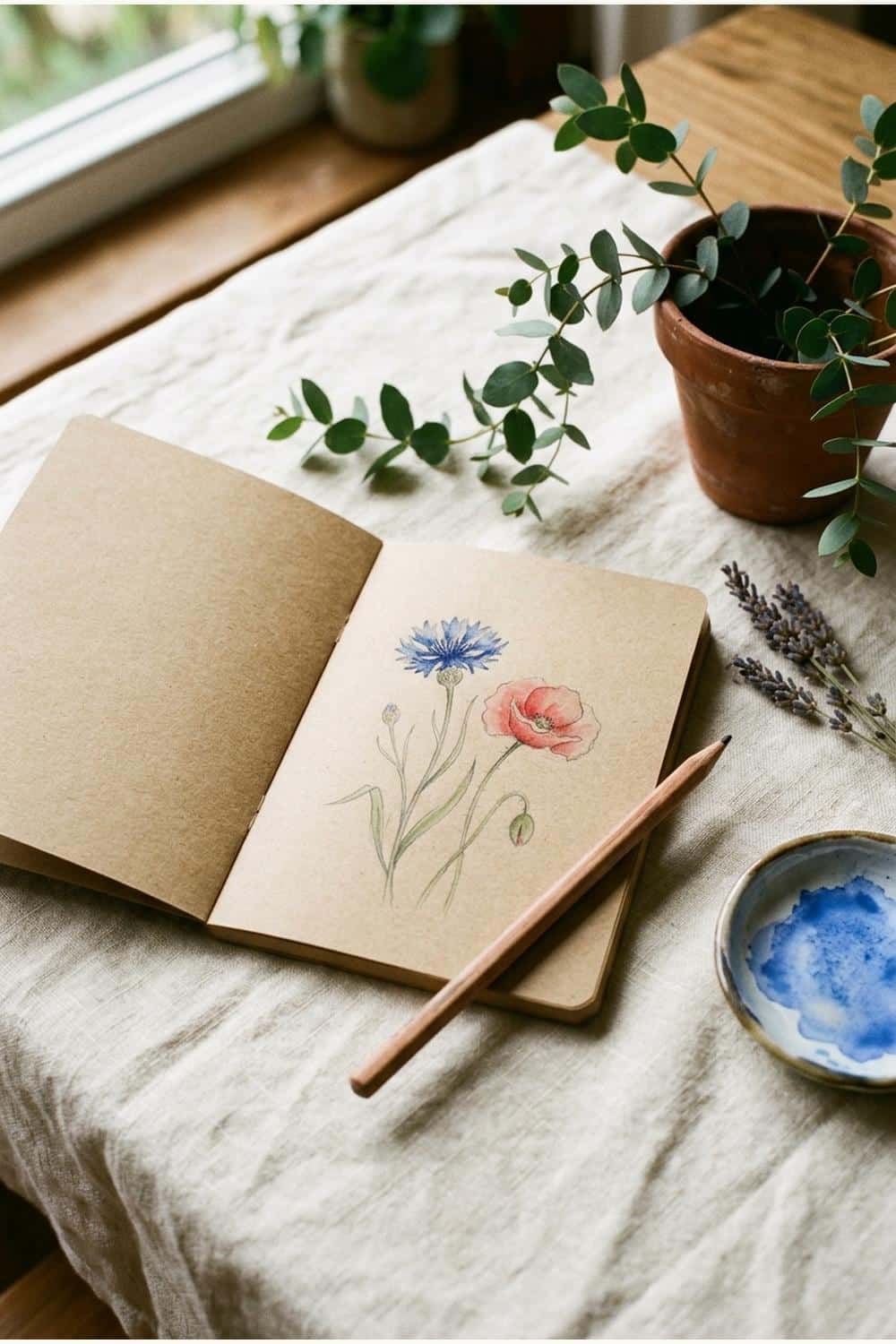
Each template prints cleanly on A4 — regular paper if you’re tracing or sketching with pencil, watercolour paper if you plan to add a wash. I deliberately kept the lines soft and pencil-like (not heavy black) so they almost disappear under a watercolour wash, leaving you with just the painted shape.
How to Use These Templates (4 Easy Ways)
Quick answer: Print on A4, then trace with pencil, sketch over the lines freehand, paint a watercolour wash directly on the printed page, or use them as reference under tracing paper.
1. Trace lightly with a soft pencil
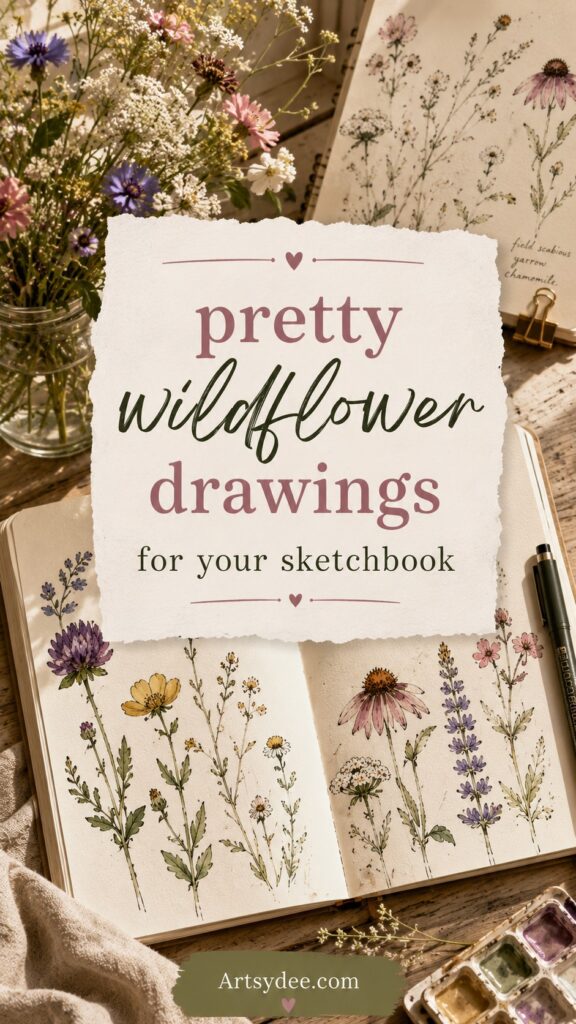
This is the simplest entry point. Print the page on regular paper, lay a fresh piece of cream sketchbook paper on top against a window or lightbox, and trace the outline with a 2B pencil. The original printed page becomes a reusable reference. After tracing, lift it off and you’re left with a clean light pencil sketch on your own paper, ready to develop.
2. Watercolour wash directly on the printed page
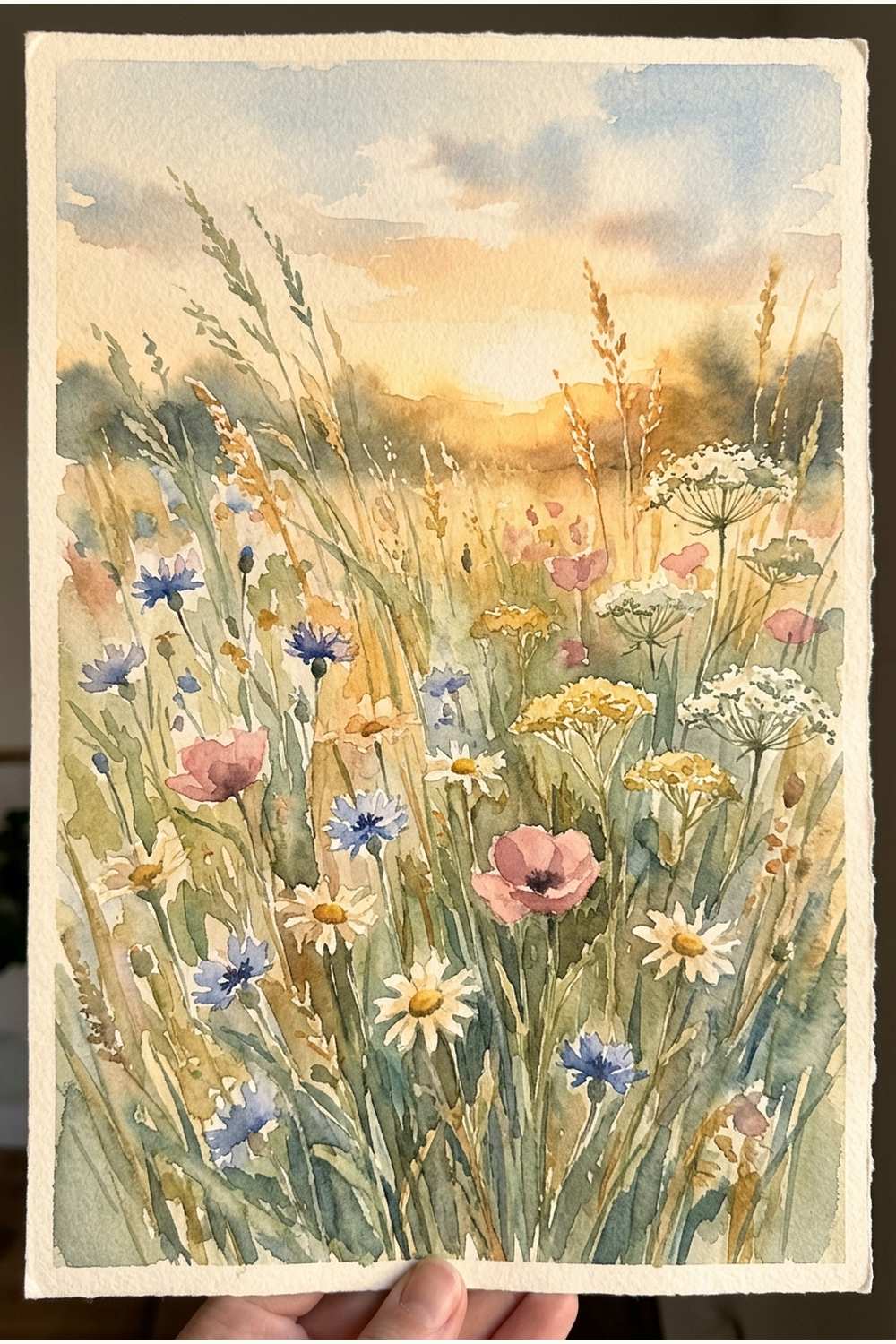
Print on a watercolour-friendly paper (90+ lb/180+ gsm), then paint a soft wash right on top of the pencil lines. The lines are pale enough that they soften under a wet wash and become a guide rather than a border. I like a single dropped colour — a soft cornflower blue, a buttercream yellow, a dusty rose — and let the water do the rest.
3. Sketch over them freehand
Use the printed page as a confidence-builder: hold a fresh page next to it and copy the wildflower freehand into your own sketchbook. The eye learns the shape faster when you’ve got a clear soft reference next to you. After three or four passes you’ll find you no longer need the template — the wildflower lives in your hand now.
4. Use as reference under tracing paper
Lay tracing paper or a smooth-bristol sheet over the printed template, then ink with a fineliner — a 0.3 Sakura Pigma Micron works beautifully — to get a clean line drawing. This gives you a ready-to-paint inked outline without the original pencil getting in the way.
Supplies I Use With These Templates
You don’t need much for these wildflower templates — a printer, some decent paper, and a pencil will get you started. But if you want to level up the watercolour wash version, here are the supplies I reach for again and again. They’re the same ones I keep recommending because they actually work for everyday loose botanical practice.

|

|

|
For the soft pencil work, a Faber-Castell 9000 graphite pencil set in 2B-4B handles the loose outline beautifully without smudging across the page. For the watercolour wash, I keep a small Winsor & Newton Cotman set — the dusty sage and cornflower blue from a basic palette suit wildflowers perfectly.
This post contains affiliate links — if you grab something through one of them I get a tiny commission at no extra cost to you. I only recommend supplies I genuinely use myself.
Want a New Template Pack Every Month?
If these wildflowers gave you that “ooh I want more” feeling, the Artsydee Patreon is where I drop a brand-new printable template pack every single month. Drawing references, watercolour templates, sketchbook prompt cards — whatever’s in season. Patrons also get access to the full back-catalogue and monthly tutorials, plus a cosy little community of folks doodling along.
The Tier 2 Creatives Treasure Chest is £8/month. Have a peek at what’s inside →
Frequently Asked Questions
Are these wildflower drawing templates really free?
Yes — pop your email into the form above and the full 14-page PDF lands in your inbox. They’re for personal use (your sketchbook, your watercolour practice, gifting drawings to friends). Just don’t resell them or claim them as your own.
What size are the templates?
A4 portrait — the standard European page size. They print cleanly on US Letter too, you’ll just get slightly more white border on the long edges.
Can I use them with watercolour?
Yes — that’s actually one of my favourite ways to use them. Print on watercolour-friendly paper (90lb/180gsm or higher), then drop a soft wash directly on top of the pencil lines. The lines are pale enough to disappear under wet pigment.
Do I need to be a beginner to use these?
Not at all. Beginners use them as a confidence-building starting point; more experienced sketchers use them as quick reference for a daily practice — when you don’t want to think about composition, you just want to draw.
Can I print them as many times as I want?
Yes — print as many copies as you like for your own sketchbook practice. The pack is yours forever.
A Gentle Nudge to Start
Pick one wildflower from the pack tonight. Just one. Print the page, pour a cup of tea, and trace or sketch the outline. Don’t aim for perfect — wildflowers don’t grow perfect. Aim for ten quiet minutes of pencil-on-paper. That’s the whole practice.
If you draw one and you feel like sharing, tag me on Instagram @artsydee_inspiring_creations — seeing what folks make with these templates is the highlight of my week.
You can also find me on Pinterest for daily soft botanical inspiration, and on YouTube for slow-paced watercolour tutorials.
You Might Also Like
- Easy Watercolour Sketchbook Ideas for Beginners
- Loose Watercolour Flowers — Gentle Painting Practice
- Sketch Ideas for Beginners (When You’re Stuck)
- 100 Sketchbook Prompts for Daily Practice
Pin this for later!
Ten wildflower templates fill a few sketchbook pages beautifully, then you’ll want more. My Payhip shop has premium template sets, Procreate brushes and creative bundles to keep that daily drawing habit fed.
Have a browse →