Last Updated on September 2, 2026 by Dee
👉 See our complete collection: Best Free Junk Journal Printables (90+ Pages, Tags & Ephemera)
The honest answer to “what do I put in a junk journal?” is: almost anything that’s flat and means something to you. Old tickets, tea-stained paper, pressed daisies, the ribbon off a birthday present — a junk journal is the one craft where your recycling pile and your memory box are both art supply shops.
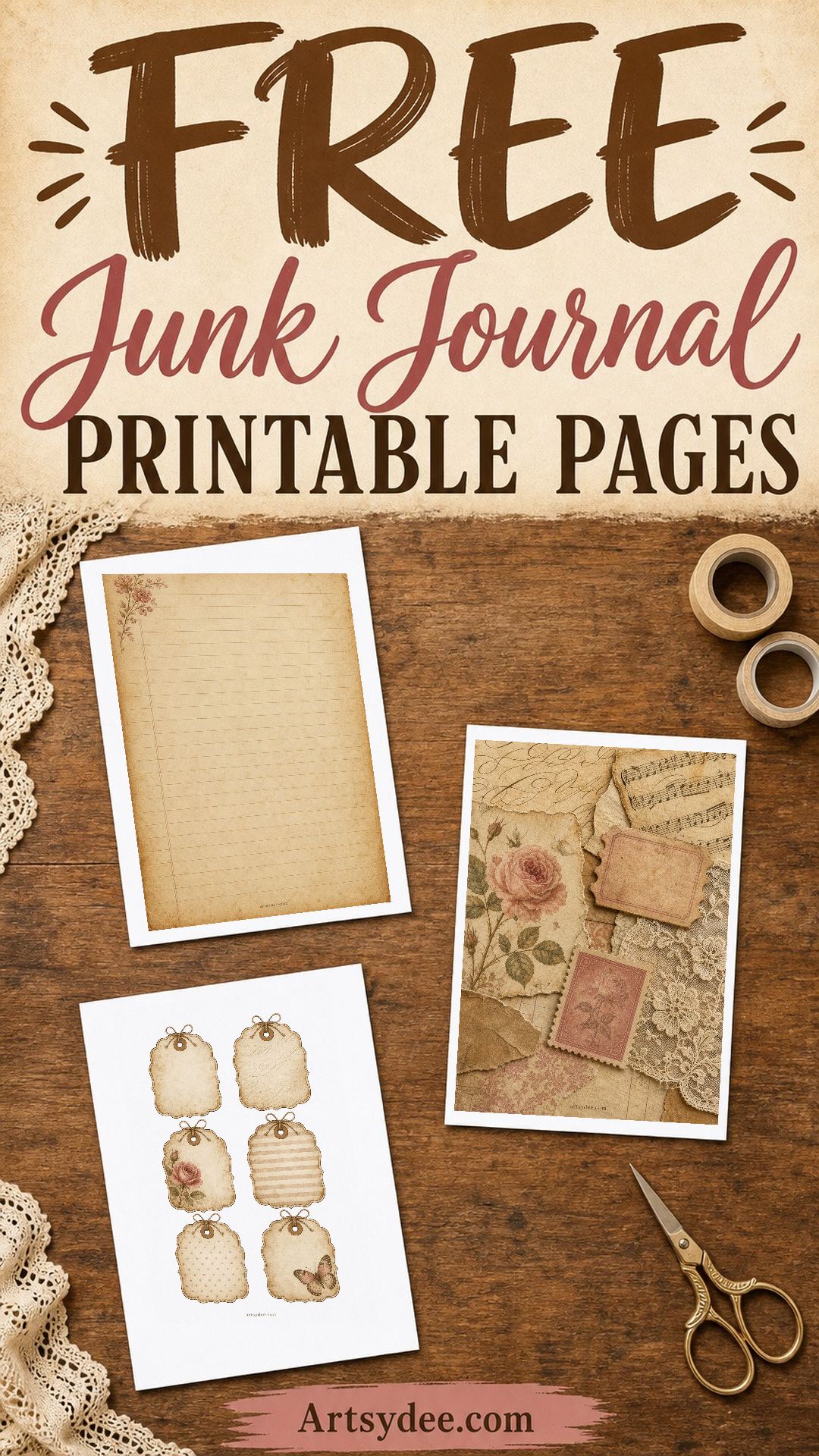
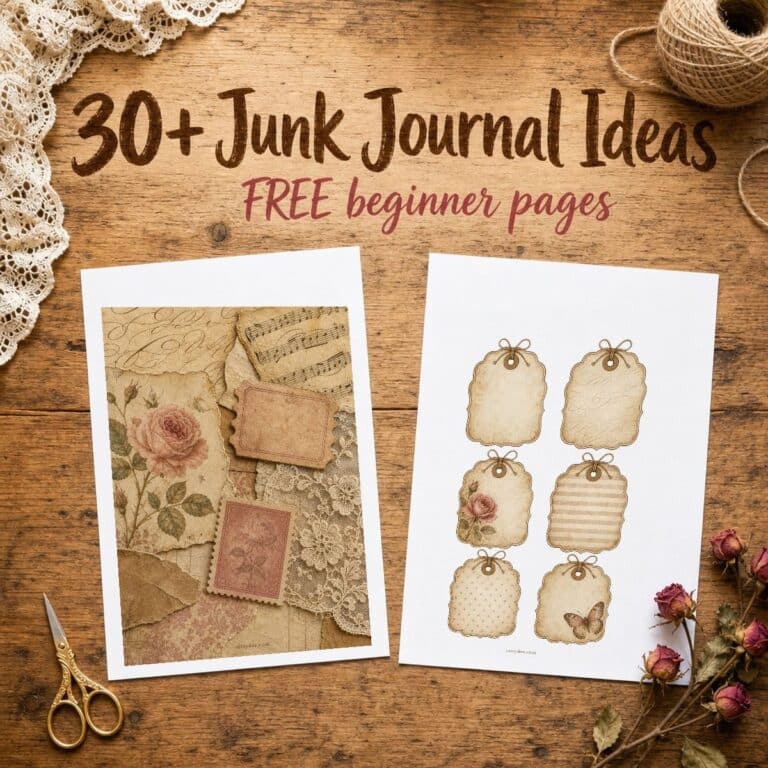
But when you’re standing in front of your very first blank journal, “almost anything” isn’t a helpful answer. So this post gives you 30+ specific ideas, sorted into groups — and to get you started straight away, I’ve made you a free set of 10 printable junk journal pages for beginners: vintage lined paper, scalloped tags, a pocket envelope, washi border strips, faux postage stamps and more. Pop your email below and the whole pack lands in your inbox.
Get Your 10 Free Junk Journal Pages
Download the free junk journal pages 👇
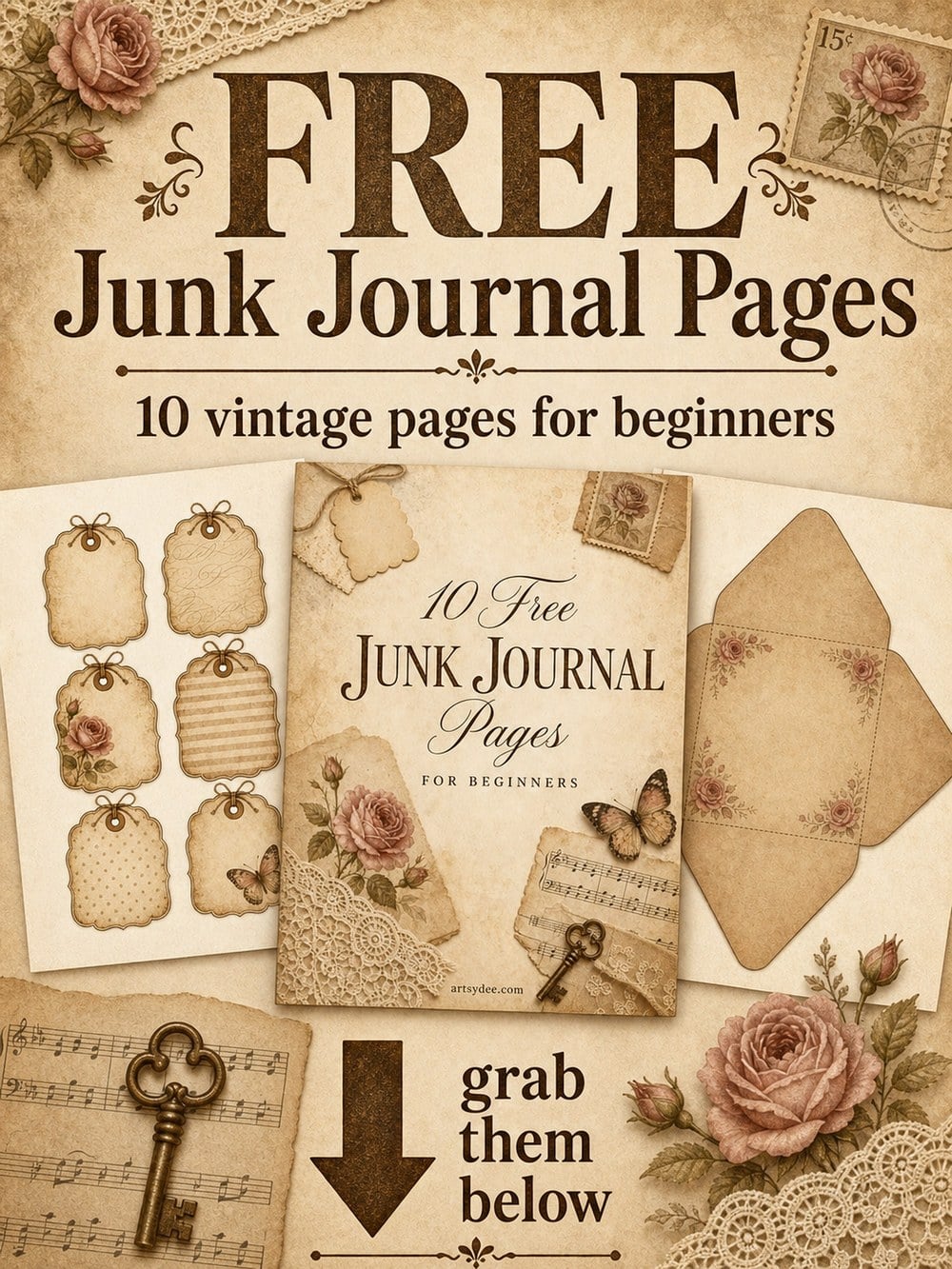
Enter your email above and the full 14-page printable pack — cover, how-to page, all 10 vintage junk journal pages, plus a little thank-you — drops straight into your inbox as a print-ready PDF and individual PNGs. Print, cut, tear, layer. There’s no wrong way to use them.
Table of Contents
What Exactly Goes in a Junk Journal?
Quick answer: a junk journal is filled with ephemera — flat paper bits like tickets, book pages, tags and postcards — plus natural finds, fabric scraps, photos, and your own writing. Unlike a scrapbook, nothing needs to match and nothing needs to be precious. The “junk” is the point: ordinary scraps become beautiful once they’re layered together.
When I run craft afternoons, junk journaling is the session where people relax fastest. There’s no “correct” result to fail at. A bus ticket glued at a wonky angle next to a pressed pansy looks better than something perfectly aligned — the charm lives in the imperfection. If you can glue paper to paper, you have every skill this hobby requires.
One word you’ll meet constantly is ephemera — it just means paper items that were originally made to be thrown away. Ticket stubs, receipts, labels, old envelopes. Junk journalers rescue them, age them, and give them a second life between the pages.
What’s Inside the Free Beginner Pages
The free pack covers the first ten ideas on this list for you, ready to print. Every page is A4 (it prints happily on US Letter too) in a soft vintage palette of sepia, cream and dusty rose:
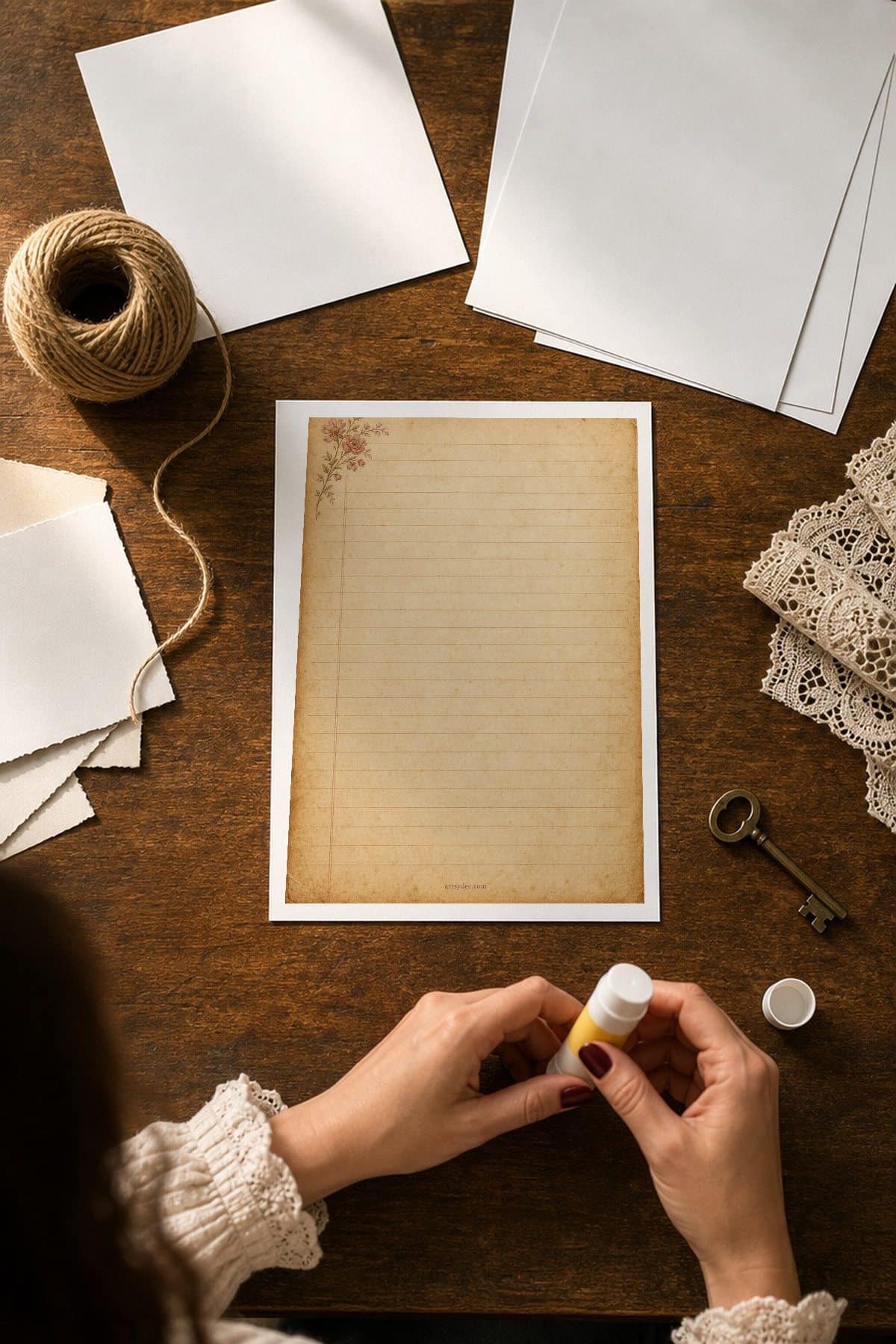
- Vintage lined writing page — aged letter-paper for journaling spots
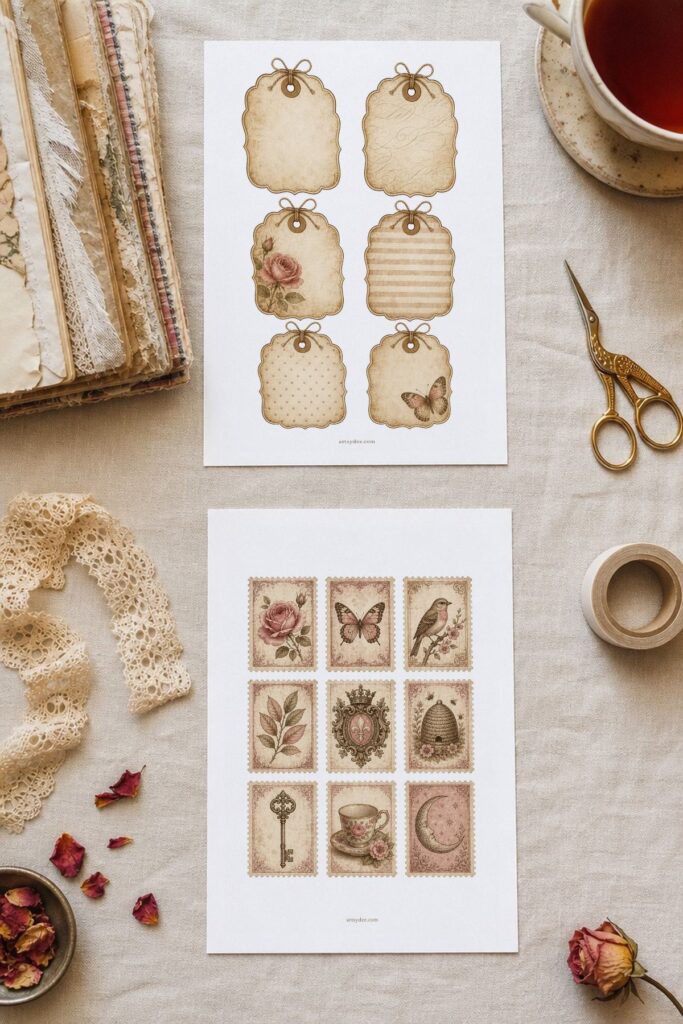
- Scalloped tag set — six cut-out gift tags with drawn string bows
- Pocket envelope template — fold-it-yourself kraft pocket for hiding treasures
- Washi border strips — seven tear-and-glue decorative borders
- Kraft journal frame — an ornate frame page for a title or quote
- Ephemera collage page — a ready-layered background when you want instant depth
- Polaroid frame templates — four instant-photo frames for snapshots or sketches
- Vintage stamp clipart sheet — nine faux postage stamps to fussy-cut
- Scallop page divider — a layered-lace divider to mark sections
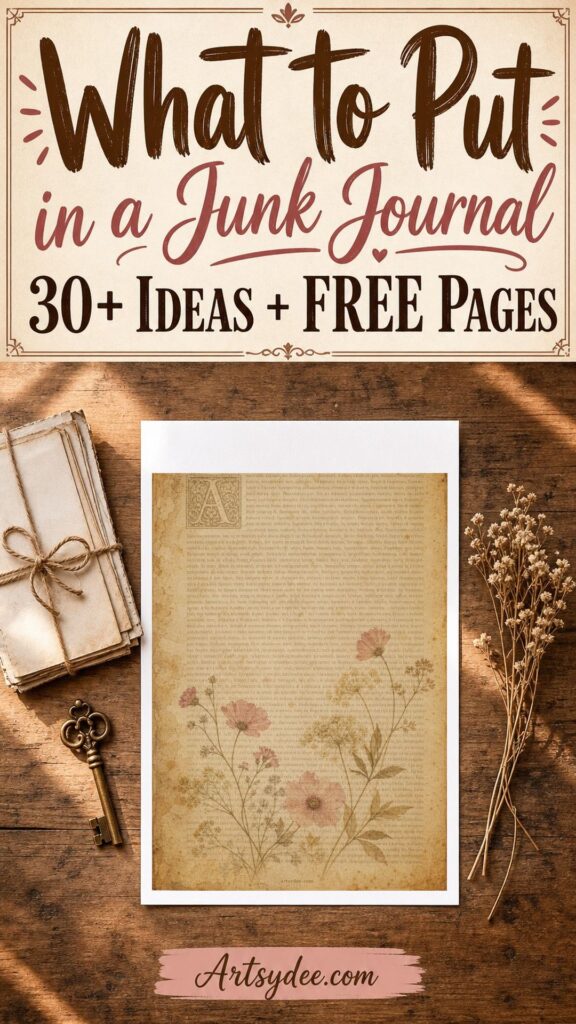
- Vintage book page background — aged book-text paper for layering under everything
Print one copy or twenty — they’re yours for personal use. Now let’s fill the rest of your journal.
Paper Ephemera You Already Own (Ideas 1–10)
Before you buy a single supply, do a lap of your house. Most of these are hiding in a drawer right now:
- Ticket stubs — cinema, train, museum, raffle. Instant memory-keeping with zero effort
- Old book pages — charity-shop paperbacks with yellowed pages are junk journal gold (never wreck anything rare!)
- Sheet music — torn into strips it makes the loveliest layering paper
- Maps and atlas pages — especially of places that mean something to you
- Postcards and greeting cards — the fronts become focal points, the insides become journaling spots
- Envelopes — glue one in by its back flap and you’ve made a pocket; the free pack includes a printable one too
- Receipts and shopping lists — oddly moving years later. A grocery list is a tiny portrait of a week in your life
- Packaging — tea boxes, soap wrappers, the tissue paper from a parcel. Beautiful typography is everywhere
- Sewing patterns — the tissue ones with printed markings are perfect translucent layers
- Postage stamps — steamed off envelopes, or use the faux vintage stamp sheet in the free pack
A quick trick that makes any modern paper look a century old: tea-staining. I’ve got a full tea-stained paper tutorial that turns printer paper into antique parchment with one teabag.
Bits of Nature (Ideas 11–15)
- Pressed flowers — pansies, violets and cosmos press flat and keep their colour beautifully. A heavy book and two weeks is all it takes
- Pressed leaves and ferns — autumn leaves pressed in September will fill your journals all winter
- Dried petals — tuck loose rose petals into a glued-in envelope or a glassine bag
- Seed packets — empty ones are gorgeous ephemera, and they date your garden year
- Feathers — a small found feather under a paper corner or washi strip adds instant texture
Nature bits love company: layer a pressed flower over the vintage book page background from the free pack and it looks like a Victorian herbarium page in about thirty seconds.
Fabric, Lace & Texture (Ideas 16–20)
- Lace scraps — even a 5cm snip of old lace softens a whole spread. Charity shop doilies are a cheap goldmine
- Ribbon and twine — tie them around page edges, dangle them from tags, or stitch them flat
- Fabric swatches — worn-soft florals and ticking stripes glue down surprisingly well with a strong adhesive
- Buttons — grandma’s button tin was a junk journal supply all along. Sew or glue them to sturdier pages
- Washi tape — the gateway supply. Borders, hinges, photo corners, quick fixes — and the free pack has printable washi strips if your stash is thin
Photos & Memory Keeping (Ideas 21–25)
- Printed photos — print them small (four to six per sheet) so they layer instead of dominate. The polaroid frames in the free pack dress them instantly
- Photocopies of old family photos — copy, keep the originals safe, and age the copies guilt-free with tea or distress ink
- Children’s drawings — or shrink them on a photocopier into tiny tuck-spots. Future you will be so glad
- Handwriting samples — a line of a letter from someone you love, a recipe in your nan’s hand. The most precious ephemera there is
- Journaling cards — little dated cards recording what a spread is about. Plain index cards tea-stained at the edges work perfectly
Journaling & Writing Bits (Ideas 26–30)
- Quotes and song lyrics — handwritten on a tag or typed and torn out. The scalloped tags in the free pack were made for this
- Lists — books read, films watched, things you’re grateful for. Lists are journaling for days when sentences feel like too much
- Letters to yourself — write one, seal it in a glued-in envelope, date the front. Opening it a year later is a whole experience
- Daily one-liners — a single sentence about today on the vintage lined page. Low pressure, lovely to reread
- Borrowed words — a line of poetry, a fortune-cookie slip, the message from a birthday card. Words you didn’t write still tell your story
A Few Unexpected Extras (Ideas 31–34)
- Paperclips and safety pins — vintage brass ones clip tags and photos in place and look lovely doing it
- Wax seals — a blob of sealing wax on a tag or envelope flap feels wonderfully ceremonial
- Keys and charms — a small flat key tied on with twine makes a beautiful page dangle
- Teabag papers — rinsed, dried and ironed flat, used teabag paper is the most delicate translucent layer you’ll ever glue down (and it’s free with every cuppa)
That’s well past thirty ideas — and honestly, once you start seeing the world through junk journal eyes, everything flat becomes a candidate. If you’d like more themed inspiration, my moth junk journal ideas and celestial junk journal posts both come with their own free printables.
The Only Supplies You Actually Need
Junk journaling needs shockingly little: something to stick with, something to cut with, and paper — which you now have thirty-plus sources for. These are the three things that live permanently on my own junk journal tray.
For sticking, the Tombow Mono permanent adhesive is my forever glue — no soggy warped pages like wet glue, and the refillable runner lasts ages. For pretty edges, a decorative edge scissors set turns any plain scrap into scalloped, deckled loveliness. And if your washi drawer needs starting, a vintage floral washi tape set covers borders, hinges and photo corners in one go.
This post contains affiliate links — if you grab something through one of them I earn a tiny commission at no extra cost to you. I only recommend supplies I genuinely use myself.
Want 400+ Creative Resources?
If you love these free printables, you’d really enjoy the Artsydee Creations Club. Every week I add new resources — junk journal kits, vintage papers, watercolor templates, coloring pages, and more. Plus you get instant access to a vault of 400+ creative resources the moment you join.
It’s just £8/month (about $10, and there’s a saving on the annual plan) — the easiest way to keep your junk journal stocked with fresh vintage papers. Check out the Creations Club here → Prefer to own kits outright? My Payhip shop has standalone junk journal kits too.
Frequently Asked Questions
What should a beginner put in a junk journal first?
Start with paper ephemera you already own — a ticket stub, a torn book page, a teabag wrapper — layered over a printed background page. The free pack above gives you ten ready-made pages so your first spread isn’t a blank one. Add one written line and the page is done.
What’s the difference between a junk journal and a scrapbook?
Scrapbooks are usually planned, themed and bought-supply based; junk journals are built from found and rescued materials with no rules about matching. A scrapbook documents events; a junk journal is more like a textured, collaged diary that grows page by page.
Are these printable junk journal pages really free?
Yes — pop your email in the form above and the 14-page pack (PDF plus individual PNGs) arrives in your inbox. They’re for personal use: your journals, your gifts, your craft group. Just don’t resell them or claim them as your own work.
Do I need a special journal to start?
No — an old hardback book, a cheap notebook, or a handful of folded A4 sheets stitched down the middle all work. If you’d like to make a proper one, my junk journal covers post walks you through beautiful cover options (with freebies, naturally).
Final Thoughts
Don’t wait until you’ve “collected enough” — that day never comes, and it isn’t the point. Print the free pages, find three scraps with a story, and make one imperfect spread tonight. The journal gets better as you get braver, and you get braver by gluing things down.
You can find me on Pinterest for daily junk journal and printable inspiration, and on YouTube for slow-paced craft and painting tutorials.
You Might Also Like
- Free Junk Journal Vintage Printables
- Vintage Junk Journal Labels (Free Printables)
- Free Junk Journal Background Pages
- How to Make Tea-Stained Paper
- Junk Journal Covers — Ideas + Free Printables
Pin this for later!