There is a particular hour in a winter evening — after the dishes, before bed, when it is properly dark outside and the heating has finally caught up — where you want to be doing something with your hands but nothing that requires a decision.
Colouring in is very good at that hour. You are not composing anything. You are not deciding where the line goes, because somebody else already did. All that is left is the nice bit: choosing a colour, and filling a shape.
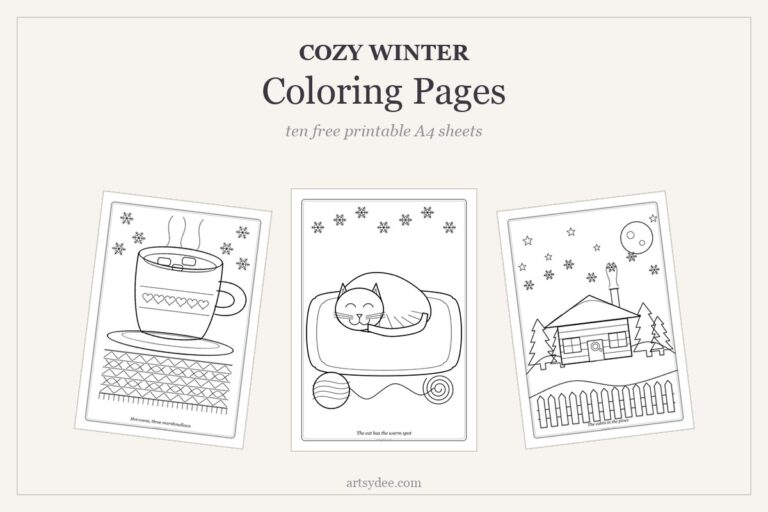
So I have drawn you ten. They are winter rather than strictly Christmas — a mug of cocoa, a window seat, a cat who has claimed the warm spot — which means they are still worth printing in February when you are sick of tinsel. They are free, they print on ordinary A4, and you can grab them just below.
Grab your 10 free winter coloring pages
Pop your email into the box below and I’ll send the ten printable sheets over as one PDF. Print the whole lot, or just the one you fancy tonight.
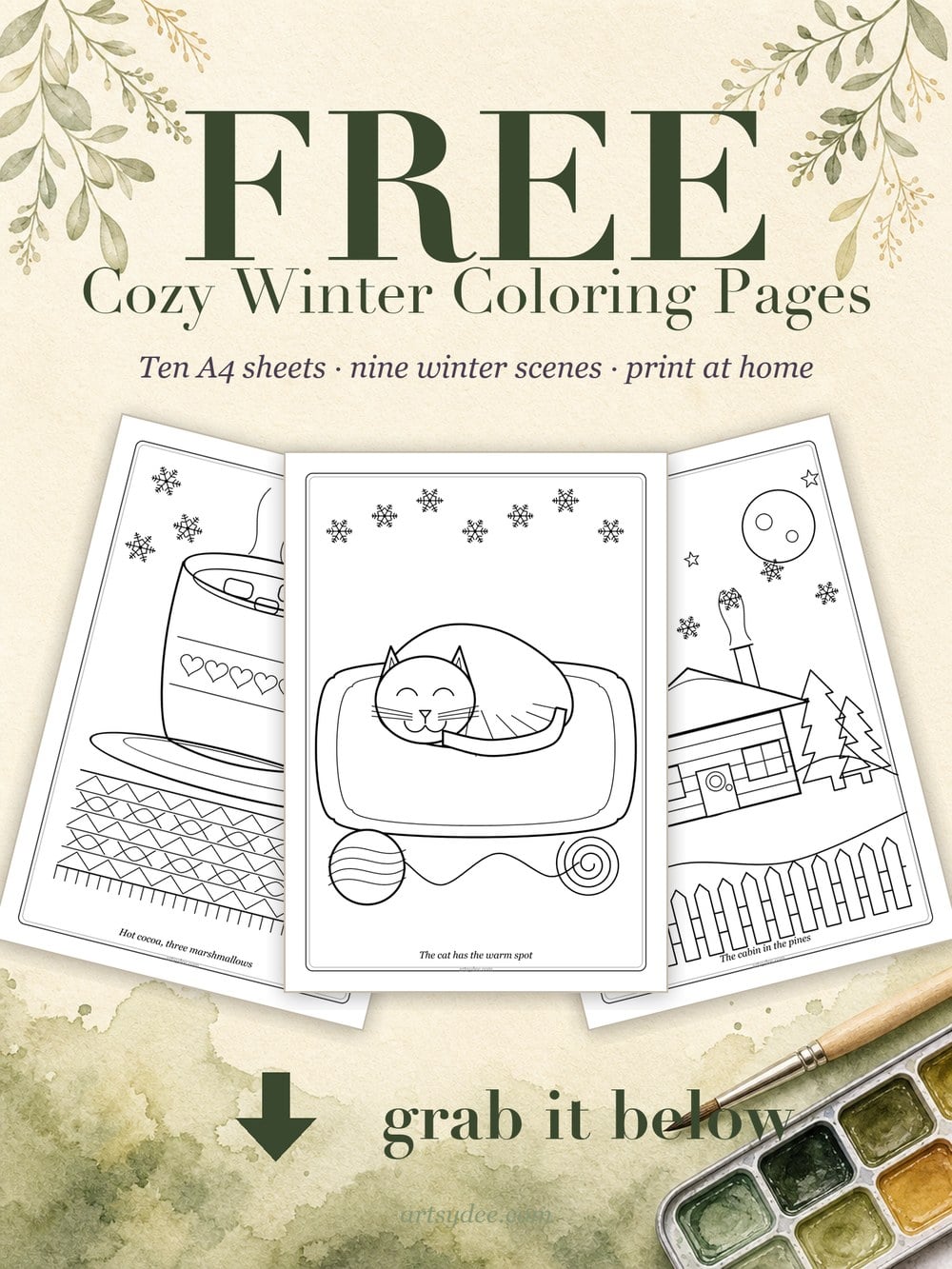
Table of Contents
What’s inside the free set
Ten A4 sheets: nine winter scenes, plus a cover with a wreath on it, because it seemed a waste to give you a title page you could not colour in.
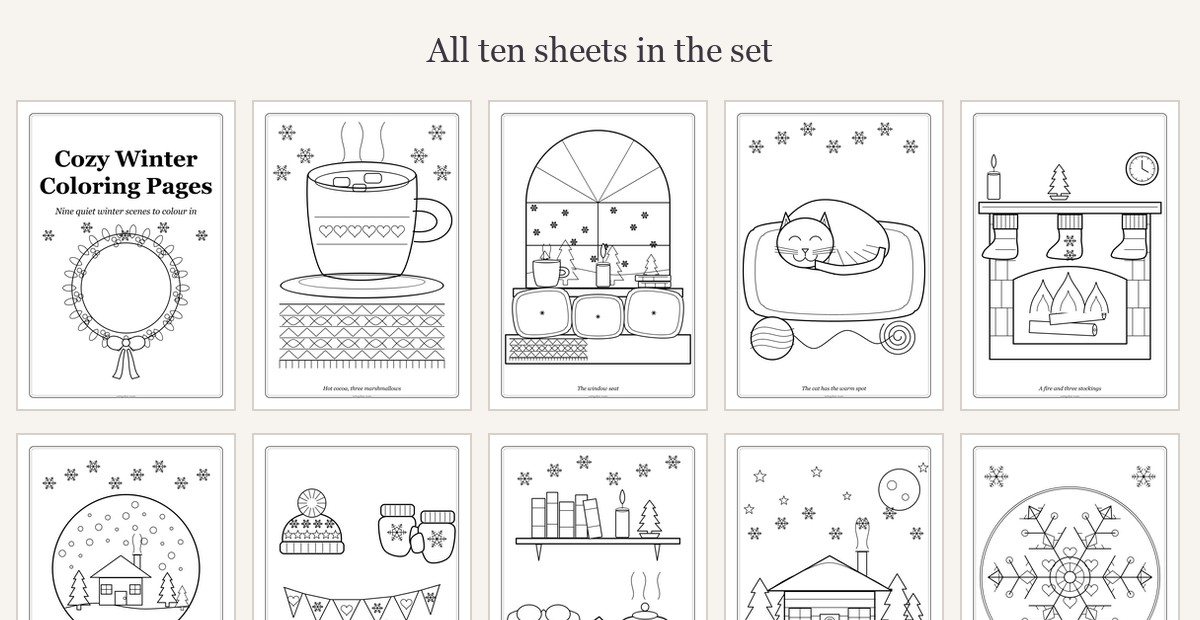
- A wreath cover — leaves, berries and a ribbon bow.
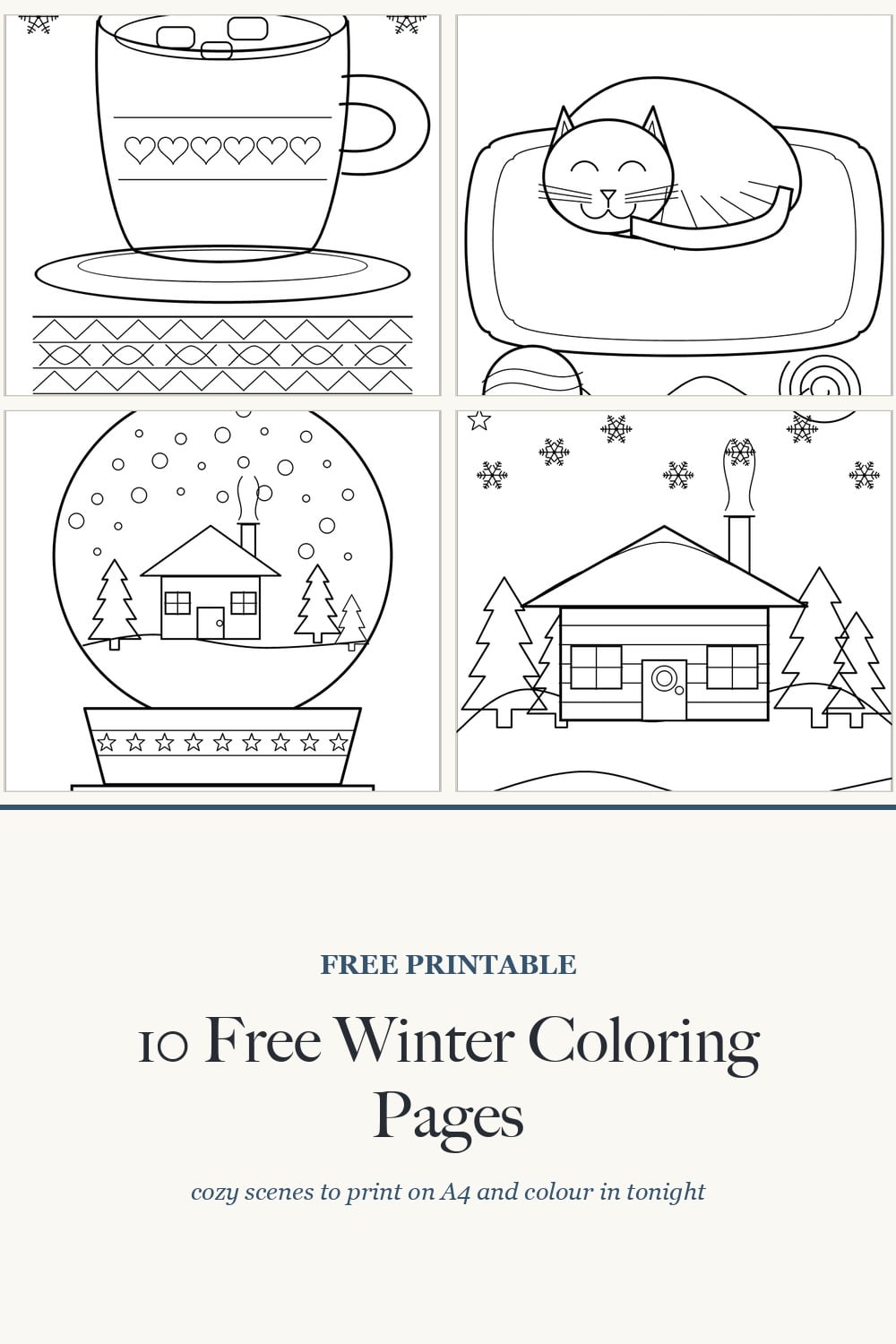
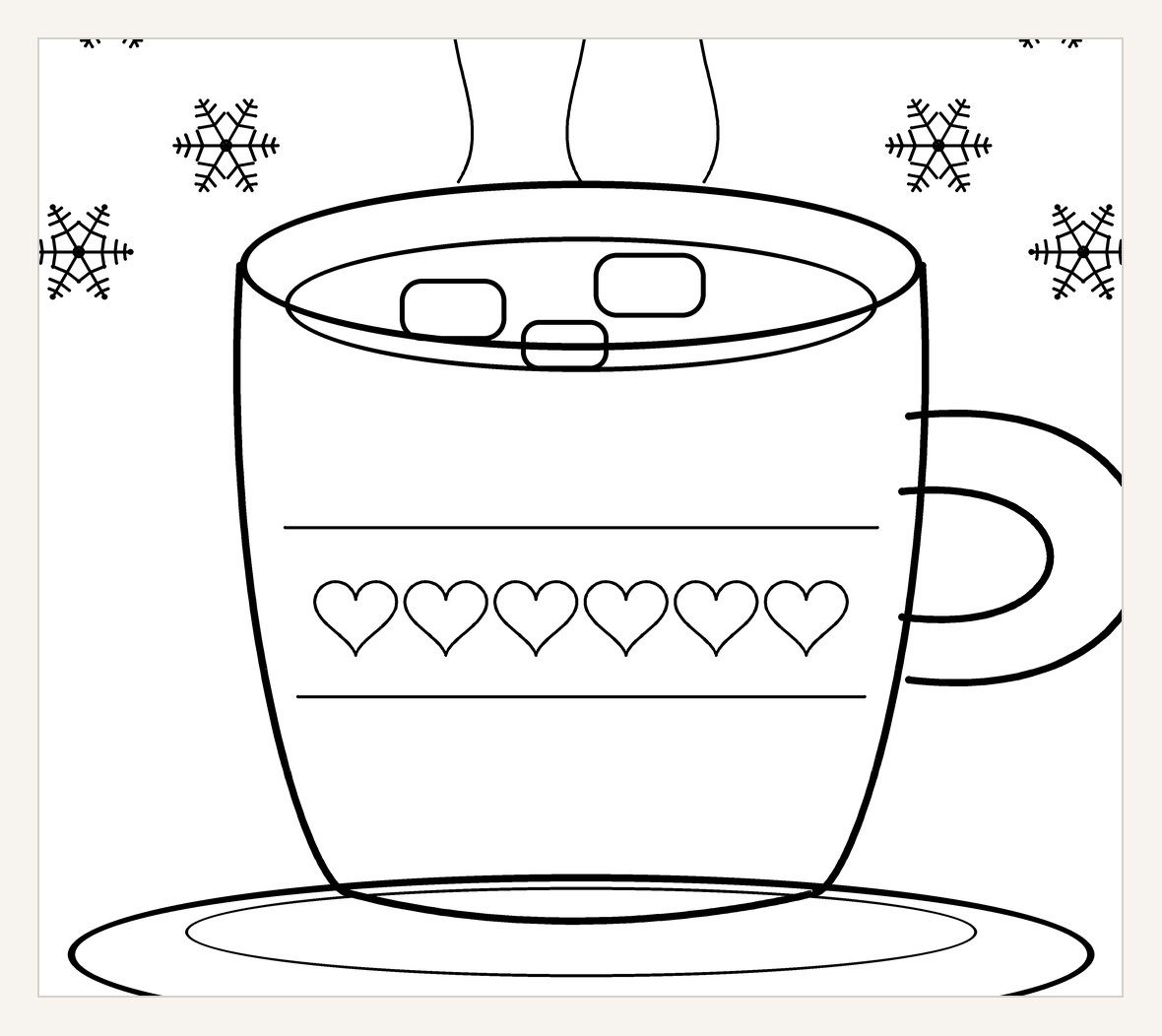
- Hot cocoa — a big mug with three marshmallows, on a folded knitted blanket.
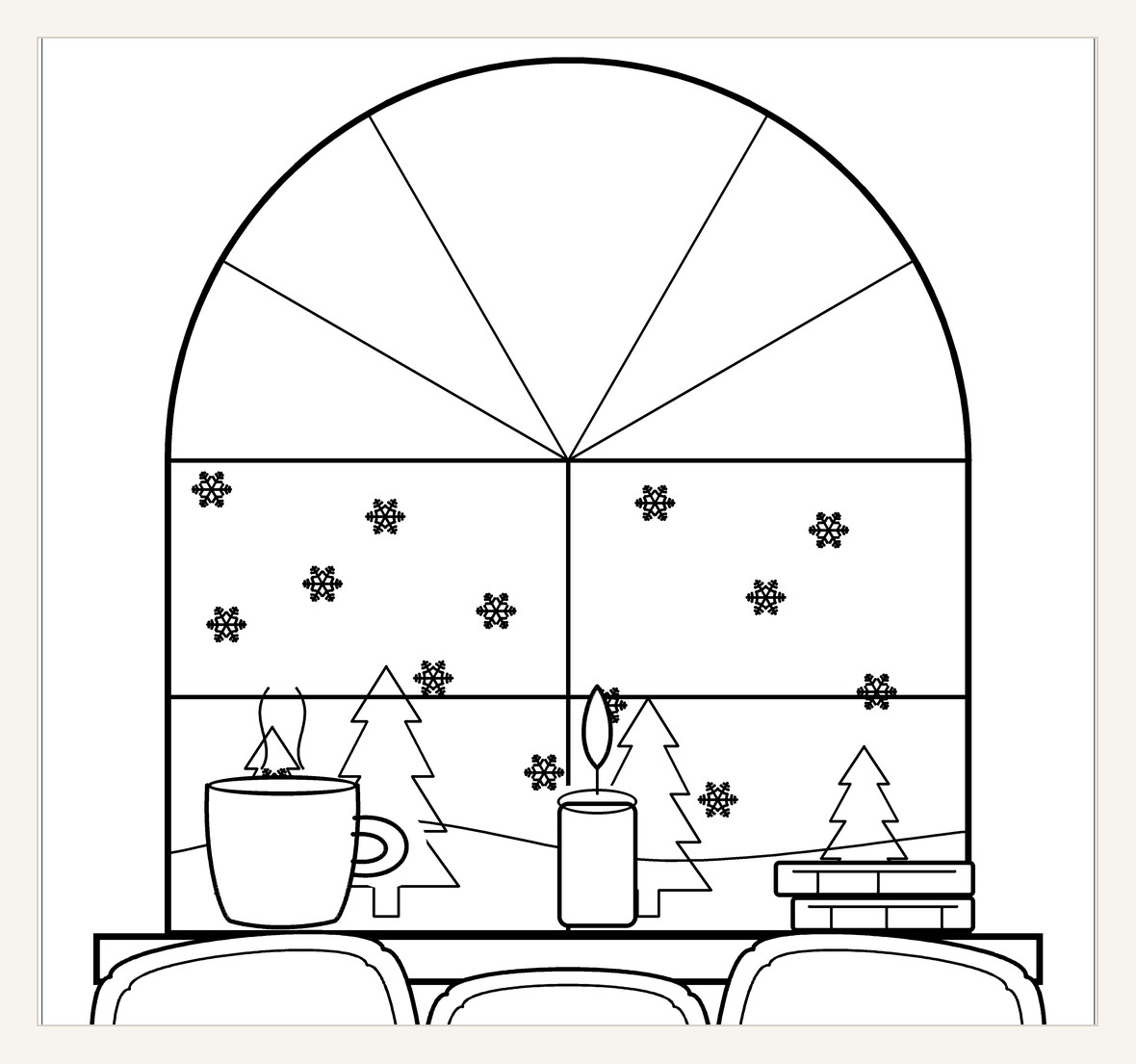
- The window seat — an arched window with snow falling past it, cushions below.
- The cat has the warm spot — curled up, eyes shut, a ball of yarn unravelling.
- A fire and three stockings — brick surround, logs, a clock on the mantel.
- A cabin in a snow globe — smoke from the chimney, firs, a starry base.
- Hat, mittens, scarf — all the woollies, with bunting.
- Books, tea and nowhere to be — a teapot, a stack of books, reading glasses.
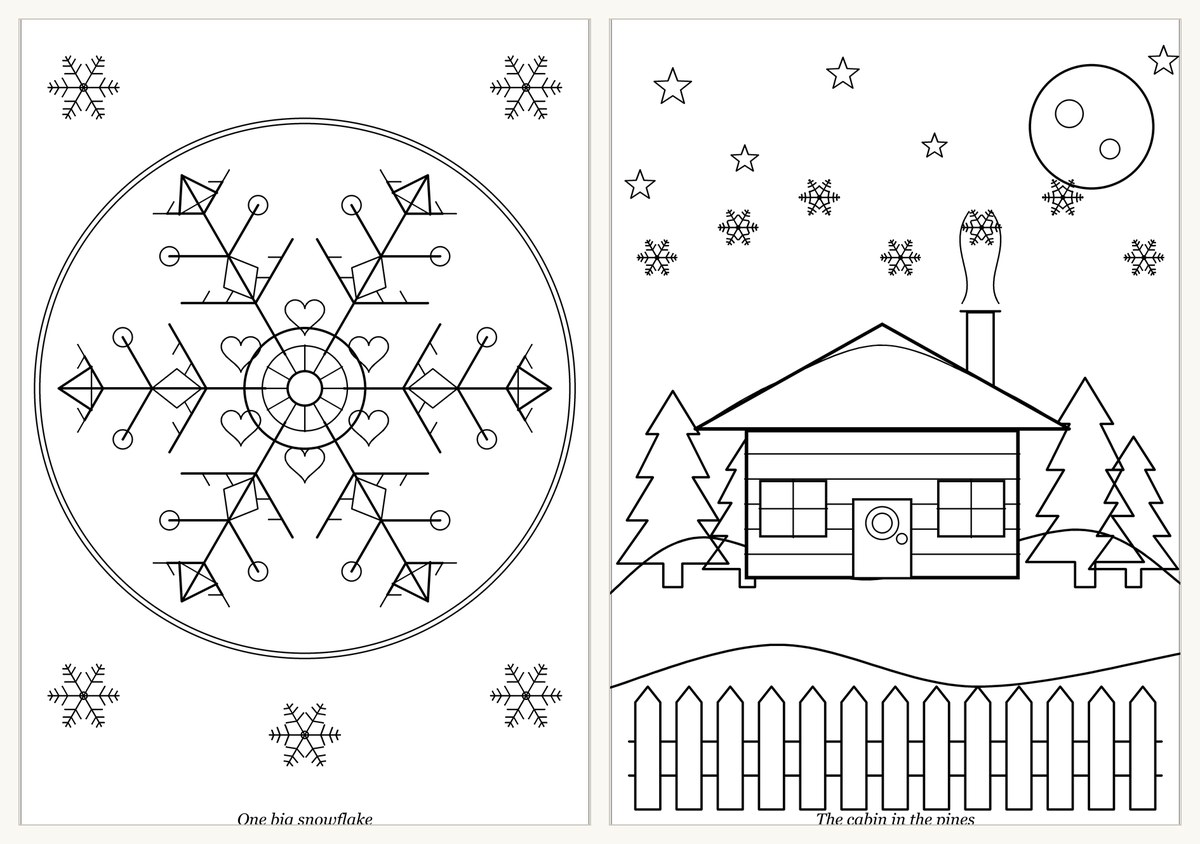
- The cabin in the pines — a moon, a fence, lit windows.
- One big snowflake — a six-fold mandala that fills the page.
Nine of the ten are scenes with a lot of separate shapes in them, which is what you want if you like colouring for a while. The snowflake is the odd one out: it is symmetrical, so it is the one to do if you want the soothing kind of colouring where you repeat a palette round and round.
Why the lines are thick on purpose
These are drawn with a heavy outline and a lighter line for the detail inside. That is deliberate. Very fine lines look lovely on a screen and then disappear under a coloured pencil, and they are miserable to colour up to because you cannot see where to stop. A fat line gives you an edge to aim at. It also survives a photocopier, in case you want six copies for a table of children.
How to print them so they come out right
Nothing here is complicated, but two settings ruin more printables than anything else:
- Print at 100%, or Actual size. Do not use Fit to page — it shrinks everything by a few millimetres and leaves a fat white margin.
- Set the paper to A4. If you are in the US and only have Letter, choose Letter and Fit to page after all — the drawing is well inside the margins, so it will scale down without losing anything.
- Print black and white or greyscale if your printer offers it. There is no colour in these files, and a colour cartridge will mix a muddy black out of three inks for no reason.
- If your printer has a Draft or Economy mode, use it. Line art at draft quality is indistinguishable and uses a fraction of the ink.
Print one page first and look at it before you commit to all ten. It takes thirty seconds and saves the sinking feeling of ten slightly wrong pages in the output tray.
What paper to use
Ordinary 80gsm printer paper is completely fine for coloured pencils and for children. Move up to 160gsm card if you are using felt tips, alcohol markers or anything wet, because thin paper will bleed through and you will end up colouring your kitchen table. If you want to go further than that, I have written a whole piece on printing templates onto watercolour paper, which applies to these just as well.
What to colour them with
Coloured pencils are the easy answer and the best one for these. They let you build up slowly, they do not bleed, and you can go over an area again when you decide it is too pale. If you only own one set, own pencils.
Felt tips and markers give you flat, confident colour and are much faster, which matters if you want a finished page in one evening. Use card. Colour the big shapes with the marker and do the small details in pencil on top — markers are clumsy in a tight corner.
Gel pens, particularly white and metallic ones, are worth having for these specifically. A white gel pen over a dark background is how you get snow to read as snow rather than as an unfilled gap.
Some links in this section are affiliate links. If you buy through them I may earn a small commission, at no extra cost to you. I only suggest things I would use myself.
If you are starting from nothing, these three cover every page in the set:
- Derwent watercolour pencils — they work perfectly well dry, like ordinary coloured pencils, and if you print onto heavier paper you can brush a little water over them later for a soft wintry wash.
- An Ohuhu marker set for big, flat areas like the cocoa mug, the snow globe base and the cabin walls. Use them on 160gsm card, not printer paper.
- A Sakura Gelly Roll white pen for the snow. Colour the sky first, let it dry, then dot the flakes on top — it is the most satisfying five minutes of the whole page.
If you want to use watercolour
You can, with two caveats. Print onto proper watercolour paper, and accept that the printed line may lift slightly if you scrub at it. Work in thin washes rather than puddles. If watercolour is where you actually want to end up, the watercolour Christmas cards post walks through the same wet-on-dry approach on a smaller piece of paper.
Which page to start with
If you have not coloured anything since school, start with the cocoa page. It has a few large shapes at the top — the mug, the marshmallows, the saucer — so you get the satisfying feeling of finishing something within about ten minutes, and the knitted band at the bottom is there if you want to keep going.
If you want the long, absorbing kind of evening, do the cabin in the pines. There are a lot of small things in it: fence posts, log courses, windows, stars. It will take you two or three sittings, and it is the one that looks most impressive on a fridge.
If you are cross about something, do the snowflake. Repetition is unreasonably calming.
Colouring with children
All ten work for children, but they are not toddler pages — there is detail in them. From about six upwards they are fine, and the trick with younger ones is to hand them a page and not mention staying inside the lines at all. Nobody has ever been made to love drawing by being corrected about edges.
The window seat page is the friendliest for a small person, because the snowflakes are separate and each one is a tiny finished job. If you have two children and one page, print it twice rather than making them share — that is not a colouring problem, it is a negotiation problem, and you will not win it.
What to do with a page once it’s finished
Most of them end up in the recycling, and that is genuinely fine — the point was the hour, not the artefact. But a few are worth keeping:
- Trim the snowflake mandala to a square and it is a perfectly good card front.
- Punch a hole in the cocoa page, thread ribbon through it, and it is a gift tag the size of a dinner plate, which is funny and children love it.
- Photograph a finished page in daylight and you have a phone wallpaper nobody else has.
- Glue the cover wreath onto card and hang it — it is already circular, so it does most of the work for you.
Want new printables every month?
If these are your sort of thing, there are a lot more where they came from. Every month I share new colouring pages, watercolour templates, Procreate brushes and full-length tutorials with my Patreon members, plus early access to everything I make.
If you would rather buy one set at a time, all my printable packs are in my Payhip shop too.
Frequently asked questions
Are these winter coloring pages really free?
Yes — all ten of them. Put your email in the box near the top of this post and the PDF lands in your inbox. There is no second locked set and no catch.
Can I print them more than once?
Please do. They are yours to reprint as often as you like for your own personal use, and colouring the same page twice in two different palettes is genuinely worth doing — you learn more from the second one.
Can I use these in my classroom or care home?
Yes. Print as many copies as you need for the people in front of you. What you cannot do is sell the printable files themselves, or hand them out as a freebie to grow somebody else’s list.
Can I sell what I colour in?
No, sorry. The line art is mine, so a coloured-in version is still my drawing underneath. Colour them for yourself, for your wall and for people you like.
Why do they say winter and not Christmas?
Because a mug of cocoa is still relevant on the fourteenth of January and a reindeer is not. If you do want the Christmassy ones, they are over in the cosy Christmas coloring pages and the Christmas coloring pages for adults.
Final Thoughts
Print one page tonight. Not all ten — one. Ten sheets in a tray becomes a task, and a task is exactly the thing this is supposed to be a break from.
If you finish that one and want more, there are the gothic coloring pages for something moodier, and the easy Christmas drawing ideas if you get the urge to draw the lines yourself rather than fill them in. That urge is worth following. It usually turns up about three pages in.
I also make relaxed art videos over on my YouTube channel — subscribe here if you would like the next one to turn up in your feed on a dark evening.
Pin this for later so the pages are easy to find again in January, and come and say hello on Pinterest, where I save all my printables.
Dee x