Last Updated on October 1, 2026 by Dee
There is something almost magical about tangle patterns. You pick up a pen, start drawing one tiny mark at a time, and before you know it you have made something genuinely beautiful — no planning, no special talent, no pressure. It is one of the most calming, beginner-friendly art forms out there, and it deserves a permanent spot in every sketchbook.
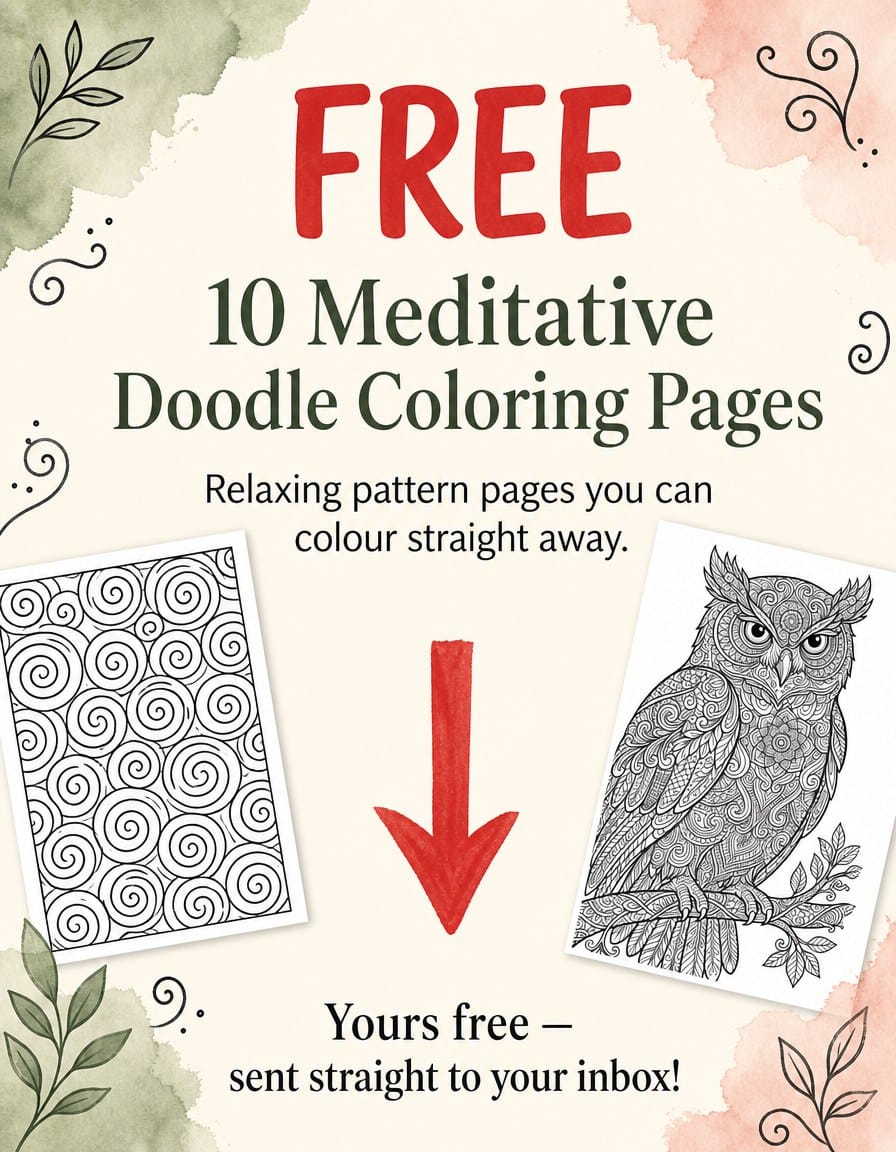
🎨 I made you a free printable pack to get you started — 10 Meditative Doodle Coloring Pages, relaxing pattern pages you can colour straight away, plus a reference sheet and a warm-up sheet to practise on. Pop your email below and it will land in your inbox in a minute or two.
If you have been telling yourself you “can’t draw” for years, tangle patterns are the gentlest possible place to start. The whole idea is that there are no mistakes — just marks. Every wobbly line becomes part of the design. That one shift in mindset is what makes this so freeing (and honestly, a little addictive).
In this post I will share 30 easy tangle patterns for beginners, a simple step-by-step guide to drawing them, the supplies I actually reach for, ideas for what to draw your patterns on, and how this quiet little practice can genuinely support your wellbeing. Grab your free coloring pages above, then read on.
Table of Contents
Free Meditative Doodle Coloring Pages
Before we get into the patterns, grab these free printable coloring pages. Inside the pack you will find a beginner pattern reference sheet with twelve named designs, a warm-up practice sheet, and eight beautiful pattern-filled coloring pages — a mandala, an owl, a butterfly, a floral swirl and more. It is the perfect low-pressure way to practise every pattern you will meet below. Just enter your email above and it lands straight in your inbox.
Want New Printables Every Week?
If you love free printables like these, you would feel right at home in my Patreon membership. Every week I share new coloring pages, watercolor templates, Procreate goodies and colour palettes with my members — plus you get the whole back catalogue the moment you join.
It is the loveliest corner of my creative world, and members shape what I make next. Come and have a look →
What Are Tangle Patterns? (And Why They Suit Beginners)
Quick answer: Tangle patterns are structured, repetitive doodle patterns you build one small mark at a time inside sections of a page. They suit beginners because every pattern is made from the simplest strokes — lines, dots, curves and orbs — so anyone can learn them, and there is no way to get them “wrong.”
Tangle drawing sits somewhere between doodling and meditation. Unlike free-form doodle art designs, you work inside defined sections, choose one repeating pattern at a time, and fill each area with slow, deliberate marks. That gentle structure is exactly what makes it so calming — there is a rhythm and a reason to every stroke, so your mind settles instead of racing.
The golden rule? There are no mistakes. Anything you draw becomes part of the piece. That slightly wobbly line is a design choice now. If you have spent years believing you are “not artistic,” this is the practice that quietly proves you wrong.
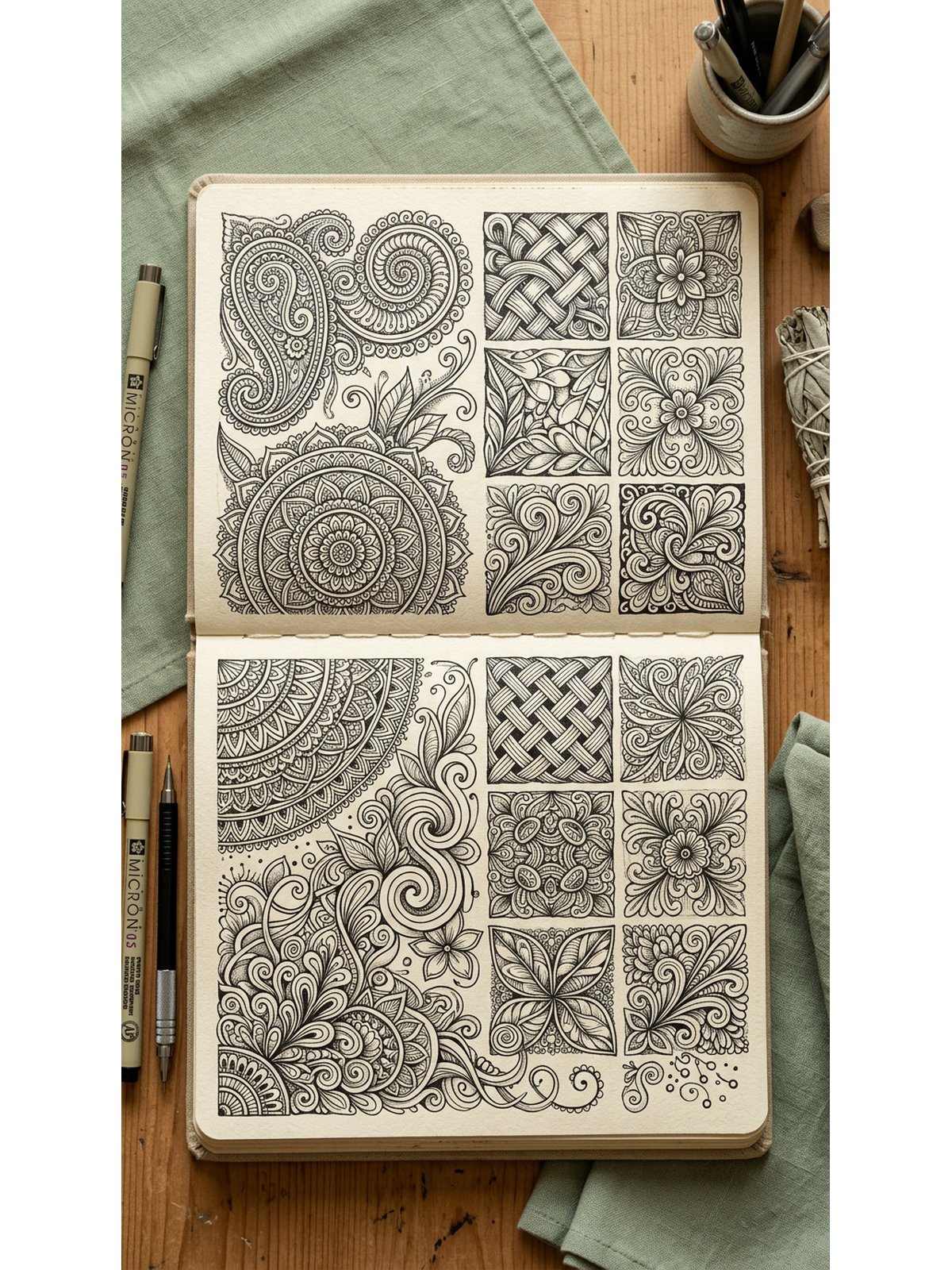
30 Easy Tangle Patterns for Beginners
Here are 30 lovely patterns to get you started, grouped by type so you can build your skills gradually. Start with the basic strokes, then work through the organic, grid-based and nature-inspired designs. (You will find printable practice versions of the beginner-friendly ones in the free pack above.)
Basic Stroke Patterns
These are built from the most fundamental marks — perfect for your very first pages.
- Crescent Rows — rows of crescent shapes stacked like fish scales. Simple, satisfying, endlessly adaptable.
- Bubble Cluster — a scatter of small circles in varying sizes. A brilliant background filler.
- Spiral Swirls — tight little spirals worked from the centre outwards for a bubbly, playful texture.
- Woven Bands — bands of straight lines that appear to weave over and under each other.
- Angled Lines — parallel diagonal lines that switch direction between sections for a woven look.
- Wavy Stripes — gently waving parallel lines that mimic flowing water or fabric.
- Nested Diamonds — a diamond-within-a-diamond repeat that looks complex but follows one clear rule.
Organic Shape Patterns
Softer and more natural — great for filling irregular sections.
- Petal Burst — petal shapes radiating outward from a central point like a stylised flower.
- Flowing Leaves — leaf-like ribbons that flow freely across the page with a graceful energy.
- Ribbon Curls — curling ribbon shapes that twist and loop down the section.
- Leaf Arches — curved leaf shapes arranged in a repeating arch pattern.
- Linked Petals — rounded petal forms that link together into a connected, flowing surface.
- Feather Fans — small teardrop shapes arranged in a fan or feather formation.
- Cushioned Squares — rounded square cells filled with lines for a soft, padded look.
Grid-Based Patterns
These work on a regular grid — wonderful for building precision and confidence.
- Woven Grid — parallel lines within grid cells that alternate direction for a textile effect.
- Bead Rows — curved lines within grid cells that produce a rounded, 3D bead-like surface.
- Interlock — a tessellating pattern of interlocking shapes that fills space beautifully.
- Basket Weave — diagonal lines within squares that create a woven basket appearance.
- Connected Dots — gentle curves connecting a grid of dots — elaborate-looking, single simple rule.
- Brick Rows — rounded rectangles arranged in a brick-like offset grid.
- Checker Shade — a simple checkerboard of filled and empty squares, shaded for depth.
Nature-Inspired Patterns
These draw on botanical forms and natural textures — lovely for journal borders and sketchbook pages.
- Fern Frond — a delicate arrangement of small pointed leaves along a central stem.
- Grass Tufts — feathery grass-like strokes growing upward in gentle clusters.
- Pinecone Scales — overlapping scales in a spiral — a little practice, stunning results.
- Sea Tendrils — organic, free-flowing forms inspired by sea creatures and plant tendrils.
- Echo Outlines — concentric outlines that follow the silhouette of a leaf or petal.
- Contour Stripes — layered stripes that follow the edges of a shape to create dimension.
- Dewdrops — simple teardrop shapes in neat rows, like rain on a window.
- Honeycomb — tiny circles arranged in a soft honeycomb formation.
- Twining Vines — two vine-like lines that weave and intertwine across the page.
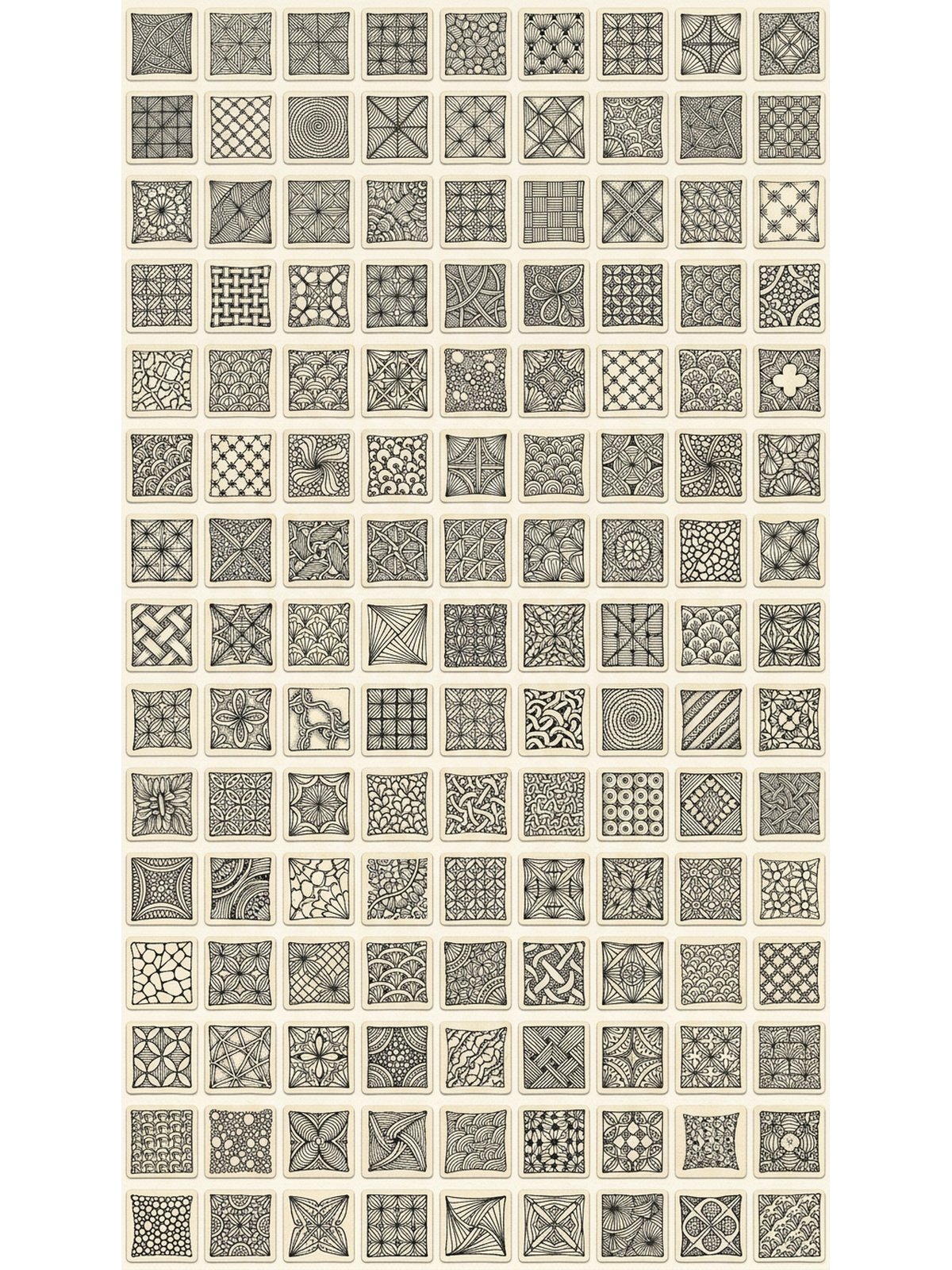
How to Draw Tangle Patterns Step by Step
Ready to make your first page? Here is the classic process, followed by four beginner-friendly patterns to try.
Setting Up Your Page
- Start with a small square of smooth white card — around 3.5 inches is traditional, but any paper works.
- With a pencil, lightly draw a border about 5mm from the edge to frame your page.
- Still in pencil, draw a few freeform lines inside the border. These “strings” divide the page into sections to fill.
- Switch to your pen and fill each section with one chosen pattern. Complete one before moving to the next.
- When every section is filled, add light pencil shading along edges and under overlapping elements for depth.
- Sit back and enjoy what you made.
Step-by-Step: Spiral Swirls
- Draw a small dot anywhere in your section.
- Draw a tight spiral around it — just two or three rotations.
- Draw another spiral beside the first, letting them nearly touch.
- Fill the section with spirals of slightly varying sizes.
- Shade the centre of each spiral for a lovely dimensional effect.
Step-by-Step: Crescent Rows
- Draw a curved line from one side of your section to the other.
- Draw another curve beneath it, slightly offset, like a crescent.
- Repeat, building rows of crescents that overlap like fish scales.
- Add a few small lines inside each crescent for texture.
- Shade along the lower edge of each crescent to add depth.
Step-by-Step: Flowing Leaves
- Draw a gentle S-curve flowing across your section.
- Add a second curve parallel to the first to create a leaf or ribbon shape.
- Add a central vein down the middle of the ribbon.
- Add small parallel lines on either side of the vein, like leaf veins.
- Repeat the ribbon in different directions to fill the section.
Step-by-Step: Bubble Cluster
- Draw a small circle about the size of a lentil.
- Draw another circle right beside it, touching but not overlapping.
- Fill the section with circles in varying sizes.
- Where circles cluster, leave tiny slivers of white space between them.
- Shade lightly between the circles to bring the bubbles forward.
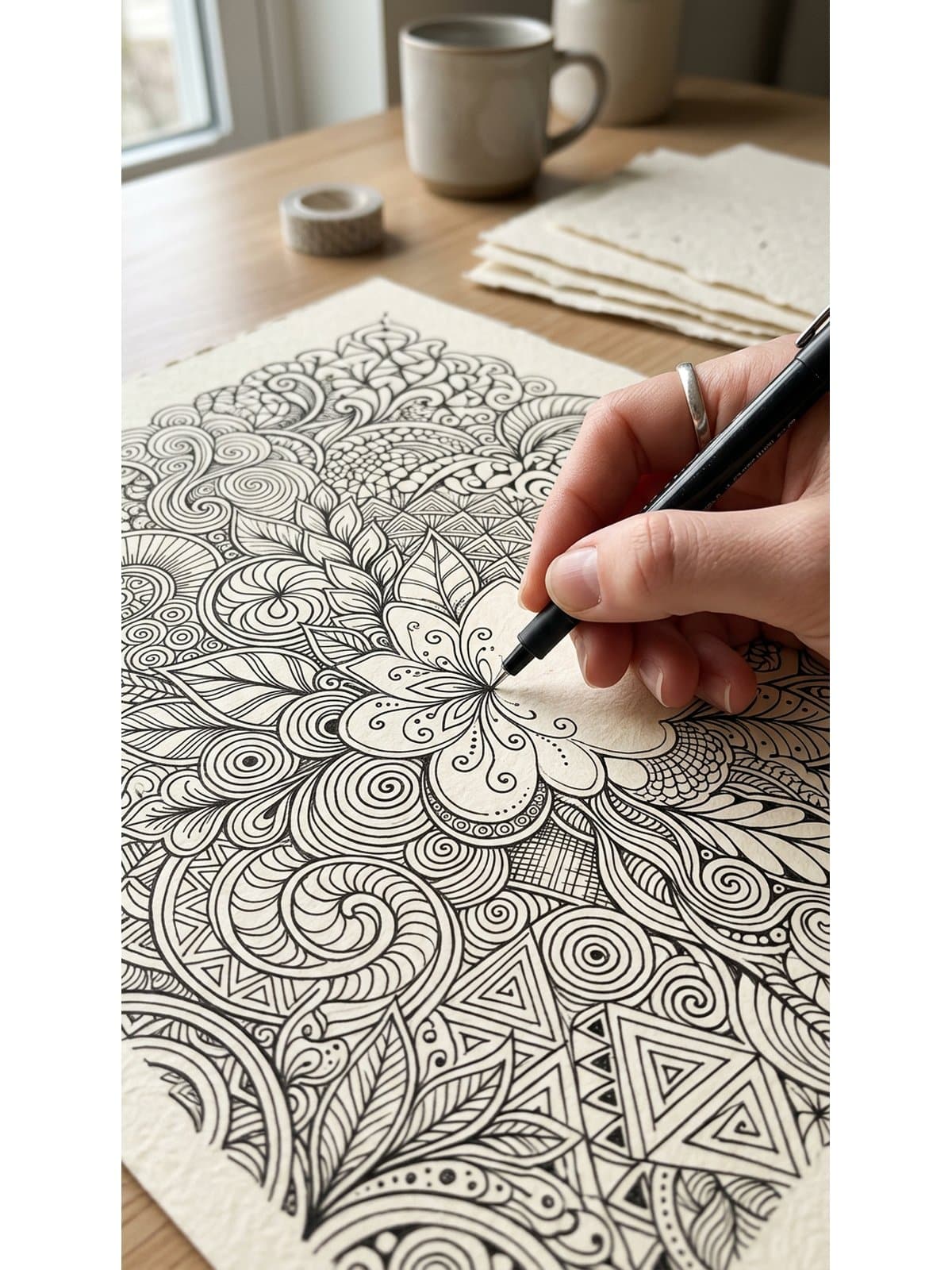
Art Supplies for Tangle Drawing
One of the best things about tangle drawing is that you barely need anything. Here is my simple beginner setup.
A fine black pen: the gold standard is a set of fine-tipped archival pens. A Sakura Pigma Micron fineliner set gives you several nib sizes (0.1 to 0.5 are the most useful), smooth flow and ink that will not bleed through most papers. If you would like a few extra nib sizes for filling larger areas, a set of Faber-Castell PITT artist pens in black is a lovely addition.
A pencil: a soft graphite pencil for your border, strings and final shading. A Faber-Castell graphite pencil set covers every grade you could want. Do not skip the shading step — it is what makes your finished piece look truly polished.
A precise eraser: a Tombow Mono Zero round eraser is brilliant for cleanly lifting stray pencil marks and pencil strings once your ink is dry.
- Smooth white card: any smooth-surface paper or card works. Cut your own small squares, or use a smooth sketchbook.
- A blending stump: optional, but lovely for softening and blending your pencil shading.
Looking for more drawing inspiration to pair with your patterns? My posts on easy cute doodles and mandala coloring pages are a lovely next stop.
This post contains affiliate links. If you purchase through these links, I may earn a small commission at no extra cost to you. I only recommend products I genuinely use and love — thank you for supporting Artsydee!
What to Draw Your Patterns On
Once you have a few patterns under your belt, the fun really begins — tangle art works beautifully on so many surfaces. Here are my favourite ways to use it beyond the classic square.
- Classic tiles — the traditional small square is a perfect little canvas. Collect them in a tin, swap them with friends, or make one at the end of the day to unwind.
- Sketchbook pages — fill the background of a spread, make a full-page design, or build patterned borders around a focal drawing.
- Coloring pages — the pattern pages in the free pack above are made for exactly this: fill each section with a different pattern, then colour it in.
- Mandalas — use a different pattern in each ring or segment of a mandala coloring page for a show-stopping result.
- Journal borders and headers — draw a simple frame and fill it with one repeating pattern for beautiful, meditative page decoration.
- Letters and words — sketch block letters or your name and fill each one with a different pattern for a personalised piece.
Using Tangle Art as a Mindfulness Practice
This is the part that surprises people most. You pick up your pen expecting to make art — and you end up feeling genuinely calm. That is not an accident.
The repetitive, structured nature of tangle drawing settles the mind the way meditation does. Because you are focused on one small mark at a time, your thoughts have less room to wander into worries and to-do lists. The slow, deliberate strokes anchor you firmly in the present moment.
Lots of people use tangle art to ease anxiety, improve focus, or simply keep a creative habit going on busy days. A single small piece takes around 20 to 30 minutes — enough to properly settle, not so long it feels like a commitment. If you are new to mindful art, this is one of the most accessible entry points there is.
- Set a timer for 20 minutes before bed — no screens, just a page and your pen.
- Use it as a reset between work tasks — one small pattern to clear your head.
- Keep a dedicated tin of finished pieces and let it grow over time. Looking back at the stack is deeply satisfying.
- Pair it with calming music or a podcast for a lovely creative wind-down.
If you would like even more printable art resources, templates and creative packs, have a browse of the Artsydee shop on Payhip — all designed with beginner artists in mind.
Frequently Asked Questions
What supplies do I need to start tangle drawing?
Just three things: a fine-tipped black pen (a 0.1 or 0.3 archival fineliner is ideal), a pencil for borders and shading, and a piece of smooth white paper or card. You really do not need anything fancy — a piece of cartridge paper cut to size works perfectly for your first pieces.
How long does it take to learn tangle patterns?
You can draw your first recognisable pattern in minutes — that is the beauty of it. Simple patterns like bubble clusters, spiral swirls and crescent rows can be learned and filling a page within your very first session. Building a comfortable vocabulary of 10 to 15 patterns takes most people just a few weeks of casual practice. Start simple and add patterns gradually rather than trying to master everything at once.
What is the difference between tangle patterns and doodling?
Doodling tends to be free-form and spontaneous, while tangle drawing uses a light framework: you work inside defined sections and repeat one chosen pattern at a time. That gentle structure is what makes it feel so meditative — there is a rhythm to every mark, which quietens the mind in a way loose doodling sometimes does not.
Can kids do tangle art?
Absolutely — it is wonderful for children, usually from around age 7 or 8 upward (confident younger artists can manage simple patterns too). The structured, step-by-step nature works brilliantly for kids who enjoy following instructions, and the “no mistakes” philosophy is genuinely freeing for children who feel anxious about art. Simple patterns like bubble clusters and crescent rows are ideal starting points, and it makes a lovely calm activity for classrooms and homeschooling.
Final Thoughts
If you have been putting off trying tangle art because you thought you were not artistic enough — this is your sign to start today. You do not need talent, you do not need experience, and you do not need expensive supplies. Just a pen, a piece of paper, and five quiet minutes.
Start with one pattern. Fill one small section. Shade it lightly and watch it transform. I promise you will be surprised by what you create — and by how you feel while you are creating it.
Do not forget to grab your free 10 Meditative Doodle Coloring Pages above — they are the perfect companion to your new practice. Happy doodling, friend. ✨
Dee xx
I would love to see what you create — come and follow me on Pinterest for daily art inspiration, say hello on Instagram @artsydee_inspiring_creations, and if you love tutorials, subscribe on YouTube. Sharing this with a creative friend would mean the world. 💛
You Might Also Like
- Doodle Art Designs: Easy Ideas to Fill Your Sketchbook
- Easy Cute Doodles for Beginners
- Mandala Coloring Pages (Free Printables)
- Sketchbook Inspo Ideas to Spark Your Creativity
Pin This for Later!
Save this to your Pinterest boards so you can find it again next time you fancy a calming pattern session.