Last Updated on July 24, 2026 by Dee
This post contains affiliate links, which means I may earn a small commission if you buy through them — at no extra cost to you. I only link things I actually use or would genuinely recommend. Thank you for supporting Artsydee this way!
One of my Patreon members, Elizabeth, asked me a question I get a version of all the time: “What watercolour paper actually goes through a printer — hot press or cold press? And do you have an Amazon list?”
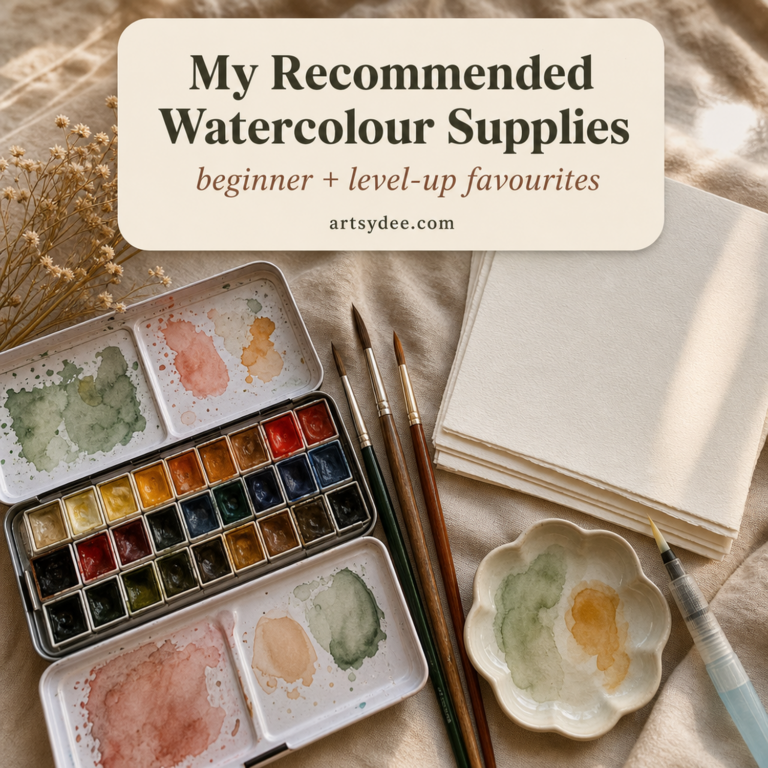
So here it is — the honest, kitchen-table version of what I reach for. Not the fanciest list, just what actually works.
First: printing your templates (Elizabeth’s question)
If you’re printing one of my watercolour templates or line-art sheets at home, here’s the thing nobody tells you upfront: true heavyweight watercolour paper (the 300gsm stuff) is usually too thick for a standard home printer. It’ll jam, or the printer just won’t pull it through.
What I actually use is 160gsm mixed media paper through my Epson EcoTank printer. It’s thick enough to hold up to a light watercolour wash, thin enough to feed through the printer without a fight.
Quick hot press vs cold press primer, since Elizabeth asked:
- Cold press = the classic textured watercolour surface. Lovely for painting freehand, but that texture can make fine printed linework look a bit soft or broken up.
- Hot press = smoother. It takes printer ink and fine detail much better, which is exactly what you want when you’re printing a template and then painting on top of it.
So for printed templates specifically: go smoother and mid-weight (that 160gsm mixed media paper is my sweet spot), and paint with light-to-moderate water rather than soaking, heavy washes. You’ll get much crisper results and a lot less cockling.
Beginner Essentials
Paper
- Canson XL Watercolour Pad — my go-to budget practice pad, and genuinely great for printing-and-painting templates.
- Strathmore 400 Watercolour Pad — a step up in quality, still an everyday price.
Paints
- Winsor & Newton Cotman Watercolour Set — the classic starter set. Reliable, forgiving, widely loved for a reason.
- Kuretake Gansai Tambi 48 Colour Set — Japanese gansai pans with big, creamy colour. Gorgeous in flat-lays and a joy to actually paint with.
Brushes
- Pentel Aquash Water Brushes (set of 3) — my pick for anyone starting out or painting on the go. No separate water pot needed.
- Princeton Heritage Round Watercolour Brush, size 6 — a proper round brush that holds a nice point, still budget-friendly.
Extras
- Sakura Pigma Micron Fineliner Drawing Set — for any linework or journalling detail before you paint.
- Mijello Folding Watercolour Palette — keeps your mixing space tidy and travels well.
Level-Up
Paper
- Arches Cold Press Watercolour Block — the professional cotton paper. This is the “treat yourself” upgrade once you’re painting freehand rather than printing templates.
- Hahnemühle Britannia Watercolour Pad — beautifully behaved paper, a favourite among more experienced painters.
Paints
- Daniel Smith Essentials Watercolour Set (6 tubes) — the artist-grade upgrade. This is the “first professional paints” recommendation I give most often.
- Schmincke Horadam Half Pan Watercolour Set — luxury German pans, beautifully pigmented.
Brushes
- Escoda Round Watercolour Brushes (Joseph Zbukvic set, sizes 8/10/12) — a proper investment set once you know watercolour is your thing.
- Da Vinci Cosmotop Spin Watercolour Brush — a beautiful, precise round for detail work.
Printer — the one I’m upgrading to
My current everyday printer is the Epson EcoTank (great for 160gsm mixed media paper, low cost per print). But I’m planning to add a Canon imagePROGRAF PRO-310 — a proper A3+ fine-art printer, so I can print on thicker papers and go bigger with A3 prints. If you’re printing a lot of templates or want to size up, this is the direction I’m heading.
A note on hot vs cold press, one more time
If you take one thing from this post: for anything you’re printing — templates, line art, reference sheets — reach for a smoother, mid-weight paper (160gsm mixed media is my staple) rather than a heavy textured cold-press block. Save the gorgeous cold-press cotton papers for freehand painting, where that texture works in your favour instead of against your printer.
Got a supplies question of your own? Drop it in the comments or send me a message — I’m always happy to talk shop.