Most new year vision boards are made in the first week of January and quietly stop being looked at by the second week of February. Not because the ideas on them were wrong, but because the board was made in a rush, hung somewhere out of the way, and never given anything to do afterwards.
This is the making version rather than the manifesting version. Paper, scissors, a glue stick and an evening — and a board small enough that it can live in the front of a journal instead of on a wall you walk past without seeing.
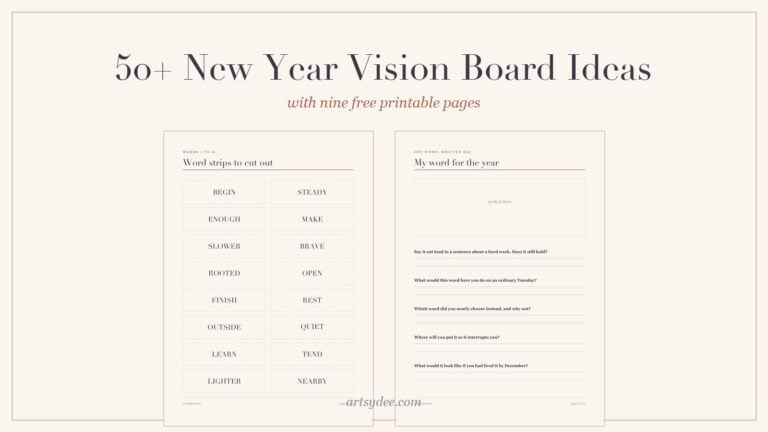
Fifty-two ideas below, grouped, plus nine free printable pages: a word-of-the-year page, a six-area planning grid, forty-eight cut-out word strips, a pocket board template and a one-page plan for the year. Grab those first.
Grab your free vision board pages
Pop your email into the box below and I’ll send the nine printable pages straight over. Print them at 100% on A4, cut the word strips out and you have everything except the pictures.
What’s inside the free set
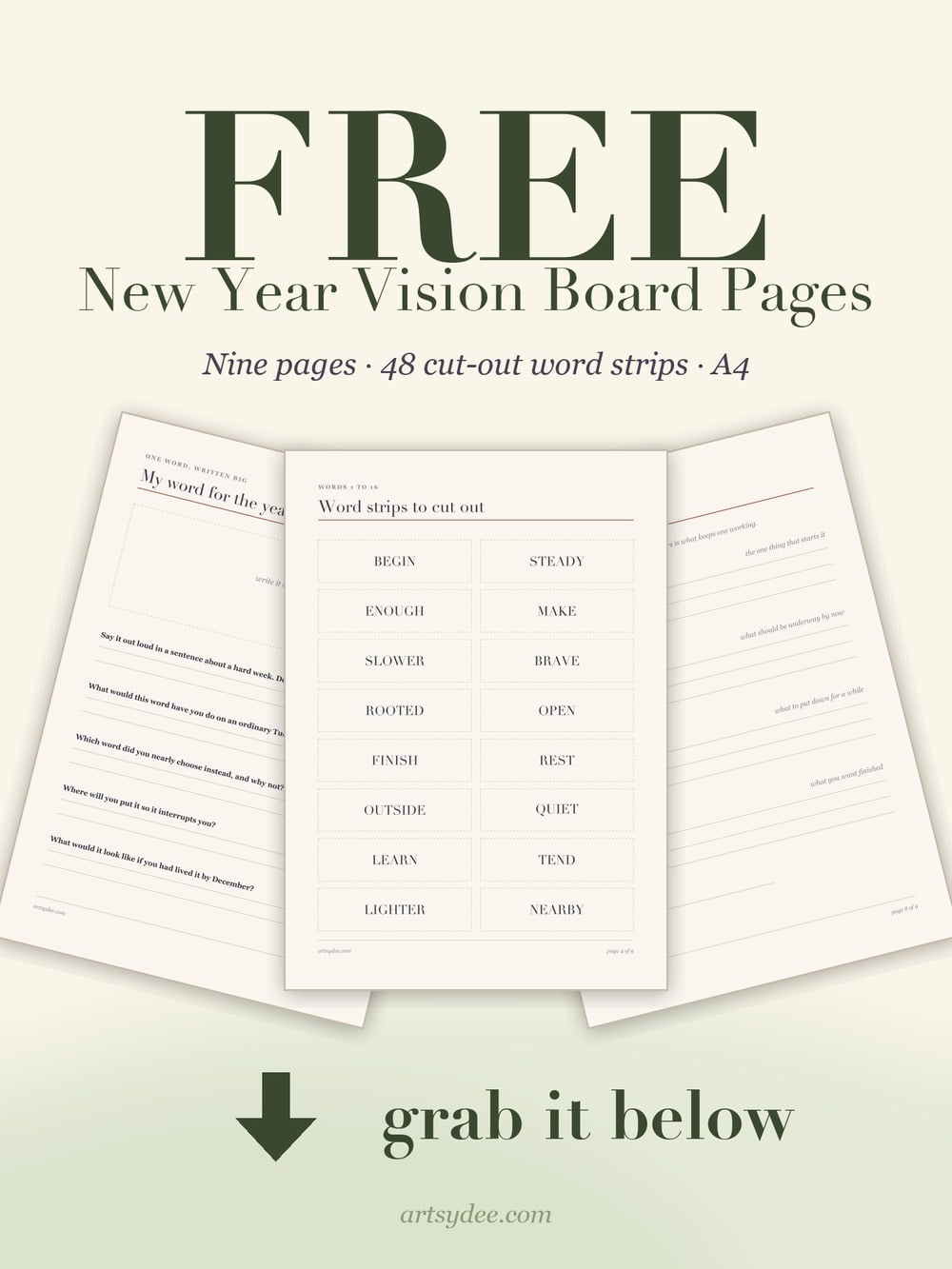
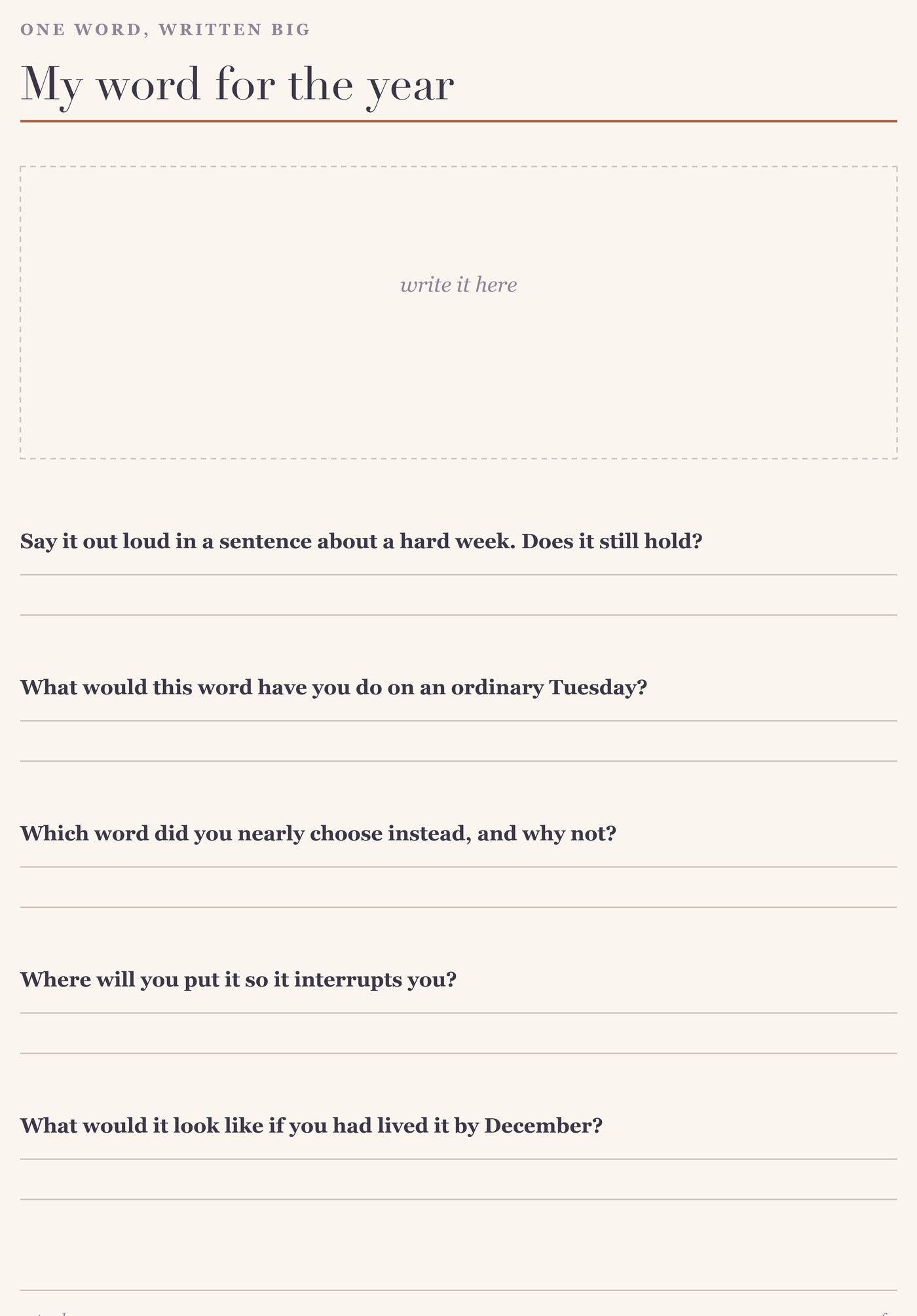
- A word-of-the-year page. One large framed space for the word, then five questions to test it against before you commit.
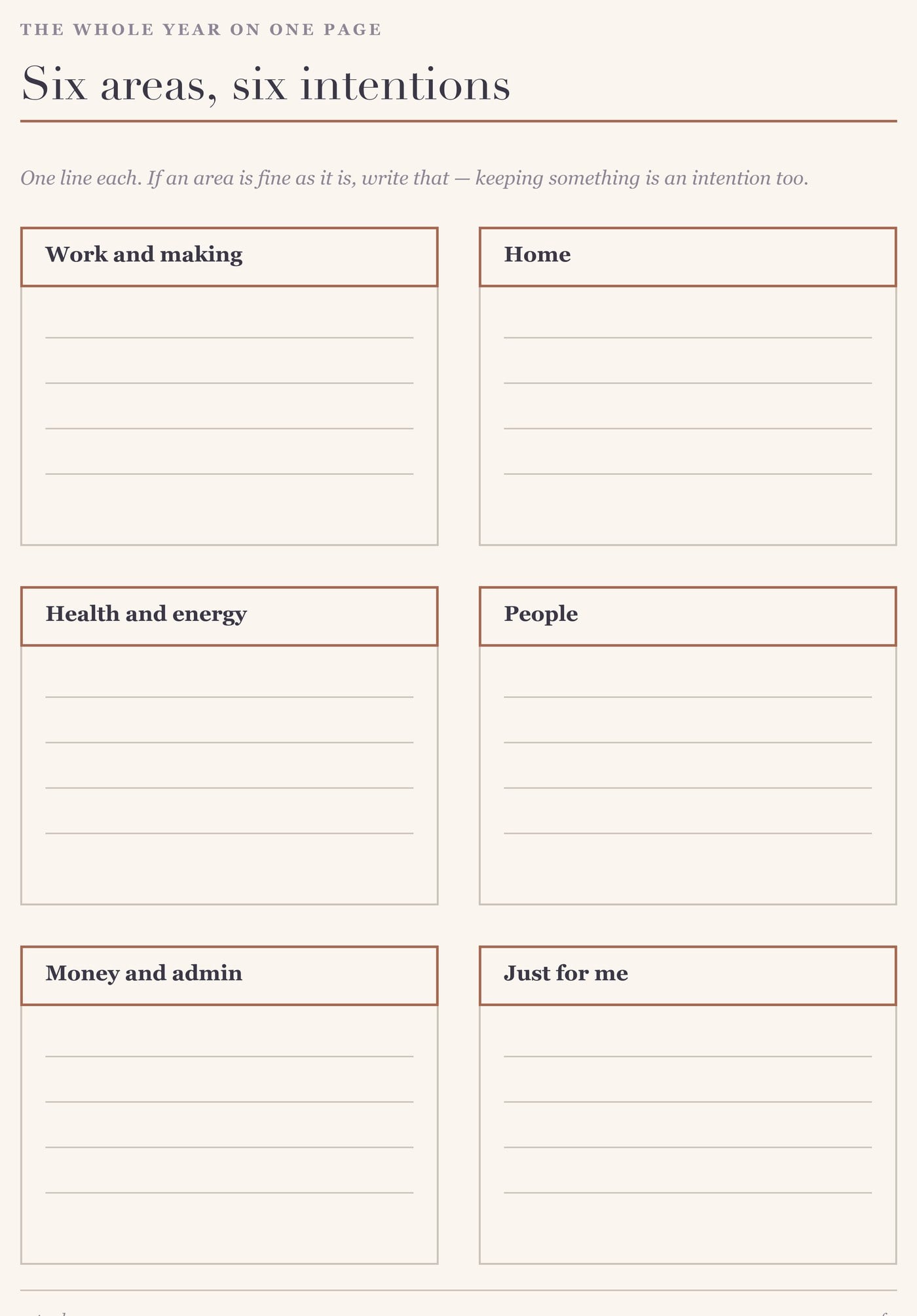
- A six-area planning grid. Work and making, home, health and energy, people, money and admin, and one box that is just for you.
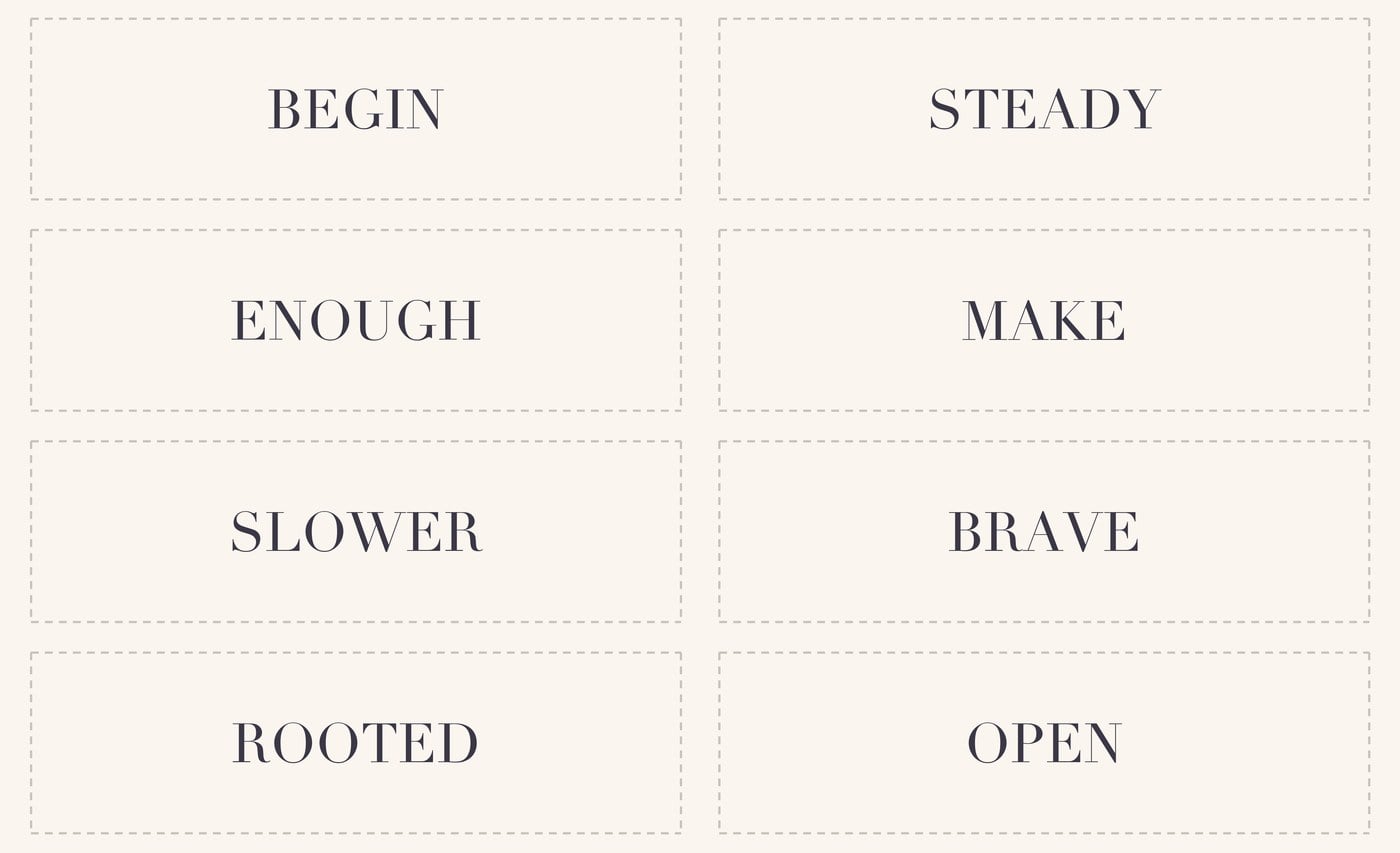
- Three pages of word strips. Forty-eight words, sixteen to a sheet, with dotted cut lines — so a board can be built out of type rather than magazine cuttings.
- A pocket board template. An A5 frame with corner marks, sized to be cut out and tucked into the front of a journal.
- A one-page plan. Four quarters, three lines each, and a review date.
- A cover and a closing page carrying the printing notes.
Start with the word, not the pictures
The single most useful thing you can do before you glue anything down is pick one word. It does two jobs: it gives you something to test every other element against, and it stops the board turning into a collection of nice images with no argument between them.
Test the word by saying it out loud in a sentence about a difficult week. “Steady” survives that test. “Abundance” usually does not. And if two words keep fighting, keep both — write the second one small in a corner for the months the first one does not fit.
Ways to start when you are staring at a blank board
- Begin with last year, not next year: one page of what actually worked.
- Write the year’s headline first — one sentence — and build the board to match it.
- Pick the format before the pictures: a board you will actually look at beats a big one.
- Give yourself an evening and a kitchen table rather than a whole weekend.
- Tear a pile of paper before you decide anything; the deciding gets easier with scraps in front of you.
- Start with three words and let everything else earn its place beside them.
- Make a rough version in a sketchbook first and treat it as a draft, because it is.
- Ask what you want less of. That half of the board is usually the honest half.
What actually goes on a new year board
- One photograph of a place you intend to stand in this year.
- A colour you want the year to feel like, painted as a plain swatch.
- The name of one skill you will be visibly worse at in January than in December.
- A date already in the diary, written large.
- Something you are keeping exactly as it is — boards are allowed to protect things.
- A number that matters: hours a week, pages a month, miles, minutes.
- One person you want more of in your year.
- A small photo of the room you want to work in, tidy, so you know what you are aiming at.
- A line of a song or a poem, hand-lettered rather than printed.
- An empty space you deliberately leave for whatever turns up by March.
Word-of-the-year ideas
- Choose a verb rather than a noun — verbs tell you what to do on a Tuesday.
- Test the word by saying it out loud in a sentence about a hard week.
- Letter it by hand in the biggest size on the board and let it sit off-centre.
- Pick a second, quieter word for the months the first one does not fit.
- Write the word in three different ways and keep the one you still like the next morning.
- Put the word somewhere it will interrupt you: the kettle, the car, the inside of a notebook.
- Avoid words you have used before unless last year’s is genuinely unfinished.
- Keep a word you rejected pinned to the back of the board; some of them come good in June.
Collage, paint and paper techniques
This is the part most vision board posts skip, and it is the part that decides whether the finished thing is something you want to look at:
- Tear edges instead of cutting them for anything you want to feel soft.
- Lay a watercolour wash over the whole board first so every scrap sits on something.
- Use one repeated shape — a circle, an arch, a square — to hold a messy board together.
- Keep to three colours plus paper. A board with every colour on it reads as noise.
- Print your own photos small and matte; glossy prints fight the paper.
- Glue with a stick, not liquid, or the paper will cockle and lift at the corners.
- Leave one layer unfinished on purpose so the board looks made rather than designed.
- Stitch one element on instead of gluing it — thread reads as effort.
- Paint the lettering last, over everything, so it belongs to the whole board.
- Photograph the board when it is finished; the photo becomes the phone wallpaper.
If you are working on top of a painted background, let it dry properly before gluing. A wash that is still damp will lift the moment paper goes down on it, and you will not notice until the edges curl an hour later.
Small boards that live in a journal
A wall-sized board is a lovely object and a slightly impractical one. A board that fits inside a notebook gets opened. If you already keep a junk journal, the pocket board template in the free set is sized to sit in the front of it:
- A single A5 board tucked into the front of this year’s journal.
- One board per season, four pages, revisited at each turn of the weather.
- A concertina strip that folds out of a notebook and away again.
- A pocket at the back of the journal holding cut-out words you have not placed yet.
- A board drawn straight onto the endpapers so it cannot get lost.
- Index cards, one intention each, held with a bulldog clip and reordered monthly.
- A board the size of a postcard, posted to yourself for a January morning.
- A board built inside a tin, so it travels and stays private.
Keeping it alive after January
- Put a pencil near it. A board you can write on stays a working document.
- Date the board. An undated board quietly becomes wallpaper.
- Book the first review for the end of February, not the end of the year.
- Cross things off in ink and leave them legible.
- Move one element every month, even if only slightly, so your eye keeps seeing it.
- Add a scrap from something that actually happened, not only things you want.
- Take the whole thing down in July and see what you would put back.
- Keep last year’s board. Compared side by side they tell you more than either does alone.
Pair it with something you write in. A board tells you what you decided in January; a few lines a week tell you what actually happened. If you want prompts for that side of it, there are fifty-two gratitude journal prompts with their own free printable pages.
Making an evening of it
Print the pages, put the kettle on and give it two hours rather than a whole weekend. Tear a pile of paper before you decide anything. Lay everything out loose and leave it overnight without gluing — almost every board is better for one night of second thoughts, and the pieces you quietly remove in the morning are the ones that were there to impress somebody.
Printing the pages so they come out right
- Turn off Fit to Page and print at 100% or Actual Size, or the cut lines will not line up.
- Choose A4 rather than Letter unless you are happy losing a strip off one edge.
- The word strips hold up better on 160gsm. On ordinary paper they curl as soon as glue touches them.
- The pocket board wants card if you are going to stick things to it.
- Print one sheet first to check the size.
There is a longer guide to printing templates at home without jamming your printer if your printer is the difficult sort.
If you would rather not cut anything out
Then use what is already here. There are 75 free vision board printables on the blog already, and a longer round-up of vision board ideas and examples with a video. This post is the hand-made, paper-and-glue version; those two are the printable-pack versions, and there is no need to do both.
Frequently asked questions
When should I make a new year vision board?
Any time between the middle of December and the end of January. Earlier than that and the year is still too abstract; much later and you have already settled into the year you were going to have anyway.
How many ideas are in this post?
Fifty-two, in six groups: getting started, what goes on the board, the word of the year, collage and paint techniques, small boards that live in a journal, and keeping it alive after January.
Do I need magazines?
No. The free set includes forty-eight cut-out word strips precisely so that a board can be built from type, your own photographs and painted paper. Magazines are optional and, for most people, the reason the board never gets started.
What size should the board be?
Smaller than you think. A5 gets looked at; A2 gets admired for a fortnight and then ignored. The pocket board template in the free set is A5 for exactly that reason.
What if my word turns out to be wrong by March?
Change it. A word of the year is a tool, not a contract. Write the new one underneath and leave the old one visible — the pair of them together is more interesting than either alone.
Can I print these pages more than once?
As many times as you like, for yourself, your family and your classroom. Please do not sell them or pass the file on — send people here and they can get their own copy.
Before you go
Print the word page tonight and write one word on it in pencil. Leave it somewhere you will see it tomorrow morning. If it still looks right after a night’s sleep, you have the hardest part of the board already done.
And if you like making your own paper things, all my printable kits live in the Artsydee Creations Club, with a new one every month.