Last Updated on October 1, 2026 by Dee
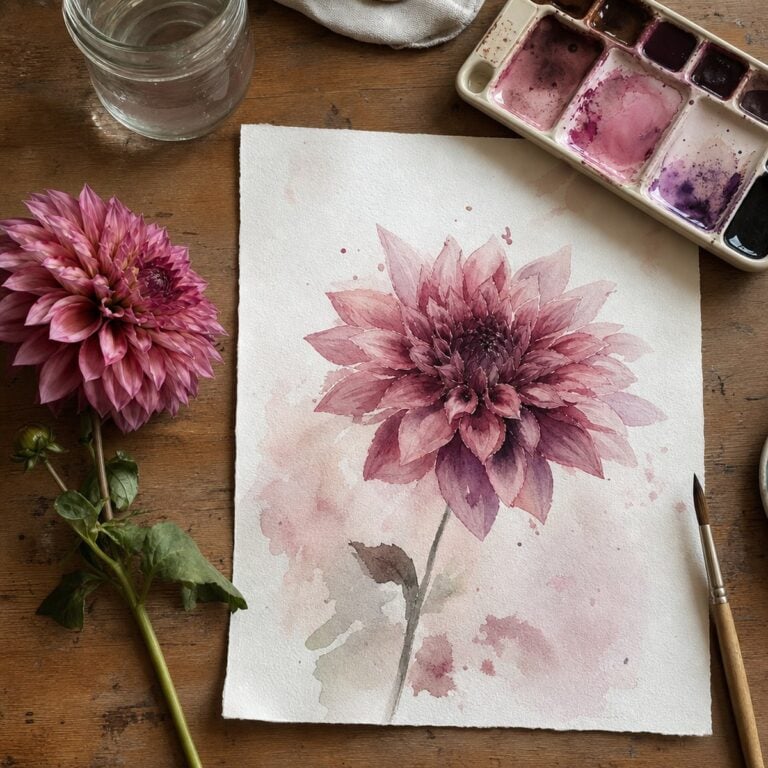
Dahlias are the flower that makes people put the brush down. All those petals, packed in tight overlapping rings, and every one of them apparently needing its own careful shape. It looks like an hour of fiddly work before you have anything to show for it.
It really is not. Almost every good watercolour dahlia comes down to one idea — paint the petals in rings from the outside in, and let each ring dry before you start the next. Below is the whole method step by step, and you can grab 17 free printable watercolour templates plus a ‘Cafe au Lait’ dahlia outline right here so you can skip the drawing and get straight to the paint.
Below you will find the short supply list, the five-step method, how the different dahlia types change your approach, and the fixes for the two problems everybody hits.
Table of Contents
What you need to paint a dahlia
Quick answer: Three colours, one round brush around size 6, and paper heavy enough not to buckle — 300 gsm cold press. That is genuinely the whole list.
Dahlias need less kit than almost any other flower, because the shape does the work and you only ever need two tones of one colour at a time. I paint mine on a Canson XL watercolour pad, which takes a proper soaking without cockling, and mix from a Winsor & Newton Cotman watercolour set — the Cotman pinks and plums lift cleanly if you go too dark.
One good round brush does everything here. A Princeton Heritage round brush size 6 holds enough water for a full petal ring and still comes to a point fine enough for the centre. That is it — no fan brushes, no detail brushes, nothing clever.
This post contains affiliate links, which means I may earn a small commission at no extra cost to you if you buy through them. I only link supplies I actually use.
The three-colour dahlia palette
Quick answer: One light warm pink, one deep plum or burgundy, and one muted green. Every petal is a mix of the first two at different strengths; the green only appears in the leaves.
The mistake nearly everyone makes is using too many colours. A dahlia looks rich because of the tonal range between its lightest and darkest petals, not because of how many different pigments went in. Mix one strong puddle of your deep plum and dilute it — that single puddle gives you the whole flower.
Knock your green back with a touch of the plum so it does not read as bright grass green next to all that warmth. Dahlia foliage is genuinely dark and slightly dusty, which is why straight sap green always looks wrong.
How to paint a dahlia in watercolour, step by step
1. Find the centre and work outwards in rings
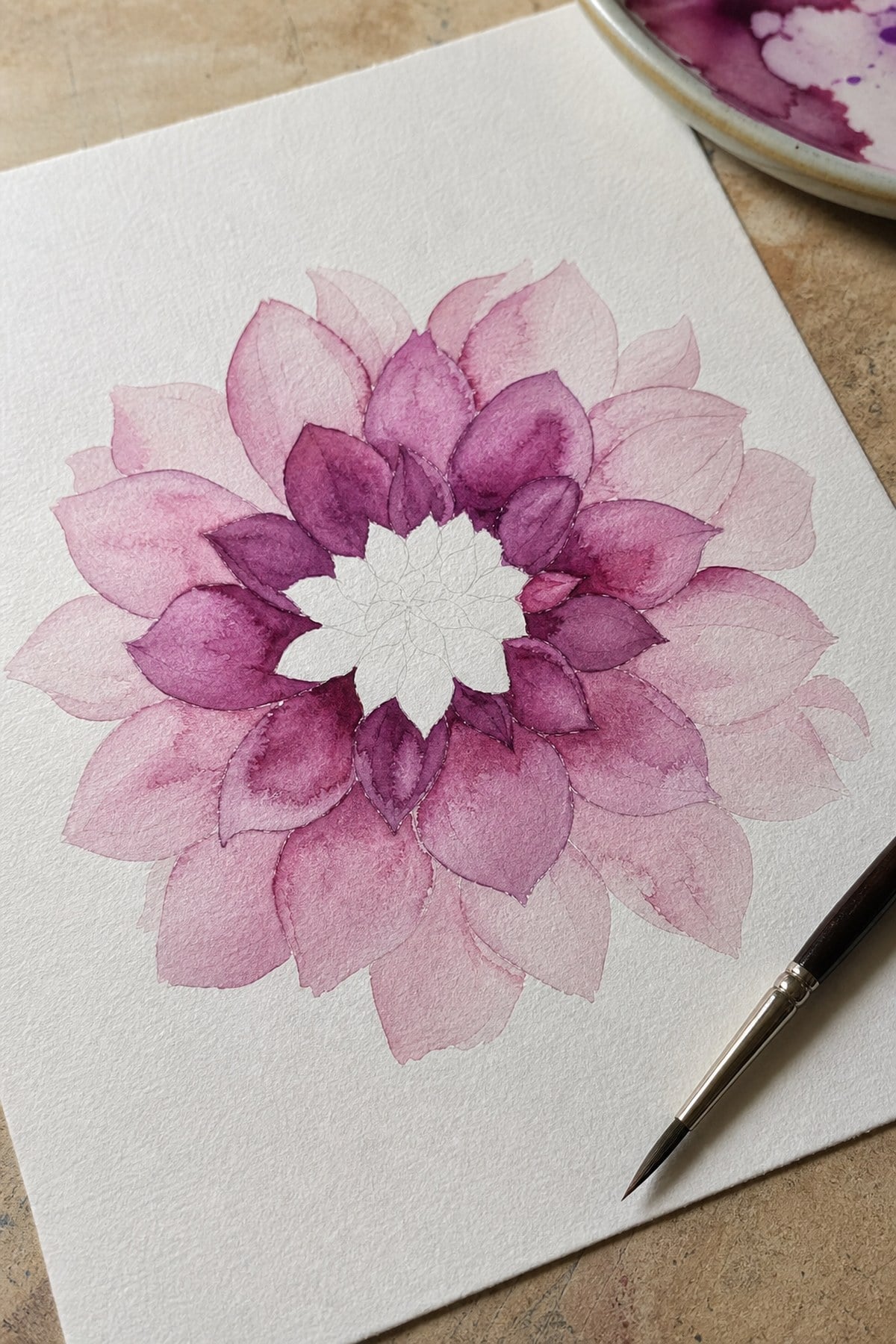
Mark the centre lightly and think of the bloom as three or four concentric rings of petals, not fifty individual ones. The petals get larger and looser as they move outwards. If you get the rings right the flower reads as a dahlia even if no single petal is accurate.
2. Paint the outer ring first, in your palest mix
Start with the biggest, outermost petals in the lightest wash. Skip every other petal on this first pass so neighbouring shapes cannot bleed into each other and lose their edges. Let it dry, then come back for the alternates.
3. Deepen each ring as you move inwards
Each ring inwards gets a slightly stronger mix of the same colour. By the time you reach the middle you are close to your undiluted plum. This is what gives a dahlia its depth — the centre reads as shadow because it genuinely is darker, not because you drew shading on it.
4. Leave the very centre until everything is bone dry
The packed inner petals are tiny and dark and they are the single most common place a dahlia turns to mud. Wait. Properly dry, not nearly dry. Then use small, decisive marks with an almost-dry brush — you are suggesting tightly furled petals, not drawing each one.
5. Add the leaves last
Dahlia leaves are large, pointed and slightly toothed, and they sit well below the bloom. Paint them last so you can place them where the composition needs them rather than where the plant would actually put them.
Ball, cactus and dinnerplate: how the types differ
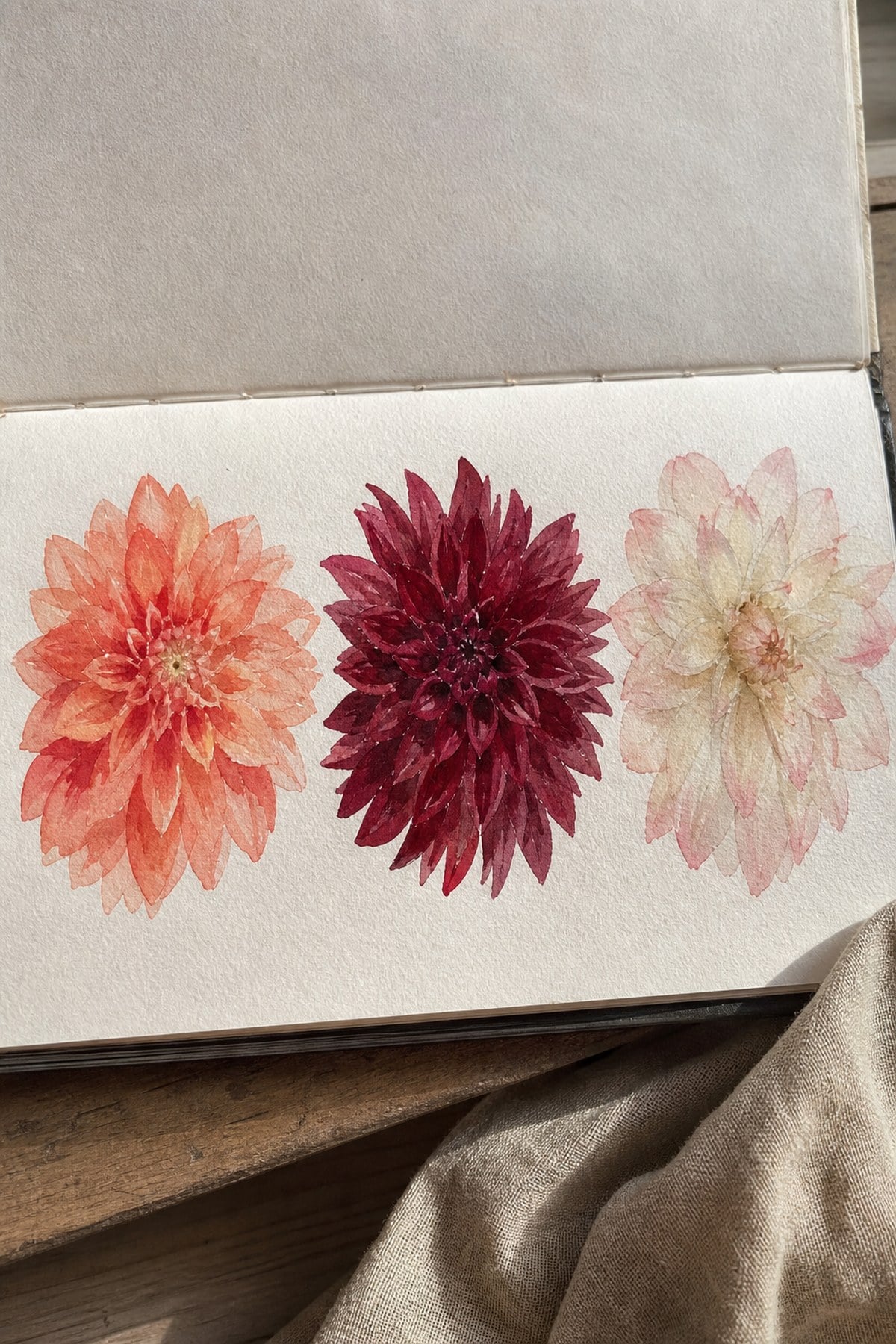
- Ball and pompon dahlias are almost geometric — tight, rounded, evenly spiralled petals. Treat them as a sphere first, then add the petal pattern over the top. They are the easiest to start with.
- Cactus dahlias have long, spiky, rolled petals radiating out. Here the white paper between the petals is doing most of the work, so paint the petals and leave the gaps alone entirely.
- Dinnerplate dahlias are huge and open with broad soft petals. These want a wetter approach — wet the petal shape first, then drop colour in at the base and let it travel. Painting them dry makes them look stiff and papery.
- Collarette dahlias have a single ring of flat outer petals and a frilly collar around a yellow centre. Nearly the easiest of all: one ring, one collar, done.
The named varieties are worth a look too. ‘Cafe au Lait’ is that famous dusty blush that shifts towards cream at the edges, ‘Karma Choc’ is so deep it is almost black, and ‘Bishop of Llandaff’ pairs scarlet petals with near-black foliage. Same method, very different palettes.
Using the free printable templates
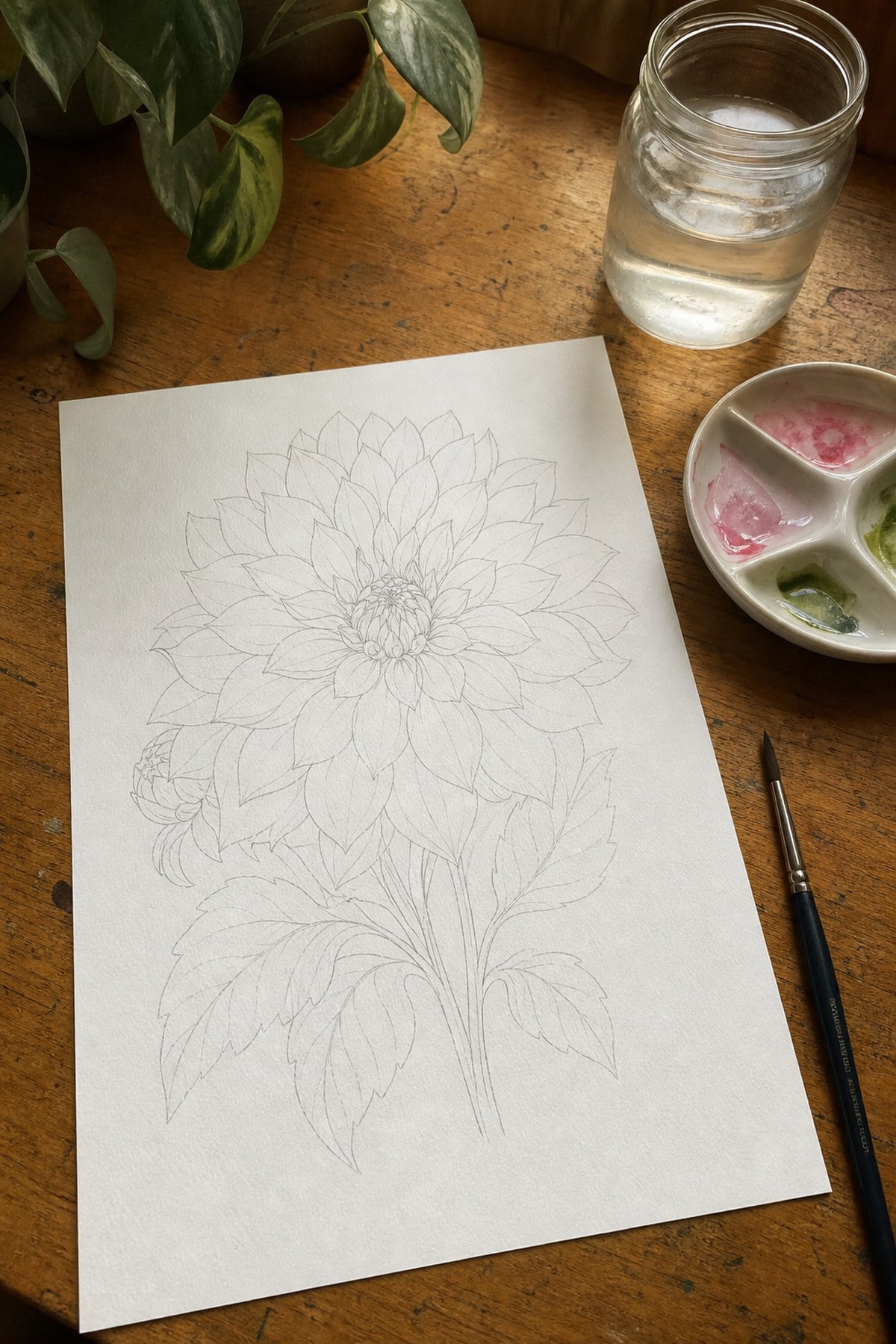
The free download above is my 17 Printable Watercolor Templates pack, with a ‘Cafe au Lait’ dahlia outline added to it — soft pencil-style outlines on A4 that you print and paint straight onto. Having the drawing already done removes the step that stops most people before they have even mixed a colour.
- 17 printable watercolour templates plus a ‘Cafe au Lait’ dahlia outline, soft outline style, A4
- Print on watercolour paper if your printer takes 300 gsm, or trace through from plain paper against a window
- Print as many copies as you like — the same outline painted three ways teaches you more than three different outlines
- Delivered as a PDF straight to your inbox
Printing tip: templates print at A4 by default. If you are in the US, choose ‘fit to page’ and Letter paper — the drawing shrinks by a couple of millimetres and nothing gets cropped.
The Dreamy Dahlia premium watercolour set
If the free templates get you hooked, Dreamy Dahlia Premium Watercolour Set is the full version — 20 named dahlia varieties, each with its own colour recipe card. Every card carries five swatches sampled straight from the painted reference, with hex codes and a brand-neutral mix hint, so you are never guessing what to mix for ‘Cafe au Lait’ or ‘Karma Choc’.
- 20 named dahlia variety templates, soft pencil line art on A4
- 20 colour recipe cards with five sampled swatches, hex codes and mix hints
- A variety identifier index showing all twenty at a glance
- 42-page A4 PDF at 300 DPI, plus a zip of the individual PNGs
- Digital stamps bonus pack included
It is £14 (roughly $18) in the Artsydee Payhip shop.
Prefer to get everything rather than buy sets one at a time? Dreamy Dahlia is included in the August watercolour drop on my Patreon, along with every other watercolour kit, brush set and Procreate goodie I make. Membership starts at £8 a month and the whole back catalogue comes with it.
Dahlia watercolour problems and how to fix them
Quick answer: Nine times out of ten a disappointing watercolour dahlia is a timing problem, not a skill problem — something was painted while something else was still wet.
- The centre went muddy. The inner petals were painted before the ring around them dried. Three dry stages, not one wet one.
- All the petals merged into one blob. Skip every other petal on the first pass and come back for the alternates once the first lot are dry.
- It looks flat. Not enough tonal range. Your darkest mix should be genuinely dark — much darker than feels comfortable while the paper is still wet, because watercolour dries around 30 percent lighter.
- The shape reads as a rose, not a dahlia. The petals are too curved. Dahlia petals are flatter and more pointed, and they radiate outwards rather than wrapping inwards.
- The green looks like plastic. No straight tube greens. Knock sap green back with a touch of your plum.
If you want to see the wet-on-wet stage moving rather than in stills, I put step-by-step painting videos on my YouTube channel most weeks. Subscribe here if you would like the next one to turn up.
Frequently asked questions
Are dahlias hard to paint in watercolour?
They look much harder than they are. The trick is to stop seeing individual petals and start seeing three or four concentric rings. Paint the rings from the outside in, going darker as you go, and the flower assembles itself.
What colours do I need for a watercolour dahlia?
Three: a light warm pink, a deep plum or burgundy, and a muted green. Every petal is the same plum mix at a different dilution. Adding more colours almost always makes it worse, not better.
How do I stop the middle of the dahlia going muddy?
Wait for the surrounding ring to dry completely — bone dry, not nearly dry — then use small decisive marks with an almost-dry brush. Muddy centres are always a timing problem, never a brush problem.
What paper is best for painting dahlias?
300 gsm cold press. The weight means you can flood a petal without the sheet buckling, and the texture gives the darker centre a natural grain that would take real effort to fake on smooth paper.
Do I need to print the templates on watercolour paper?
It is easier if you can — most home printers will take a single sheet of 300 gsm through the rear feed. If yours will not, print on plain paper and trace the outline onto watercolour paper against a bright window or a light pad.
Final thoughts
Print one template, mix one puddle of plum, and give yourself twenty minutes this afternoon. Paint the outer ring, let it dry, go a shade darker, repeat. The first one will probably be a bit muddy in the middle and that is fine — the second one almost never is.
You can also find me on Pinterest, where every new template gets saved as it goes up.
You might also like
- 17 Printable Watercolor Templates
- How to Paint a Watercolor Peony
- Beginner Watercolor Templates
- How to Paint Lilies in Watercolor
- Rose Watercolor Sketch Outlines
📌 Pin this for later!
I’m confused about how I get the free dahlia download. Your site has so many ads and buttons for downloading. They all make it so hard to get to what I’m looking for. Can you help me, please?
Hi Denise, sorry it was confusing! Tap “Grab it here” at the very top of the page and it jumps you straight to the box. Pop your email in there and the templates (with the dahlia outline) land in your inbox. If they don’t arrive, email me at info@artsydee.com and I’ll send them over 🌸 Dee x