Last Updated on October 13, 2026 by Dee
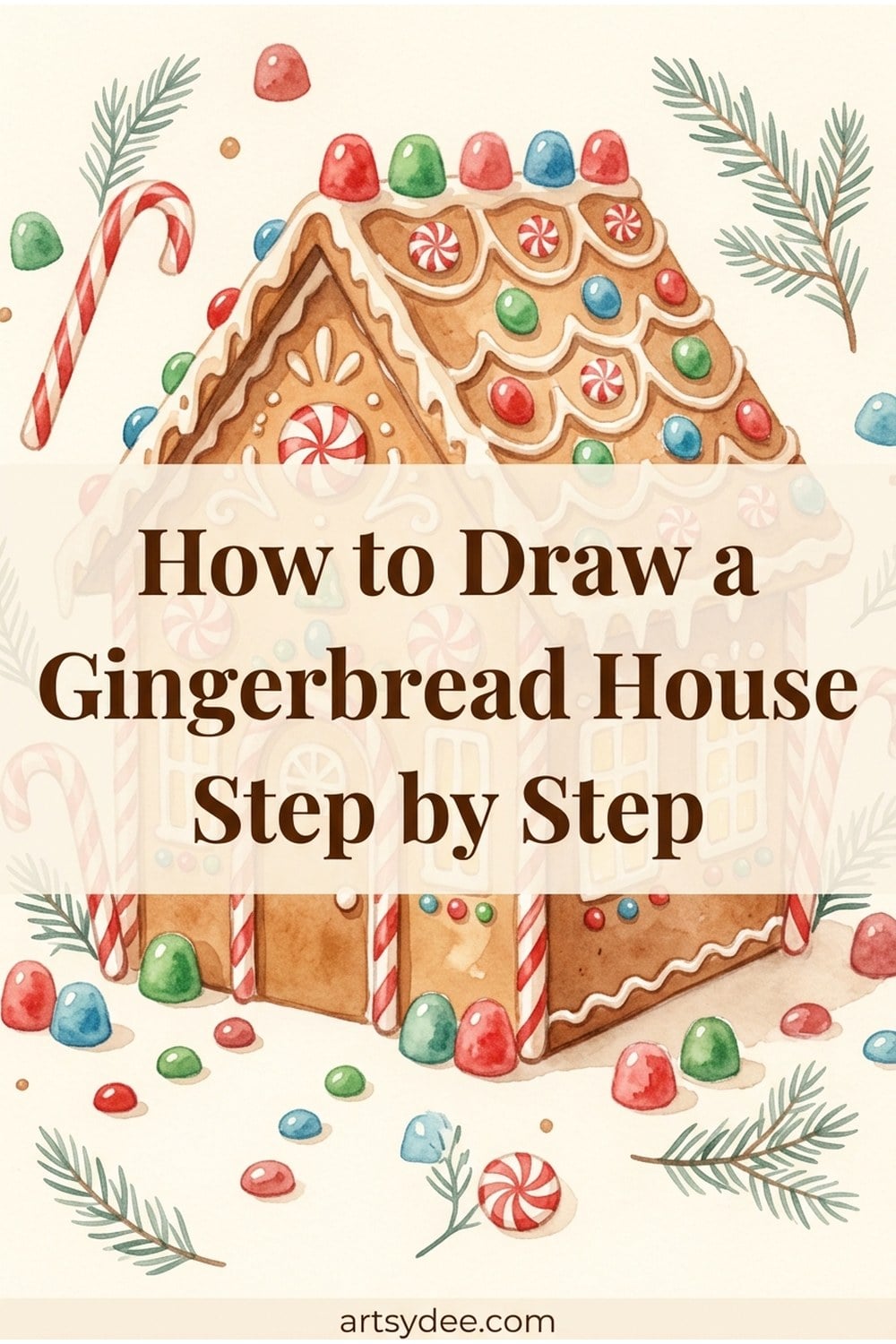
This is how to draw a gingerbread house step by step, from a square and a triangle to icing and gumdrops, plus six free printable practice sheets.
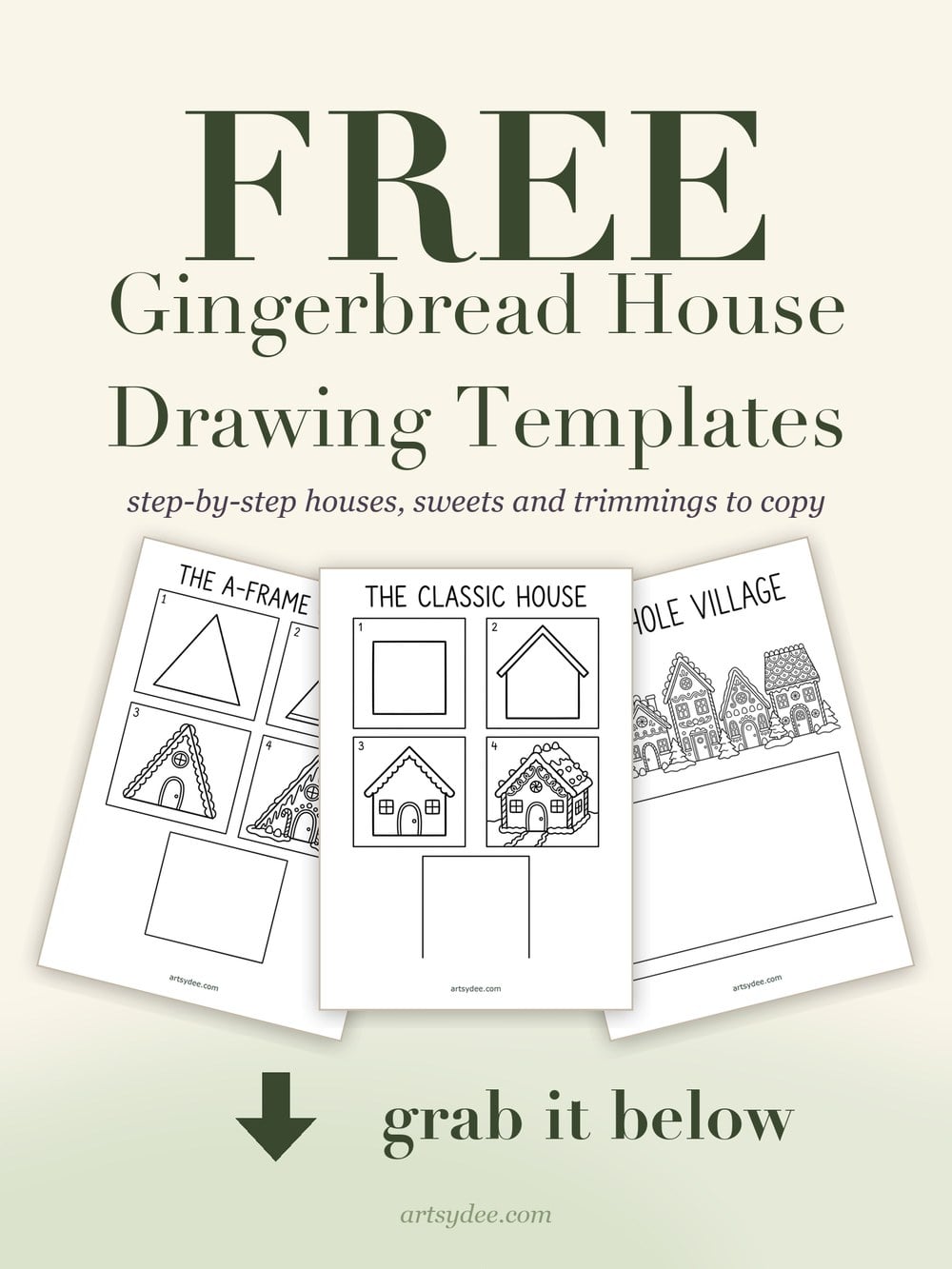
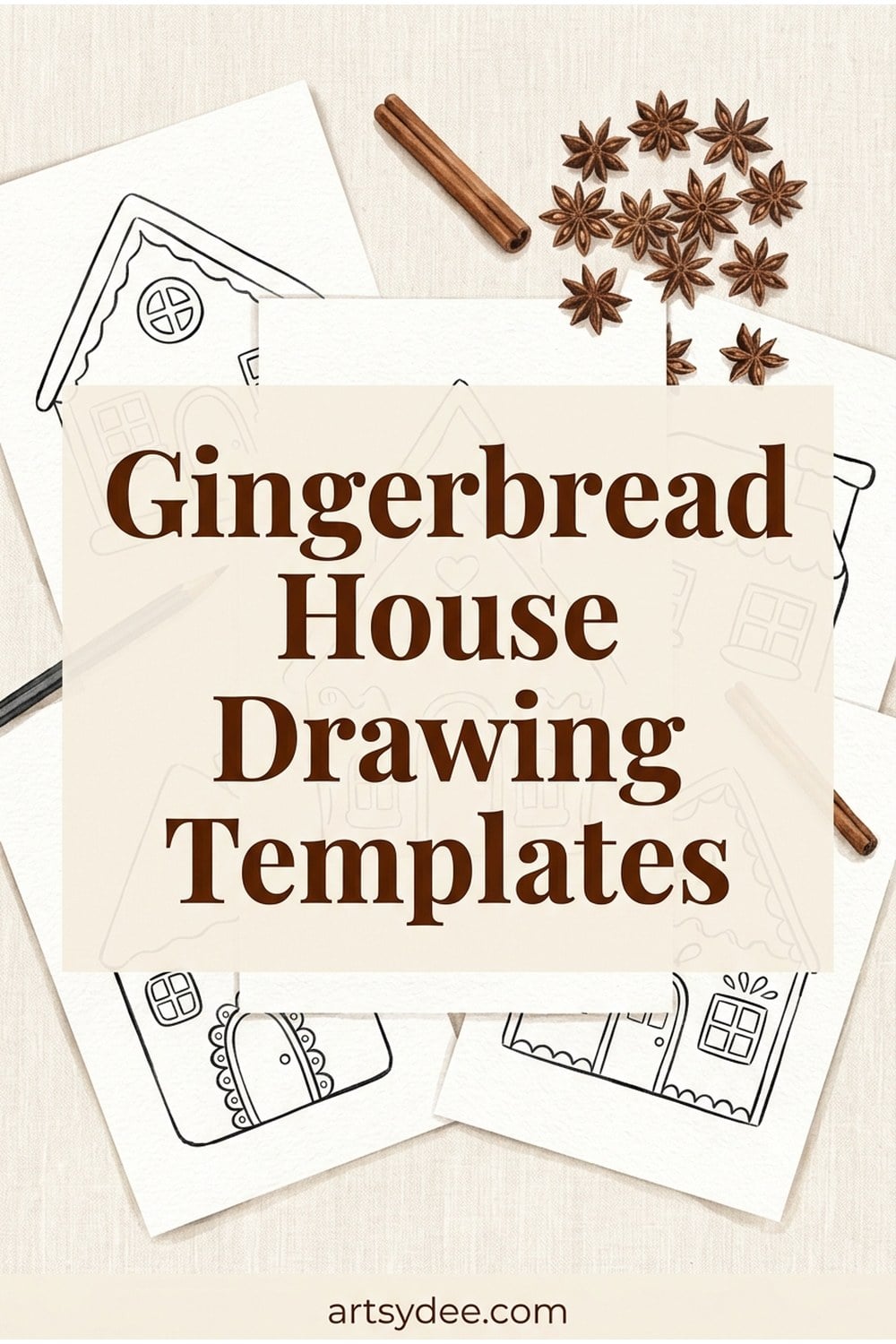
I’ve made you six free printable practice sheets — three houses broken into numbered stages, a sheet of sweets and trimmings to borrow from, a whole gingerbread village to copy, and a page of blank boxes with faint guides for your own. Pop your email in below and they’ll come straight to your inbox.
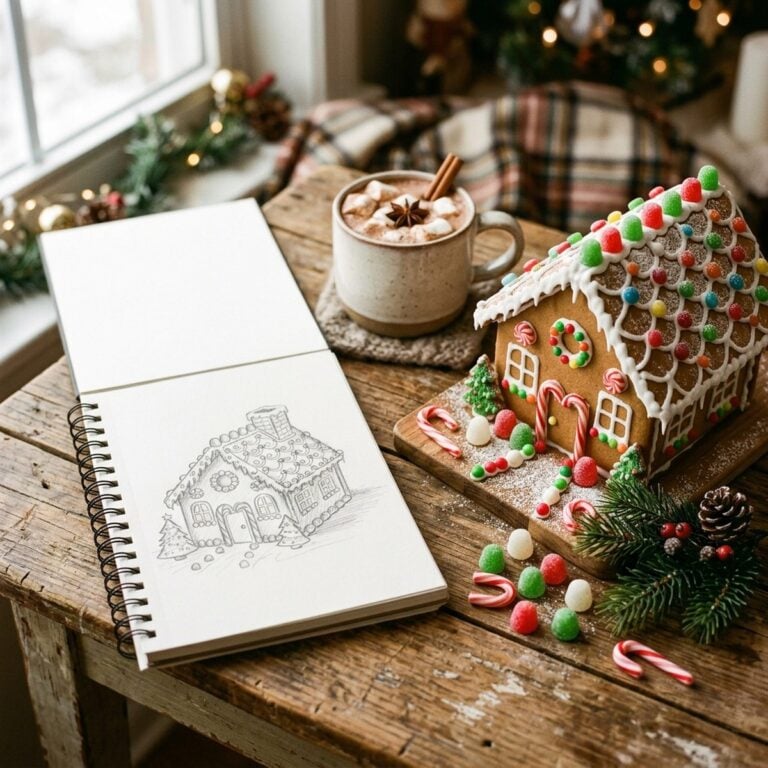
A gingerbread house drawing is really just a square with a triangle on top. Everything after that — the icing scallops, the gumdrop path, the little wonky windows — is decoration, and decoration is the easy part. That’s why this is one of the friendliest Christmas things you can draw, and why it works just as well for a seven-year-old as it does for someone filling a journal spread.
Table of Contents
What Do You Need to Draw a Gingerbread House?
Quick Answer: A pencil and paper. Draw the structure lightly in pencil first, then go over it in a black fineliner and rub the pencil out — that one step is what makes a gingerbread house drawing look crisp rather than sketchy.
Nothing here needs buying. But if you want the drawing to look neat, the pencil-then-ink order matters more than any material does, because it lets you get the roof angle wrong twice before anything is permanent.
For the ink stage I use a Sakura Pigma Micron fineliner set — the 05 for the walls and roof, the 01 for icing detail. Having two line weights is the single biggest upgrade you can make to a drawing like this: thick for structure, thin for decoration, and suddenly it reads as deliberate. If you like a bolder look, the Faber-Castell Pitt artist pens give you a lovely confident weight.
If you want to colour it in afterwards, warm browns and creams do most of the work. Prismacolor Premier coloured pencils blend softly enough to make gingerbread look baked rather than flat, which is really the only hard part of colouring one.
This post contains affiliate links, which means I may earn a small commission at no extra cost to you if you make a purchase. I only recommend things I actually use.
How to Draw a Gingerbread House Step by Step
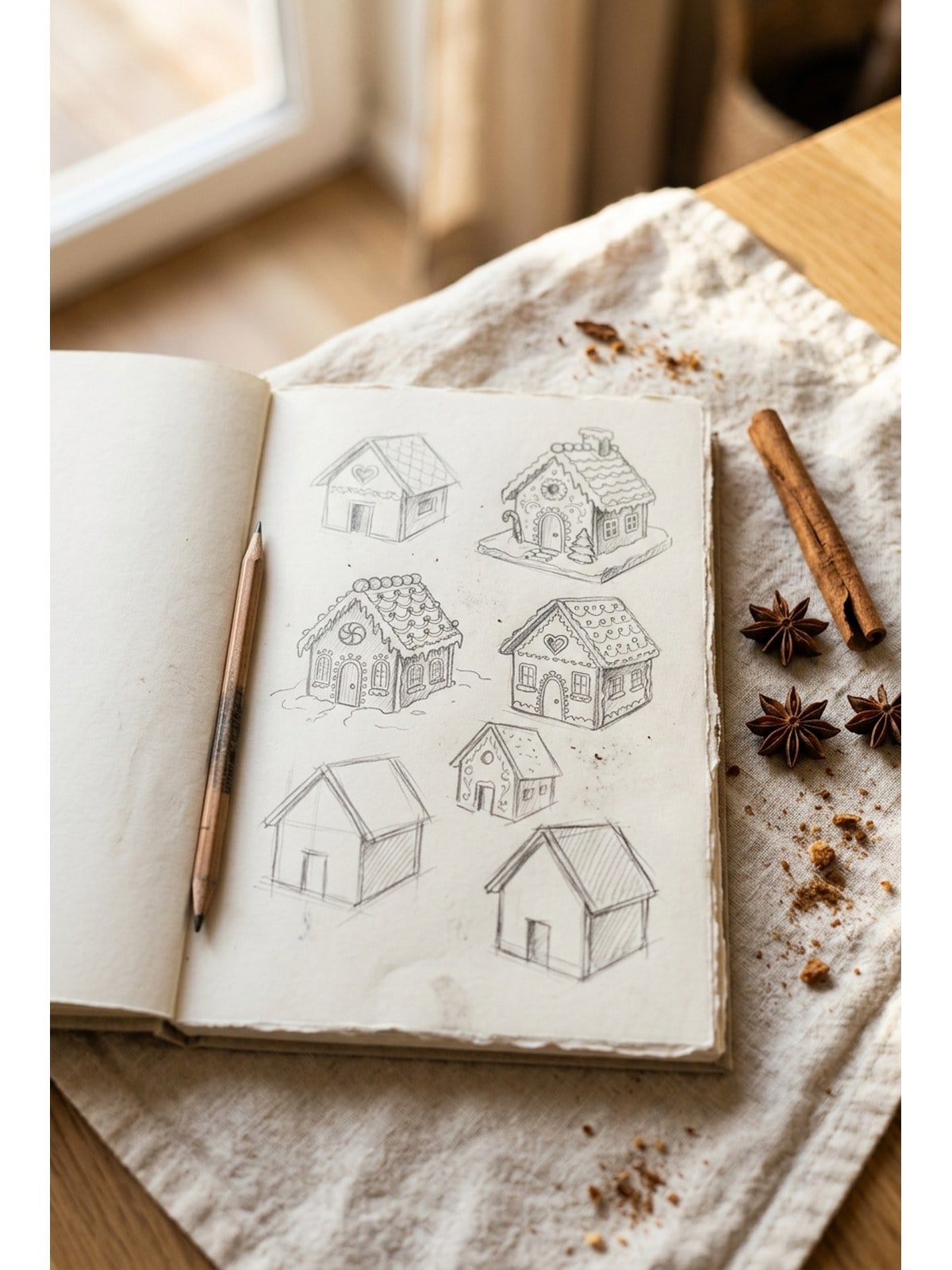
Here’s the classic cottage. Work in pencil the whole way through and don’t ink anything until step six.
- Draw a square. Slightly wider than it is tall is friendlier than a perfect square. This is the front wall.
- Put a triangle on top. Rest it on the top edge of the square. A shallow triangle looks like a cottage; a steep one looks alpine. Both are right — just pick one and commit.
- Add the roof overhang. Draw a second line just outside each slope of the triangle, so the roof sticks out past the walls by a few millimetres either side. Real gingerbread houses do this and it instantly stops the drawing looking like a child’s house symbol.
- Cut the door and windows. An arched door centred at the bottom, and two small square windows either side or one above. Keep them small — beginners nearly always draw them too big, and a big door makes the house look like a shed.
- Scallop the roofline. Along the bottom edge of each roof slope, draw a row of joined-up U shapes for piped icing. This is the detail that makes it read as gingerbread rather than just a house, so don’t skip it.
- Ink it and decorate. Go over your pencil lines in fineliner, wait a moment, then rub out the pencil. Now add gumdrops along the roof ridge, icing swirls round the door and windows, a sweet-lined path at the base, and a drift of snow along the bottom.
That’s the whole thing. If yours came out lopsided, good — lopsided is the house style. Actual gingerbread houses sag.
3 More Gingerbread House Shapes to Try
Once the classic feels easy, changing the silhouette gives you a completely different house for almost no extra effort.
- The A-frame. Skip the square entirely — one tall triangle sitting on a base line, with the roof running all the way to the ground. Add a small chimney, an arched door and a single round window high in the point. Candy cane posts either side of the door finish it.
- The tall townhouse. A tall upright rectangle with a small pitched roof, divided into two floors with two windows on each. Icing trim under the eaves, a wreath on the door, gumdrop lights along the roofline. Very satisfying to draw in a row.
- The little shopfront. A wide low rectangle with a striped awning across the front, a big window and a door at one end. Draw tiny sweets in the window and it becomes a sweet shop, which children love drawing more than any other version.
16 Sweets and Trimmings to Decorate With
Decoration is where a gingerbread house drawing actually comes alive, and you only need a handful of shapes on repeat. Practise these small and you can scatter them anywhere. All sixteen are drawn out for you on one of the free sheets.
- Candy cane — a walking-stick shape with diagonal stripes. Keep the stripes going the same way or it looks wrong.
- Gumdrop — a soft dome with a flat base and a few dots for sugar.
- Swirled lollipop — a circle with a spiral inside and a straight stick.
- Wrapped sweet — an oval with a pinched, fanned twist at each end.
- Icing swirl — a loose S or a row of joined loops. Best drawn fast.
- Meringue kiss — a rounded blob drawn up to a little twisted point at the top.
- Scalloped icing edge — joined U shapes along a roofline or a window ledge.
- Dripping icicles — a wavy band with downward teardrops of uneven length hanging off it.
- Arched door — a rectangle with a curved top and a dot for the handle.
- Shuttered window — a square with a cross through it and two thin shutters.
- Little fir tree — three stacked triangles on a short trunk.
- Snowflake — six lines from a centre point, with two small ticks on each arm.
- Gingerbread man — a rounded body, stubby arms and legs, two dots and a smile.
- Peppermint swirl — a circle with a pinwheel of curved segments.
- Heart biscuit — a heart with a second heart outline just inside it for the icing.
- Star biscuit — a five-pointed star, again doubled for the icing edge.
How to Draw a Whole Gingerbread Village
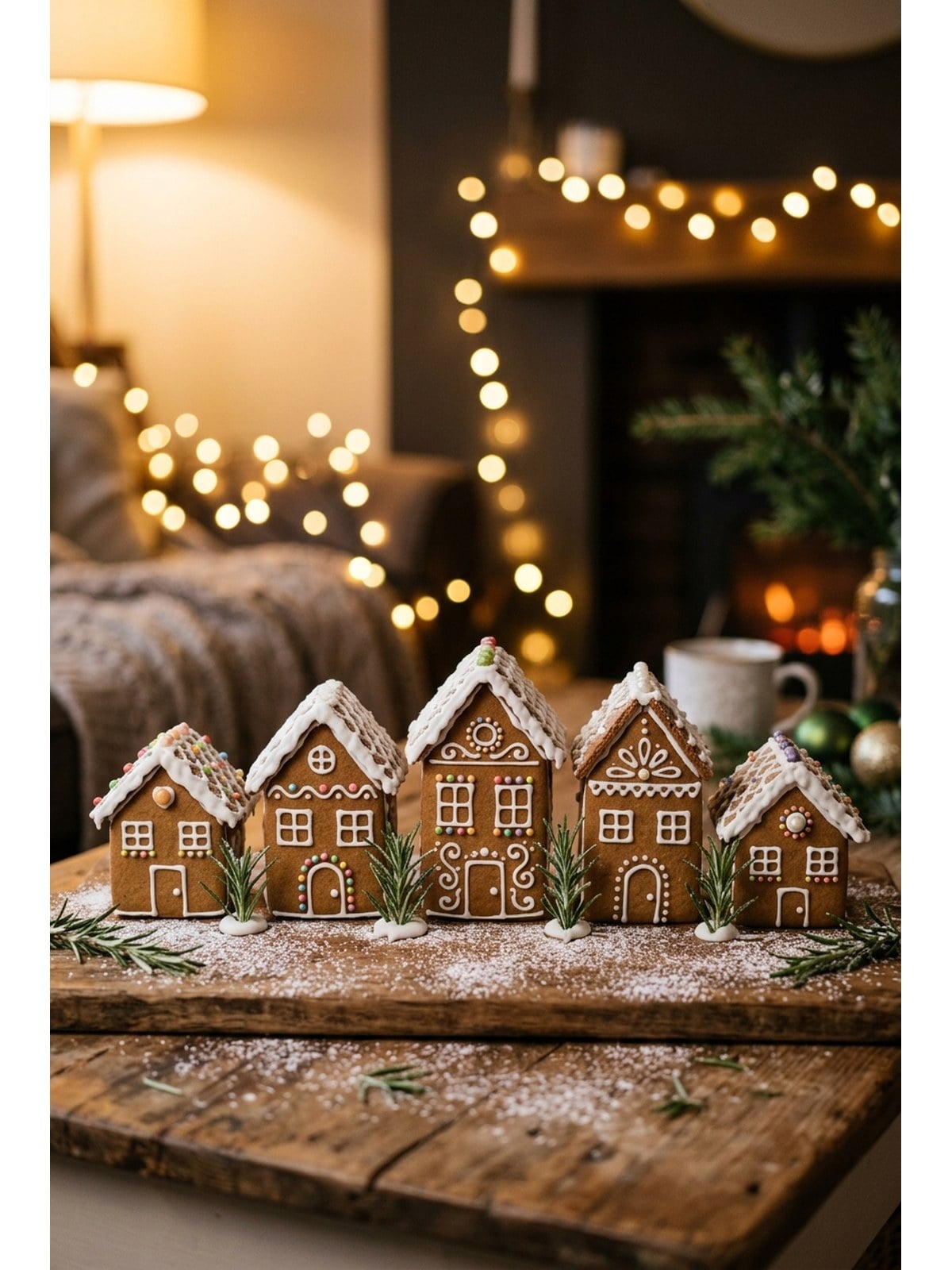
A village looks far harder than it is, because the eye reads the row rather than any single house. Three rules and it works every time.
Vary the heights. Put a tall townhouse next to a squat cottage next to an A-frame. If they’re all the same height it looks like a fence.
Overlap them slightly. Let each house tuck a little behind its neighbour rather than lining them up edge to edge. That single move is what creates depth, and it costs you nothing.
Fill the gaps with small things. Little fir trees, a lamp post, a snowdrift, a tiny gingerbread man. The gaps are what make it a street rather than a set of houses.
Draw the whole row lightly as plain boxes and triangles first, get the rhythm right, and only then go back and decorate. It’s very tempting to finish house one completely before starting house two, and it’s the reliable way to run out of room.
What’s in the Free Template Pack?
Six A4 sheets, printable on ordinary paper:
- The Classic House — four numbered stages plus a big empty box to copy into.
- The A-Frame Cottage — same four-stage build-up for the tall triangular house.
- The Tall Townhouse — the two-storey version, stage by stage.
- Sweets and Trimmings — sixteen decorations drawn out individually so you can borrow them.
- The Whole Village — a full row of five houses to copy, with a wide box beneath it.
- Your Turn — six empty boxes with faint dotted guides, for houses of your own.
5 Tips for a Better Gingerbread House Drawing
- Draw the structure before the sweets. Get walls, roof, door and windows down as plain shapes first. Decorating an unfinished shape is how houses end up with no room for a door.
- Use two line weights. Thick for the outline of the house, thin for icing and sweets. This one habit does more for a finished drawing than any amount of extra detail.
- Keep the door and windows small. The most common beginner mistake by a mile. Small openings make the house look substantial; big ones make it look like a shed with a hat.
- Repeat your decorations. Use the same three or four sweets all over the house instead of a different one everywhere. Repetition reads as a designed thing; variety reads as clutter.
- Let it be wonky. A slightly leaning wall or an uneven scallop makes it look handmade, which is exactly what a gingerbread house is. Straightening everything with a ruler makes it look like an estate agent’s drawing.
Want More Printables Like These?
If practice sheets like these are your thing, come and join me on Patreon. It’s where my weekly watercolor template sets go out to members: printed outlines with painted references, so you can see where the color goes, plus Procreate stamps and palettes.
Frequently Asked Questions
How do you draw a gingerbread house for beginners?
Start with a square for the front wall and a triangle on top for the roof. Add a small overhang either side, then a door and two small windows, then a row of joined U shapes along the roofline for icing. Ink over your pencil, rub the pencil out, and decorate with gumdrops and swirls.
Is a gingerbread house hard to draw?
No — it’s one of the easiest Christmas subjects there is, because the whole structure is two straight-edged shapes. The only fiddly part is the icing detail, and that’s forgiving by nature. Wonky icing looks like real icing.
Are the templates suitable for children?
Yes. The stage sheets suit roughly age six and up, and younger children usually do best going straight to the “Your Turn” page and drawing over the faint guides. The village sheet is the trickiest of the six.
Can I use these in a classroom?
Please do — print as many copies as your class needs. Just don’t sell them or pass the file on; send people to this page and they can grab their own set.
What pens are best for drawing gingerbread houses?
Any black fineliner. If you can, use two sizes — something around 05 for the house itself and 01 for the icing and sweets. The contrast between the two is what makes the drawing look finished.
Final Thoughts
Draw one house badly, then draw it again underneath. The second one always looks better, and by the fourth you’ll be adding shutters you didn’t plan. That’s the whole trick with gingerbread houses — they reward repetition rather than care.
Grab the six free practice sheets below and start with the classic cottage.
If you draw a village, I’d love to see it — I’m on Instagram and Pinterest, and there’s more drawing and painting over on YouTube.
You Might Also Like
- Christmas Drawing Ideas — the big list, if you want something to draw after this
- Cozy Christmas Coloring Pages — six printable scenes, including a gingerbread kitchen
- Candy Cane Templates — for decorating your houses with
- Christmas Things to Draw — more festive subjects broken into simple shapes
Pin this for later so you can find the free practice sheets when you sit down to draw.