Last Updated on October 8, 2026 by Dee
A gingerbread man drawing is a circle, a rounded rectangle and four stubby limbs. That’s the whole structure. Everything that makes it charming (the wonky smile, the zigzag icing cuffs, the three buttons down the front) sits on top of those five shapes, and none of it has to be neat. Gingerbread men are supposed to look handmade.
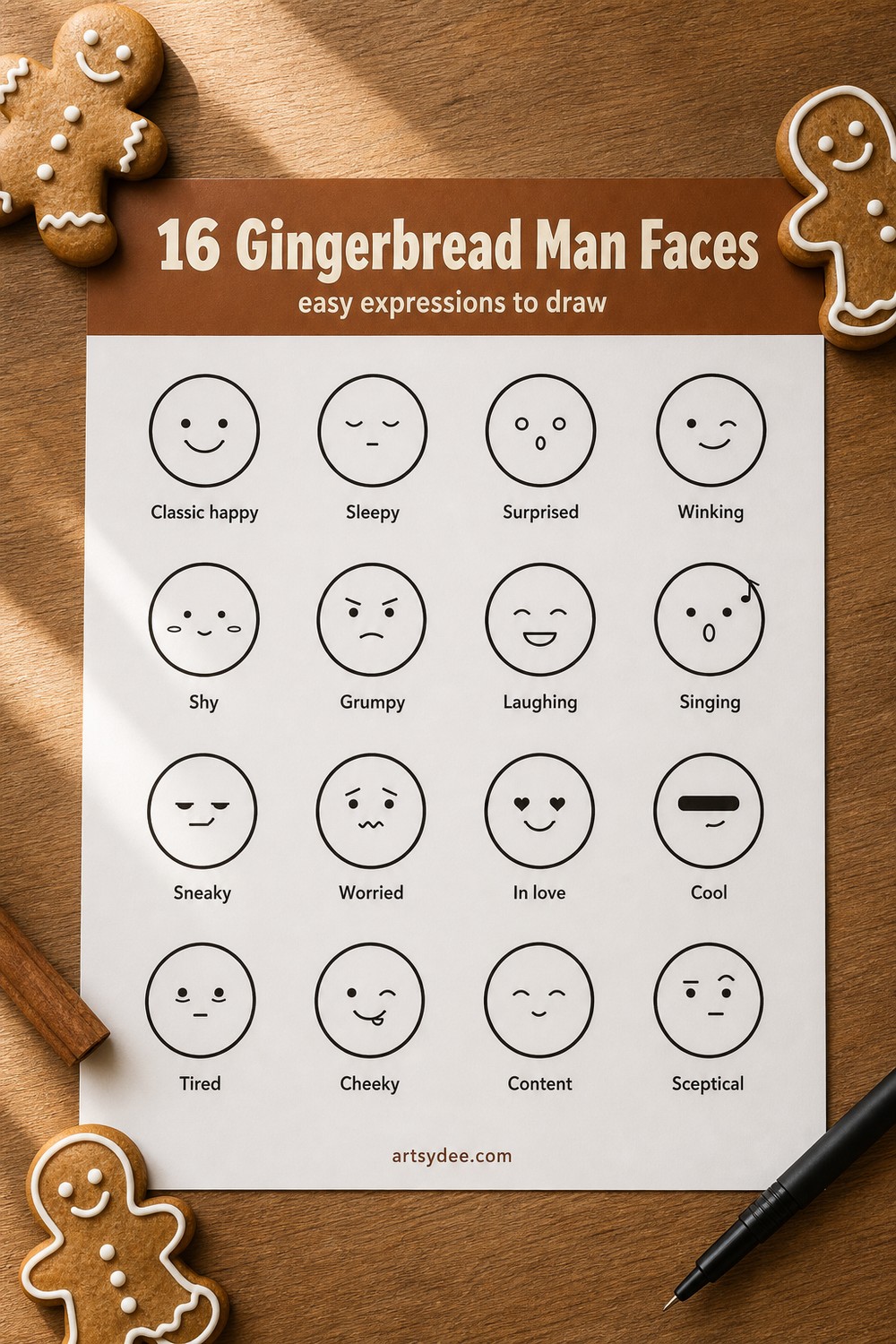
I’ve made you three free printable practice sheets: the classic gingerbread man and the cute kawaii version, both broken into six numbered stages, plus a sheet of sixteen faces to borrow.
Pop your email in below and they’ll come straight to your inbox.
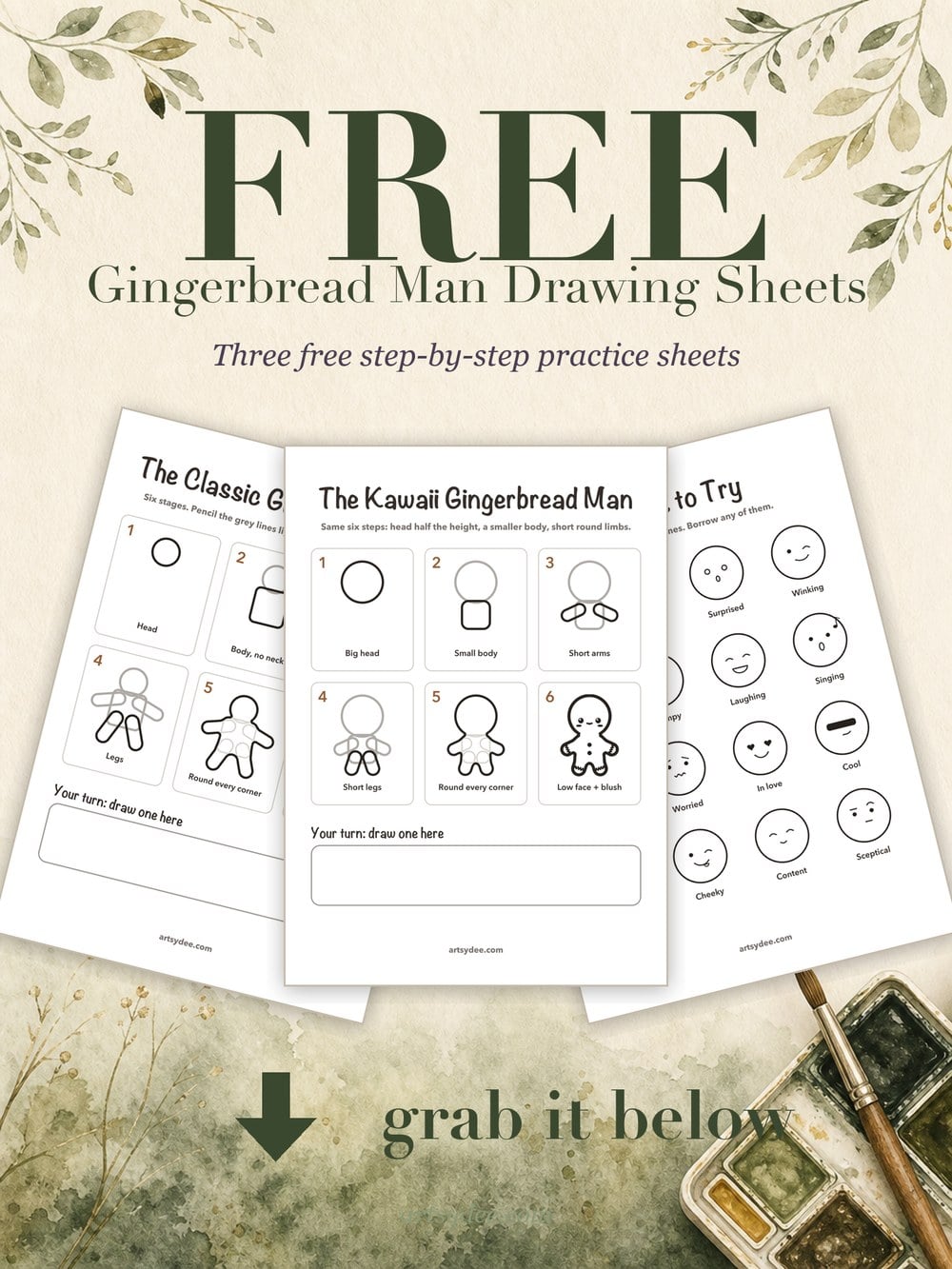
Table of Contents
What Do You Need to Draw a Gingerbread Man?
Quick Answer: A pencil and paper. Sketch the head, body and four limbs lightly in pencil, round off every corner, then ink over it in a black fineliner and rub the pencil out. Add the face and the icing last. That order is what stops a gingerbread man looking like a stick figure.
Nothing on this page needs buying. But the pencil-then-ink habit matters more than any material, because it lets you get the arms wrong twice before anything is permanent, and arms are the bit most people redraw. A soft eraser like the Tombow Mono Zero is handy for lifting the pencil afterwards without smudging the ink.
For the ink stage I use a Sakura Pigma Micron fineliner set: the 05 for the outline of the biscuit, the 01 for the face and icing. Two line weights is the single biggest upgrade you can make to a drawing like this. Thick for the body, thin for the decoration, and suddenly it reads as deliberate instead of scratchy.
If you want a bolder, more confident outline, the Faber-Castell Pitt artist pens give you a lovely chunky brush line that suits a fat little biscuit shape.
And if you colour your gingerbread man in with brown pencil, a white Gelly Roll pen on top is the trick for icing. Draw the zigzags and buttons in white over the brown and it suddenly looks piped.
This post contains affiliate links, which means I may earn a small commission at no extra cost to you if you make a purchase. I only recommend things I actually use.
How to Draw a Gingerbread Man Step by Step
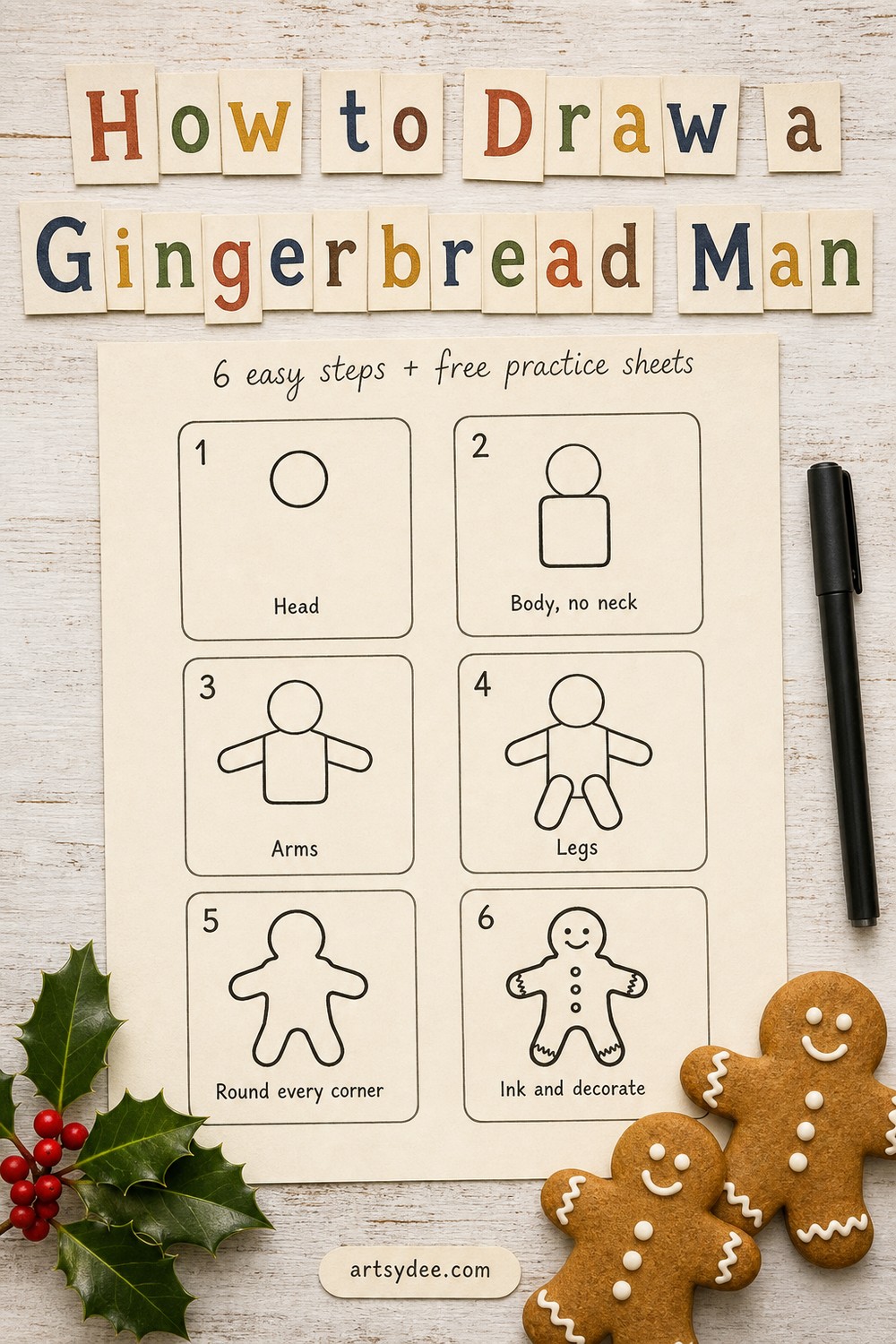
Here’s the classic biscuit. Work in pencil the whole way through and don’t ink anything until step six. The first free sheet shows each of these six stages drawn out, with the new line in dark and the earlier ones in grey.
- Draw a circle for the head. Make it generous, roughly a third of the total height. A small head makes the drawing read as a person; a big one makes it read as a biscuit, which is what you’re after.
- Add the body straight underneath. A rounded rectangle, a little wider than the head, sitting directly against it. No neck. Cookie cutters don’t do necks, and drawing one is the fastest way to lose the gingerbread look.
- Add the arms. Two short stubby limbs coming out of the upper body, angled slightly downward, with rounded ends instead of hands. Keep them fat and short. Thin arms snap off in real life and look wrong on paper.
- Add the legs. Same again at the bottom, angled slightly apart so there’s a shallow V of space between them, with rounded feet. The legs should be about the same thickness as the arms.
- Round every corner. Go back around the whole outline and soften every sharp angle: where the arms meet the body, the tops of the shoulders, the ends of the feet. Real dough spreads in the oven, and this one pass is what turns a pile of shapes into a biscuit.
- Ink it and decorate. Go over your pencil in fineliner, wait a moment, then rub the pencil out. Now add two dots and a curved smile, three buttons down the front, and a zigzag band of icing across each wrist and ankle.
That’s the whole thing. If one arm ended up longer than the other, leave it. A slightly lopsided gingerbread man looks hand-cut, and hand-cut is the point.
How to Draw a Cute Kawaii Gingerbread Man
The cute version isn’t a different drawing. It’s the same six steps with a few proportions changed. Cuteness in illustration is mostly maths, which is very good news if you don’t feel like a natural.
- Make the head half the total height. Not a third, a half. Big head, small body. This one change does most of the work.
- Put the face low. Drop the eyes and mouth into the bottom half of the head instead of the middle. High features read as grown-up, low features read as baby.
- Shrink the limbs. Shorter, rounder, tucked closer to the body. Kawaii arms barely reach past the sides of the tummy.
- Space the eyes wide. Two big dots set far apart, with a tiny highlight left white in each. Add a small blush oval under each eye.
- Simplify the mouth. A tiny curved line. Resist adding teeth. Detail is the enemy of cute.
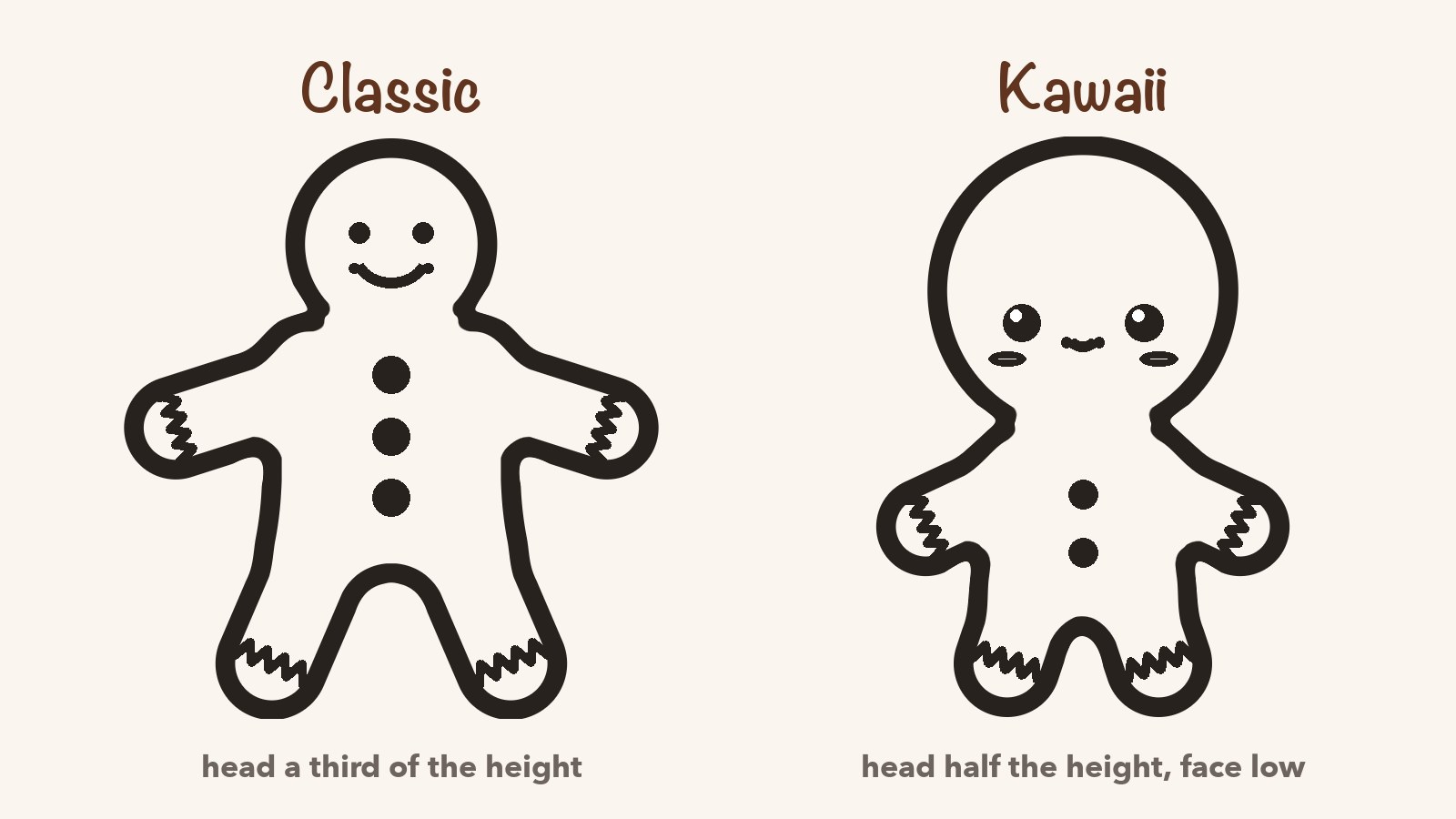
Draw the classic and the kawaii one side by side on the same page and you’ll see the whole trick at a glance. Both six-stage sheets are in the free set for exactly that reason.
16 Faces and Expressions to Try
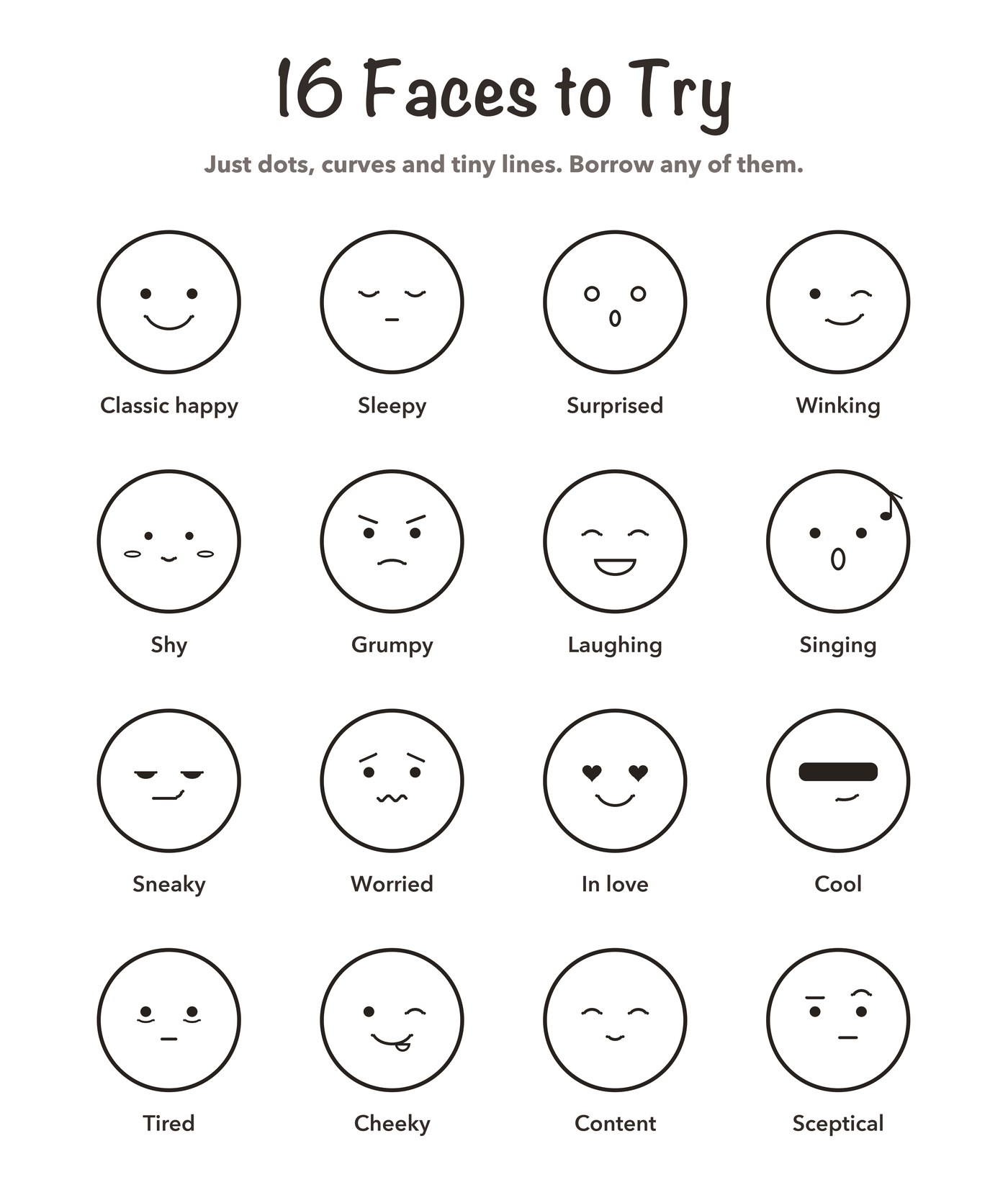
The face is where a gingerbread man gets its personality, and every one of these is built from dots, curves and the occasional tiny line. Practise them small in the corner of a page first. They’re much easier at biscuit size than at full size. All sixteen are drawn out for you on one of the free sheets.
- Classic happy: two dots and a wide upward curve.
- Sleepy: two downward arcs for closed eyes and a tiny flat mouth.
- Surprised: two round eyes and a small oval mouth.
- Winking: one dot, one curved line, and a lopsided smile.
- Shy: small eyes, a tiny mouth, and two blush ovals on the cheeks.
- Grumpy: two dots with short angled brows above and a small downturned mouth.
- Laughing: two curves for squeezed-shut eyes and a wide open smile.
- Singing: dot eyes and a tall open oval, with a small music note beside the head.
- Sneaky: half-closed eyes drawn as flattened half-circles, mouth curved up at one end only.
- Worried: dots with brows angled up in the middle, and a small wavy mouth.
- In love: two small hearts instead of eyes and a soft smile.
- Cool: a single rounded bar across both eyes for sunglasses, and a smirk.
- Tired: two dots with a short curved line under each and a small flat mouth.
- Cheeky: a wink plus a small tongue poking out under the smile.
- Content: two curves for closed eyes and a tiny smile, no other detail at all.
- Sceptical: one brow raised higher than the other, mouth a short flat line off to one side.
16 Icing Details and Trimmings
Decoration is what turns one gingerbread man into a whole page of them, because you can draw the same biscuit sixteen times and dress each one differently. Pick two or three of these per figure. Using all of them on one man is how you end up with clutter.
- Zigzag cuffs: a short band of sharp Ws across each wrist and ankle. The signature detail.
- Scalloped hem: joined U shapes along the bottom edge of the body instead of zigzags.
- Three round buttons: evenly spaced down the centre of the tummy. Three is the magic number.
- Heart button: swap the middle button for a small heart.
- Bow tie: two small triangles meeting at a knot, just under the head.
- Scarf: a band around the neck line with one striped end trailing off to the side.
- Earmuffs: a curved band over the top of the head with a fluffy circle at each side.
- Santa hat: a triangle tilted to one side with a wavy band at the base and a bobble at the tip.
- Holly sprig: two pointed leaves and three dots, tucked beside the head.
- Candy cane: a walking-stick shape with diagonal stripes, held under one arm.
- Striped legs: horizontal bands down each leg like little stockings.
- Apron: a rounded square across the middle with two thin ties going round the sides.
- Piped outline: a wavy line following the whole silhouette just inside the edge.
- Dotted border: the same idea, but a row of evenly spaced dots instead of a line.
- Swirl on the tummy: one loose spiral where the buttons would go.
- Tiny snowflake: six short lines from a centre point, dotted onto the chest or a shoulder.
If you want somewhere to put all these decorated biscuits, they look wonderful piled around a gingerbread house drawing. The two go together on a page as well as they do on a plate. And if you fancy a candy cane to tuck under an arm, my candy cane templates have ten to trace.
How to Draw a Whole Gingerbread Family
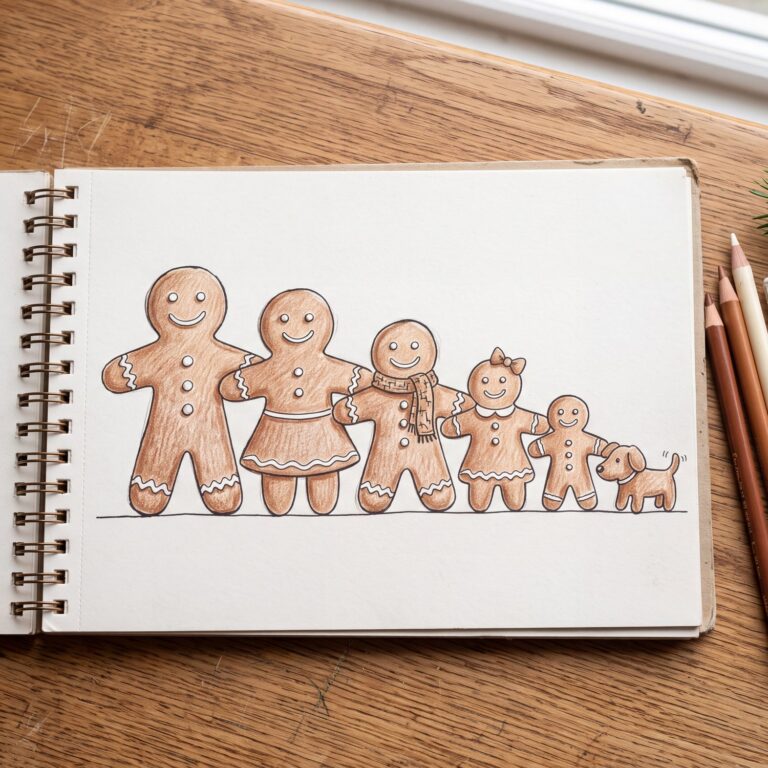
A row of gingerbread people looks like a much bigger drawing than it is, because the eye reads the group rather than any single biscuit. Three rules and it works every time.
Keep the outline identical, change the height. Don’t redesign the body for each one. Draw the same shape at five different sizes (tall, tall-ish, medium, small, tiny) and the family reads instantly. Same cutter, different bakes.
Change exactly one thing per figure. A skirt shape on the body for one, a bow on the head of another, a scarf on the third, nothing at all on the fourth. One distinguishing feature each is plenty. Two starts to look busy; three and they stop looking like a set.
Stand them on one line and overlap slightly. Give them a single ground line so nobody floats, and let each one tuck a fraction behind its neighbour. That small overlap is what creates depth, and it costs you nothing.
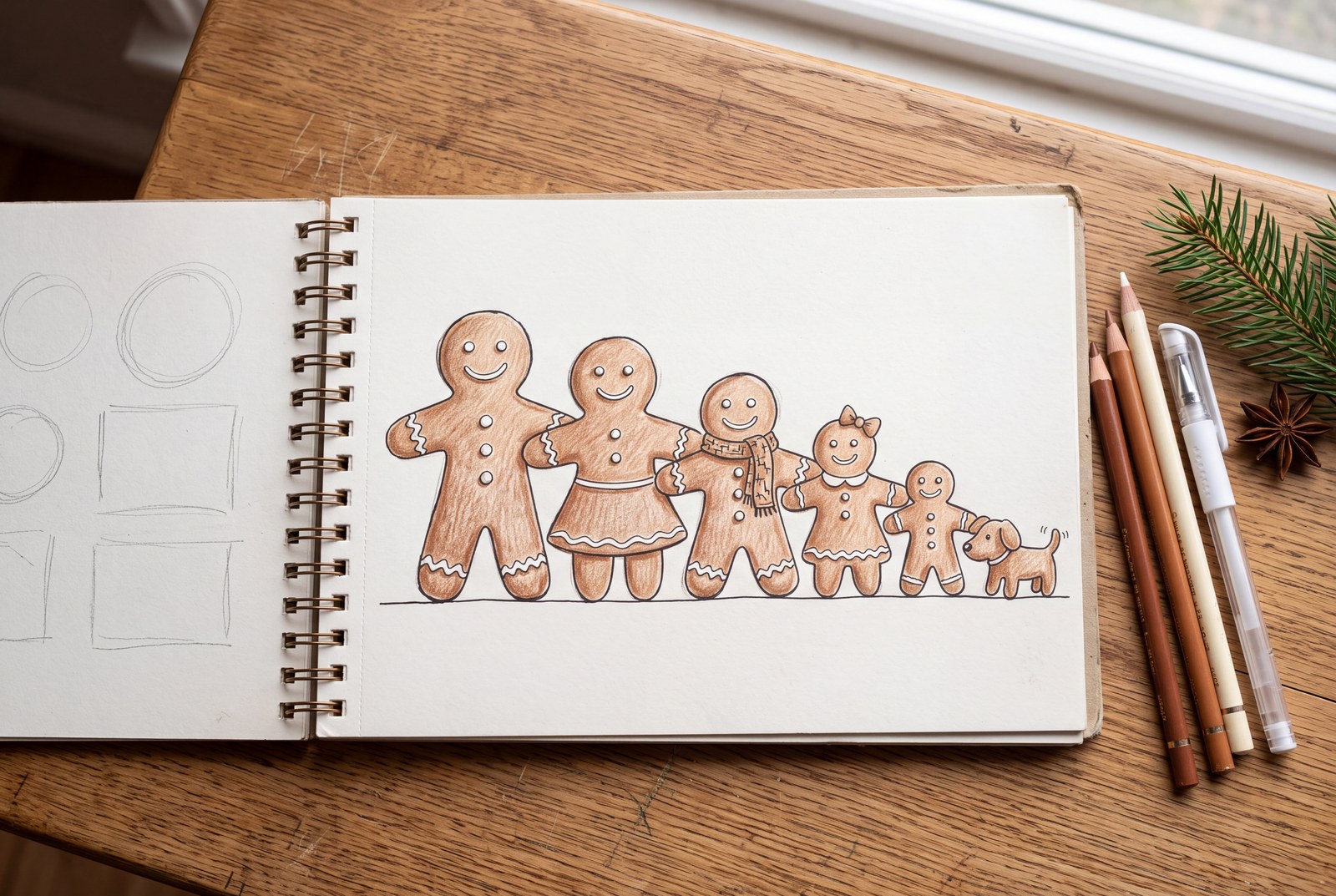
Sketch the whole row lightly as plain circles and rectangles first, check the spacing, and only then start decorating. Finishing figure one completely before starting figure two is the reliable way to run out of paper. I have done it more than once.
Add a gingerbread dog at the end if you want. A small oval body, a round head, four stubby legs and a curl of a tail, decorated to match.
What’s in the Free Practice Sheets?
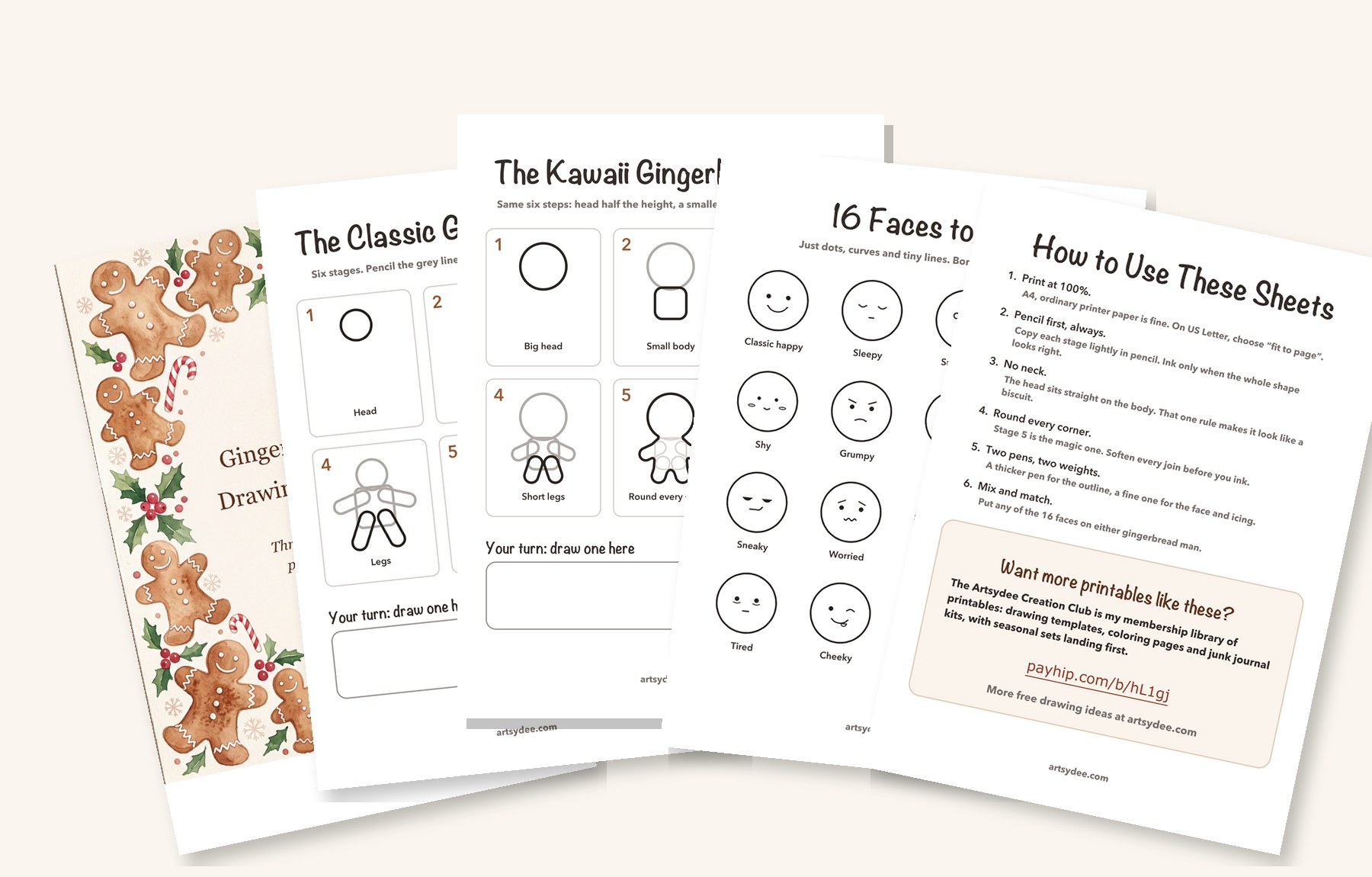
Quick answer: one 5-page A4 PDF with three practice sheets, a cover and a page of tips. Print it on ordinary paper.
- The Classic Gingerbread Man: all six stages from this post, numbered, with a big empty box to copy into.
- The Kawaii Gingerbread Man: the same six-stage build-up for the cute, big-headed version, with its own copy box.
- 16 Faces to Try: every face above drawn out on its own little gingerbread head, labelled, so you can borrow them.
- How to use the sheets: six quick tips on one page, plus where to find more printables like these.
The icing details and the family row aren’t on the sheets. Those are yours to invent once the shape is in your hand.
5 Tips for a Better Gingerbread Man Drawing
- No neck, ever. The head sits straight on the body. This is the single fastest way to tell a gingerbread man from a person, and beginners add a neck almost every time.
- Round every corner before you ink. One pass softening the angles turns a set of rectangles into something that looks baked. Skip it and the biscuit looks like a robot.
- Keep the limbs short and fat. If an arm looks elegant, it’s too thin. Stubby is correct.
- Use two line weights. Thick for the outline, thin for the face and icing. It does more for the finished drawing than any amount of extra detail.
- Draw the face last, and let it be wonky. A slightly off-centre smile is what makes it look hand-iced. A perfectly symmetrical face makes it look printed.
Want the Full Christmas Drawing Set?
Love these? My Christmas Drawing Templates set has 36 more festive drawings to trace or sketch from (five each of gingerbread, Christmas trees, lights and ornaments, plus fourteen stockings and two mixed pages) and four new step-by-step guides: a gingerbread girl, a snowy fir tree, a wreath wrapped in lights and a vintage finial ornament. None of the pages repeat the free sheets above.
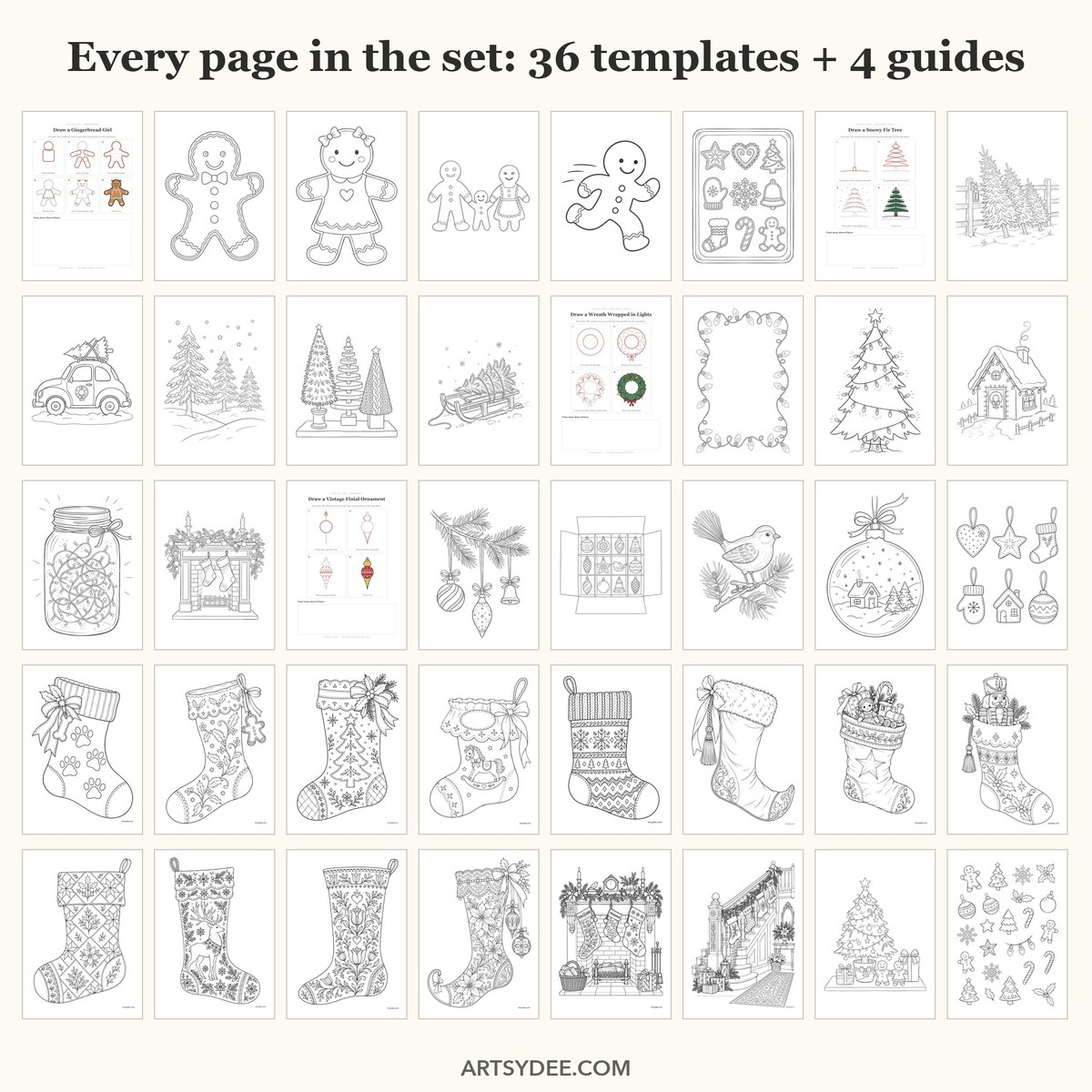
It’s £9, an instant download: a 43-page A4 PDF plus every page as a PNG.
Want More Printables Like These?
If practice sheets like these are your thing, the Artsydee Creation Club is where the rest of them live: a growing library of drawing templates, coloring pages and junk journal kits, with the seasonal sets landing first.
You can also browse everything else I make in my Artsydee shop, and there’s more drawing and painting with me over on YouTube. If you’d like the next video when it lands, subscribe to my YouTube channel here.
Frequently Asked Questions
How do you draw a gingerbread man step by step?
Draw a circle for the head, then a rounded rectangle straight underneath for the body with no neck between them. Add two short stubby arms angled down from the upper body and two stubby legs angled slightly apart. Round off every corner, ink over your pencil lines, then add a face, three buttons and zigzag icing at the wrists and ankles.
How do you draw a cute gingerbread man?
Make the head about half the total height, drop the eyes and mouth into the lower half of the face, space the eyes wide apart, and shorten the arms and legs so they tuck close to the body. Add two small blush ovals on the cheeks. Cute is mostly proportion, not skill.
Is a gingerbread man easy to draw for kids?
It’s one of the easiest Christmas subjects there is. The whole figure is a handful of simple shapes and nothing needs to be symmetrical. The six-stage sheets suit roughly age five and up, and younger children usually do best copying the finished stage 6 into the empty box and decorating it.
Can I use these practice sheets in a classroom?
Please do. Print as many copies as your class needs. Just don’t sell them or pass the file on; send people to this page and they can grab their own set.
What pens are best for drawing gingerbread men?
Any black fineliner will do. If you can, use two sizes: around 05 for the outline of the biscuit and 01 for the face and icing. The contrast between the two is what makes a small drawing look finished.
Final Thoughts
Draw one gingerbread man badly, then draw another one next to it. The second is always better, and by the fifth you’ll be giving them earmuffs and little scarves you didn’t plan. That’s the whole appeal of this subject. It rewards repetition rather than care, which makes it a lovely one to do with a cup of tea and no particular intention.
Grab the three free practice sheets from the box at the top of this post and start with the classic. If you draw a whole family, I’d love to see it. I share drawing ideas on Pinterest too.
You Might Also Like
- Gingerbread House Drawing: six more free sheets, and somewhere to put all these biscuits
- Easy Christmas Drawing Ideas: 30 simple things to draw when you want something next
- Christmas Doodles to Draw: 20 easy festive doodles, all built from simple shapes
- Cozy Christmas Coloring Pages: snug scenes if you’d rather colour than draw
- 37 Free Christmas Drawing Templates: the big printable collection
Pin this for later so you can find the free practice sheets when you sit down to draw.
Happy drawing!
Dee x