Last Updated on October 1, 2026 by Dee
Sunflowers are the flower everyone paints in August, and they are also the one that trips people up. Too much yellow and the whole thing goes flat. Too much water in the middle and that gorgeous seeded centre turns into a brown puddle. The good news is that almost every sunflower problem is fixed by the order you paint things in.
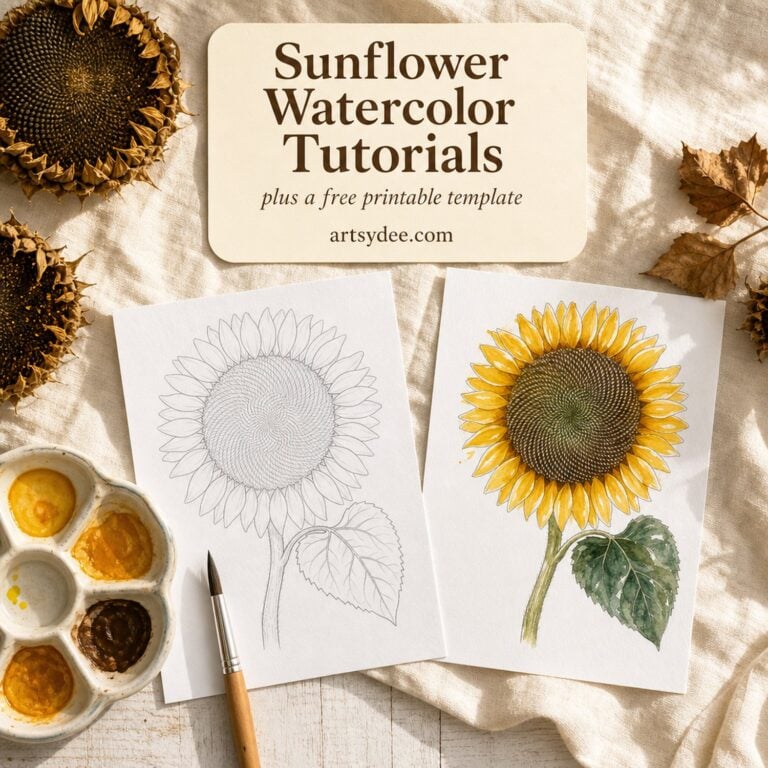
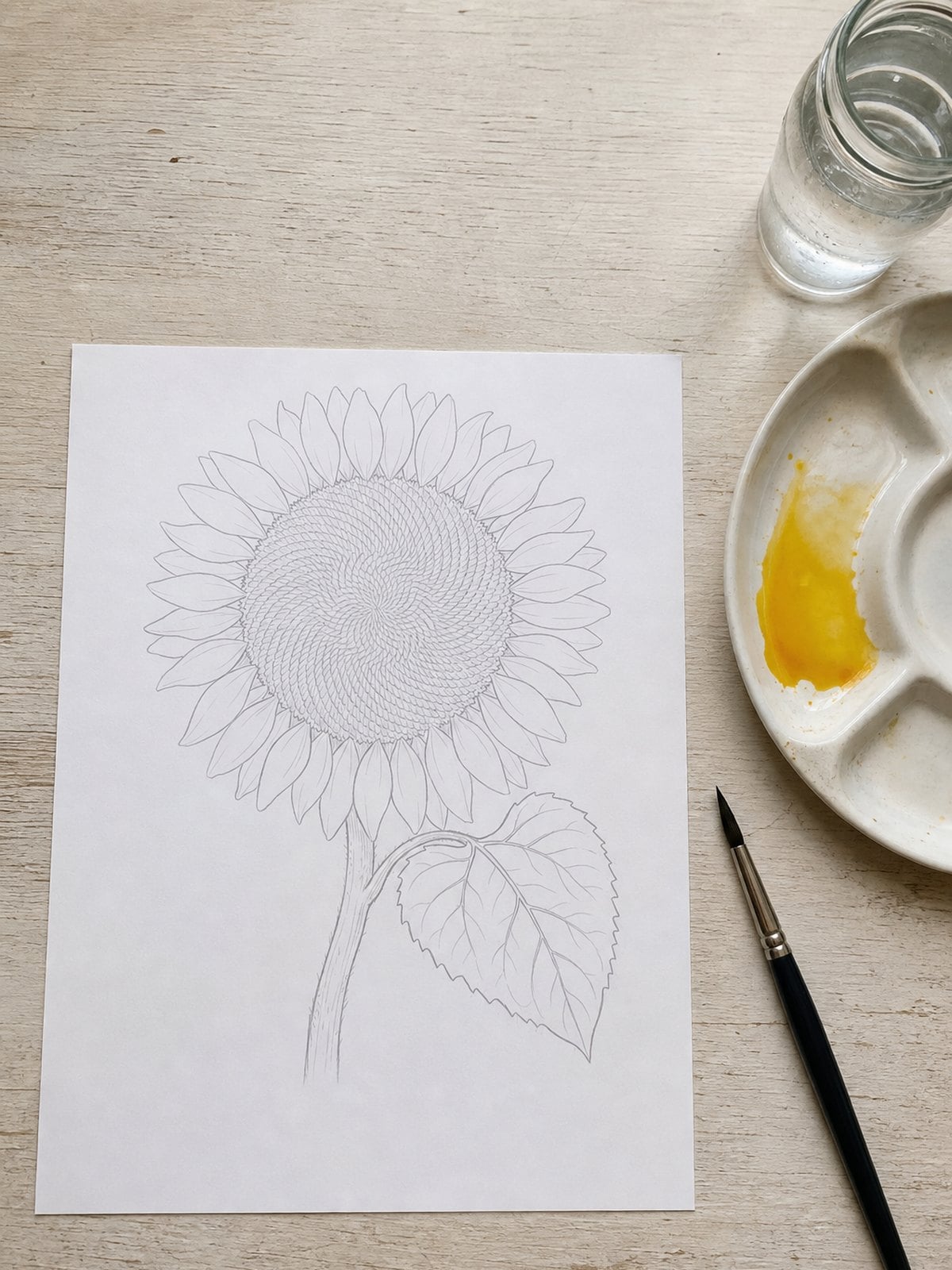
So here are 16 sunflower watercolor tutorials to work through, from a one-wash beginner bloom to a full branching plant study — plus a free printable sunflower template you can grab right below and print on watercolour paper today.
Below you will find the supply list, the sixteen tutorials grouped from easiest to hardest, and a section on painting sunflowers by name — because ‘Teddy Bear’ and ‘Italian White’ are two quite different painting jobs.
Table of Contents
📌 Pin this for later!
What you need to paint a sunflower in watercolour
Quick answer: A sunflower needs surprisingly little: a warm yellow, a burnt umber or sepia for the seed disc, one green, a round brush around size 6, and paper heavy enough not to buckle — 300 gsm cold press is the sweet spot.
You do not need a big palette for sunflowers. Most of the work happens in the gap between two yellows and one brown. I paint mine on a Canson XL watercolour pad because it takes a soaking without cockling, and I mix from a Winsor & Newton Cotman set — the Cotman yellows are honest and they lift cleanly if you overdo it.
One good round brush does nearly everything here. A Princeton Heritage round in size 6 holds enough water for a whole petal ring but still comes to a point fine enough for the seed detail. Keep your mixes in a ceramic palette rather than plastic, so the golds do not bead up on you halfway through a wash.
This post contains affiliate links, which means I may earn a small commission at no extra cost to you if you buy through them. I only link supplies I actually paint with.
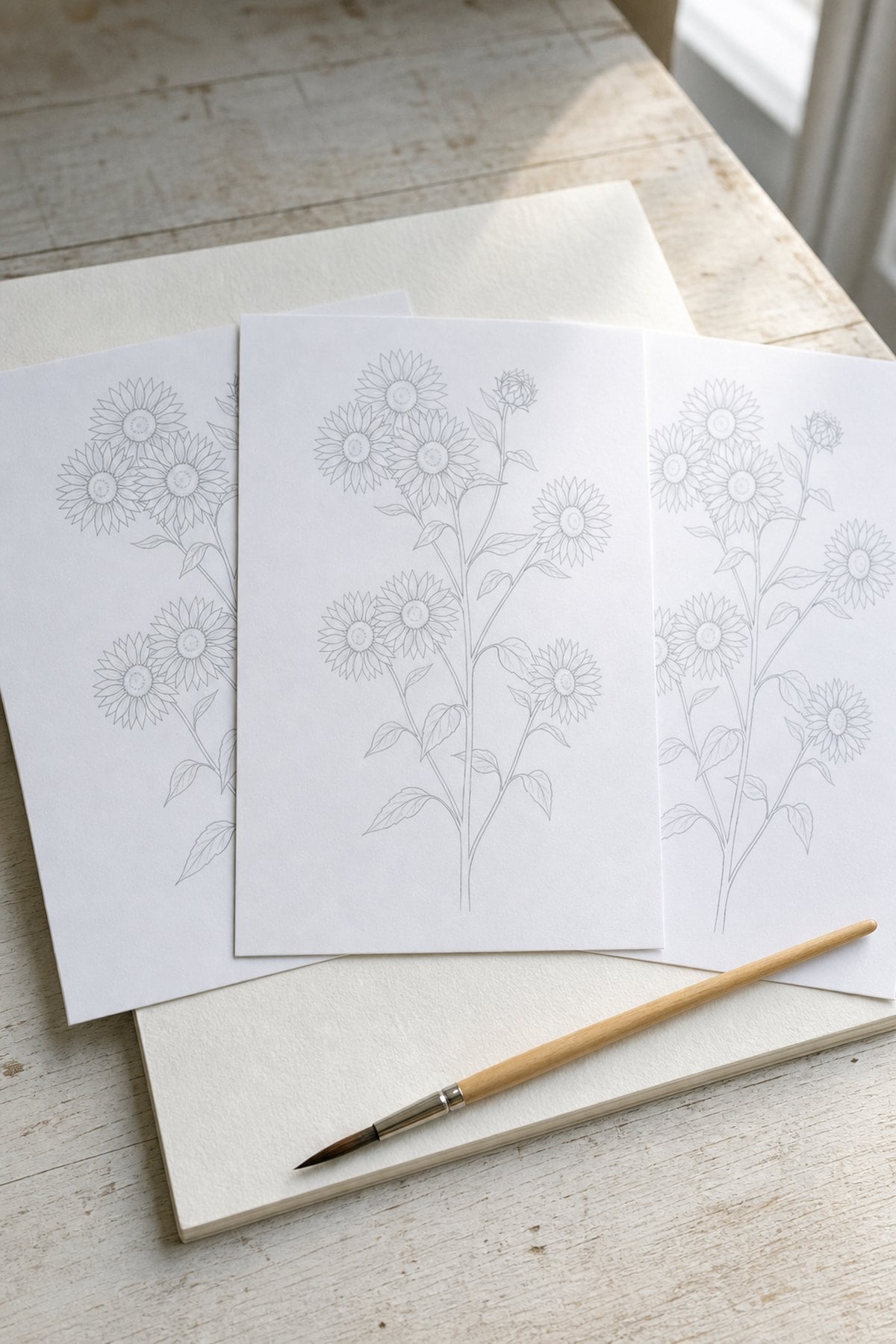
Printing tip: templates print at A4 by default. If you are in the US, choose ‘fit to page’ and Letter paper — the drawing shrinks by a few millimetres and nothing gets cropped. Print on the watercolour paper itself if your printer will take 300 gsm; if it will not, print on plain paper and trace over a window or a light pad.
Start here: 5 simple sunflower watercolor tutorials
These five are the ones I would give anyone painting their first watercolour sunflower. Each takes twenty minutes or less and each one teaches a single thing, so if it goes wrong you know exactly what went wrong.
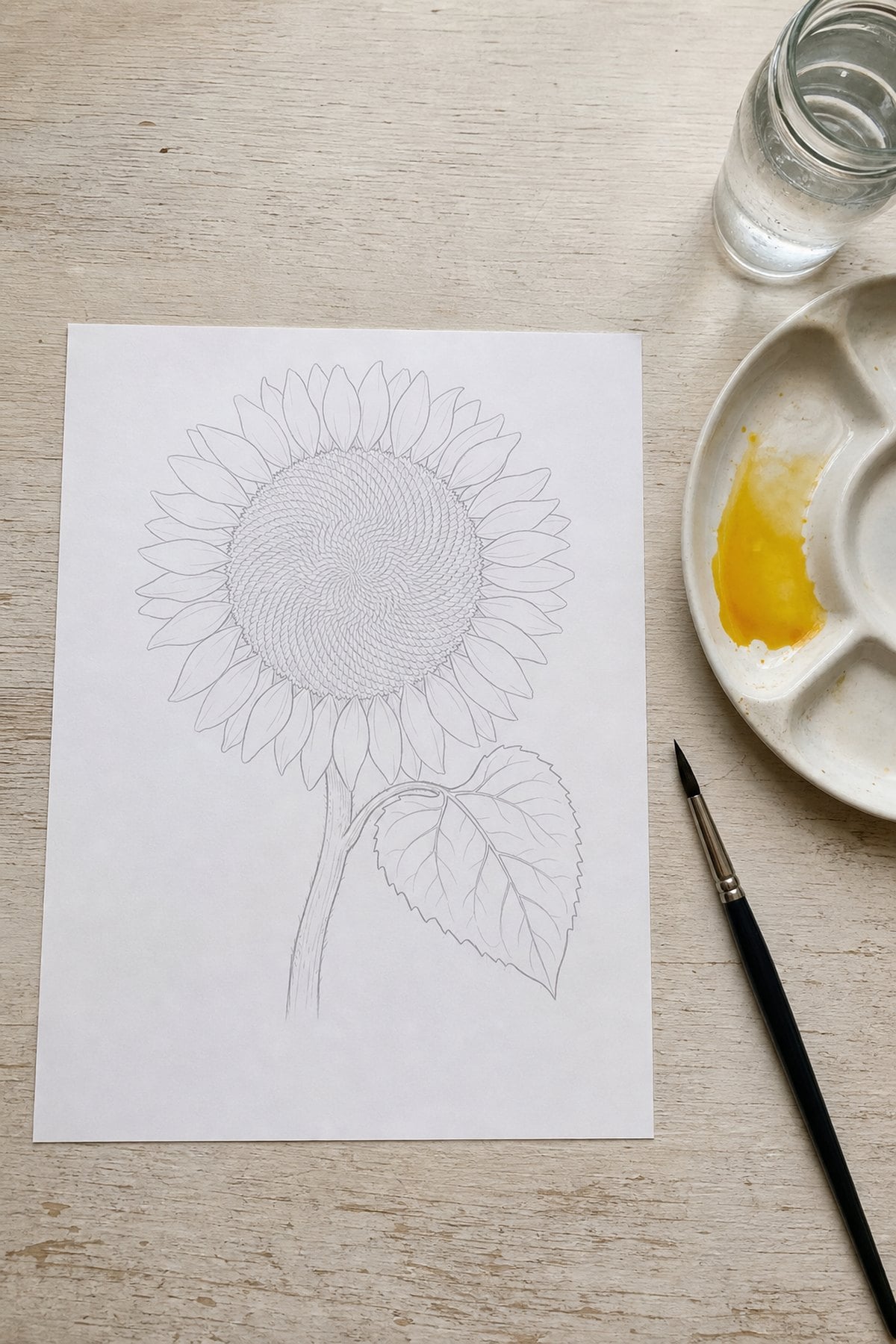
1. The one-wash sunflower
Mix one puddle of warm yellow, big enough for the whole flower, and paint every petal in a single pass without going back over anything. Let it dry completely. Then, and only then, drop in the brown centre. This is the whole trick — the reason most beginner sunflowers go muddy is that the centre is painted while the petals are still damp and the brown creeps outwards into the yellow.
2. Wet-on-wet petal glow
Paint a petal in clean water first, then touch a loaded brush of deep gold to the base of the petal, where it meets the centre. The pigment runs up the wet shape and stops on its own. Do it petal by petal, skipping every other one, so neighbouring petals do not bleed into each other and lose their edges.
3. The seed-centre spiral
Lay a mid-brown wash across the whole disc and let it dry flat. Then take an almost-dry brush and stipple a darker brown in curving lines that spiral out from the middle. You are not drawing every seed. You are suggesting two directions of spiral crossing each other, and your eye fills in the rest.
4. The two-colour sunflower
Yellow and burnt umber. That is the entire palette. Mix a little umber into the yellow for the shadowed petals and use it neat for the centre. Restricting yourself to two pigments forces you to work in values rather than colours, which is the single fastest way to make a flat painting look solid.
5. A leaf and stem study
Paint just one sunflower leaf — that big rough heart shape with the toothed edge — and the thick hairy stem it hangs from. Sunflower green is never a straight tube green. Mix sap green with a little yellow ochre and it stops looking plastic straight away.
6 sunflower watercolor tutorials that teach you a technique
Once the basics feel comfortable, these six each add one technique you will reuse on every flower you paint afterwards, not just sunflowers.
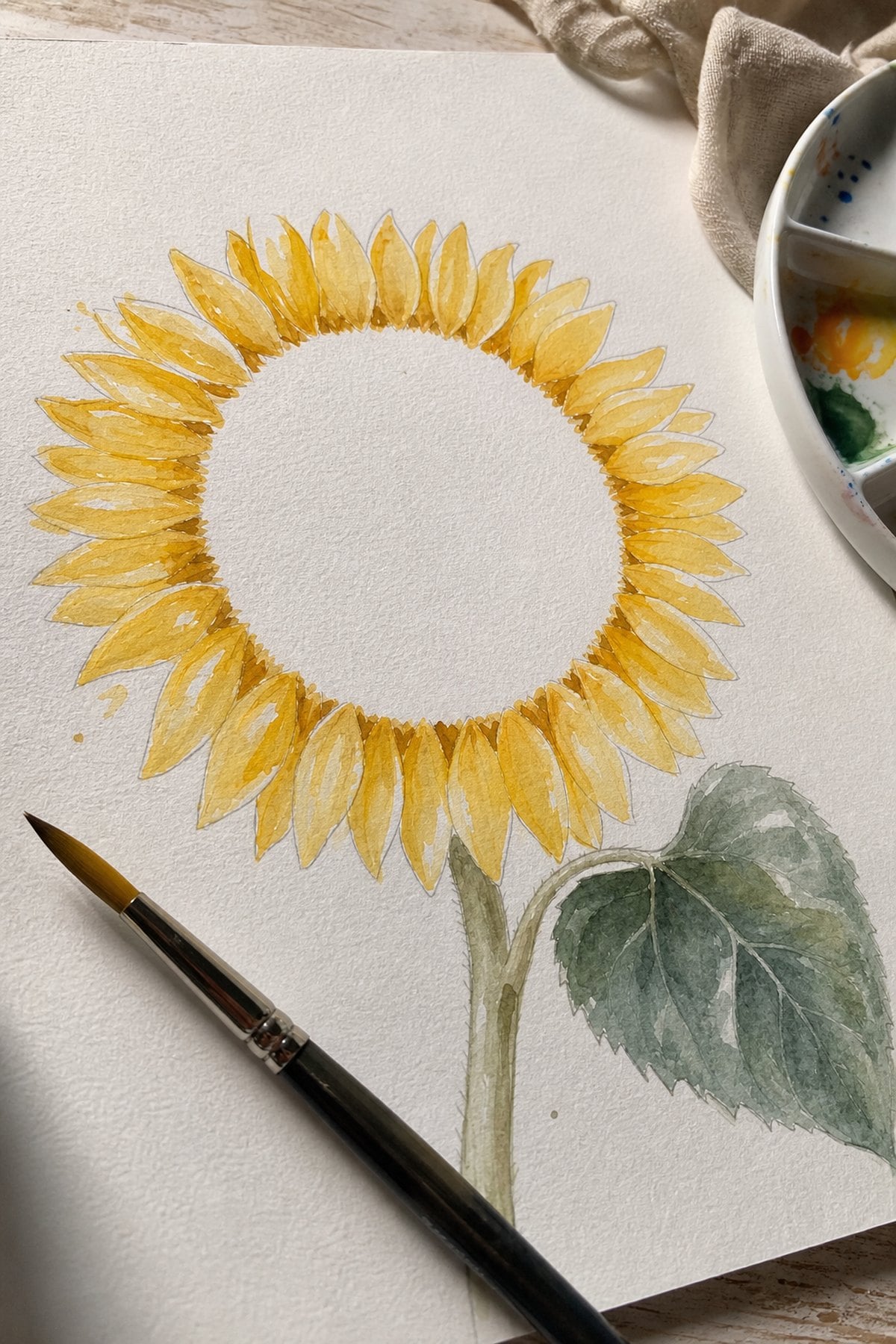
6. Glazing for depth
Paint the flower in three complete passes, letting each dry fully. Pass one is a pale wash over everything. Pass two adds the shadowed side of each petal. Pass three is a handful of small darks in the crevices. Three thin layers glow in a way one thick layer never does.
7. Lifting highlights back out
Let a petal wash dry to a damp sheen, then press a clean, thirsty brush along the centre line of the petal and blot with tissue. The pigment lifts and leaves a soft pale rib. Easier than reserving the white, and much more forgiving.
8. A banded, two-tone petal
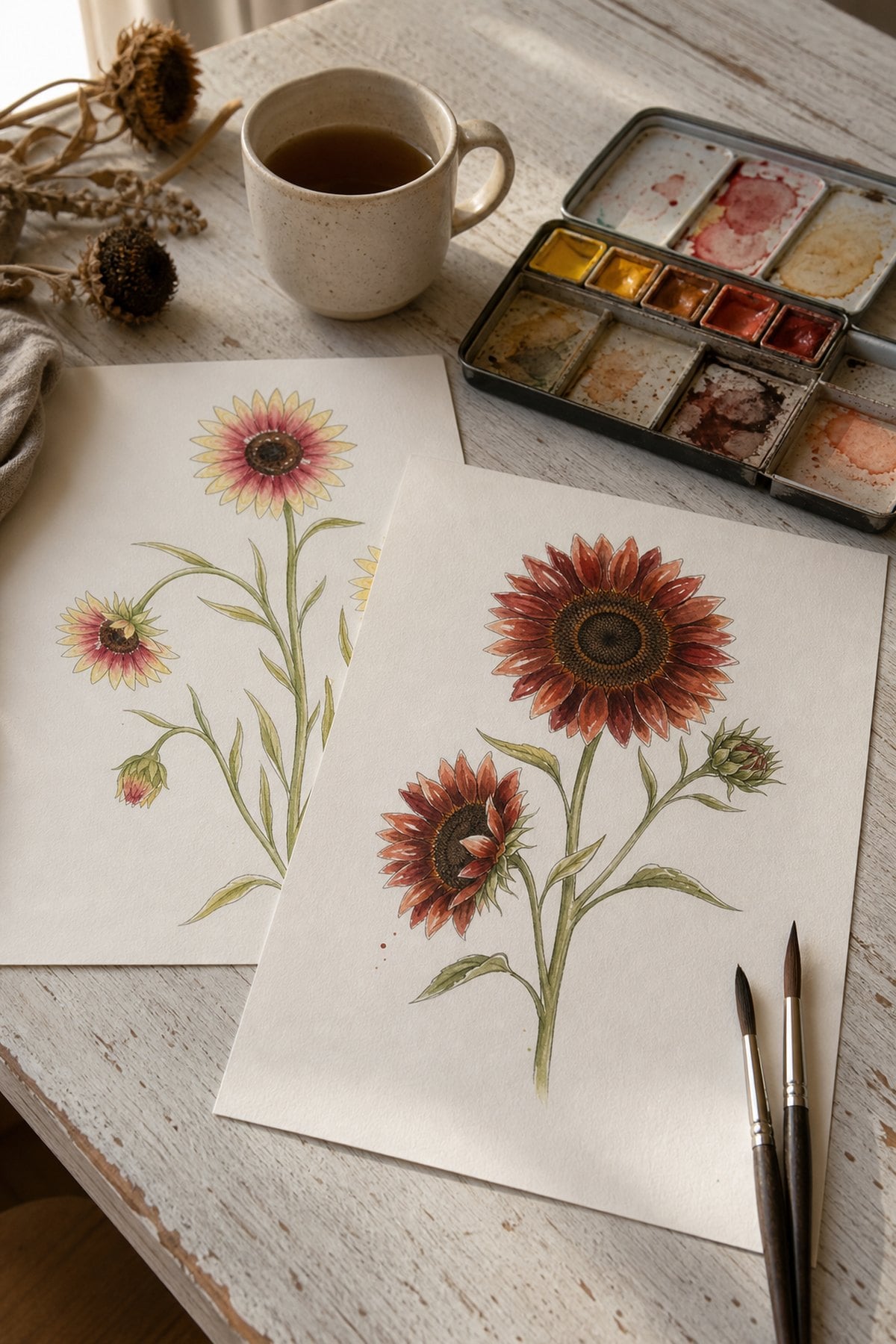
Some sunflowers carry a ring of darker colour partway along the petals. Paint the outer half in gold, wait for the shine to go off, then touch red into the inner half so the two colours meet and blur along one soft line. The ‘Ring of Fire’ sunflower is the classic example of this.
9. Backlit petals
Leave the paper white along one edge of each petal and paint only the shadow side. It reads instantly as afternoon sun coming through the flower. Sunflower petals are thin, and painting that thinness is what makes a study feel alive.
10. A loose bouquet with no outlines
Put the template away. Block in five or six ovals of gold with the side of the brush, add brown centres while they are still damp, then drop in green stems underneath. Twelve minutes, no drawing, and it looks like you meant it.
11. The negative-space sunflower
Paint the background instead of the flower. Wash a soft blue-grey around the petal shapes and let the white paper become the sunflower. It is fiddly and it will teach you more about edges than any other exercise on this list.
5 sunflower watercolor tutorials for when you want a challenge
These take a proper afternoon. They are the ones worth putting in a sketchbook you keep.
12. A whole plant, not just a bloom
Most sunflower paintings are one head on a stick. Paint the whole plant instead — branching stems, blooms at different heights, a couple of tight buds and one flower already going over. Branching habit is the thing that makes one variety look different from another, long before colour comes into it.
13. Colour-match a named variety
Pick a real sunflower, find a good photograph, and mix until you match it rather than reaching for the yellow you always use. This is slower than it sounds and it is the exercise that improves people’s colour fastest.
14. Monochrome sunflower
One pigment, ideally a granulating brown or an indigo, and the full range from nearly-white to nearly-black. No colour to hide behind. If the painting reads in monochrome, it will read in colour.
15. Sunflowers in a jar
Three stems in a glass jar of water. You get the flowers, the stems refracting where they cross the waterline, and the cast shadow on the table. A whole still-life lesson wrapped in a flower study.
16. The five-minute daily sunflower
One small sunflower a day for a week, five minutes each, on the same sketchbook page. Set a timer and stop when it goes. By day four you will be making decisions instead of copying, which is the entire point.
Painting named sunflower varieties (this is the fun part)
Quick answer: ‘Sunflower’ is not one flower. Teddy Bear is a shaggy double with no visible seed disc at all, Italian White is an airy branching spray of narrow cream petals, and Velvet Queen is deep rust — and each one needs a different brush and a different mix.
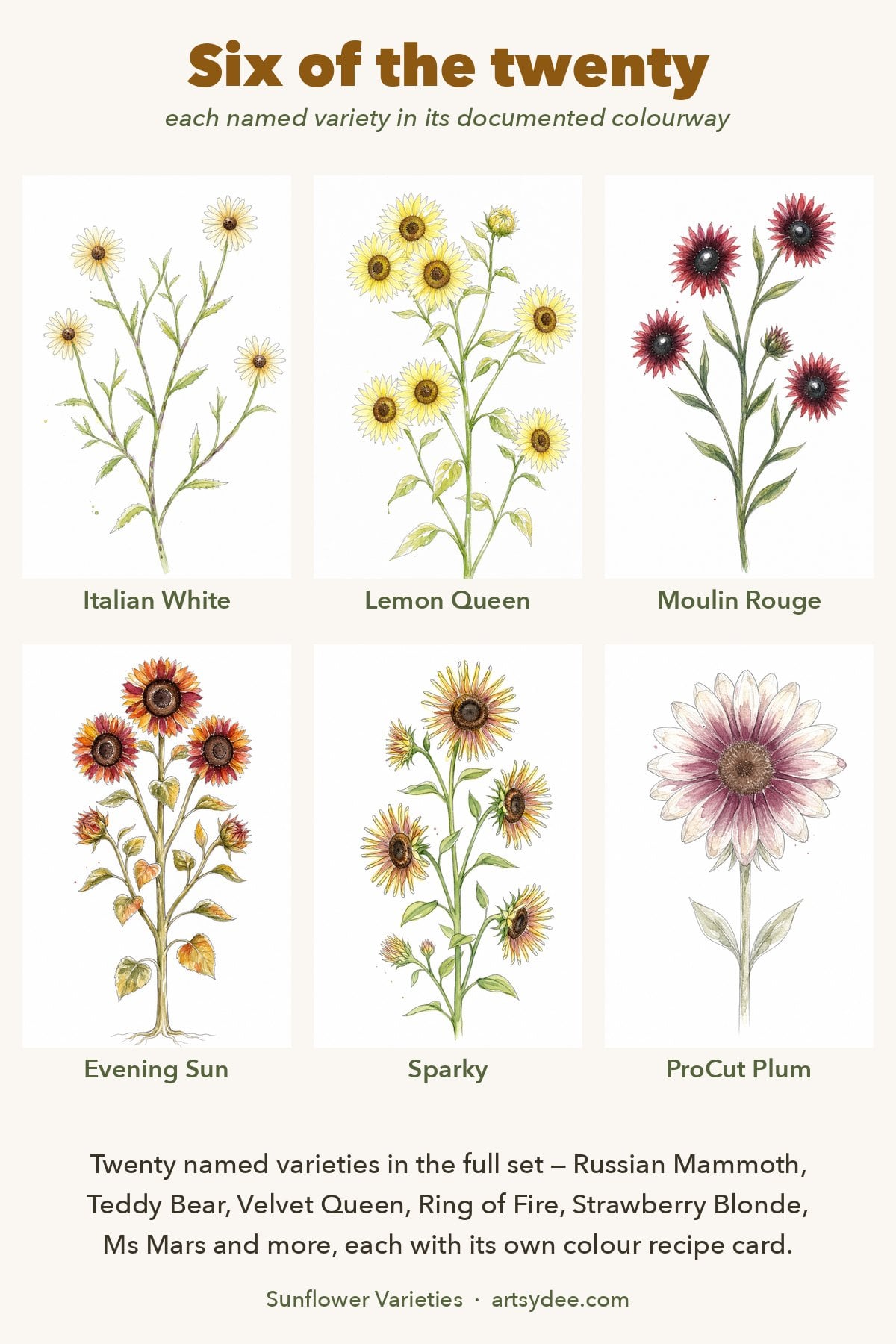
Once you start painting sunflowers by name, the whole subject opens up. ‘Teddy Bear’ is a dense pompon of short shaggy petals packed right into the middle, so there is no disc to paint at all. ‘Sparky’ carries long slender quilled petals like little rolled tubes around a dark chocolate centre. ‘ProCut Plum’ is a single unbranched cut-flower stem with strikingly even petals fading from dusky plum to pale cream at the tips. Same flower family, three quite different painting problems.
A few of the best-loved ones are worth a word of warning. ‘Velvet Queen’, ‘Earthwalker’, ‘Autumn Beauty’, ‘Evening Sun’ and ‘Pastiche’ are documented as colour blends rather than single fixed colourways — sow a packet and you get a range of shades, sometimes on the same plant. So if your painting does not match the seed packet photograph exactly, that is not you getting it wrong. That is the strain doing what it does.
If you want more sunflower line art to practise on, my free sunflower printables page has the biggest collection on the site, and there are more outlines in sunflower template free printable and sunflower printables, coloring pages and templates.
The Sunflower Varieties reference set
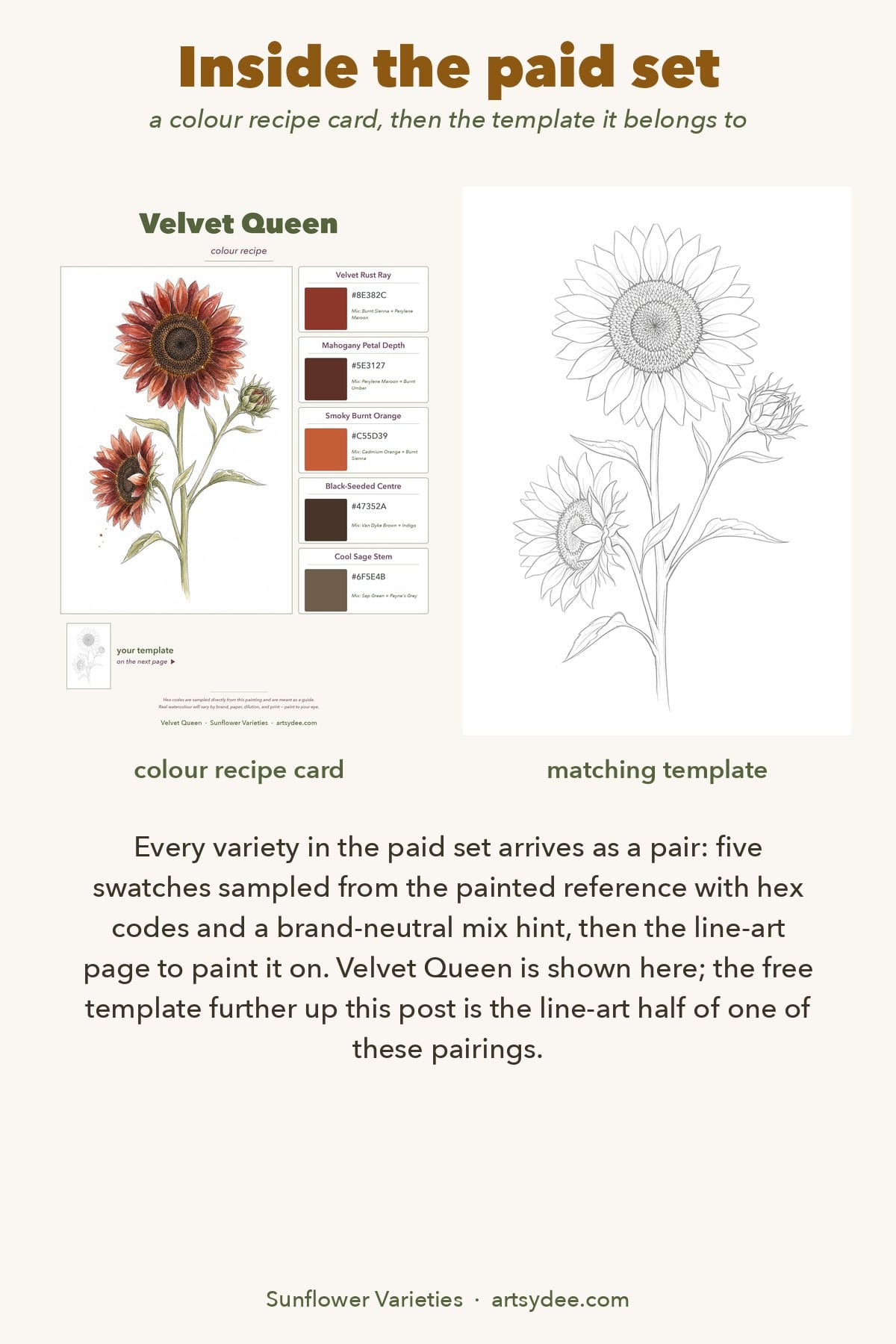
The free template above is one page from a much bigger set I have been building all summer. Sunflower Varieties is a watercolour reference set of 20 named sunflower varieties, each with its documented colourway and its own colour recipe card. Every card carries five swatches sampled straight from the painted reference, with hex codes and a brand-neutral mix hint, so you are never guessing what to mix.
- 20 named sunflower variety templates, soft pencil line art on A4
- 20 colour recipe cards — five swatches each, with hex codes and mix hints
- A variety identifier index showing all twenty at a glance
- 42-page A4 PDF at 300 DPI, plus a zip of all 20 individual PNGs
It is £14 (roughly $18) in the Artsydee Payhip shop, and you can find it here: Sunflower Varieties — Watercolour Reference Set.
Prefer to get everything rather than buy sets one at a time? Sunflower Varieties is included in the August watercolour drop on my Patreon, along with every other watercolour kit, brush set and Procreate goodie I make. Membership starts at £8 a month and the whole back catalogue comes with it.
Sunflower watercolour problems and how to fix them
Quick answer: Nine times out of ten a disappointing watercolour sunflower is a timing problem, not a skill problem — something was painted while something else was still wet.
- The centre bled into the petals. The yellow was still damp. Dry the petals completely — properly bone dry, not nearly — before the brown goes anywhere near them.
- The yellow looks flat and dead. There is no shadow in it. Add a second pass of yellow with a whisper of umber on the side of each petal away from the light.
- The petals merged into one blob. Skip every other petal on the first pass and come back for the alternates once the first lot have dried.
- The paper buckled. Lighter paper than 300 gsm, or too much water. Either stretch the sheet or work on a block.
- The green looks like plastic. No straight tube greens. Knock sap green back with yellow ochre or a touch of the same brown you used in the centre.
If you want to see the wet-on-wet stage in motion rather than in stills, I put step-by-step painting videos on my YouTube channel most weeks. Subscribe here if you would like the next one to turn up.
Frequently asked questions
What paper is best for watercolour sunflowers?
A 300 gsm cold press paper. The texture helps the seed centre look grainy without any extra work, and the weight means you can flood a petal wash without the sheet buckling. Anything under 200 gsm will cockle the moment you get generous with water.
Which yellow should I use for a sunflower?
A warm yellow rather than a lemon one — cadmium yellow, gamboge or Indian yellow all work. Lemon yellow is too cool and green-leaning on its own, though it is lovely for the pale varieties like ‘Italian White’ and ‘Lemon Queen’.
How do I paint the seed centre without it going muddy?
Wait. Let the petals dry completely, lay one flat mid-brown wash over the whole disc, let that dry too, then stipple the darker spirals on top with a nearly dry brush. Three dry stages, not one wet one.
Do I need to print the templates on watercolour paper?
It is easier if you can — most home printers will take a single sheet of 300 gsm through the rear feed. If yours will not, print on plain paper and trace the outline onto watercolour paper against a bright window or a light pad.
Are the free templates the same as the paid ones?
The free download is one full page from the paid set — the ‘Russian Mammoth’ template, exactly as it ships. The paid set adds the other nineteen varieties and the colour recipe card that goes with each one.
Final thoughts
Pick one tutorial from the top of this list, print the free template, and give it twenty minutes this afternoon. Not the whole list. One. Sunflowers are forgiving in a way most flowers are not, and the difference between a muddy first attempt and a bloom that glows is usually just letting the yellow dry before you touch the middle.
You can also find me on Pinterest, where I save every new template as it goes up, and on YouTube for the video versions.
You might also like
- Free Sunflower Printables
- Sunflower Watercolor Templates
- How to Paint a Watercolor Sunflower
- Sunflower Pencil Drawing Ideas
- Sunflower Junk Journal Pages
📌 Pin this for later!