Last Updated on October 13, 2026 by Dee
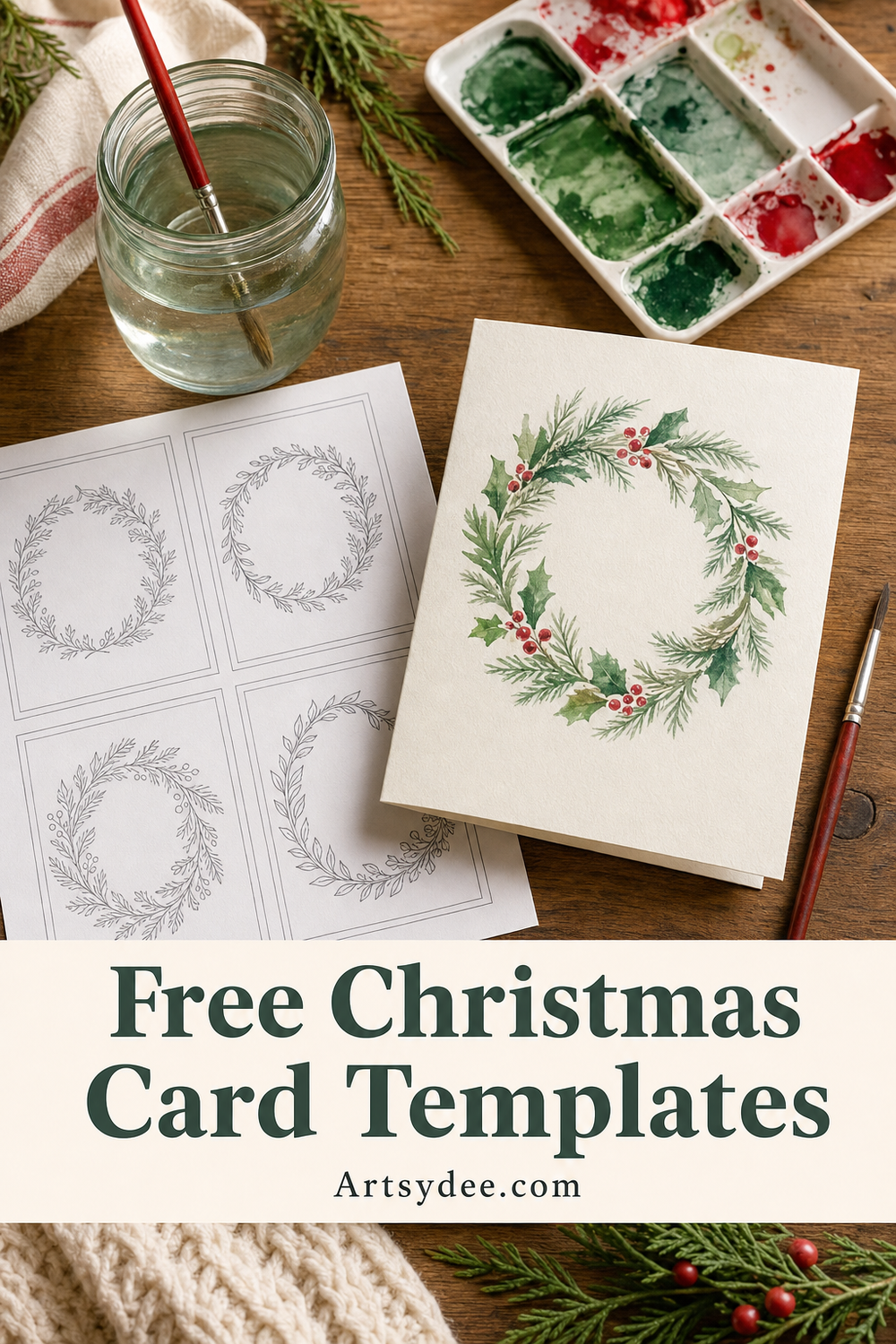
Here are 15 easy watercolor Christmas card designs to paint, plus free Watercolor Christmas Card Templates: four printable card designs, each as a cut-and-mount panel and a fold-out card (A4 and US Letter), ready for paint.
Every year I promise myself I’ll paint the Christmas cards instead of buying them, and every year I leave it until about the 18th of December. So this time I made the templates in August. Print them, paint straight over the top, fold, done — no drawing, no blank-paper panic, no 11pm scramble at the kitchen table.
Your Free Watercolor Christmas Card Templates pack is at the top of this post — four printable card designs, each as a cut-and-mount panel and a fold-out card (A4 and US Letter), ready for paint. Grab it, then keep scrolling for 15 easy designs and the small handful of techniques that make loose watercolor Christmas cards look effortless.
You do not need to be able to draw for any of this. Every design here starts from a printed outline or three simple shapes, and the whole point of loose watercolor is that the wobbly bits are the charm.
Table of Contents
Quick answer: how do you paint watercolor Christmas cards?
Paint watercolor Christmas cards on cold press watercolor paper (300gsm / 140lb) using three or four colors and one round brush. Print or sketch your design, wet the shape with clean water, drop in pigment and let it spread on its own, then leave it to dry completely before you add a second layer or any fine detail. Fold, sign, envelope. Once you stop trying to control the water it’s about ten minutes a card — and a printed template takes the drawing step away entirely.
This post contains affiliate links, which means I may earn a small commission at no extra cost to you if you make a purchase. I only recommend products I genuinely love and use myself!
What you need (and what you can skip)
You need four things to paint a Christmas card: watercolor paper, a small set of paints, one round brush and a jar of water. That’s genuinely it. Everything else on the shelf is optional, and half of it will slow you down on a card this small.
Paper is the one place to spend the money. Watercolor is mostly water, and thin paper buckles the second it gets wet — you’ll paint a lovely little fir sprig and watch it dry into a warped crisp. Look for cold press, 300gsm (that’s 140lb), which has enough tooth to hold the pigment and enough weight to stay flat. If you’d rather skip the cutting and folding entirely, pre-cut blank watercolor postcards are the shortcut I reach for most — proper 300gsm stock, already card-sized, ready for an envelope.
Paints: a small pan set is perfect here. I’ve used a Winsor & Newton Cotman pocket set for years for exactly this kind of thing — it lives in a drawer, opens flat, and the pans rewet in seconds so there’s no mixing ritual before you start. If you’re still deciding, I’ve broken down the options properly in the best watercolor paints for beginners.
Brushes: one. A round brush in a size 6 holds plenty of water, comes to a sharp point for berries and needles, and spreads out flat for a wash. On a card this size a second brush is just a second thing to rinse.
Skip: masking fluid, a dozen brush shapes, and any tutorial that opens with a twenty-item supply list. New to all of this? Start with my watercolor for beginners guide and come back — the cards will still be here.

The only four colors you need for Christmas cards
Four colors will paint every design in this post: a warm red, a deep green, a yellow ochre and a payne’s gray. Christmas has a very small palette, and leaning into that is what makes a stack of hand-painted cards look like a set rather than a jumble.
- Warm red — berries, bows, cardinals, candy canes. Keep it slightly watery; a full-strength red on a small card reads as loud.
- Deep green — fir, holly, wreaths, eucalyptus. Drop a touch of the red into your green and it goes instantly softer and more natural. Straight-from-the-pan green is the flattest thing on the page.
- Yellow ochre — stars, candlelight, warm windows, a wash of straw under a stable scene.
- Payne’s gray — snow shadows, bare branches, silhouettes, and a drop into your green for pine that’s nearly black.
The white is your paper. Snow on a roof, the shine on a bauble, the fluffy top of a stocking — all of it is just paper you painted around. That takes a bit of planning at first and then becomes the thing you look forward to.
Wet-on-wet vs wet-on-dry: the whole technique in two moves
Wet-on-wet means dropping pigment into paper you’ve already wet, so the color spreads and blooms by itself. Wet-on-dry means painting onto dry paper, so the edge stays exactly where you put it. Every card in this post is those two moves in some order, and knowing which one you’re doing is most of the skill.
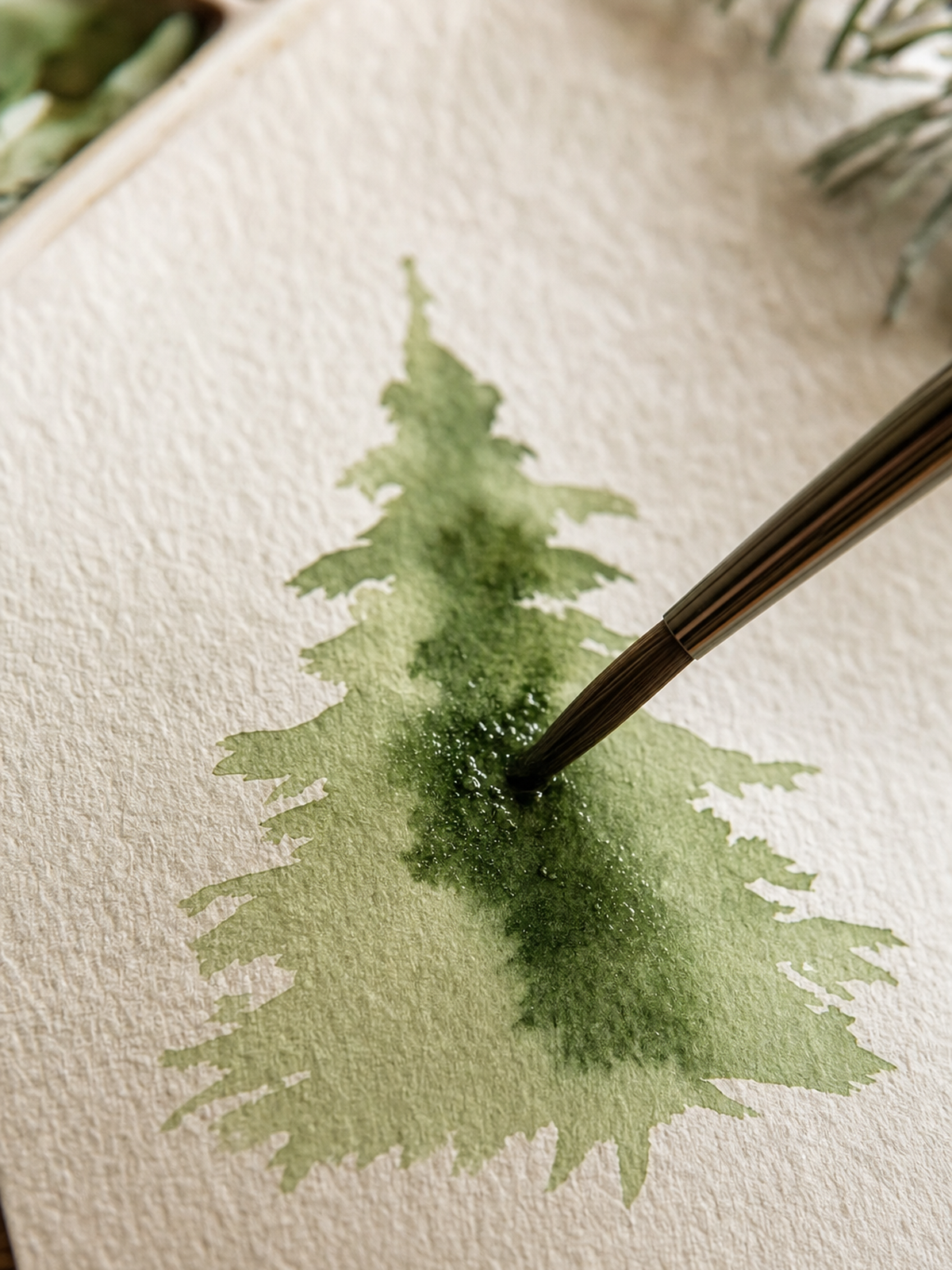
Use wet-on-wet for anything soft: a snowy sky, the body of a fir tree, a foggy hill behind a cottage. Brush clean water over the shape, wait until the shine goes from glossy to satin, then touch in your color and let go. Genuinely — put the brush down. The pigment travels through the damp paper and does something more beautiful than you’d have painted deliberately.
Use wet-on-dry for anything crisp: holly leaves, berries, a candy cane stripe, the outline of a little house. Dry paper, loaded brush, one confident stroke. If you’re painting over a printed template, this is the mode you’ll be in most of the time — the line does the shape-holding for you.
The mistake almost everyone makes on card one is going back into a wet-on-wet area with a fresh loaded brush. That’s how you get a cauliflower bloom with a hard scratchy edge. If it’s still shiny, walk away. If it’s fully dry, you can paint on top of it happily. It’s the in-between — that damp, dull, tacky stage — that ruins things. There’s more on this in my post on loose watercolor techniques.
🎬 If you’d rather watch someone do it than read about it, I paint this sort of thing slowly and out loud over on YouTube — subscribe to my channel here and you’ll catch the Christmas ones as they go up.
15 easy watercolor Christmas card designs to paint
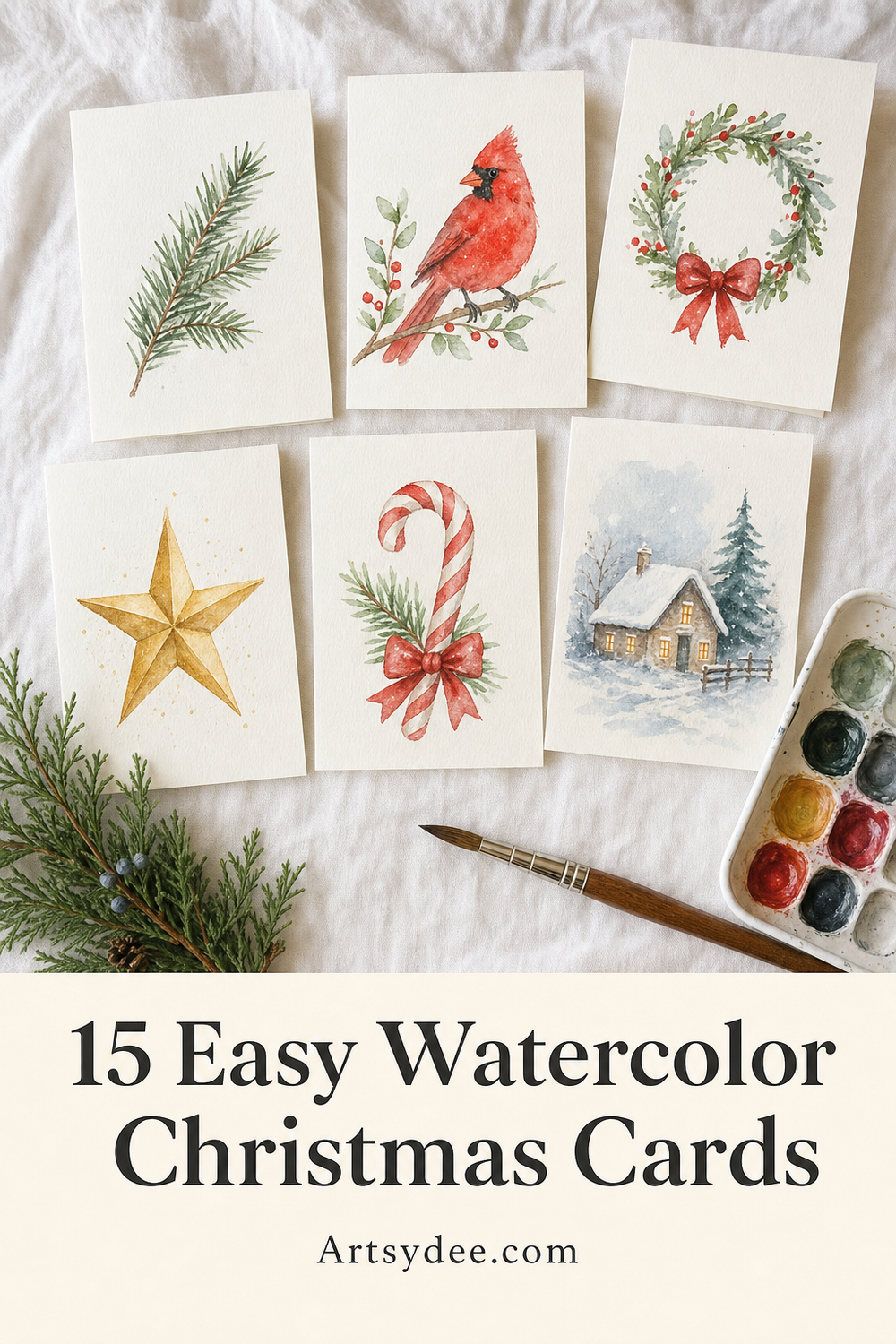
These 15 designs are all beginner-friendly, all fit on a folded card, and all use the same four colors. They’re grouped from simplest to slightly braver, so start anywhere — nobody is checking. Four of them come as printable line art in the free pack above if you’d rather not draw first.
Foliage and botanicals (1–5)
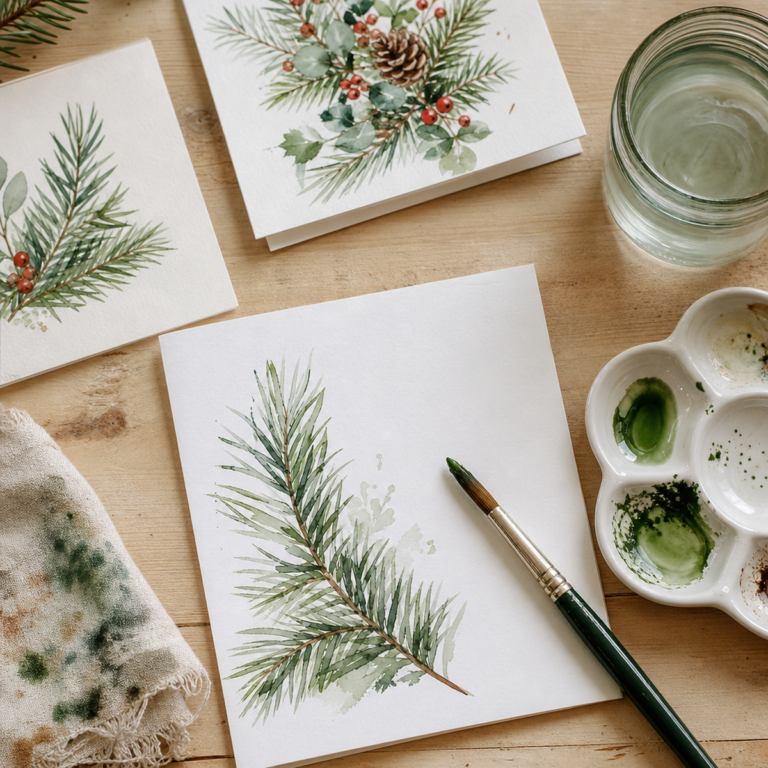
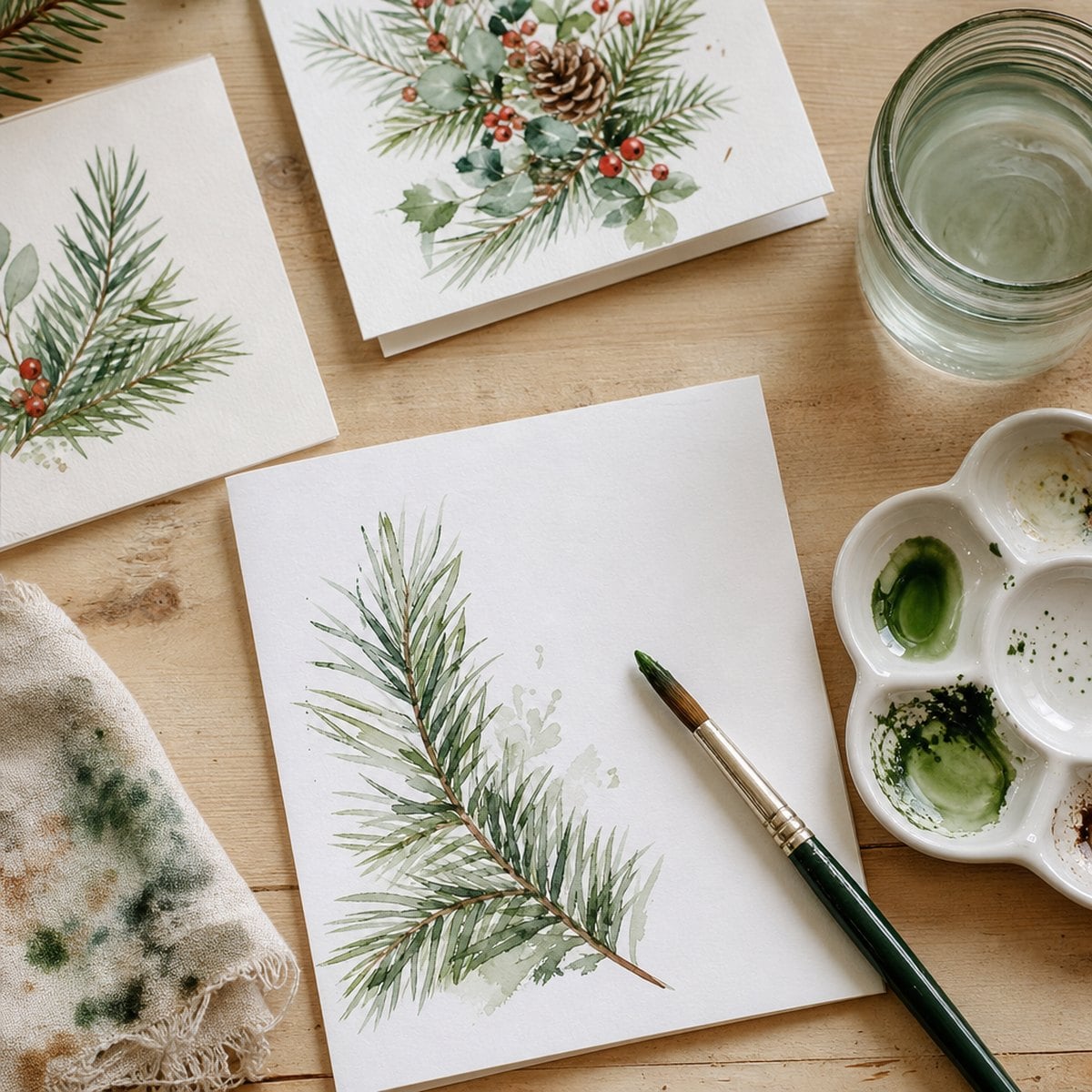
- Single fir sprig. Paint one slightly curved stem, then pull needles out from it in quick strokes — press at the stem, lift as you go, so each needle tapers. Uneven is correct.
- Holly and berries. Two spiky leaves wet-on-dry in deep green, then three red berries touched in while the leaf edges are still damp so a little red bleeds into the green.
- Eucalyptus garland. Pencil a soft curve, then lay sage-green ovals along it. Tuck three or four extra leaves behind the others in a paler mix — that’s the whole trick to depth.
- Mistletoe sprig. Two leaves and a Y-shaped stem, and leave three small circles of bare paper for the berries. A pencil dot of payne’s gray at the base of each one makes them read as round.
- Simple wreath. Draw round a mug in pencil, then dot foliage all the way around the ring, going heaviest at the bottom left and top right. A red bow at the base and you’re finished. There’s a full printable Christmas wreath template here if you want the shape ready-made.
Tiny winter scenes (6–10)
- Snowy cottage. A warm gray box, a triangle roof left as bare paper for snow, two yellow ochre windows glowing. Resist adding bricks. The bricks are what kills it.
- Christmas tree in a pot. Wet a triangle with clean water, then drop three different greens into it and tilt the paper. Add a terracotta pot once it’s bone dry.
- Robin on a branch. One round body, one smaller round head overlapping it, a red-orange breast dropped in wet. Beak, eye and tail go on last with the tip of the brush.
- Deer silhouette. A flat payne’s gray silhouette with no interior detail whatsoever, standing on a single dry-brushed line of snow. Simplest card here and always the one people keep.
- Winter lane. A pale gray wash across the lower half, then three fir trees — one dark and close, two pale and further back. Distance is just paler paint.
Simple shapes and patterns (11–15)
- A row of baubles. Five circles in alternating red and green, each with a small crescent of bare paper left near the top left for the shine. Thread a payne’s gray line across the top.
- Candy cane. Paint the hook shape in clean water first, then lay diagonal red stripes across it — skip, stripe, skip, stripe. The water underneath softens the stripe edges just enough.
- Star. A five-pointed star in yellow ochre with a wetter yellow blurred out behind it like a glow. A white gel pen dot in the middle finishes it.
- Christmas stocking. One shape, one red wash, and the fluffy cuff left completely unpainted. Add tiny gray shadow lines to the cuff once dry.
- Lifted snowflake. Wash a soft blue rectangle, wait until it’s just losing its shine, then lift a snowflake out with a clean damp brush. Negative-space painting, and it feels like magic every single time.
Want more seasonal painting prompts once these are done? I’ve got a whole gallery of Christmas watercolor ideas to work through.
How to keep it loose (and stop before you overwork it)
Loose watercolor comes from using more water, fewer strokes and a bigger brush than feels sensible. The looseness isn’t a style you apply at the end — it’s what happens when you stop going back in. Almost every card I’ve spoiled, I spoiled in the last two minutes.
Three things that actually help. First, hold the brush further back, near the middle of the handle — you physically can’t fuss from there. Second, decide before you start how many strokes a shape gets. A holly leaf gets two. If it takes seven, it’s a diagram, not a painting. Third, paint three cards side by side instead of one. While card two dries you’re working on card three, which means you’re never sitting in front of a damp card with a loaded brush and time on your hands.
And the wobbly ones are fine. A slightly lopsided fir sprig painted by a person is worth more than a perfect printed one, and everybody who opens it knows that. That’s the entire reason you’re painting them.
Drying, folding and getting them in the mail
Let painted cards dry flat for at least an hour before you fold or stack them — watercolor paper holds damp far longer than it looks, and a stacked card will emboss itself onto the one below. Fold along a scored line rather than a guessed one, and write your message before you seal anything.
A few practical bits that save a lot of grumbling:
- Score before you fold. Run the back of a butter knife or a bone folder along a ruler first. Watercolor paper is thick, and folding it dry and unscored will crack the fibers right across your painting.
- Flatten the buckle. If a card has warped, press it face-up under a heavy book overnight with a clean sheet of paper on top. It’ll come out flat.
- Details last, on bone-dry paper. Snow dots, bauble highlights, a star’s twinkle — a white gel pen and fineliner set does these in about four seconds each, and they lift a simple card enormously.
- Check the envelope size before you cut. Ask me how I know. A5 and 5×7 are the safe bets, and pre-cut card blanks sidestep the problem completely.
- Mail them early. Handmade cards are slightly thicker than store-bought ones, so weigh one at the post office rather than assuming.
Painting cards for a birthday or a thank-you rather than Christmas? The same approach works year round — I’ve written up easy watercolor birthday cards using exactly these techniques.
Your free watercolor Christmas card templates
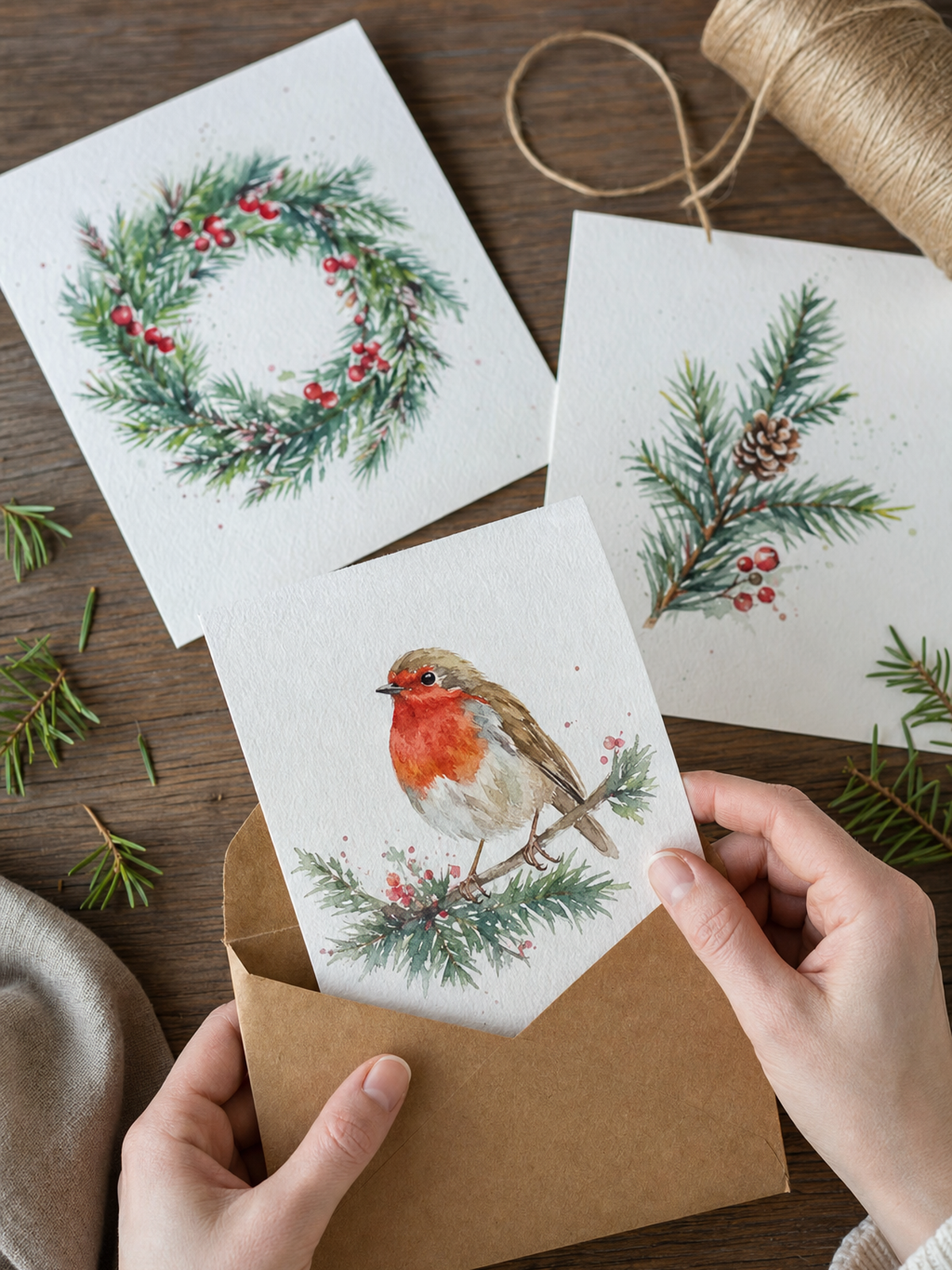
The free pack is four printable card designs in clean black line art — an evergreen sprig, a holly wreath, a robin on a branch and a little snowy cottage. Each design comes two ways. The cut-and-mount version is drawn on A4 inside a 5×7 card panel with a dashed cutting line: print onto watercolor paper, paint straight over the lines, trim, and mount it on a folded card blank. It fits a standard 5×7 envelope.
The fold-out version is the whole card on one landscape sheet, on A4 (folds to an A5 card) or US Letter (folds to a 5.5 x 8.5 inch card). Print it onto watercolor paper if your printer takes it, or trace it, paint the front, then score and fold. No card blank needed.
They’re deliberately simple and deliberately open. There’s no shading to copy and no right answer — the sprig can be silver-green or nearly black, the cottage can sit in daylight or at dusk with the windows lit. Pop your email in the form near the top of this post and the PDF lands in your inbox. If you’d like more printable line art to paint over, there’s a bigger set of Christmas watercolor templates here too.
Want to paint along with me every month?
If you enjoy this kind of slow, low-pressure watercolor, come and join me on Patreon. Every month there are new watercolor templates, reference photos and full paint-along tutorials — including seasonal sets like these cards — plus a lovely, very unintimidating group of people painting alongside you.
It’s the easiest way I know to actually keep painting once January arrives and the tin goes back in the drawer. Have a look at what’s inside → If you’d rather just buy a set outright, my printables are all in the Artsydee shop.
Frequently asked questions
What paper should I use for watercolor Christmas cards?
Use cold press watercolor paper at 300gsm (140lb) or heavier. Anything lighter buckles when it gets wet and won’t flatten properly afterwards. Cold press has a light texture that grabs pigment and makes loose washes look better than smooth hot press does. Pre-cut blank watercolor cards are the easiest option because they’re already the right weight and the right size for a standard envelope.
Can I print watercolor Christmas card templates on watercolor paper?
Yes, and it’s the fastest way to make a batch. Most home inkjet printers handle 300gsm cold press if you feed one sheet at a time through the rear or manual tray and set the paper type to “thick” or “cardstock”. Use A4 sheets, print at 100% rather than “fit to page”, and let the ink sit for a minute before painting. If your printer refuses the weight, print onto normal paper and trace the lines onto watercolor paper against a sunny window.
How long do watercolor Christmas cards take to make?
About ten minutes of painting per card, plus an hour of drying time before you fold. Working in batches is far quicker than one at a time — set out six cards, paint the same element on all six, then move on to the next color. A batch of twelve cards is a comfortable Sunday afternoon with the radio on, not a whole weekend.
What if my watercolor Christmas card goes wrong?
Most mistakes are fixable while the paint is wet — blot a too-dark patch with a scrunched tissue, or lift color out with a clean damp brush. Once it’s dry, a white gel pen covers a lot of sins, and a few loose ink lines over the top turn a muddy wash into a deliberate line-and-wash card. And if it’s genuinely beyond saving, cut a shape out of it and glue it onto a fresh card blank. Nobody will ever know.
Do I need to be able to draw to paint Christmas cards?
No. Every design in this post is built from circles, triangles and single brushstrokes, and the free template pack removes the drawing step altogether — you print the outline and paint over it. Painting and drawing are separate skills, and plenty of people who say they can’t draw are lovely, confident painters once there’s a line to follow.
Final thoughts
Hand-painted Christmas cards are one of those small things people quietly keep. I’ve seen my own wobbly little fir sprigs propped on shelves the following June, which is more than any store-bought card has ever managed.
So print the templates, put on something Christmassy in August like a lunatic, and paint three. Not twenty. Three is enough to remember that you enjoy this.
Come and say hi
I’d genuinely love to see what you paint — finished cards, half-finished cards, gloriously failed cards, all welcome. Send me a photo, or share it inside my Patreon where we paint along together every week.
You’ll also find me over on Pinterest where I save everything seasonal, and on YouTube for watercolor tutorials you can paint along with. Subscribe here so you don’t miss the Christmas ones.
You might also like
- Christmas Watercolor Templates — more printable line art to paint straight over.
- Easy Watercolor Birthday Cards — the same techniques, year-round.
- Christmas Watercolor Ideas — a whole gallery of festive painting prompts.
- Loose Watercolor Techniques — how to stop overworking your paintings.
- Christmas Wreath Template — a printable wreath outline for cards and tags.
Pin this for later!