Last Updated on September 16, 2026 by Dee
Here is the thing almost nobody tells you when you pick up a paintbrush: the reason your watercolour feels blocked is usually not that you can’t paint. It’s that you are trying to make something perfect. Perfectionism is the single biggest thing standing between most people and the creative life they actually want. And watercolour, of all the mediums, is the one that refuses to be controlled — which is exactly why it’s the best place to let go.
So this is my case for painting wonky on purpose. Not sloppy, not careless — wonky. Loose, honest, a little bit magical, and completely yours. If that sounds like a relief rather than a compromise, you’re in the right place. Grab my free beginner watercolour starter set right below to paint along, and let me show you how much easier this gets when you stop aiming for perfect.
Below you’ll find what ‘wonky’ really means, why perfectionism quietly sabotages beginners, how to start this week with supplies you almost certainly already own, and — if you’d like company on the journey — how my Wonky Watercolour School works, with doors opening to everyone this Thursday.
Table of Contents
What ‘wonky watercolour’ actually means
Quick answer: Wonky watercolour means letting the paint do its wandering, blooming thing instead of forcing it into neat lines. Wonky isn’t a mistake to fix — it’s the style. It’s how you make work that is unique, curious and a little bit magical, rather than a stiff copy of someone else.
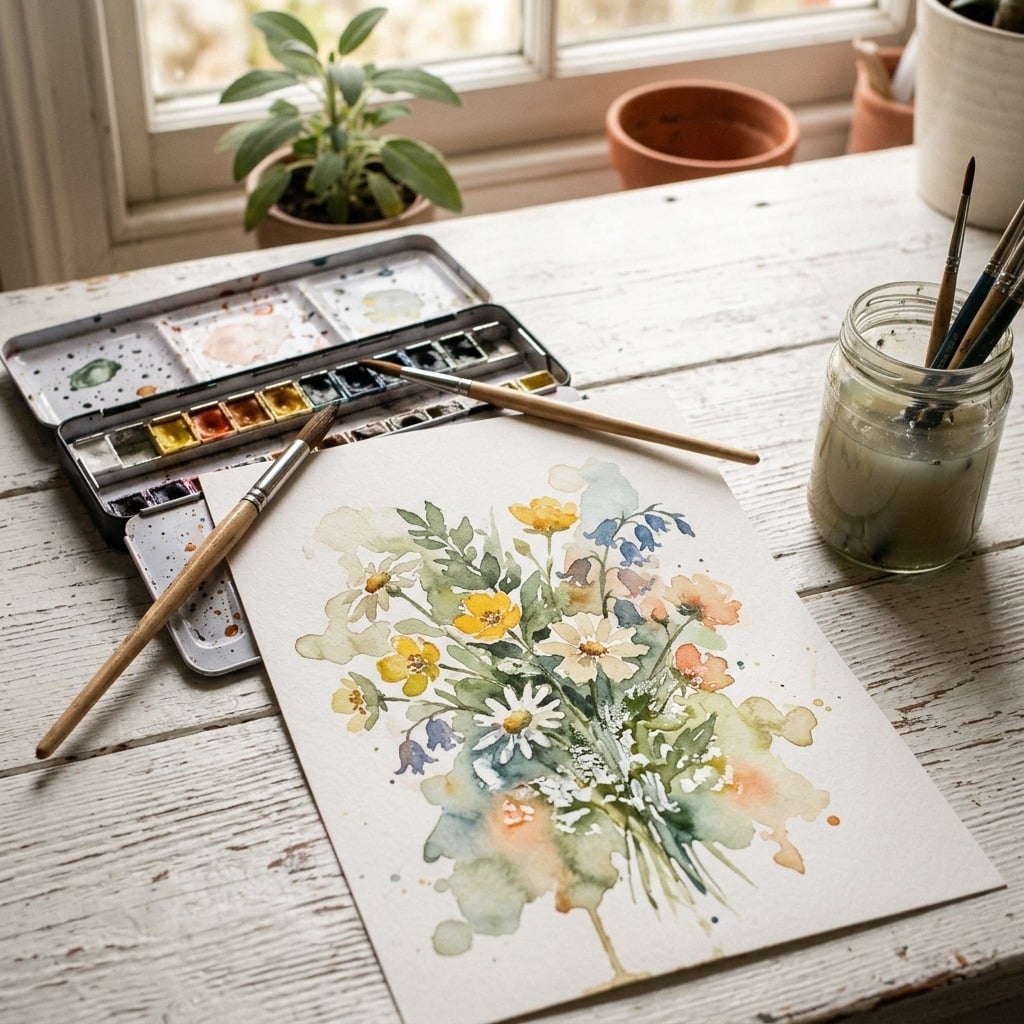
When I talk about wonky, I mean we are going against perfectionism and against control. Watercolour has a mind of its own. Water carries pigment where it wants to go, edges bloom and feather, two colours meet and make a third you didn’t plan. Fighting that is exhausting and it never really works. Leaning into it is where the joy lives.
Wonky is the whole modus operandi. Wonky is beautiful. A slightly lopsided flower with a soft bleeding edge has more life in it than a perfectly traced one, every single time. Once you believe that — really believe it — painting stops being a test you might fail and turns back into play.
Why trying to make it perfect is the thing stopping you
Perfectionism doesn’t look like a problem from the inside. It looks like ‘having high standards’ or ‘not being ready yet’. But what it actually does is keep the brush out of your hand. If the only acceptable outcome is a masterpiece, then starting feels enormous, and so you don’t start. The blank page wins.
The fix isn’t to try harder. It’s to lower the stakes so far that there’s nothing left to be afraid of. A five-minute study on scrap paper cannot be a failure — it can only be practice. And practice, quietly and without any drama, is the only thing that has ever made anybody better at painting.
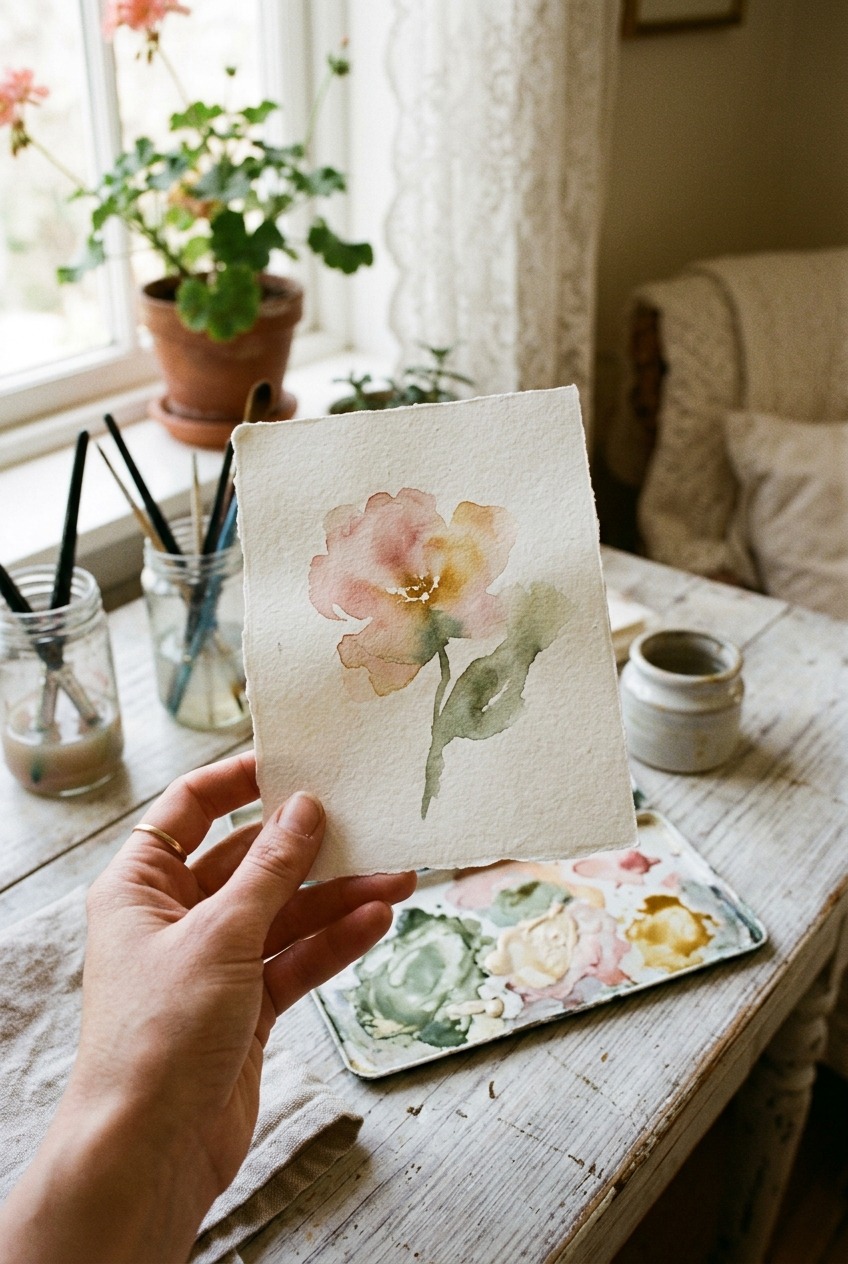
So the very first skill in wonky watercolour is not a brush technique at all. It’s permission. Permission for the first ten paintings to be wonky, for the paper to buckle, for the centre to bloom where you didn’t mean it to. Give yourself that, and everything else gets easier.
How to start wonky watercolour this week (with what you own)
Quick answer: You do not need expensive supplies to start. An old set of student watercolours, any small round brush, a clear glass jar of water, some kitchen towel and a white plate to mix on is genuinely enough. Start small and cheap; upgrade only once you know you love it.
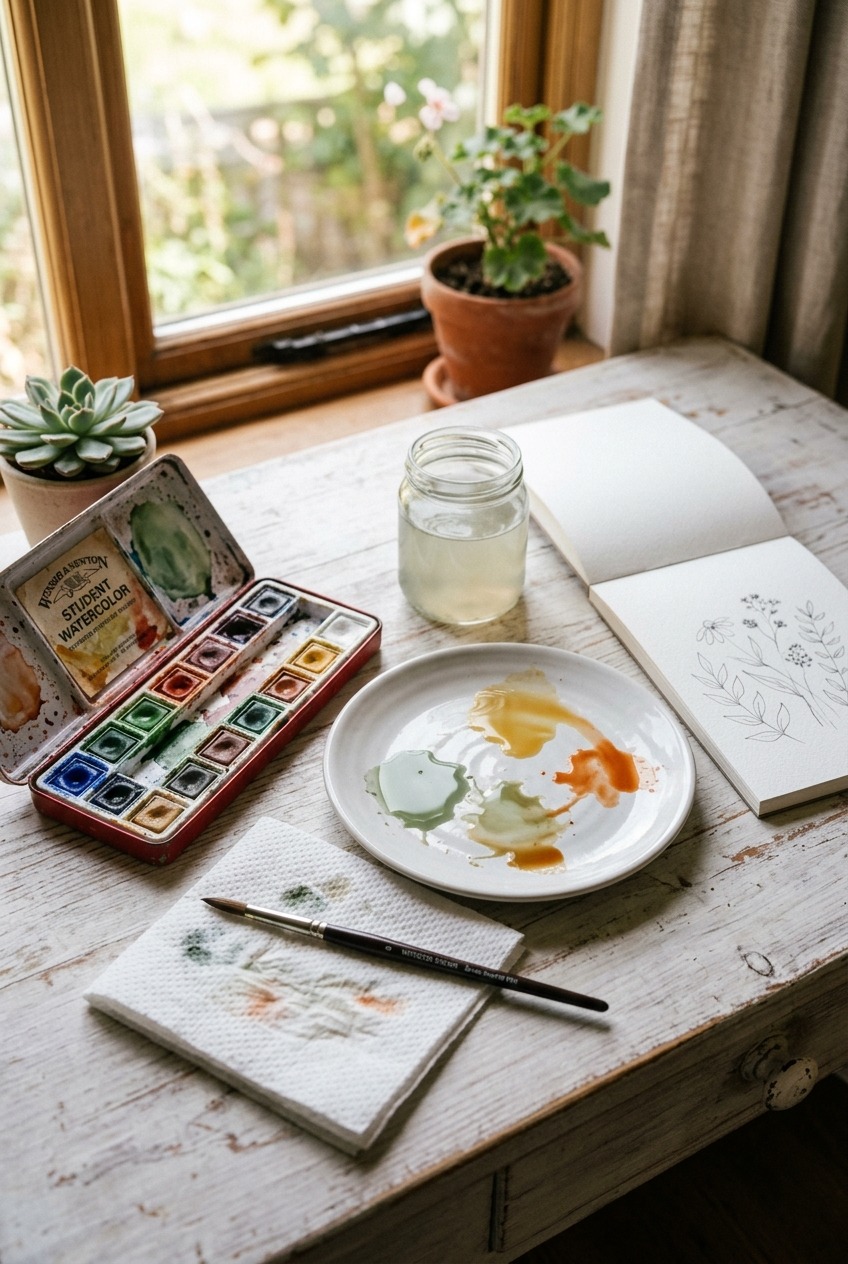
Please do not go and spend a fortune before you’ve even felt the paint move. If you have an old set of student watercolours in a drawer, use them. Any round brush will do — a smallish one, because we start small and work bigger later if you fall in love with it. A clear glass jar for your water, a bit of kitchen towel, and a plain white ceramic plate as a palette. That’s it.
One of the loveliest things about watercolour is that it forgives you. It dries, and then it waits. You don’t have to seal anything or keep it airtight the way you would with acrylic, which cracks if you leave it out. Watercolour just dries on the plate, and whenever you come back you drop a little water on it and it springs straight back to life. You can use a pan of paint right down to nothing.
When you’re ready to add a little, a Winsor & Newton Cotman set and one good round brush in size 6 will take you a very long way, on a cold-press watercolour pad heavy enough not to cockle. But truly — not yet. Start with what you have.
This post contains a few affiliate links, which means I may earn a small commission at no cost to you if you buy through them. I only ever link the supplies I actually paint with — and my honest advice is to start with what’s already in your cupboard.
The three techniques that unlock everything
Almost all of watercolour rests on three foundations, and none of them are hard. A flat wash is simply laying colour evenly across a shape. Wet-on-wet is dropping paint into a damp area and letting it bloom and travel on its own — this is the magic one, and the most wonky. Glazing is letting a layer dry completely, then floating a second transparent layer on top to build depth. Learn those three and you can paint almost anything.
Finding your own style instead of copying someone else’s
Here is the part that matters most to me. The whole point of painting wonky is not to end up with a copy of my flowers, or anyone else’s. It’s to discover what makes your art yours. That’s the thing artists struggle with for years, and it’s the thing that actually makes a painting feel alive on a wall.
Your style hides inside your wonk. The way your lines wander, the colours you reach for without thinking, the shapes you can’t help but repeat — that’s not error, that’s voice. The more you paint, the clearer it gets. So my goal for anyone starting out is simple: finish one real painting. One you’d actually put on your lounge wall, or the fridge, or give to someone you love. Completing something — in your own hand, start to finish — changes how you see yourself as an artist.
Inside the Wonky Watercolour School
If you’d like to actually do this rather than just read about it, I built a Wonky Watercolour School for exactly that. It’s a gentle, term-based way to build real watercolour skills without the pressure that usually makes beginners quit. Here’s how a term works.
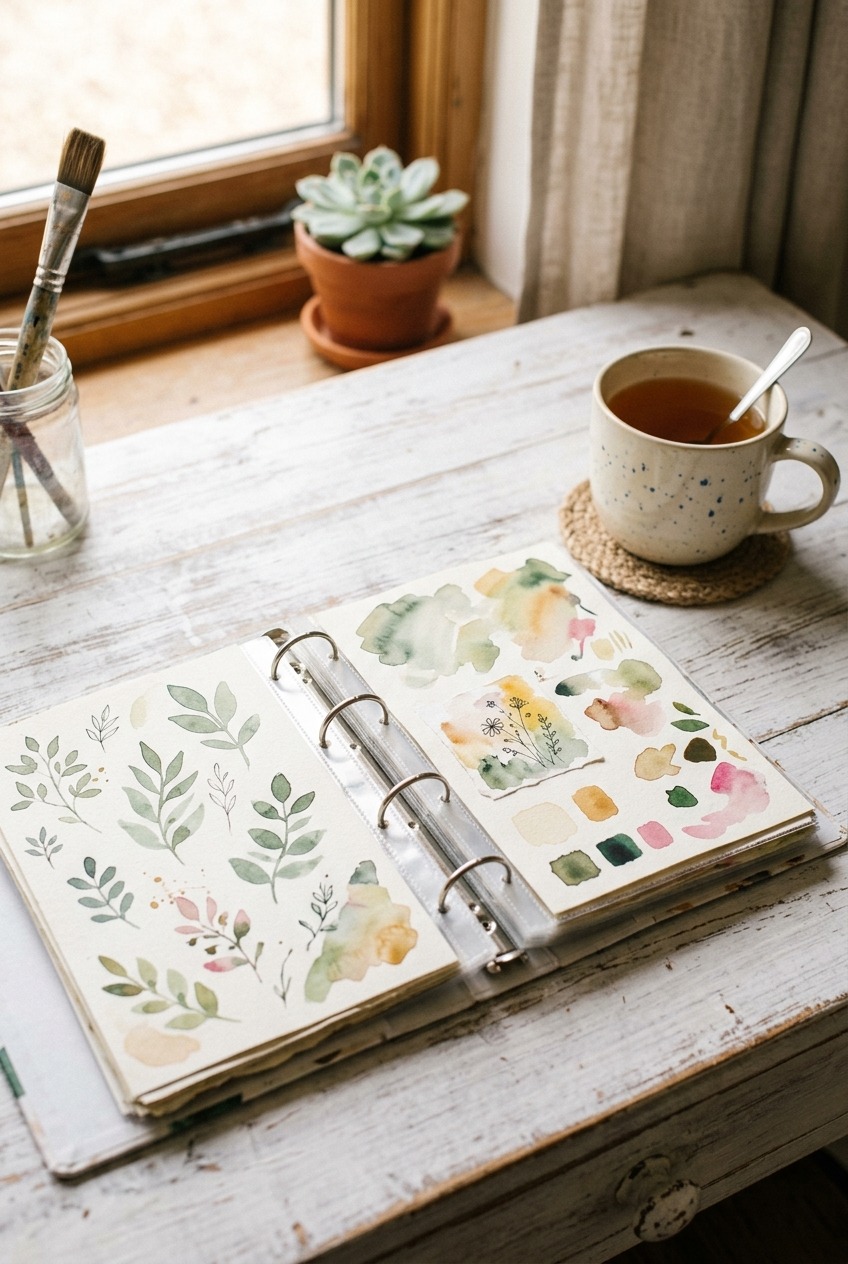
- A video from me every week, walking you through one thing at a time — the core techniques (washes, wet-on-wet, glazing) and a variety of subjects, lots of botanicals plus some landscape and architectural studies.
- A workbook section each week with simple exercises. By the end of term you’ll have a whole workbook you can print, keep in a flip file, and come back to again and again.
- Homework that’s completely optional and low-pressure — each task is something you can do in an afternoon, or under an hour. Do it if you want to level up; skip it with no guilt if life is busy.
- The Wonky Gallery Wall — my favourite part. It’s a digital gallery where students share a piece each week. You can post anonymously or with just your initials if you’re shy, and at the end of term we hold a final exhibition you can share with family and friends.
- One finished painting by the end of term, entirely in your own style — something to frame, gift, or be quietly proud of.
Everything lives on a simple members’ platform, and you get an email reminder the moment each week’s video and workbook go live, so nothing gets missed. If you ever get stuck — with a technique or just the tech — you can email me directly.
Doors open Thursday: how to join
Quick answer: Doors to the Wonky Watercolour School open to everyone on Thursday. If you’re on the waitlist you get first access before then. Head to the school page to read all about the term and to join when doors open.
The next term is opening up, and I’d genuinely love to have you in it. Doors open to everyone this Thursday — and if you’re already on the waitlist, you get in first. There’s no need to decide anything today; just have a read and be ready.
In the meantime, the free beginner starter set above is the perfect way to warm up — print it, pick one small study, and paint it wonky on purpose. That’s the whole spirit of the school in a single afternoon.
Frequently asked questions
Do I need to be able to draw to paint watercolour?
No. Wonky watercolour leans on loose shapes and blooming colour rather than tight drawing, and the free starter set gives you simple outlines to paint straight onto so you can skip the drawing entirely while you find your feet.
What if I’ve honestly never painted before?
Then you’re exactly who this is for. We start small, with the three core techniques, using cheap supplies, and every task is low-pressure. Beginners often make the freshest, most alive paintings precisely because they aren’t overthinking it.
Do I have to share my paintings?
Never. The Wonky Gallery Wall is there if you want the encouragement, and you can post anonymously or with just your initials. Plenty of students paint quietly the whole term and share nothing at all — that’s completely fine.
What supplies do I need to start?
An old set of student watercolours, one small round brush, a glass jar of water, kitchen towel and a white plate to mix on. Please don’t buy anything expensive until you know you love it.
When can I join the school?
Doors open to everyone on Thursday. If you join the waitlist on the school page you’ll get first access before doors open to the public.
Final thoughts
You don’t need better supplies, more talent, or a spare weekend to begin. You need one small piece of paper, a bit of paint, and permission to make something wonky. Print the free starter set, give one study twenty minutes this week, and let the paint wander. That’s not a lesser version of painting. That’s the whole thing.
You can also find me on Pinterest, where I save every new template as it goes up, and on YouTube for step-by-step painting videos. Subscribe here if you’d like the next one to turn up.
You might also like
- Watercolor for Beginners: 20 Easy First Paintings
- How to Paint a Watercolor Sunset (Free Outlines)
- My Recommended Watercolour Supplies for Beginners
- The Wonky Watercolour School
📌 Pin this for later!