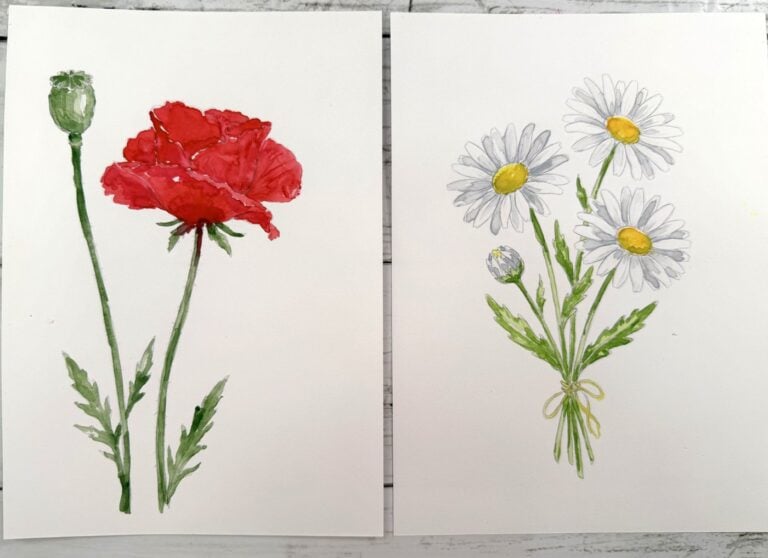
If you’ve been looking for watercolor flowers for beginners, start right here. Today we’re painting two wildflowers: a little bunch of ox-eye daisies and a field poppy. The shapes are already drawn for you, so all you have to do is paint.
The daisy template is free. Pop your email in just below and I’ll send it straight over, with a page of my paint notes, so you can print it on watercolour paper and paint along with the video.
Get the free daisy watercolor template
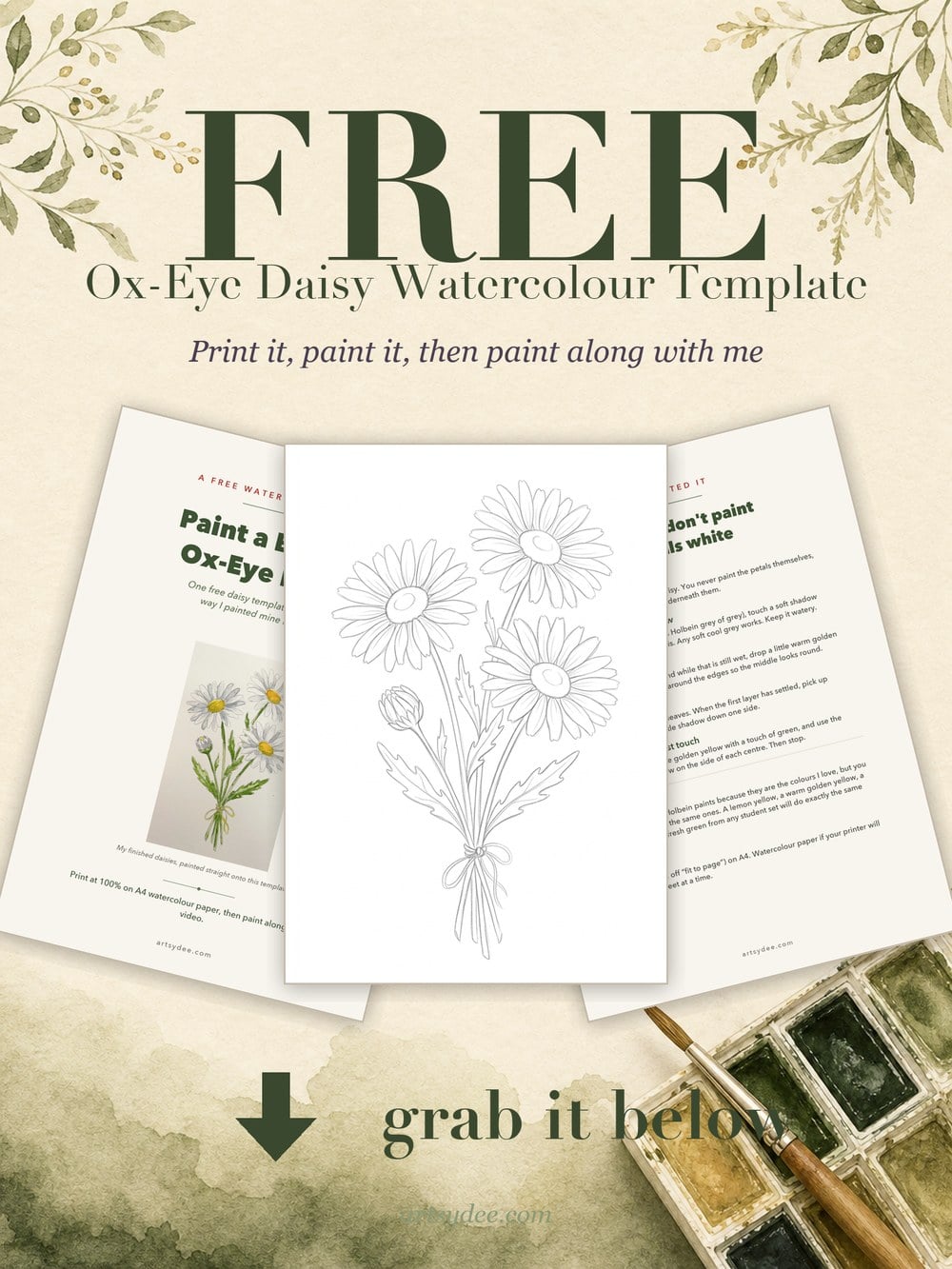
Once it lands in your inbox, print it at 100% on A4 watercolour paper, then scroll down and paint along with the video.
Table of Contents
What We’re Painting (and the Video)
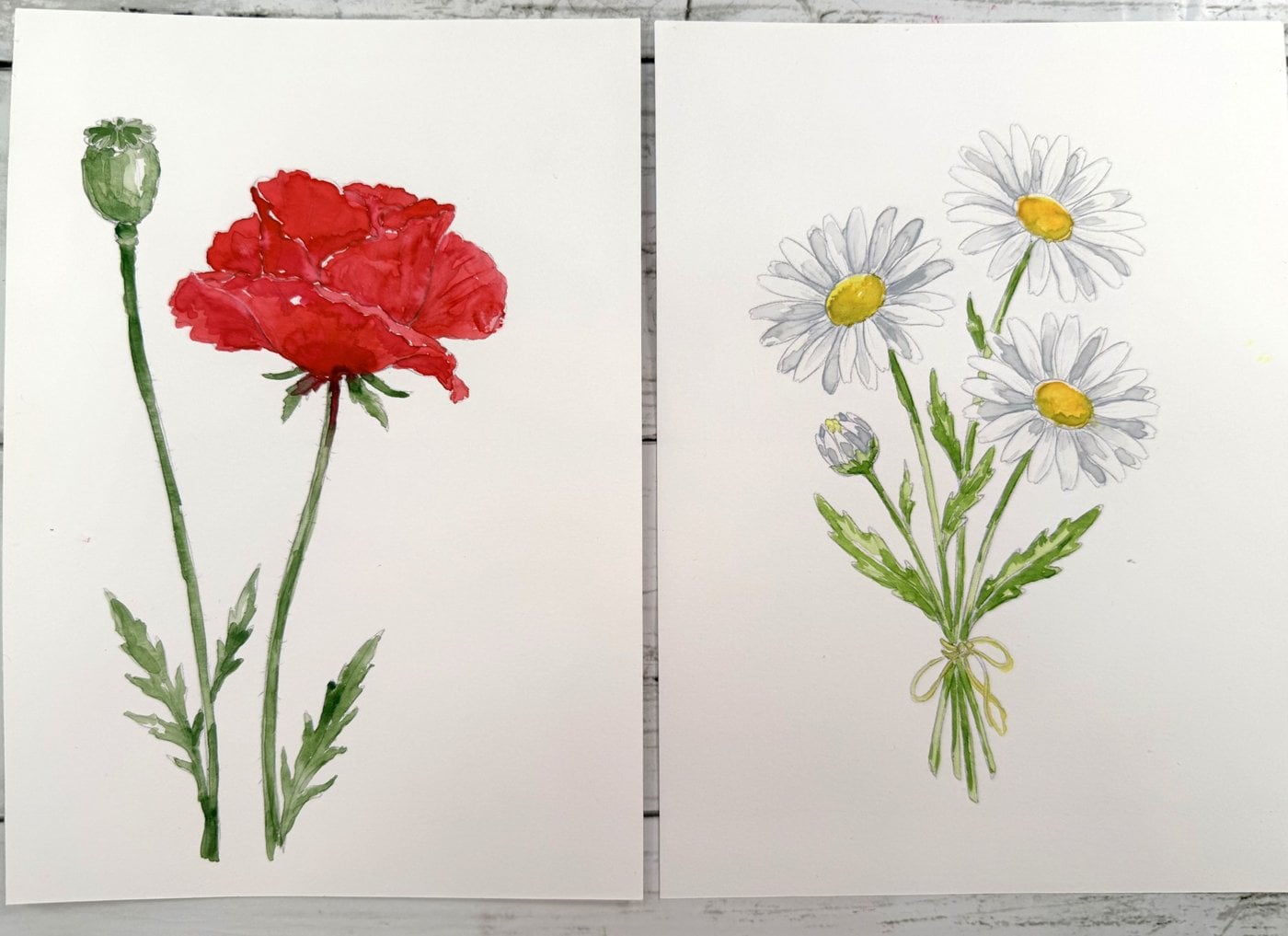
Two flowers, two completely different lessons. The daisies are all about restraint: the petals are white, and you get white in watercolour by not painting. The poppy is the opposite. It’s red, which is the colour people are most nervous of, and it’s the one where you load the brush and let the water do the shading for you.
Both are printed straight onto watercolour paper, so there’s no drawing and no tracing. Here’s the whole thing, start to finish:
What You Need
Nothing fancy. I mixed two brands in the video, Kuretake and Holbein, simply because they’re the colours I love. You absolutely don’t need the same ones. I’ll tell you what kind of colour each one is, so you can find something similar in your own box.
- For the daisies: a lemon yellow and a warm golden yellow (mine is gamboge nova) for the centres, a very pale cool grey for the petal shadows (I use Holbein’s grey of grey, but any soft cool grey works), and sap green for the stems.
- For the poppy: a bright red, a deeper and cooler red (carmine) to drop in while it’s wet, and a soft muted green (I used terre verte) for the stem, leaves and seedhead.
- A small round brush. One is plenty.
- The templates, printed onto watercolour paper.
- A jar of clean water, a bit of kitchen roll and a palette to mix on.
If you’re shopping, these are the paints I painted with: the Kuretake Gansai Tambi 48 colour set and the Holbein Artists’ watercolour set. I mix on a ceramic palette (this one is similar). A cheerful student set will paint these flowers just as happily.
Some links in this post are affiliate links. If you buy through them I may earn a small commission, at no extra cost to you. I only link to things I actually use.
How to Paint Ox-Eye Daisies in Watercolor
Here’s the secret with daisies, and it’s the one thing I’d love you to take away from this post: we don’t paint the petals white. The paper is the white. Everything you paint is around and underneath the petals.
Step 1: a very pale shadow on the petals
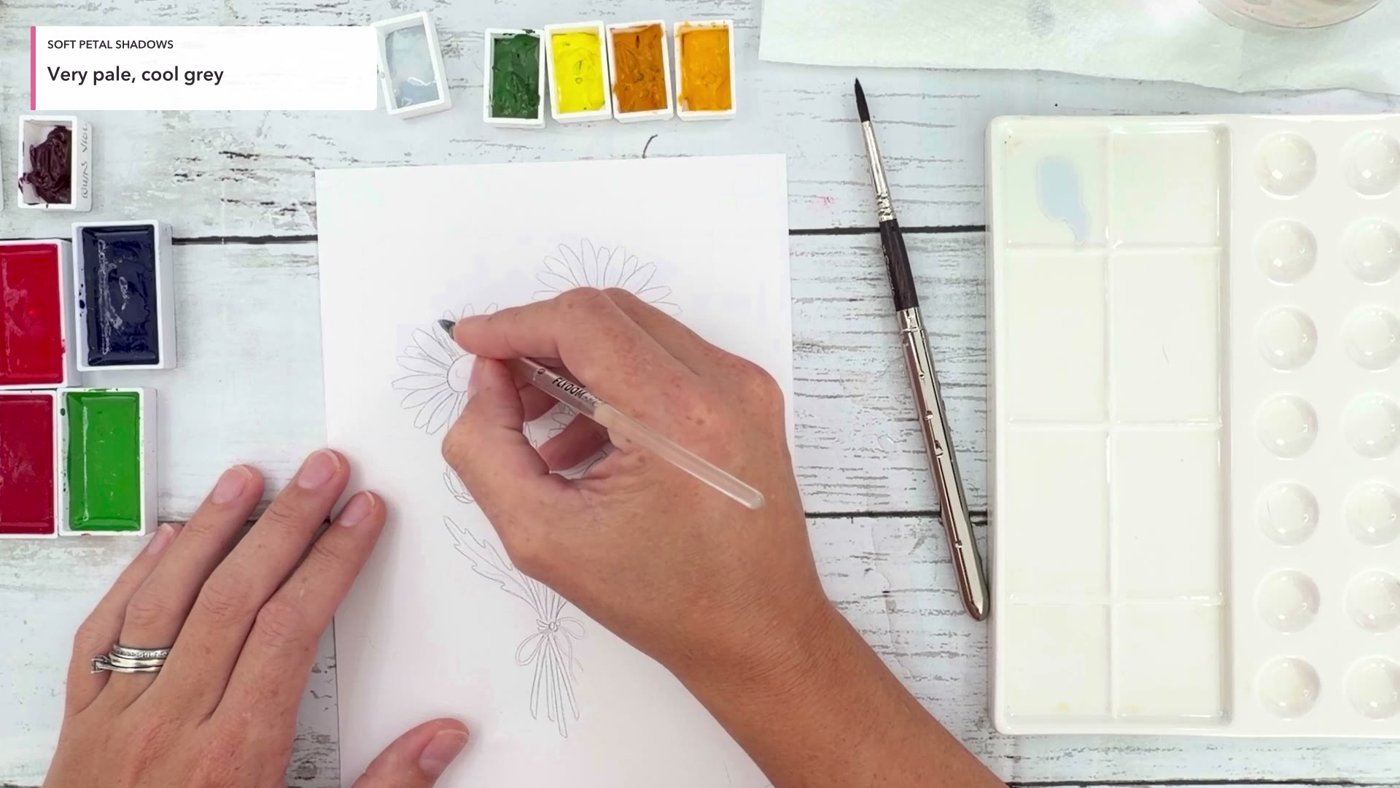
Mix a very watery, cool grey. Touch it onto one side of some of the petals, the side that would be in shadow, and leave the rest bare. Keep it pale. If it looks like a grey daisy, it’s too strong; if you can only just see it, it’s right.
Step 2: golden centres
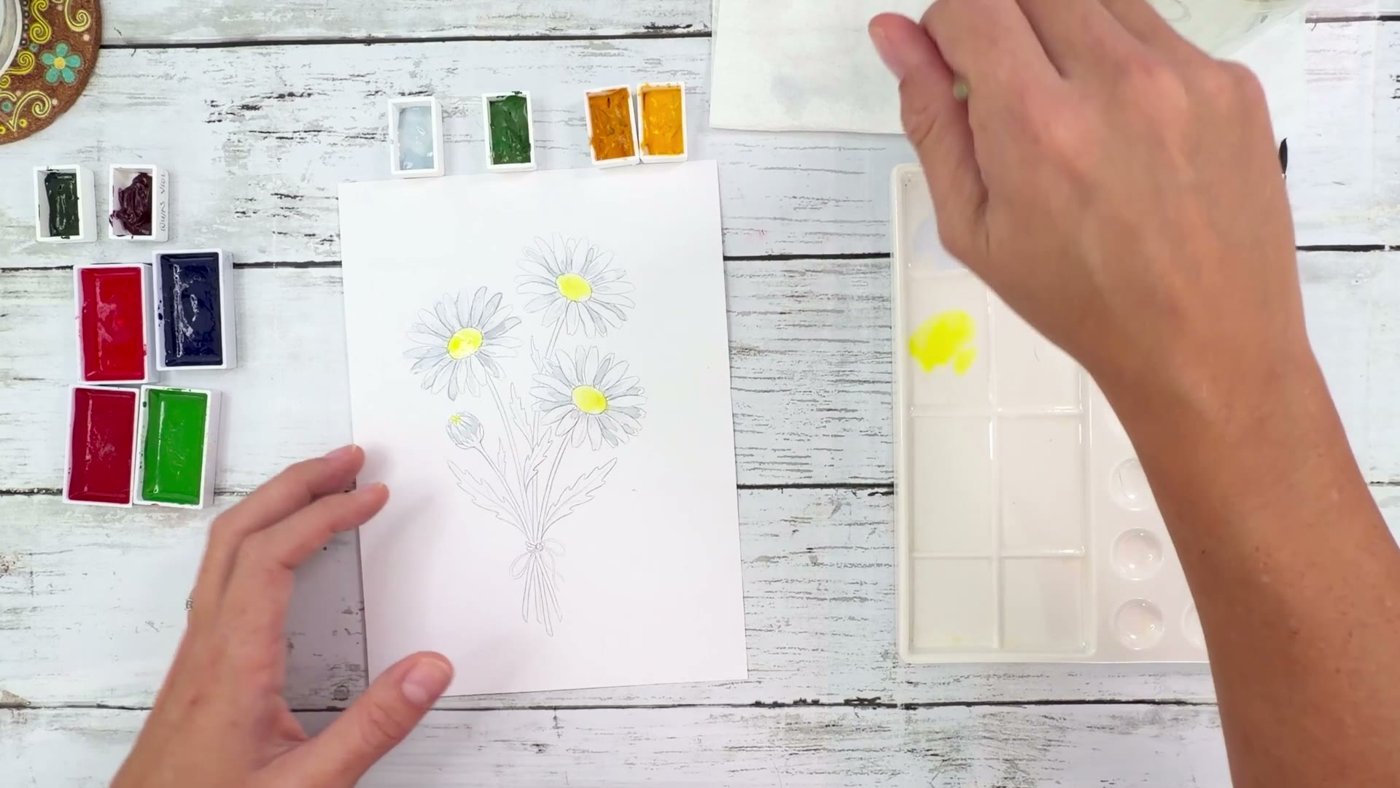
Paint each centre in lemon yellow. While it’s still wet, drop a little warm golden yellow around the edge and let it creep in on its own. That soft change from warm to cool is what makes the middle look round instead of flat.
Step 3: stems, leaves and a little shadow
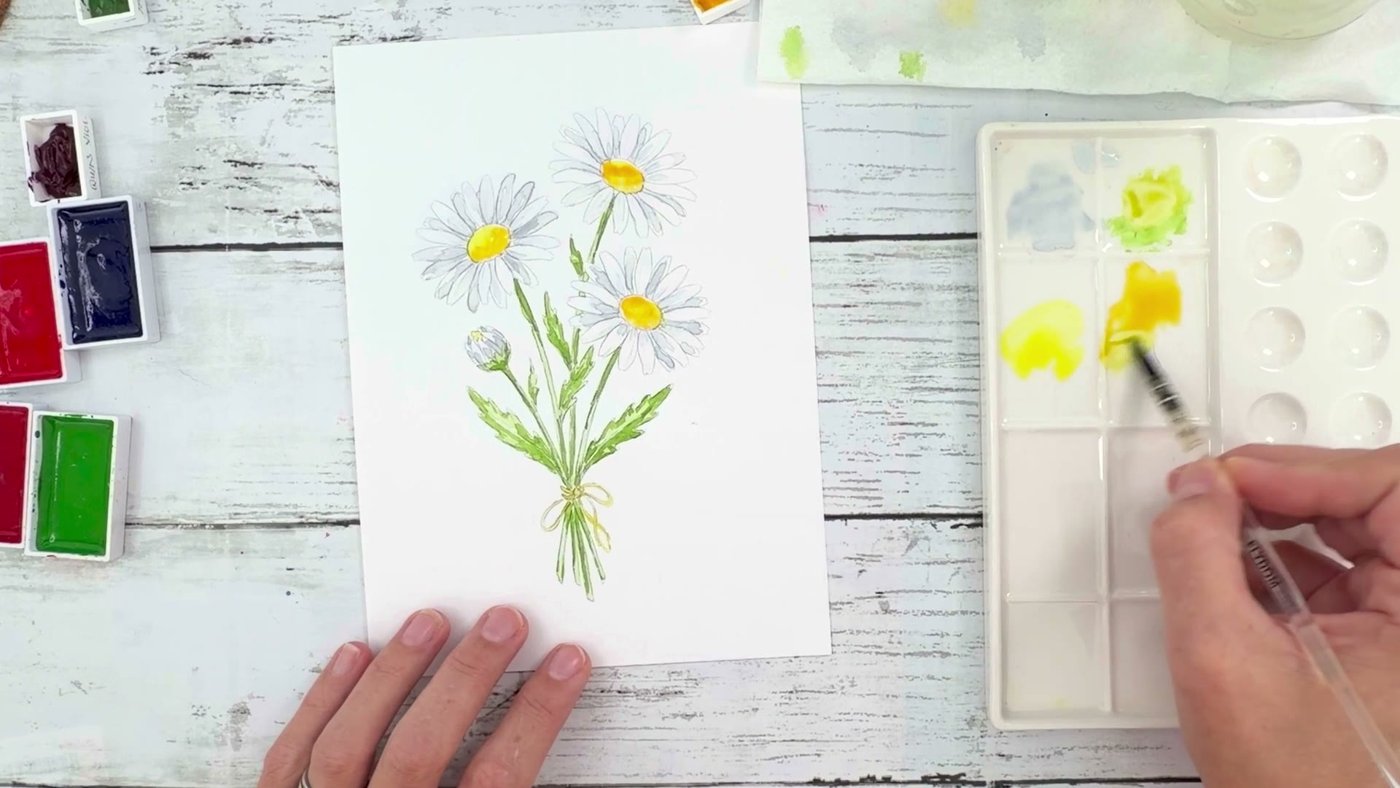
Sap green for the stems and the feathery leaves. Once that first layer has settled, pick up a little more green on your brush, so the pigment is stronger, and run a touch of shadow down one side of the stems and leaves.
Step 4: the ribbon and the finishing touches
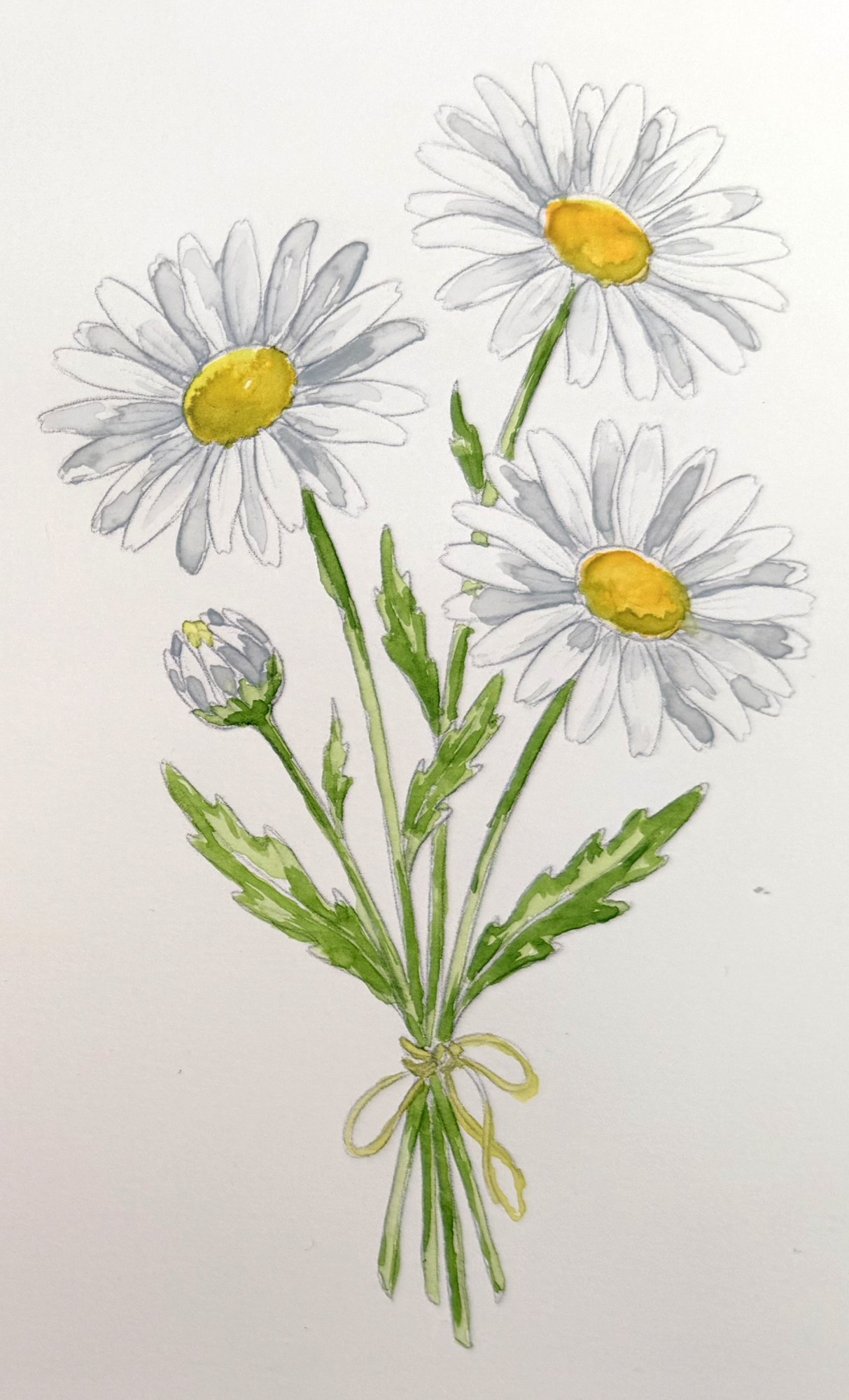
Paint the little ribbon in the golden yellow with a touch of the green mixed in. Then use that same mix for a tiny shadow on the side of each daisy centre. And stop. See how the white paper does all the work? That’s the whole trick.
How to Paint a Loose Field Poppy
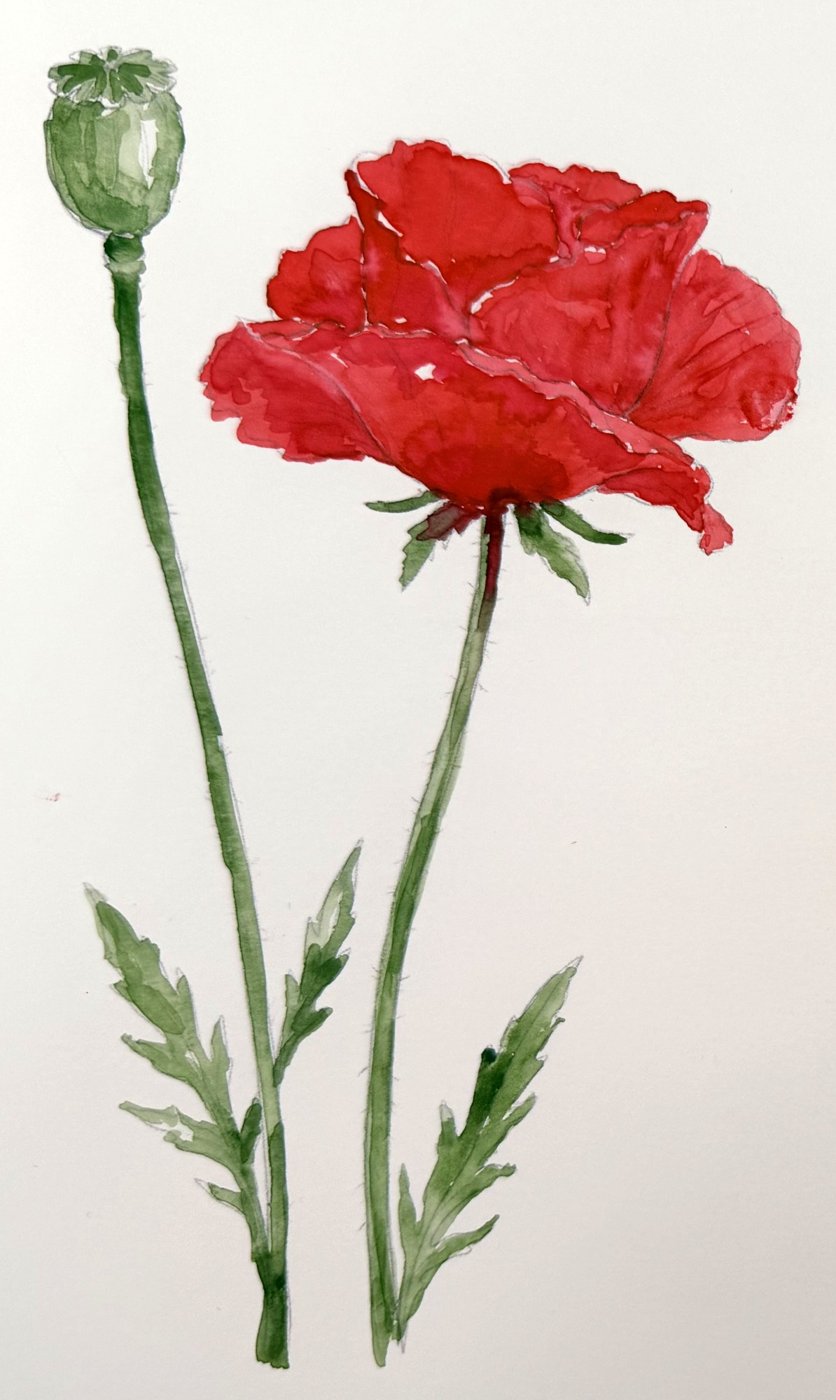
I’m not going for realism with the poppy. I’m going for an impression of a soft, vibrant poppy, which is much more forgiving and, honestly, much more fun.
Step 1: a watery red on alternate petals
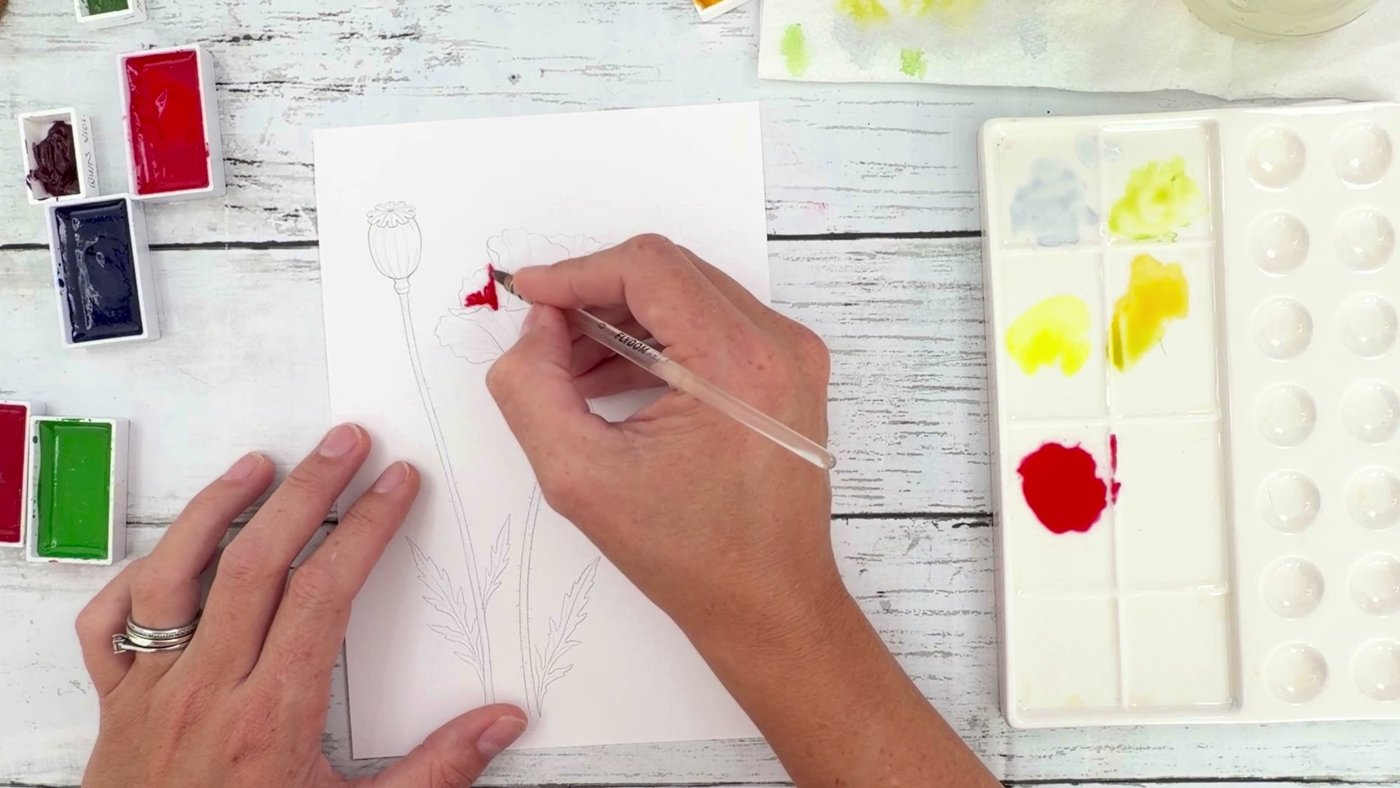
Load your brush with red and plenty of water. Paint the first wash on alternate petals, so the wet ones don’t run into each other. Where the colour pools, you can pick it back up with your brush and move it onto another part of the petal.
Step 2: lift the excess
If a petal looks too heavy, rinse and blot your brush and lift some of the colour away while it’s still damp. That’s called lifting, and it’s how you get lighter, glowing patches without ever using white paint. Leave a tiny sliver of white paper at the edge of a petal and suddenly it looks like it’s catching the light.
Step 3: a deeper red while it’s still wet
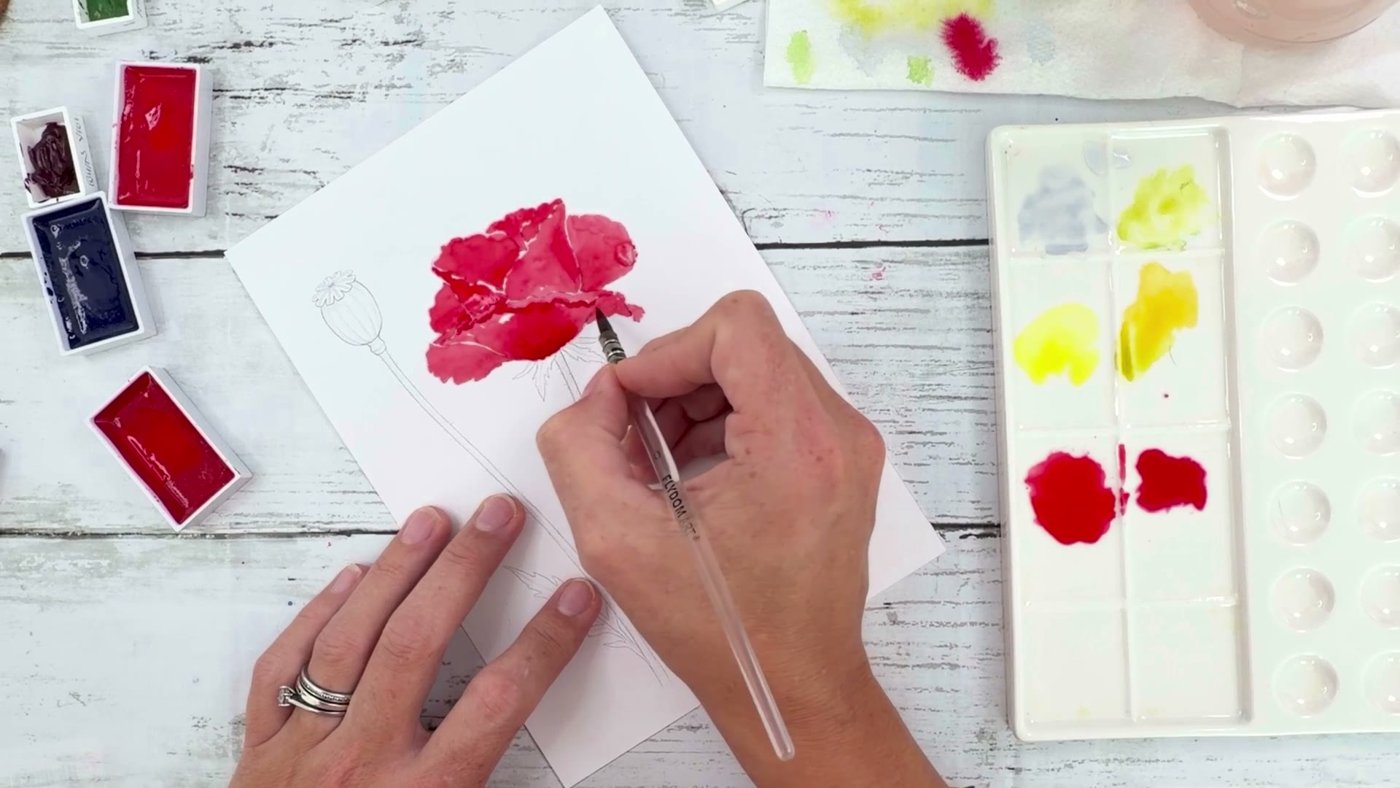
While the red is still wet, drop a little carmine, a deeper, cooler red, into the bottom of each petal and into a few other places. Don’t push it around. Let it bloom into the wet red on its own. That’s your depth.
Step 4: the stem, leaves and seedhead
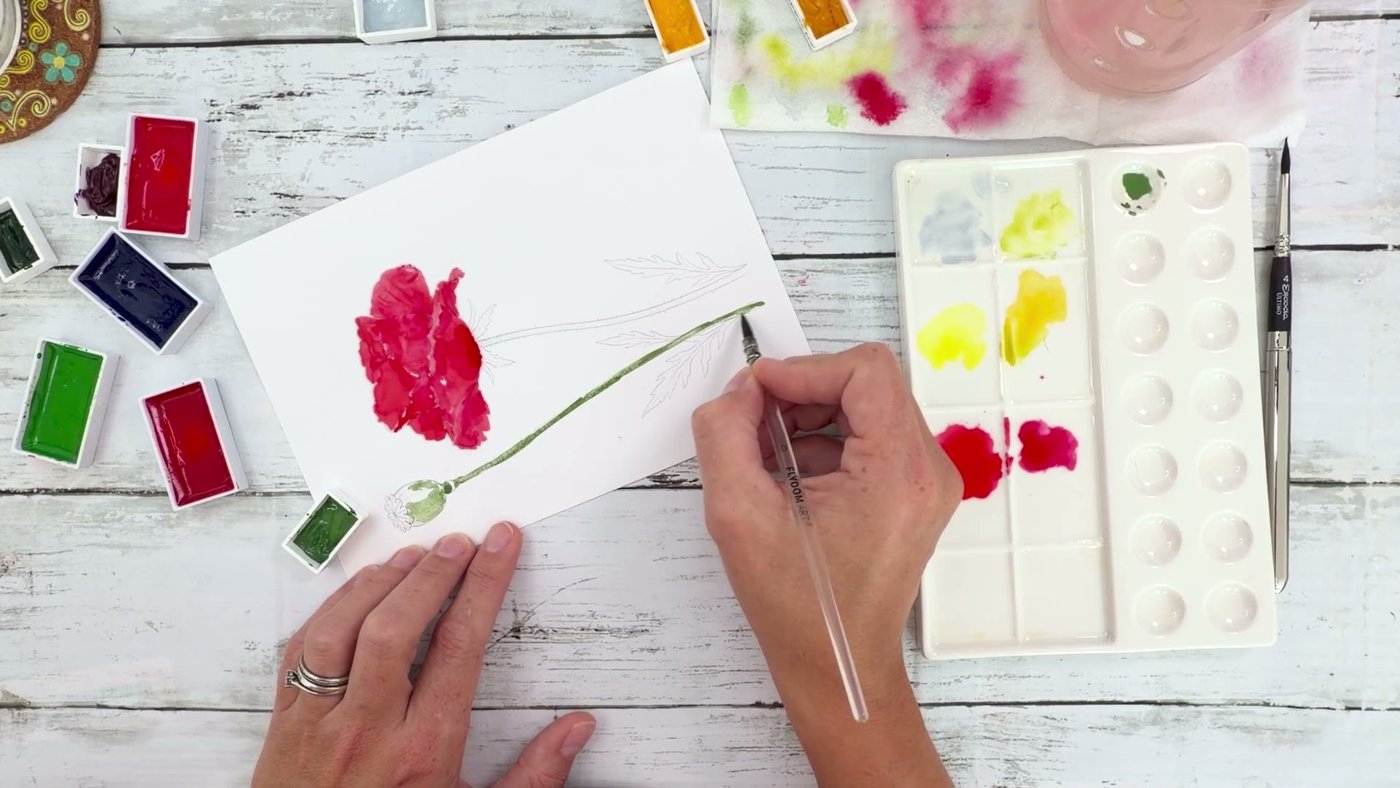
For the greens I switch from sap green to terre verte, which is more subdued and not as warm. A bright green right next to a bright red fights for attention; a quieter green lets the poppy be the star. Paint the stem and leaves, then let it dry a little before you come back to the seedhead.
Five Things That Make Watercolor Flowers Easier
- Let the paper be the white. It’s the brightest white you’ll ever have, and it’s free.
- Wet ones don’t touch. Paint alternate petals, let them settle, then go back for the others.
- Drop, don’t push. A second colour touched into a wet wash always looks softer than one you brush in.
- Choose a quieter green next to a loud flower. It makes the flower look brighter, not duller.
- Stop sooner than feels right. Most flowers get overworked in the last two minutes.
If you’re very new to all of this, my watercolor for beginners guide has twenty easy first paintings, and easy watercolor flowers step by step is a lovely next step once your daisies are dry.
The Other Nineteen Wildflowers
The daisy is one of twenty. A Wildflower Meadow is my set of twenty British wildflowers drawn as soft pencil outlines: the field poppy from the video with its seedhead, cornflowers, foxgloves, harebells, meadow buttercups, red campion, cow parsley and plenty more. Every one is an A4 template at 300 DPI, as a single PDF and as separate PNGs, ready to print onto watercolour paper.
It’s £8, yours to keep: see all 20 wildflower templates.
And if you’d love a new set to paint every month, that’s what my watercolour members get over on Patreon. Or browse all my watercolour templates in the shop.
Frequently Asked Questions
Is the daisy template really free?
Yes. Put your email in the box near the top of this post and the PDF comes straight to your inbox: a cover, the daisy template itself, a page of my paint notes and a peek at the full set.
What paper should I print it on?
Watercolour paper if your printer will take it, fed through one sheet at a time. Print at 100% on A4 with “fit to page” turned off. Ordinary printer paper works for a practice run, but it will buckle once it gets wet.
Do I need the same paints you used?
Not at all. A lemon yellow, a warm golden yellow, a pale cool grey, a bright red, a deeper red and a couple of greens from any student set will do exactly the same job.
Is the poppy template free too?
The poppy is part of the full A Wildflower Meadow set. The free template is the daisy bunch.
Can I sell the flowers I paint?
You’re welcome to sell the paintings you make by hand. Please don’t sell or share the template files themselves.
You Might Also Like
- 10 free wildflower drawing templates for your sketchbook, if you’d like to draw the lines yourself next time
- 25+ watercolor flower paintings to try when you’re ready for the next flower
- loose watercolor flowers for when you want to let go a bit more
- autumn watercolor painting for beginners: an acorn and maple keys, with a free acorn template
- fall leaves coloring pages for the evenings you’d rather colour than paint
Final Thoughts
Print the daisy tonight and paint along with the video. Then come back and tell me how it went. I’d genuinely love to see yours.
If this was your speed, subscribe to my YouTube channel for a new paint-along every week, and come and say hello on Pinterest. Pin this for later so you can find the steps again when your paint is out.
Happy painting!
Dee x